Low Humidity on Aglaonema Cutlass: Winter Air Checks
Quick answer
Low humidity on Aglaonema Cutlass shows as papery brown tips or crisp margins on older narrow lance leaves—often after winter heating or placement beside a vent—while the newest crown leaf may still look clean. Cutlass tolerates average room air better than calatheas, but ribbon tips desiccate first. First step: move the pot two feet from forced-air paths and read a hygrometer at plant height for two to three days before misting or watering more.
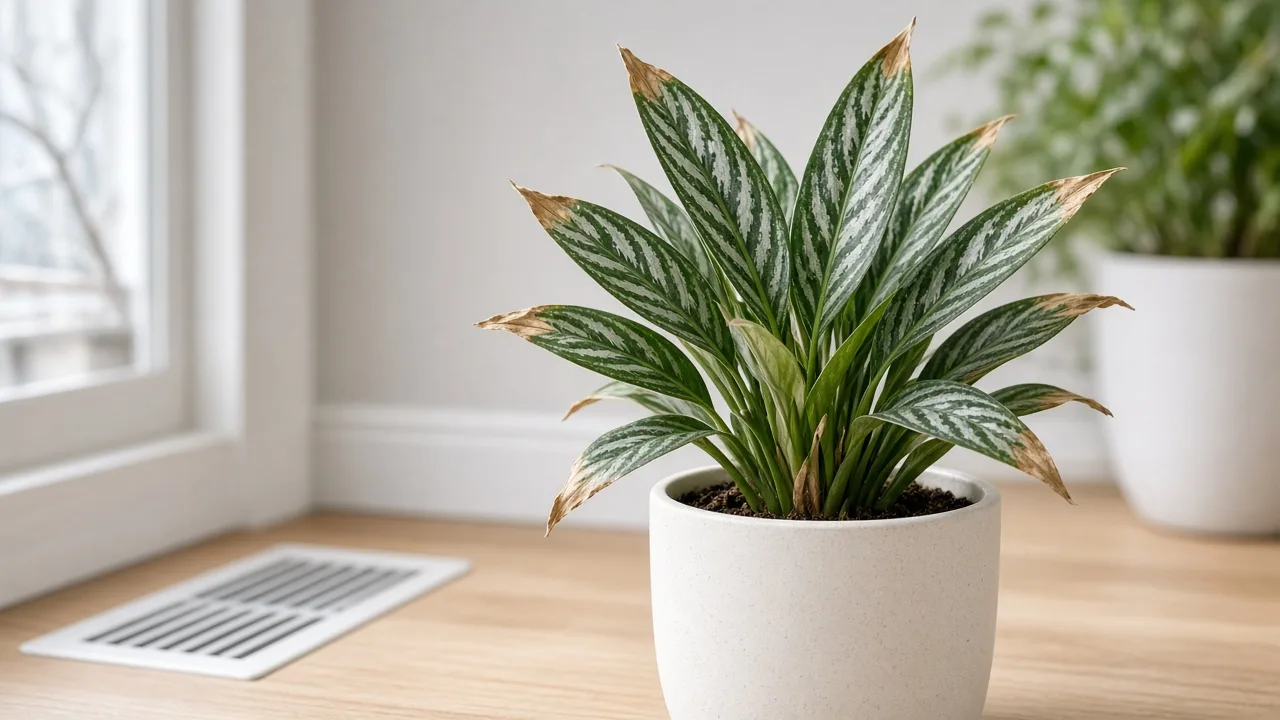
Low Humidity on Aglaonema Cutlass: Causes, Checks & Fixes
This guide covers low humidity on Aglaonema Cutlass. See also the general Low Humidity guide, watering, and light pages for this plant.
Low Humidity on Aglaonema Cutlass: Causes, Checks & Fixes
Quick answer
Aglaonema commutatum ‘Cutlass’ carries long narrow ribbon lances feathered with silver along the veins. Low humidity does not usually collapse the whole clump—it dries the thinnest leaf tissue first, especially on outer and mid-clump blades facing forced-air paths.
For how dry winter air crisp leaf edges on houseplants in general, see our low humidity hub. On Cutlass, dry air most often shows as papery brown tips on older lances while the crown still looks acceptable—easy to confuse with fluoride tip burn on fresh growth, drought in a bright room, or spider mites in the same hot dry micro-climate.
First step: move the pot two feet from heating vents, AC returns, and cold window glass, then read a hygrometer at crown height for two to three days. If humidity already sits in the 40–50% band most homes provide, fix placement and mites before buying a humidifier.
When to use this page vs other Cutlass guides
| Pattern | Read next |
|---|---|
| Brown tip on the newest crown lance within weeks of opening | Brown tips — fluoride or salt first |
| Light dry pot, cupped narrow leaves, crispy tips on new growth | Underwatering |
| Fine stippling and webbing on new lances | Spider mites |
| Leaves curling inward along the midrib | Curling leaves |
| Soft brown whole blades on a heavy wet pot | Brown leaves or overwatering |
| Washed-out silver veining, weak new lances | Pale leaves or not enough light |
This page covers dry-air crisping on ribbon lance margins and tips when the root zone is otherwise stable.
What low humidity looks like on Aglaonema Cutlass
Cutlass does not wilt like a peace lily when the air is dry. Symptoms concentrate on narrow lance tips and outer margins while the upright clump stays structurally firm.
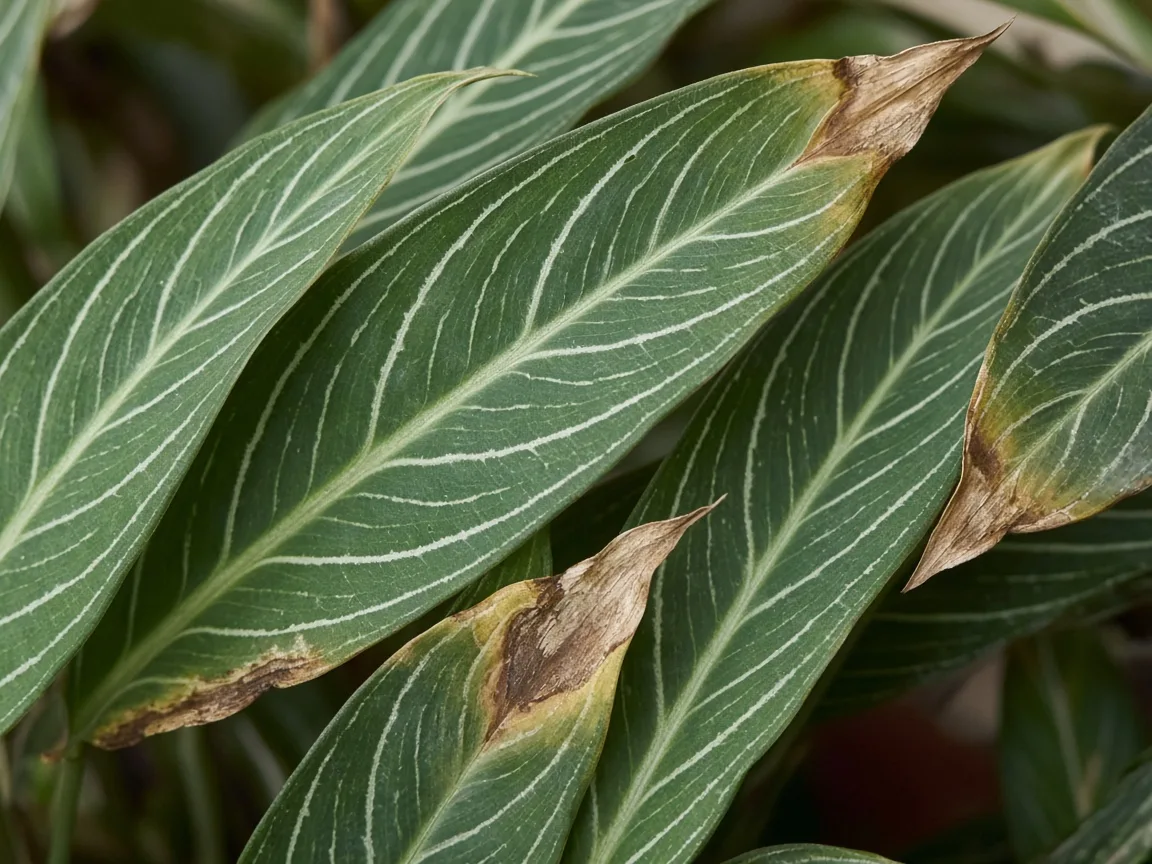
Low humidity on Cutlass—dry papery tips on narrow ribbon lances with silver veining; existing tan tissue will not re-green.
Typical signs when dry air is actually involved:
- Papery brown tips on outer or mid-clump lance leaves, often one-sided toward a heat vent or window glass
- Crisp tan margins along the narrow blade edge while the silver-veined midrib stays green
- Clean newest crown lance — dry air usually hits older tissue before fresh growth
- Slow spread over weeks in winter—not overnight soft collapse
- Localized damage on the side of the clump facing HVAC, not uniform washout across every leaf
Usually not low humidity:
- Newest crown tip browning within weeks of opening — brown tips from fluoride or salt
- Cupped lance plus very light pot and dusty dry mix halfway down — underwatering
- Stippling, webbing, and dull stippled patches on undersides — spider mites in hot dry conditions
- Soft limp whole blades on saturated mix — overwatering, not air moisture
Healthy Cutlass should show firm lance leaves with pointed tips and readable silver veining. Judge the newest two crown leaves separately from aging outer lances at the base of the clump.
Ribbon-lance desiccation: why Cutlass tips go first
This anatomy section is Cutlass-specific and does not apply to broad round-leaf aglaonemas like ‘Maria’ or pink hybrids.
- Cutlass blades are narrow ribbons—the pointed tip is the farthest tissue from rhizomatous roots and fleshy stems, so it loses water to dry air before the midrib does.
- Dark green chlorophyll along the blade base lets the plant look healthy from across the room while only the needle tip necroses—owners often notice damage late.
- Silver veining runs along the midrib; humidity stress usually stays distal to the stripe pattern, unlike pale leaves washout.
- Lower lances in a mature clump naturally age; one tan tip on an old outer leaf while crown growth stays clean is often cosmetic dry-air stress, not root failure.
Always compare newest crown tips to lowest lance tips. Crisping climbing from tips into the midrib on fresh crown growth is more urgent—and often points to water chemistry before humidity.
Crown-vs-outer-lance humidity read
Run this five-minute check before changing watering, misting, or buying gear:
| What you see | More likely cause |
|---|---|
| Tan tips on oldest outer lances only; newest crown clean | Winter dry air or heater draft — this page |
| Brown tip on newest fully opened crown lance | Fluoride or salt — brown tips |
| Crisp tips plus light pot and dry top half of mix | Drought — underwatering |
| Stippling + fine webbing on new lances | Spider mites beside sunny glass |
| Uniform pale washout, weak new blades | Not enough light in a dim dry office |
NC State Extension notes that Aglaonema prefers high humidity but tolerates drier air, and that leaves may turn brown in very dry air or a drafty location. On Cutlass, where the tan tissue appears matters more than the hygrometer reading alone.
The office winter dry-air trap
Cutlass is marketed for dim offices and north windows, which creates a predictable winter failure mode:
- Plant sits in a low-light cubicle where growth slows and water use drops.
- Central heating pulls relative humidity below 30% for weeks.
- Moisture evaporates from narrow lance tips faster than roots supply it in slow-growing conditions.
- Outer and mid-clump lance tips tan while the crown still looks acceptable.
- Owner misted leaves daily—brief surface wetting without raising room RH—or watered more because tips looked “dry.”
Crispy tips from dry air usually hit older lances first while the newest crown leaf stays clean. If the newest leaf tip browns, suspect fluoride or salt before humidity. Match irrigation to the watering guide half-pot dry-down check, not to misting frequency.
Why Aglaonema Cutlass gets low-humidity symptoms
Winter heating and forced-air paths
Radiators, heat vents, and fireplace ledges create micro-climates far drier than the rest of the room. Chinese evergreen culture guides recommend avoiding drafts and heating vents because constant desiccating airflow targets the thinnest leaf margins first. On Cutlass ribbon blades, that means tips and outer edges on the side facing the vent.
Narrow leaves in slow winter growth
In dim winter light, Cutlass uses less water. Roots still function, but transpiration from the thinnest tip tissue can outpace uptake when air is very dry. The pot may feel correctly watered while only lance tips crisp—not a signal to pour more water.
Spider mites in hot dry micro-habitats
Colorado State Extension reports dry weather greatly favors spider mites on houseplants. Cutlass beside sunny winter glass and a heat register matches that habitat. Mite damage adds stippling and webbing—see spider mites before you humidify alone.
Misread drought in bright dry rooms
A Cutlass moved to a brighter window for winter uses water faster. Repeated drought browns tips and may cup the lance with a light pot. Dry air and underwatering can overlap—check the half-pot skewer before assuming humidity is the only limiter.
When Cutlass truly does not need a humidifier
Cutlass tolerates average household humidity better than calatheas or heavily variegated pink aglaonemas. If your hygrometer reads 40–55% at crown height and only one old outer lance has a tan tip, you may simply be watching normal leaf aging—not a room-wide humidity crisis.
How to confirm the cause
Work through these checks in order:
- Placement scan — Is any side of the clump within two feet of a heat vent, radiator, or single-pane window? Move it before measuring air.
- Hygrometer at crown height — Log readings morning and evening for two to three days. Below 30% sustained supports a humidity fix; 40–60% points elsewhere.
- Newest crown lance — Clean pointed tip = outer-only crisping fits dry air. Fresh tip already tan = brown tips water-quality path.
- Half-pot skewer — Dry halfway with cupped lance and light pot = drought. Wet halfway with soft lower leaves = not a tip-only humidity case.
- Underside scan — Stippling with webbing on new lances = mites before humidifier shopping.
- Season timing — Symptoms appearing after heat came on strongly supports dry-air diagnosis.
If two causes fit, fix placement and measure humidity first when only outer lances show papery tips and the crown is clean.
First fix for Aglaonema Cutlass
Move the pot two feet away from heating vents, AC returns, and cold window glass, then log humidity at crown height for two to three days.
Do not mist foliage heavily, fertilize, repot, or add extra water on the same day. Give the clump one stable week in the new spot, then read whether outer tip crisping stops spreading.
Only after placement and measurement:
- If RH stays below 30% at crown height, add a pebble tray or small humidifier—keep mist off lance leaves to avoid black spots.
- If the pot is light and mix is dry halfway down, soak once per the watering guide, then resume half-pot timing.
- If stippling appears on undersides, treat spider mites before raising humidity around wet foliage.
Step-by-step recovery
For dry-air tip crisping (outer leaves only, clean crown)
- Relocate off forced-air paths; rotate the pot so no single side faces glass all winter.
- Run a pebble tray or cool-mist humidifier nearby—aim for steadier 40–60% RH at crown height without soaking leaves.
- Keep the existing half-pot watering rhythm; extra water does not replace humid air.
- Trim dead tip edges with sanitized scissors if necrosis is purely cosmetic on otherwise green lances—wear gloves; Cutlass sap can irritate skin.
- Judge success by the next one or two new lance leaves opening with clean pointed tips.
For overlapping drought (light pot, dry half-pot)
- Soak until water runs from drainage holes; discard saucer water within 30 minutes.
- Wait until the top half dries again before the next drink.
- If tips appeared after moving to a brighter window, pull back to filtered light per the light guide.
For mite overlap in dry heat
- Rinse leaf undersides with lukewarm water in the sink.
- Increase ambient humidity modestly and keep the plant off the sunniest glass until stippling stops.
- Follow the full spider mites protocol if webbing is confirmed.
Recovery timeline
- Placement fix: Outer tip crisping usually stabilizes within two to three weeks once heat exposure stops; existing tan tips remain.
- Humidifier or pebble tray: New clean tips often appear on the next one or two lance leaves (roughly four to eight weeks in warm active growth).
- Drought correction: Cupped lances relax within 24–48 hours after one proper soak; dead tip tissue stays brown.
Judge progress by new crown growth, not by old tan points you already have.
What not to do
- Do not mist Cutlass lance leaves daily to “fix” humidity—brief surface wetting does not raise room RH and risks fungal spots in dim offices.
- Do not overwater because tips look dry—saturated mix in low light invites root rot.
- Do not fertilize a plant showing fresh tip crisping before placement and humidity are corrected.
- Do not repot on day one unless the mix is failing or roots are soft on a heavy wet pot.
- Do not remove every lance with a tan tip if the blade is still mostly green—the plant needs leaf area in low light.
How to prevent it next time
- Keep Cutlass two feet from heater vents and cold window glass in winter.
- Target 40–60% RH at crown height when heating runs; a small humidifier beats daily misting.
- Water when the top half of mix dries—slower in dim offices, faster in bright rooms.
- Group plants to share transpiration humidity, but leave airflow gaps to discourage mites.
- Inspect the newest lance tip monthly—it separates dry air from fluoride burn before whole leaves fail.
Related Aglaonema Cutlass guides
- Overview — Ribbon-leaf habit, low-light tolerance, and core care checkpoints.
- Watering — Half-pot dry-down timing for dim vs bright rooms.
- Brown tips — When fresh crown tips brown from fluoride or salt, not winter air alone.
- Curling leaves — Midrib curl from dry air vs drought vs pests.
- Problems hub — Full symptom index for this plant.
Conclusion
Low humidity on Cutlass is distal stress on narrow ribbon lances, not whole-clump failure—read the newest crown tip first, then placement, then room RH. Dead tan tips will not re-green; watch for clean pointed tips on the next one or two new lance leaves as your success marker.
Related tool
Use the Humidity Calculator to narrow causes for low humidity on this plant before changing multiple variables at once.