Drooping Leaves on Aglaonema Red Siam: Pink-Tissue Checks
Quick answer
Drooping leaves on Aglaonema Red Siam are gradual petiole sag when roots fail to move water—most often overwatering in dim light, but also dry soil, cold drafts, or repot shock. First step: lift the pot and probe the top 2–3 cm of mix before you water again.

Drooping Leaves on Aglaonema Red Siam: Causes, Checks & Fixes
This guide covers drooping leaves on Aglaonema Red Siam. See also the general Drooping Leaves guide, watering, and light pages for this plant.
Drooping Leaves on Aglaonema Red Siam: Causes, Checks & Fixes
Quick answer
Drooping leaves on Aglaonema ‘Red Siam’ are a gradual root-zone signal—broad rose-pink blades hang on soft petioles when roots cannot supply water efficiently. This Thai tissue-cultured hybrid needs brighter filtered light than green Aglaonemas to hold pink color and use moisture at a steady rate. In a dim hallway with a heavy wet pot, droop is usually overwatering, not thirst.
For how turgor loss works on houseplants in general, see our drooping leaves hub. On Red Siam, lift the pot and read the top 2–3 cm of mix before you pour another drink.
First step: lift the pot and probe the top 2–3 cm of peat-perlite mix—stop watering if it is damp and heavy; soak once only if it is dry and light with a firm crown.
When to use this page vs other Red Siam guides
This page covers slow petiole sag over days to weeks. Use sibling guides when the pattern differs:
| Pattern | Read next |
|---|---|
| Gradual lower-leaf hang; crown usually firm | Stay here |
| Whole plant limp within one to two days | Wilting |
| Elongated petioles reaching toward window; leaves stay firm | Leggy growth |
| Wet heavy mix plus yellow lowers | Overwatering |
| Mushy crown, sour smell, black roots | Root rot |
| Light dry pot, curled firm leaves | Underwatering |
| Pink fading to green without obvious limpness | Not enough light |
| Crispy dry tips, firm petioles | Brown tips |
| Long-term water rhythm after droop stabilizes | Watering guide |
What drooping leaves look like on Aglaonema Red Siam
Healthy Red Siam holds broad glossy leaves splashed rose-pink, cherry-red, and green on short upright petioles. Drooping changes the silhouette: petioles angle downward and the layered crown flattens, even when blades stay mostly green-pink rather than yellow.
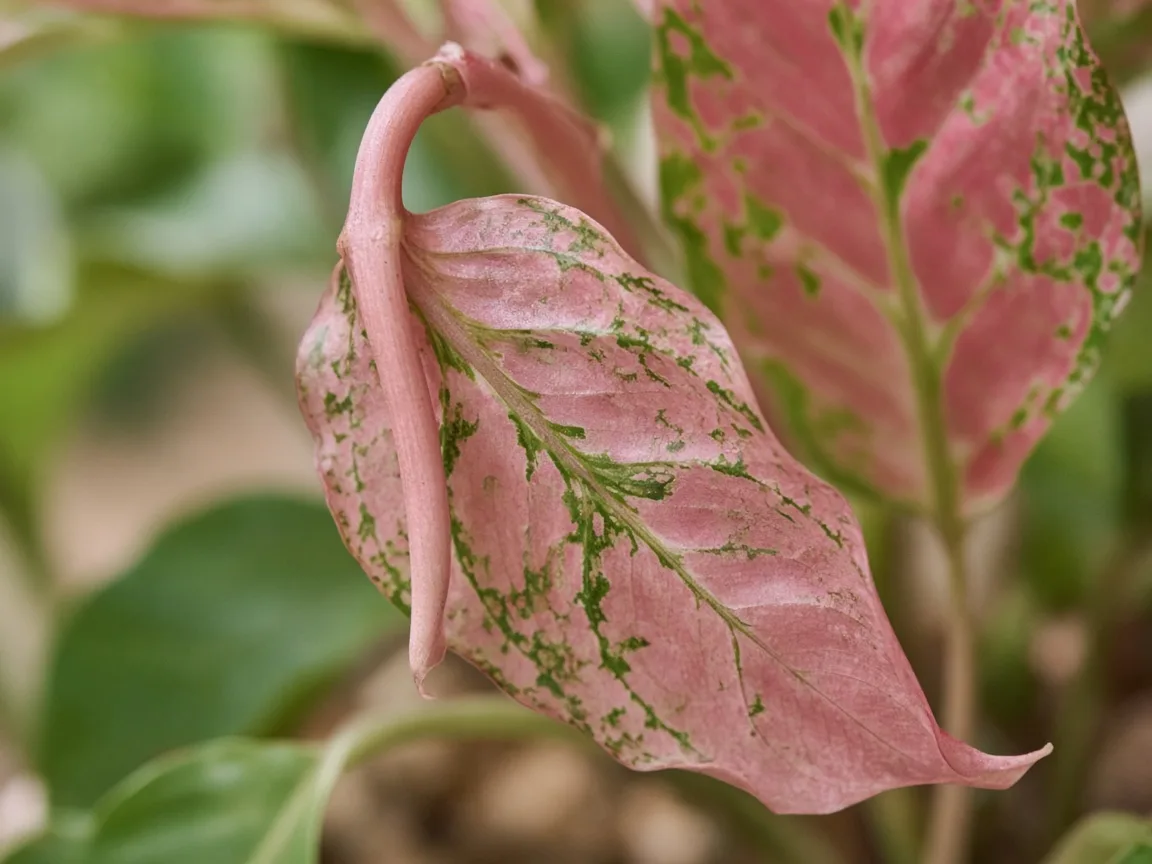
Limp petiole on pale pink tissue—compare crown firmness and pot weight before assuming the plant needs water.
Typical droop signs:
- Lower leaves sag first while the central pink flush may still look upright
- Petioles feel soft and limp, not crisp like brown tips
- Pot stays heavy and cool for days after the last watering—classic wet-soil droop
- Pink zones look dull or washed out on new growth when light is too low for this cultivar
- One-sided lean after a cold night near a drafty window or AC vent
Not simple drooping:
- Crispy brown apex only with firm petioles—fluoride or humidity margin burn, not root failure
- Long pale stems stretching toward glass with firm blades—leggy growth, not turgor loss
- Fine stippling and webbing at petiole bases—spider mites weakening the plant over time
- Whole plant collapse overnight on wet mix—wilting urgency, not gradual droop
Pink-flush droop vs green Maria droop
This distinction would be nonsense on a snake plant: Red Siam’s anthocyanin pink zones tell you whether light and moisture are matched.
| What you see | Likely cause | First action |
|---|---|---|
| Limp lowers on heavy wet pot; pink fading on new flush | Overwatering in dim light | Stop watering; brighten filtered light |
| Limp leaves on light dry pot; crown firm | Underwatering | One thorough soak, drain fully |
| Green reversion on new leaves plus soft petioles in shade | Too little light for variegated uptake | Move toward bright filtered light before more water |
| Limp flop after night below 13°C (55°F) | Cold-chilled roots in wet mix | Warm up; let upper mix dry |
| Sag after fresh repot; no sour smell | Repot shock | Hold feed; keep stable soil moisture |
Red Siam is not a deep-shade office Aglaonema. The rose-pink zones lack chlorophyll, so this cultivar needs roughly 150–300 fc bright filtered indirect light. Owners who treat it like green ‘Maria’ or ‘Silver Bay’ often overwater while pink tissue sags—two stacked problems.
Reading droop on the newest pink crown
On Red Siam, which leaves hang matters more than counting total limp blades:
- Only lowest outer leaves limp; firm crown; clean newest pink flush — Often early overwatering or normal lower-leaf aging; dry-down before the next drink.
- Newest unfurling pink blade droops while mix stays wet — Active root stress; stop watering and check crown firmness same day.
- New growth opens mostly green with soft petioles in a dim corner — Pair moisture checks with light correction; more water will not restore pink or turgor.
- Several leaves collapse together with sour mix smell — Past simple droop; see root rot.
Always judge urgency by crown firmness at the soil line, not the largest older blade.
Brighter-light dry-down on variegated pink tissue
Variegated Aglaonema cultivars need higher light than solid green types, yet direct sunlight scorches foliage. Red Siam in a north-facing room or far from windows uses water slowly. Calendar watering there keeps nursery peat saturated for weeks while petioles lose turgor—the heavy pot in dim light pattern called out in Red Siam grower notes.
Match watering to how fast the top 2–3 cm of peat-perlite mix dries in this room’s light, not a weekly schedule. When pink color washes out on new leaves, brighten placement before increasing water volume.
Why Aglaonema Red Siam gets drooping leaves
Overwatering in low or uneven light. Root rots can occur with over-watering; allow the medium to dry between waterings. Red Siam’s slow upright growth in shade cannot use moisture as fast as owners assume—overwatering suffocates roots and leaves droop even while mix feels damp.
Underwatering after a dry spell. When the upper mix is dry throughout and the pot feels light, leaves may curl slightly inward before the whole plant collapses. Red Siam tolerates brief drought better than chronic sogginess—one measured soak after confirming dryness is the fix, not misting.
Cold drafts on wet roots. Aglaonema is intolerant of cold temperatures and prefers daytime temperatures in the 70 to 80°F range. Air temperatures below 55°F can cause chilling injury, often showing on older leaves first. Chilled roots in saturated peat fail to move water even when the room looks warm by day.
Repot shock or heavy fresh mix. Disturbing fine roots during repotting or packing wet dense peat around a small root ball causes limpness for several days without the sour smell of rot.
Pest-related droop (secondary). Spider mites, mealybugs, and scale weaken Red Siam over time, but droop usually follows stippling, webbing, or sticky residue on young pink growth—not sudden limpness alone.
Cachepots and self-watering traps. Decorative outer pots hiding standing water after bottom-watering, or self-watering reservoirs topped in dim light, keep Red Siam roots submerged while pink leaves sag—overlap with overwatering and fungus gnats.
How to confirm the cause
Work through these checks in order:
- Pot weight — Heavy and cool days after watering supports overwatering. Light with limp foliage may mean drought.
- Moisture at depth — Probe the top 2–3 cm. Allow the top 1–2 inches to dry before watering again. Cold clinging mix means wait.
- Leaf pattern — Yellowing starting on lower leaves with wet mix fits overwatering. Even dulling with dry mix may mean underwatering.
- Crown firmness — Press gently at the soil line. Firm tissue with wet mix is overwatering you can fix with dry-down. Soft tissue means unpot immediately.
- Pink on newest flush — Fading to plain green in shade plus limp petioles means light stress stacked on moisture mismatch.
- Smell — Sour odor at the drainage hole confirms rotting organic matter—not simple thirst.
- Recent events — Repotted this week? Moved to a cold window? Context often explains droop faster than guessing.
Wet-soil vs dry-soil decision table
| Signal | Wet-soil droop | Dry-soil droop |
|---|---|---|
| Pot weight | Heavy, cool | Light |
| Upper mix | Damp for days | Dry to knuckle depth |
| Leaf texture | Soft, limp | Slightly curled, firm crown |
| Lower leaves | Often yellowing | May look dull, not mushy |
| First action | Stop watering | Soak once, drain fully |
First fix for Aglaonema Red Siam
Lift the pot and probe the top 2–3 cm of mix before you water.
This single step prevents the biggest mistake—adding water to an already wet, oxygen-starved root zone because droopy pink leaves look dehydrated.
- Wet pot, limp lower leaves: stop all watering until the upper half of the mix dries and the container feels noticeably lighter.
- Light dry pot, firm crown: water thoroughly once until excess runs from drainage holes, then drain saucers completely.
- Droop after cold exposure: move to stable warmth away from drafts; do not soak chilled roots in a saturated pot—let the upper mix dry first.
- Droop after repotting: hold fertilizer, keep stable light, and wait—avoid repotting again for several weeks.
Do not fertilize, mist heavily, or repot on day one unless inspection shows mushy roots or blocked drainage.
Step-by-step recovery
For overwatering and wet-soil droop
- Remove the nursery pot from any cachepot and empty saucers.
- Stop watering until the upper half dries—lift the pot daily to track weight.
- Move to the brightest filtered indirect spot Red Siam tolerates without direct sun on pale pink tissue.
- When dry, water thoroughly once, then resume waiting for the top 2–3 cm to dry again.
- Remove yellow lower leaves once the crown stabilizes—they will not re-green.
- If decline continues after one full dry cycle, unpot and inspect roots. Trim decay only if you find rot per the root rot guide.
For underwatering
- Confirm dry mix throughout and light pot weight.
- Soak once until a little water drains from the bottom; empty cachepots within 30 minutes.
- Recheck crown firmness in 24 hours—petioles should begin to firm before you water again.
Recovery timeline
- Days 3–7: Crown feels firm; no new yellowing on wet-soil cases after dry-down begins
- Weeks 1–2: Lower sagging stops spreading; new pink flush holds color in corrected light
- Weeks 3–6: New leaves open upright; old limp blades may stay angled until removed cosmetically
Worsening signs: crown softens, sour smell, or several leaves collapse together on heavy wet mix—switch to root rot diagnosis.
Lookalike symptoms
| Symptom | Often confused with drooping | Confirm by |
|---|---|---|
| Crisp brown tip only | Drooping | Apex dry; petiole firm; see brown tips |
| Long pale leaning stems | Drooping | Blades firm; petioles elongated toward window |
| Whole plant limp in 24 hours | Gradual droop | Pace and crown softness; see wilting |
| Yellow lower leaf, firm crown, appropriate dry-down | Emergency droop | One senescent leaf; remove when stable |
| Limp leaves + webbing at base | Overwatering | Stippling under leaf; see spider mites |
What not to do
- Pour another drink because pink leaves look limp on a heavy wet pot—root rot follows chronic wet mix in low light
- Move directly into hot south-window sun to “fix” droop—pale pink tissue scorches first
- Fertilize a limp plant before moisture and light match the room
- Repot, prune half the crown, and change watering on the same day—you will not know which fix worked
- Mist heavily twice daily—wet broad leaves in dim corners invite fungal spots; fix moisture rhythm instead
How to prevent drooping next time
- Place Red Siam in bright filtered indirect light so pink holds and mix dries predictably
- Water when the top 2–3 cm of mix dries; keep soil moist but not saturated with a real dry-down between drinks
- Drain cachepots within 30 minutes; never let the plant sit in standing water
- Keep temperatures above 18°C (65°F) and away from AC vents and drafty winter glass
- Scout weekly—spider mites and mealybugs on young pink growth weaken turgor over time
- After repotting, wait several weeks before changing light, water, and feed together
When to worry
Low urgency: one or two lower leaves sag on a firm crown while the newest pink flush opens clean after a dry-down cycle.
Escalate same-day when:
- Crown softens at the soil line
- Mix smells sour or drainage runs foul
- Several leaves collapse together on a heavy wet pot
- Droop spreads to the newest pink unfurl while mix stays saturated
Use the Plant Problem Diagnosis Tool to narrow causes before changing multiple variables at once.
Related Aglaonema Red Siam guides
- Overview — placement, pink color stability, and healthy crown flush
- Watering — top-layer dry-down after droop stabilizes
- Light — filtered brightness without scorching pale tissue
- Overwatering — wet heavy pot with yellow lowers
- Underwatering — light pot and curled firm leaves
- Wilting — rapid whole-plant collapse
- Problems hub — full symptom index for this cultivar
Conclusion
Drooping leaves on Aglaonema Red Siam are a root-zone and placement signal on pink-variegated Chinese evergreen tissue—not a reason to soak, repot, and feed on the same afternoon. Lift the pot and read the top 2–3 cm of mix first, split wet-soil overwatering in dim light from dry-soil thirst, and use pink color on the newest flush to tell whether light is part of the problem. Limp lower blades already on the plant may stay angled until trimmed; firm new pink growth standing upright is the recovery marker you want.
Related tool
Use the Plant Problem Diagnosis Tool to narrow causes for drooping leaves on this plant before changing multiple variables at once.