Mealybugs on Alocasia Zebrina: Checks & Treatment
Quick answer
Mealybugs on Alocasia Zebrina look like soft white wax tucked into the crown, emerging-leaf sheath, and the joints where striped petioles meet the plant. First, isolate the pot from every other plant. Then confirm that the white material covers an insect before spot-testing a direct alcohol dab on one hidden area.
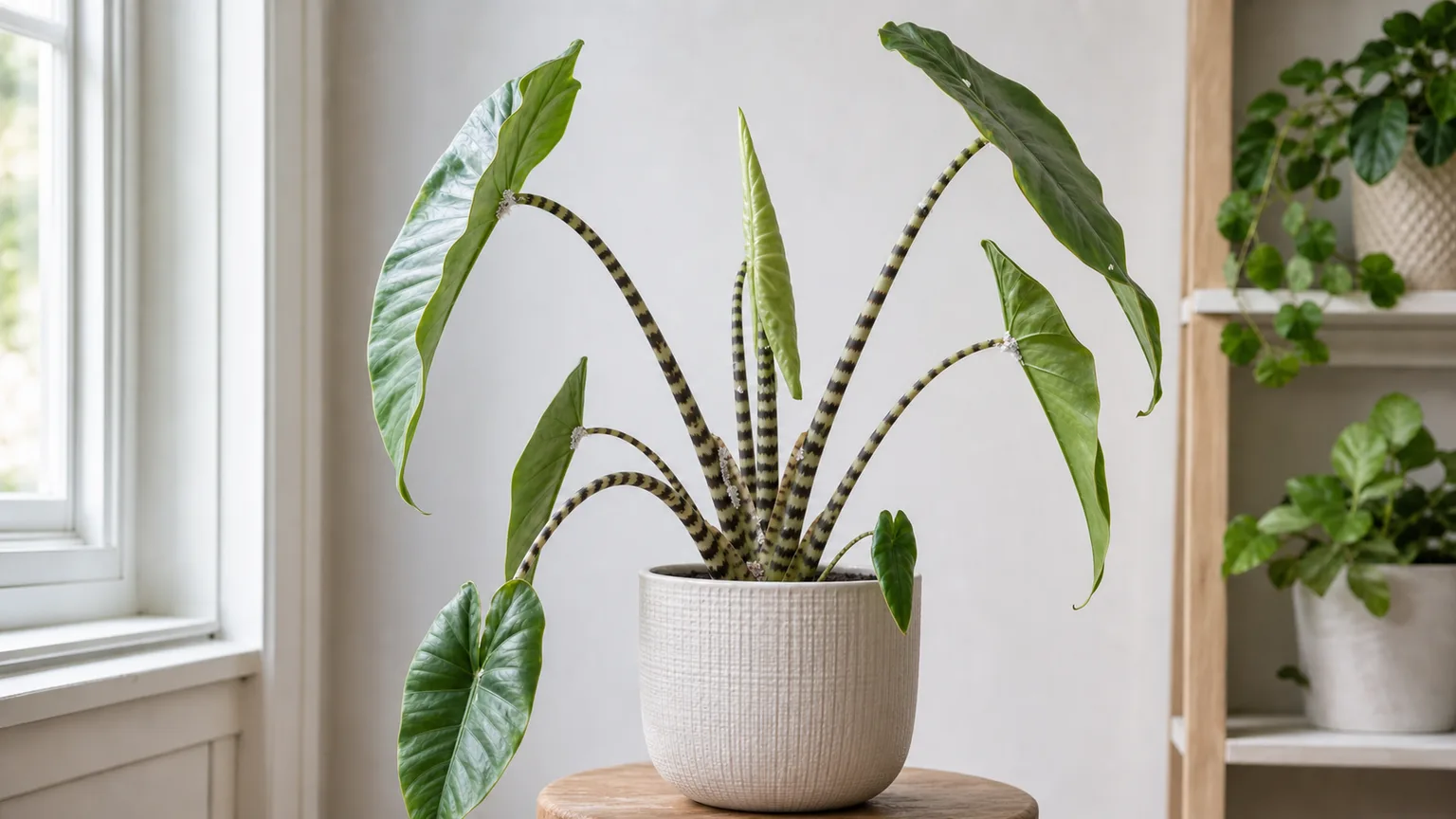
Mealybugs on Alocasia Zebrina: Checks & Treatment
This guide covers mealybugs on Alocasia Zebrina. See also the general Mealybugs guide, watering, and light pages for this plant.
Mealybugs on Alocasia Zebrina: Checks & Treatment
Quick answer
Mealybugs on Alocasia Zebrina (Alocasia zebrina) are easiest to miss where the plant is most distinctive: inside the crown and around the zebra-striped petioles. Look for soft white wax at the joint where each petiole enters the crown, beneath the sheath around an emerging leaf spear, and along the underside midrib. Mealybugs are small, soft insects covered with wax, and established colonies may leave sticky honeydew on petioles or the shelf below.
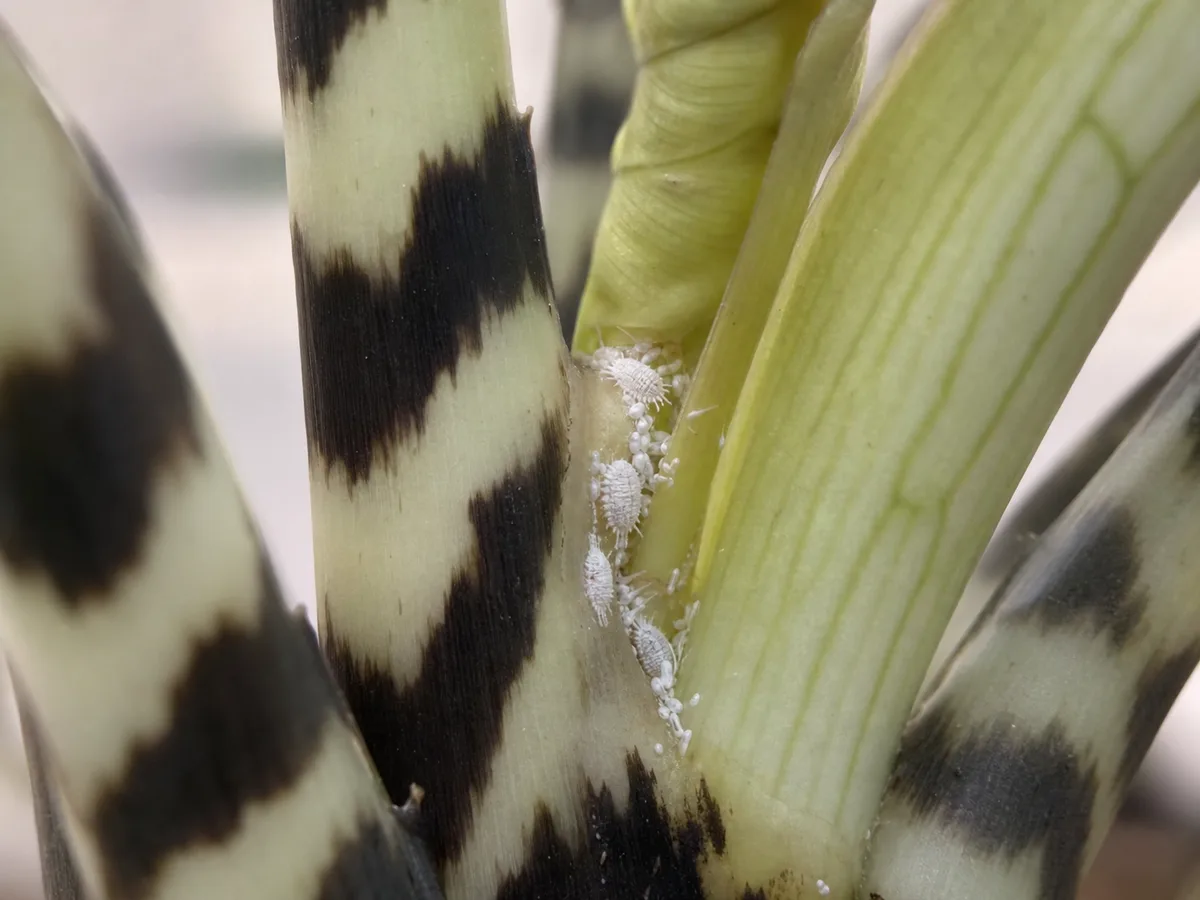
Illustrative generated diagnostic image, not a photograph of a documented infestation. Confirm a soft-bodied insect beneath the wax before treating your plant.
First fix: isolate the whole pot from every other plant. Do that before wiping, rinsing, or moving leaves around. Isolation contains the mobile immature stage and prevents a cleaning cloth, watering can, or touching leaf from carrying the problem through a grouped aroid collection.
Once the plant is apart, use this order: confirm an insect beneath the wax, spot-test one concealed area, treat exposed insects, then inspect weekly. For the general biology and control options that apply across houseplants, use the main mealybug guide. The checks below focus on the Zebrina’s striped petioles, upright crown, leaf-spear sheaths, and underground corm.
This guide is a source-backed diagnostic synthesis, not a report of a treatment trial on an individual Zebrina. The crown, sheath, and corm checks are plant-specific editorial applications of extension guidance; a local extension service or qualified pest professional should resolve an uncertain identification or product choice.
Where mealybugs hide on Alocasia Zebrina
Mealybugs favor protected plant areas, including crowns, branch crotches, touching leaves, and stems near the soil. Alocasia Zebrina creates several equivalent shelters even though its foliage looks open from across the room.
Start at the center rather than the leaf tips:
- Shine a light into the crown around the newest spear. Separate the sheath gently; do not force open a leaf that is still unfurling.
- Follow each striped petiole down to its insertion point. Check behind the petiole as well as the side facing you.
- Turn every arrow-shaped blade over and scan the underside midrib and vein junctions.
- Examine old, papery petiole sheaths at the soil line. Loose dry material can conceal wax and egg masses.
- Look around the pot rim and drainage holes if foliar treatment has not stopped the infestation.
The smooth cream bands on a healthy Zebrina petiole are part of the stem. They stay flat, follow the stripe pattern, and cannot be lifted away. Mealybug wax is irregular, loose, and often hides a segmented insect beneath it.
Confirm insects before treating the striped stems
Use a hand lens if the colony is small. Adult females are oval and segmented beneath the wax, while young crawlers have less wax and are more mobile. White cottony egg masses, fresh honeydew, black sooty growth on that honeydew, and ants visiting the plant all support the diagnosis.
Touch a suspect tuft with a dry cotton swab. Loose wax and the insect should move; natural stem coloration will not. Do not rely on a supposed “pink smear” as a universal test because appearance varies among mealybug species. If the only pale material is a hard crust on the pot rim or leaf edge, it is more likely dried mineral residue than an insect colony.
Read a Zebrina leaf spear carefully
A damaged new spear deserves a close inspection because the overlapping sheath is one of the best shelters on this plant. Mealybugs leave discrete wax tufts and may produce stickiness around the seam. A spear that is clean but slow to open may instead reflect low light, cool conditions, or disrupted watering; compare those conditions with the Alocasia Zebrina light guide and watering guide before assuming every stalled leaf is pest damage.
Never prise an emerging blade open to hunt for insects. That can tear tender tissue and create damage that resembles pest distortion later. Illuminate the seam, inspect what is visible, and treat only confirmed insects you can reach.
Mealybugs versus common Zebrina lookalikes
| What you find | More likely explanation | Deciding check |
|---|---|---|
| Loose white wax in crown folds or petiole joints, sometimes with stickiness | Mealybugs | A soft segmented insect sits beneath movable wax |
| Fine pale stippling across a broad blade, with delicate webbing | Spider mites | Tap the leaf over white paper and inspect for moving specks |
| One oldest leaf yellowing as a fresh spear opens | Normal Alocasia leaf turnover | Crown and petioles stay firm; no wax or honeydew |
| Several yellowing leaves above persistently wet mix | Overwatering or root rot | Pot stays heavy, and roots or corm may be soft or smell sour |
| Dry brown margins without insects | Leaf browning | Damage follows the edge; crown remains clean |
| Hard white crust on pot rim or splash marks | Mineral residue | Deposit is crystalline or chalky, not cottony or sticky |
Mealybugs feed by sucking sap and can cause reduced vigor or leaf drop at high populations. Their honeydew can support sooty mold, but mold itself is secondary; removing black residue without controlling the insects will not stop fresh honeydew.
Treat petiole joints without flooding the crown
After isolation and confirmation, use a cotton swab moistened with 70% or weaker isopropyl alcohol on each visible insect. On Zebrina, select a concealed section of an older petiole, wait one to two days, and keep subsequent dabs confined to insects rather than painting the striped stem.
Work from the newest spear outward so you do not push hidden insects deeper into the crown. Replace the swab whenever it becomes waxy, and use a fresh swab for a different plant. Wipe honeydew from mature blades with plain water on a soft cloth, but do not leave treatment solution pooled inside the crown.
Alcohol and pesticide safety
Use the smallest practical amount of alcohol in a ventilated place. Isopropyl alcohol is a Class IB flammable liquid, so keep the bottle, wet swabs, and treated plant away from flames, hot surfaces, sparks, and smoking until the alcohol has evaporated. Avoid skin and eye contact, close the container promptly, and store it where children and pets cannot reach it.
For any commercial pesticide, use only a product whose label permits the target pest, plant type, and indoor setting. Follow the label’s ventilation, protective-equipment, re-entry, storage, and disposal directions; do not combine products unless the label explicitly allows it. Colorado State Extension advises using only products labeled for houseplants, moving the plant outdoors for spraying when feasible, and avoiding treatment while a plant is drought- or temperature-stressed. For Zebrina, that means correcting a severely dry root ball or heat-stressed placement before applying soap, without flooding the corm.
When to add insecticidal soap
If fresh insects continue to appear after careful weekly dabbing, use a commercial insecticidal soap labeled for indoor ornamental plants and follow its label exactly. Soap and alcohol are contact treatments that work only when they touch the pest and leave no residual action. That limitation is important on Zebrina because the deepest portion of the leaf sheath may remain unreachable until the spear expands.
Spot-test the product first, keep the plant out of direct sun during treatment, and cover accessible undersides and joints rather than drenching the pot. Do not improvise with household dish detergent; product formulations vary and can injure foliage. Avoid adding fertilizer during an active infestation, because excessive nitrogen with regular irrigation can stimulate tender growth favorable to mealybugs.
| Option | Appropriate use on Zebrina | Main limit or risk |
|---|---|---|
| Swab removal with alcohol | A small, exposed colony at petiole joints or on mature leaves | Misses insects inside the sheath or roots; can burn tissue; alcohol is flammable |
| Labeled insecticidal soap | Repeated exposed crawlers or colonies that a swab cannot cover efficiently | Contact-only action; requires complete reachable coverage and a spot test |
| Root-zone escalation | Confirmed wax or insects among roots or recurring drainage-hole wax | Disturbs the corm and needs product-specific local guidance |
| Disposal | A severe, recurring infestation that remains a source for nearby plants | Sacrifices the plant but ends repeated household pesticide use |
Protect the corm while treating a sparse plant
Alocasia Zebrina may shed older leaves or enter a seasonal slowdown, leaving only a few petioles above a living corm. The RHS describes alocasias as rhizomatous plants that may lose foliage during winter dormancy. Sparse foliage therefore does not prove that mealybugs have reached the roots, and it is not a reason to water more frequently.
Keep using the plant’s normal moisture check. If the mix stays wet or smells sour and the petiole bases soften, investigate root rot on Alocasia Zebrina rather than repeatedly spraying the crown. If the corm is firm, the potting mix behaves normally, and visible cotton remains limited to leaf joints, continue foliar treatment without unpotting.
When drainage-hole wax changes the plan
A few mealybug species feed below ground, and root infestations can be missed by foliar contact treatments. Clemson Cooperative Extension confirms that some mealybugs feed on roots, while above-ground alcohol and soap applications will miss root-feeding stages.
Suspect a root-zone infestation when fresh white wax repeatedly appears at drainage holes or around roots despite clean leaves above. Confirm by sliding out the root ball once rather than repeatedly disturbing the corm. If insects or wax are present among the roots, isolate the discarded mix, clean the pot, and seek product-specific guidance from a local extension service; routine crown dabs are not a complete treatment for that problem.
A bounded monitoring and isolation plan
Alcohol or soap can remove exposed insects quickly, but one clean day is not proof of control. UC IPM advises weekly alcohol treatment until the infestation is gone and says severe houseplant infestations may justify discarding the plant rather than continuing repeated insecticide use.
Use this finite protocol:
- Day 0: isolate the pot, confirm a live insect, remove exposed mealybugs, and spot-test any treatment.
- After 1–2 days: if the test area is uninjured, treat remaining exposed insects according to the chosen product’s directions.
- Once each week: inspect the new-spear sheath, crown, every petiole joint, both sides of each blade, pot rim, and drainage holes. Remove confirmed insects and reset the count if you find a live insect, fresh wax, an egg mass, or returning honeydew.
- Release threshold: return the plant to the collection only after four consecutive weekly inspections find none of those signs. This four-check threshold is a conservative LeafyPixels monitoring rule based on extension advice to repeat treatment weekly until the infestation is gone; it is not a guarantee that every hidden stage is absent.
Inspect neighboring plants during the same weekly checks. If a Zebrina’s folded sheath prevents a clear view, keep it isolated until the sheath opens and the newly exposed tissue also passes inspection.
Judge recovery by the new spear, not the old leaf
An old leaf that has yellowed, scarred, or distorted will not return to its original surface. Improvement looks like:
- no fresh wax at the crown or along striped petioles
- honeydew no longer returning after it is wiped away
- a new spear opening without cottony deposits in its sheath
- firm petiole bases and a firm corm
- no insects appearing on neighboring plants
During active warm-season growth, a clean newly opened leaf is the clearest recovery marker. During dormancy, visible growth may pause, so rely on repeated pest-free inspections and corm firmness rather than expecting an immediate replacement leaf.
Escalate or discard instead of treating indefinitely
Seek a local extension service or qualified pest professional when you cannot identify the insect, the product label does not cover indoor ornamentals, or confirmed root-zone wax persists after the plant has been handled once. Do not keep improvising stronger mixtures around a sensitive crown and corm.
Discarding the plant is reasonable when live mealybugs continue after four correctly spaced weekly rounds, colonies remain inaccessible deep in the crown, root-feeding forms are widespread, or nearby plants are repeatedly reinfested. Seal the plant and infested potting mix before moving them through the collection. A rare or valuable plant may justify professional help, but repeated unlabelled treatments are not a safer substitute.
Mistakes that make a Zebrina infestation harder
- Treating the stem pattern. The pale bands are normal tissue; only movable wax with an insect beneath it should receive an alcohol dab.
- Pouring alcohol or soap into the crown. Direct contact with the insect matters, while pooled liquid adds avoidable stress to the growing point.
- Repotting automatically. Unpot only when drainage-hole wax or root inspection supports a below-ground infestation.
- Watering a sparse plant more often. Leaf loss reduces water use, especially during dormancy; follow the soil and drainage guide rather than a calendar.
- Combining products. Mixing or overlapping treatments can increase exposure, obscure the cause of foliage injury, and conflict with label directions.
- Returning the pot after one clean inspection. Crawlers carry little wax and are easier to overlook than established adults.
Prevent a repeat in an aroid collection
New plants are a common route into an indoor collection. Keep new houseplants in a separate area for at least three weeks and inspect them before introduction. Include the outer pot, stake, saucer, and plant label in that inspection because wax or insects can remain away from the leaf blades.
For an established Zebrina, make crown inspection part of normal watering. Rotate the pot, look behind each petiole, and inspect the new spear before setting it back among other plants. Leave enough space that its broad arrow-shaped leaves do not rest against neighbors; contact is not required for every spread event, but separation makes monitoring and containment much easier.
Keep care stable rather than trying to “boost” recovery. Bright indirect light supports normal growth, while a predictable dry-down protects the corm. The Alocasia Zebrina overview explains the seasonal growth pattern that helps distinguish a resting plant from one declining under pests.
When to use this page vs other Alocasia Zebrina guides
Use this page when you can see cottony wax, a soft-bodied insect, or recurring honeydew around the crown and striped petiole joints. Use the spider-mite guide for stippling and webbing without cotton, and the yellow-leaf guide when discoloration is the main symptom but no insect evidence is present. The Alocasia Zebrina problems hub routes symptoms that do not match these patterns.
Related Alocasia Zebrina guides
- Alocasia Zebrina watering — check moisture timing when isolation changes the pot’s light or airflow.
- Alocasia Zebrina light — troubleshoot a clean new spear that stalls after pests are controlled.
- Alocasia Zebrina soil — assess slow dry-down or collapsed mix before disturbing the corm.
- All Alocasia Zebrina problems — compare symptoms that do not match mealybugs, mites, or root rot.