Alocasia Zebrina Root Rot: Corm Checks & Rescue
Quick answer
First, lift the Alocasia Zebrina from its wet mix and inspect the roots and corm. Yellowing or drooping alone is not proof of rot: firm roots and a solid corm point to early overwatering or another stress, while soft, sloughing roots, a bad smell, or a yielding corm confirm decay.
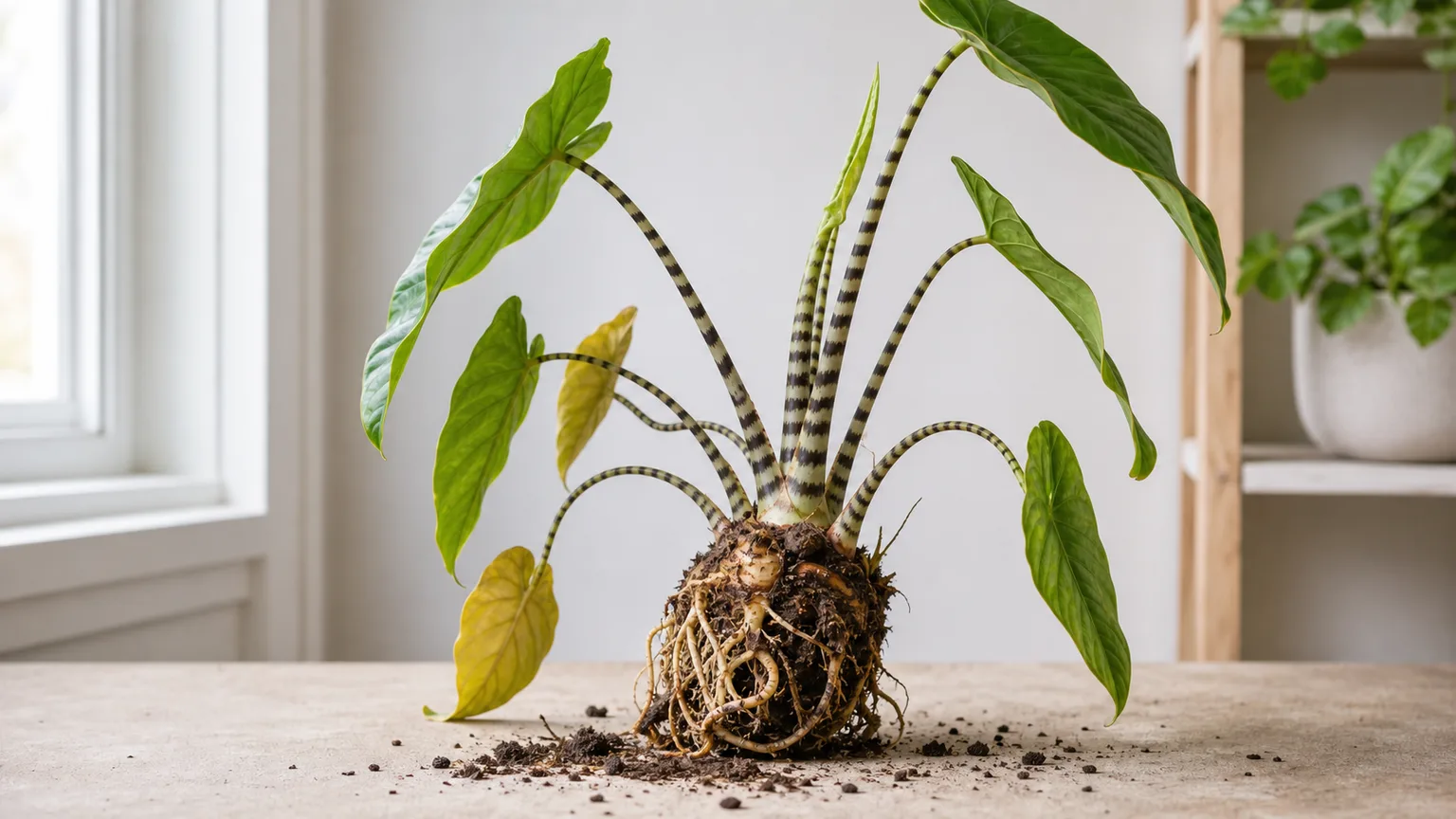
Root Rot on Alocasia Zebrina: Corm Checks & Rescue
This guide covers root rot on Alocasia Zebrina. See also the general Root Rot guide, watering, and light pages for this plant.
Root Rot on Alocasia Zebrina: Corm Checks & Rescue
Quick answer
First, lift the Alocasia Zebrina out of its wet mix and expose the roots and corm. Do this once, gently, when the plant has a sour smell, collapsing striped petioles, or several leaves wilting in damp soil. The inspection separates roots that are merely wet from tissue that is actively breaking down; yellowing or drooping by itself does not justify cutting.
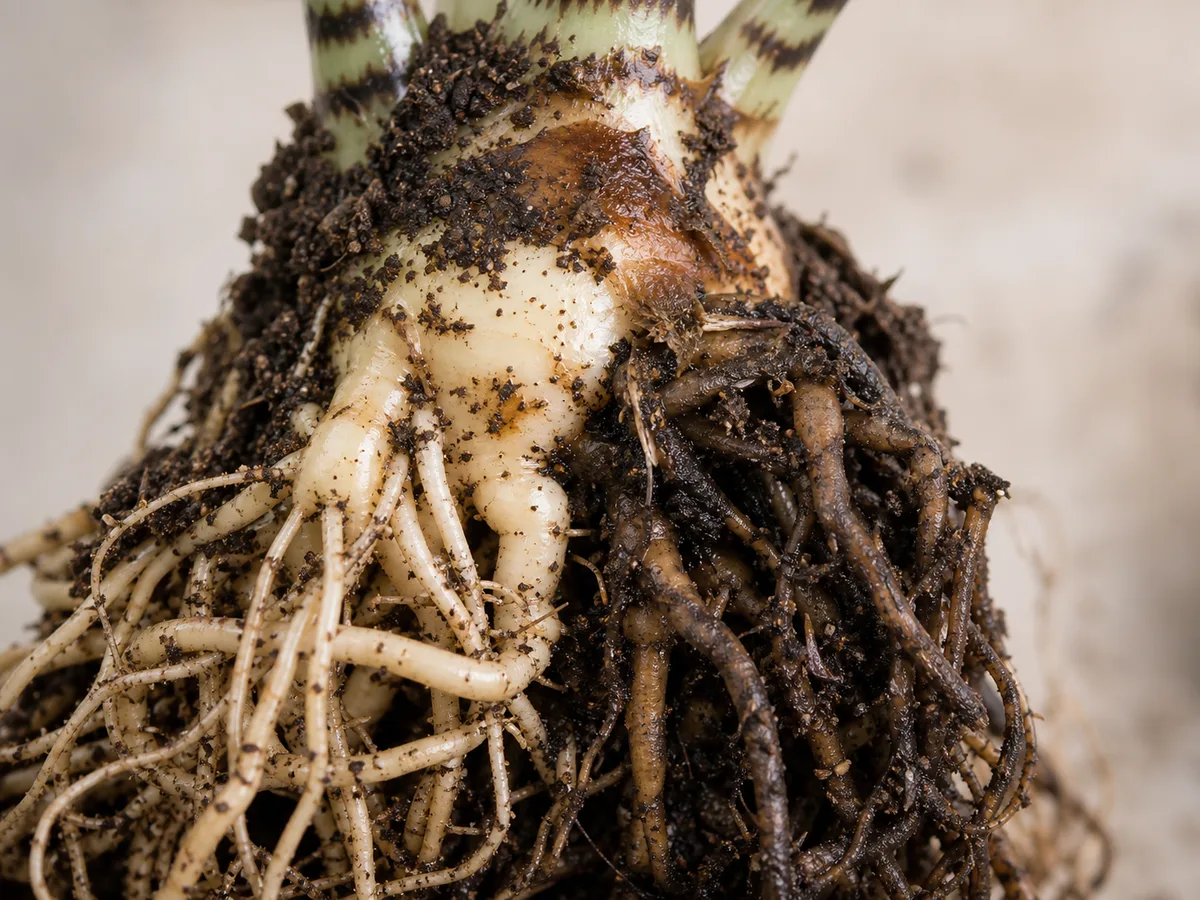
Illustrative generated diagnostic image, not a photograph of a documented case. Diagnose from texture, odor, and sloughing tissue—not root color alone.
Firm pale or tan roots, a solid corm, and crisp petiole bases mean you may have caught overwatering before root rot developed. Soft brown roots, a bad smell, skin that slips from the roots, or a yielding section of the corm confirm decay. The general root rot guide explains the disease mechanics shared by houseplants; this page focuses on the corm, petiole crown, dormancy, and salvage decisions that matter on Alocasia Zebrina.
Root rot looks different from one old leaf cycling out
Alocasia Zebrina often carries a relatively small number of large leaves on long, zebra-striped petioles. The RHS profile describes it as rhizomatous and notes that dropping a leaf as fresh foliage appears can be normal. One oldest leaf fading while a new spear rises from a firm crown is therefore not enough evidence for root rot.
Rot produces a whole-plant pattern. Several leaves may soften or hang at once, the pot remains heavy, and the bases of the striped petioles lose firmness where they enter the crown. The mix may smell sour or musty. Wisconsin Horticulture identifies wilting despite wet soil, soft brown roots, and bad odor as characteristic root-rot findings.
Rank the evidence before acting:
| Evidence level | What you find | What it means |
|---|---|---|
| Low confidence | One yellow leaf, drooping, or stalled growth | A canopy clue only; check the root zone before diagnosing rot |
| Stronger warning | Pot stays heavy, mix smells sour, or several petioles lose firmness together | Unpot once for a direct inspection |
| Confirmation | Roots are soft or slough when pinched, or the corm/crown is wet and yielding | Decay is present; move to the salvage decision |
Confirm the diagnosis at the corm and roots
Read the roots before cutting
Support the petiole crown with one hand and ease the root ball from the pot. Remove loose mix with your fingers; do not pull on the long petioles or scrub every root bare. Healthy roots should hold together and resist a light pinch. Rotting roots feel soft, hollow, or slimy and may shed their outer layer.
Root rot is a disease category, not a pathogen you can reliably identify by sight. Wisconsin Horticulture lists several soil-borne fungi associated with root rots and notes that many prefer wet soil conditions. Unless a laboratory identifies a pathogen, describe what you can confirm—decayed roots and storage tissue—rather than claiming a specific fungus.
If roots are discoloured but still firm and the corm is solid, stop the inspection without cutting storage tissue. Correct the wet conditions using the Alocasia Zebrina overwatering guide and monitor. If you cannot distinguish firm stained tissue from active decay, photograph the exposed root system and ask a local extension plant clinic, horticulturist, or experienced aroid grower before making a corm cut.
The Zebrina corm/rhizome check sets the salvage limit
The rounded underground storage structure is commonly called a corm by growers, while botanical references also describe Alocasia as rhizomatous or tuberous. NC State Extension describes the genus as tuberous herbaceous perennials and specifically records root rot from overwatering. Whatever term you use, this firm storage tissue is the plant’s reserve and the source of future shoots.
Press each exposed section gently through gloves. Healthy tissue feels solid. Rot may appear dark, translucent, wet, or spongy, sometimes with an unpleasant smell. Do not keep carving into a solid corm just to make it look cleaner; preserve as much firm tissue and as many intact growth points as possible.
The petiole crown shows how far rot has travelled
Trace each striped petiole down to the point where it joins the crown. A healthy base stays firm even when its leaf blade is old. A petiole that is soft only at the soil line, pulls away with little resistance, or reveals wet discoloured tissue has probably lost its connection to sound crown tissue.
This matters because removing dead roots is a different rescue from cutting decay out of the crown. Root-only damage may leave the main corm and emerging spear intact. Once softness reaches the central growth point or every petiole base, the odds narrow sharply; repeatedly trimming leaves while leaving a decaying crown does not stop the underlying loss.
Before you cut: protect yourself and contain the mess
Alocasia contains calcium oxalate crystals, and the RHS advises wearing gloves while handling the plant and keeping it away from children and pets. Wear gloves throughout the inspection, add eye protection if squeezing or cutting wet tissue could flick sap, and keep your face away from the work. Bag removed tissue and contaminated mix where children and animals cannot reach them, then wash your hands even if the gloves stayed intact.
Use a sharp blade on a washable surface. Remove visible debris from the blade first, then disinfect it between cuts and clean the work surface afterward; Wisconsin Horticulture recommends disinfesting tools and working surfaces after handling root-rot cases. Use one product according to its label in a ventilated area. If that product contains bleach, the CDC says to never mix it with other cleaners, including ammonia.
Salvage a firm corm without stacking treatments
After the inspection confirms decay, work in this order:
- Remove failed tissue conservatively. Cut away roots that are soft, hollow, sloughing, or foul-smelling. Cut the corm only where storage tissue is clearly wet and yielding, disinfecting the blade between passes. Stop as soon as the exposed face is consistently firm; this is a conservative home-care boundary, not proof that a named pathogen is gone.
- Discard the old mix. Do not blend it into the rescue pot or use it for another plant. Root-rot organisms can persist in soil and plant debris, and Wisconsin Horticulture advises against reusing affected potting mix or drainage water.
- Choose the pot for what survived. As a conservative editorial recommendation, use a clean draining container that only accommodates the remaining roots rather than returning a small root system to a large wet volume. Follow the Alocasia Zebrina repotting guide for depth and crown placement.
- Repot into fresh, airy substrate. Keep the corm stable without burying the petiole crown. The Alocasia Zebrina soil guide explains how coarse components prevent a dense, wet core around this species.
- Return it to stable bright indirect light. Do not use direct sun or fertilizer to force a response. Resume watering only when the new, reduced root zone has dried appropriately; the watering guide provides the post-rescue moisture check.
Do not add a fungicide soak or home-remedy treatment to this sequence. Wisconsin Horticulture does not recommend chemical fungicides for houseplant root rot because suitable home-use products are limited and treatment may not be cost-effective. No chemical can restore tissue that has already decomposed.
Salvage offsets when the central crown cannot be saved
An established Zebrina may have small offsets or separate firm growth points beside the main corm. Treat an offset as possible salvage material only if its base is solid and separate from advancing softness. Do not assume a visible nub is viable or keep cutting an ambiguous offset; uncertainty at its growth point is a reason to seek experienced help rather than sacrifice the last firm tissue.
If the central crown has collapsed but one offset remains firm, saving that offset is more realistic than repeatedly recutting the parent. If every corm section and offset is soft or foul-smelling, stop. Wisconsin Horticulture notes that disposal is often the most practical response to houseplant root rot, particularly when no sound root system remains.
Dormancy and leaf cycling can mimic a failed plant
Alocasia Zebrina may slow down or shed leaves as indoor light and temperature fall. The RHS advises that Alocasia can lose foliage during winter dormancy and that watering should be reduced to a minimum; overwatering at that stage can rot roots. A leafless pot is therefore not automatically a rotten plant.
Let tissue condition decide. A dormant corm stays firm and does not smell bad, even if no spear is visible. A rotting corm softens, discolours, or weeps, and its petiole crown may collapse. Do not keep digging up a firm dormant corm to look for progress, and do not water it on the active-season schedule merely because the surface appears dry.
When warmth and light return, a viable corm may produce a new spear. That is a possibility, not a deadline or guarantee. Until growth restarts, keep moisture conservative and judge the plant by firmness rather than the number of leaves.
What recovery can—and cannot—look like
Trimmed roots will not become intact again, and a yellow blade or collapsed petiole will not rebuild. Early success means decay stops advancing: the corm stays firm, the crown remains odor-free, and the rescue mix begins drying at a predictable rate. A surviving leaf may remain imperfect while the underground structure re-establishes roots.
New growth is the stronger confirmation, but timing depends on how much tissue survived and whether the plant is actively growing or dormant. Avoid promising a fixed number of weeks. If the corm softens again, the smell returns, or a new spear collapses at its base, inspect once more. Discard the plant if no firm corm, crown, or offset remains; seek a plant clinic or experienced aroid grower before another cut if the boundary is unclear.
Use the Alocasia Zebrina pruning guide only for removing fully failed petioles after the crown is stable. Do not fertilize a rootless corm to accelerate recovery; return to the fertilizer guide after stable new growth shows that functional roots have returned.
Prevent another wet pocket around the corm
Root-rot prevention on Zebrina is less about watering less in every season and more about matching moisture to growth. The genus prefers moist but well-drained conditions, and NC State links overwatering with root rot. The practical target is a root zone that receives a thorough drink during active growth and then regains air before the next one.
- Check moisture below the barky surface and learn the pot’s lighter, ready-to-water weight.
- Use a drainage hole and never leave the inner pot standing in collected runoff.
- Keep the pot proportionate to the roots and corm rather than the width of the leaves.
- Replace a dense nursery plug or compacted mix that stays wet in its centre.
- Reduce watering when spear production stops or leaf area shrinks.
- Keep the petiole crown at the substrate line instead of burying the striped bases.
Related Alocasia Zebrina guides
Use this root-rot page only when direct inspection finds soft, sloughing, hollow, or foul-smelling root or corm tissue. Choose the next guide by the evidence you actually have:
| Evidence | Use this guide |
|---|---|
| Wet mix, but every root and corm section is firm | Overwatering |
| Yellowing is the main symptom and decay is unconfirmed | Yellow leaves |
| Petioles hang but root-zone evidence is mixed | Drooping leaves |
| The plant is stable after salvage and needs a new moisture routine | Watering |
| The old mix or pot created a persistent wet core | Soil or repotting |
| Several care variables or symptoms overlap | Alocasia Zebrina overview or problems hub |