Alocasia Zebrina Care Guide: Light, Water, Humidity &
Alocasia zebrina
Alocasia Zebrina (Alocasia zebrina) care: bright indirect light, 60–75% humidity, chunky aroid mix, zebra-stem ID tips, corm-safe watering, and winter dormancy. Troubleshoot yellow leaves, root rot, spider mites, and cold shock.
Alocasia Zebrina Care Guide: Light, Water, Humidity & Dormancy
Start with wateringThe most common care mistake for Alocasia ZebrinaWatering guide →Alocasia Zebrina care essentials
Light
bright indirect light
Water
Water when the top 2–3 cm of soil is dry; reduce sharply in winter dormancy. Avoid overwatering — the corm rots fast in wet mix.
Soil
Chunky, well-draining aroid mix with perlite and orchid bark; never use dense peat-heavy mix alone.
Humidity
60–75%
Temperature
18–26°C (65–80°F)
Fertilizer
Stop fertilizing, reduce watering to roughly every 3–5 weeks (just enough to keep the corm from desiccating), and keep the pot warm with bright indirect light.
About Alocasia Zebrina
Alocasia Zebrina is native to Philippines (Luzon, Mindanao, Leyte, Samar, Biliran, Alabat), typically reaches 50–120 cm tall indoors; arrow-shaped leaves on long striped petioles indoors, with moderate to fast in warm, bright conditions growth. Alocasia Zebrina has a upright growth habit and part of the Araceae family. It is also known as Zebra Alocasia and Zebra Plant.
| Detail | Information |
|---|---|
| Also known as | Zebra Alocasia, Zebra Plant |
| Native region | Philippines (Luzon, Mindanao, Leyte, Samar, Biliran, Alabat) |
| Mature size | 50–120 cm tall indoors; arrow-shaped leaves on long striped petioles |
| Growth rate | Moderate to fast in warm, bright conditions |
| Growth habit | Upright |
| Scientific name | Alocasia zebrina |
| Family | Araceae |
Alocasia Zebrina Care Guide: Light, Water, Humidity & Dormancy
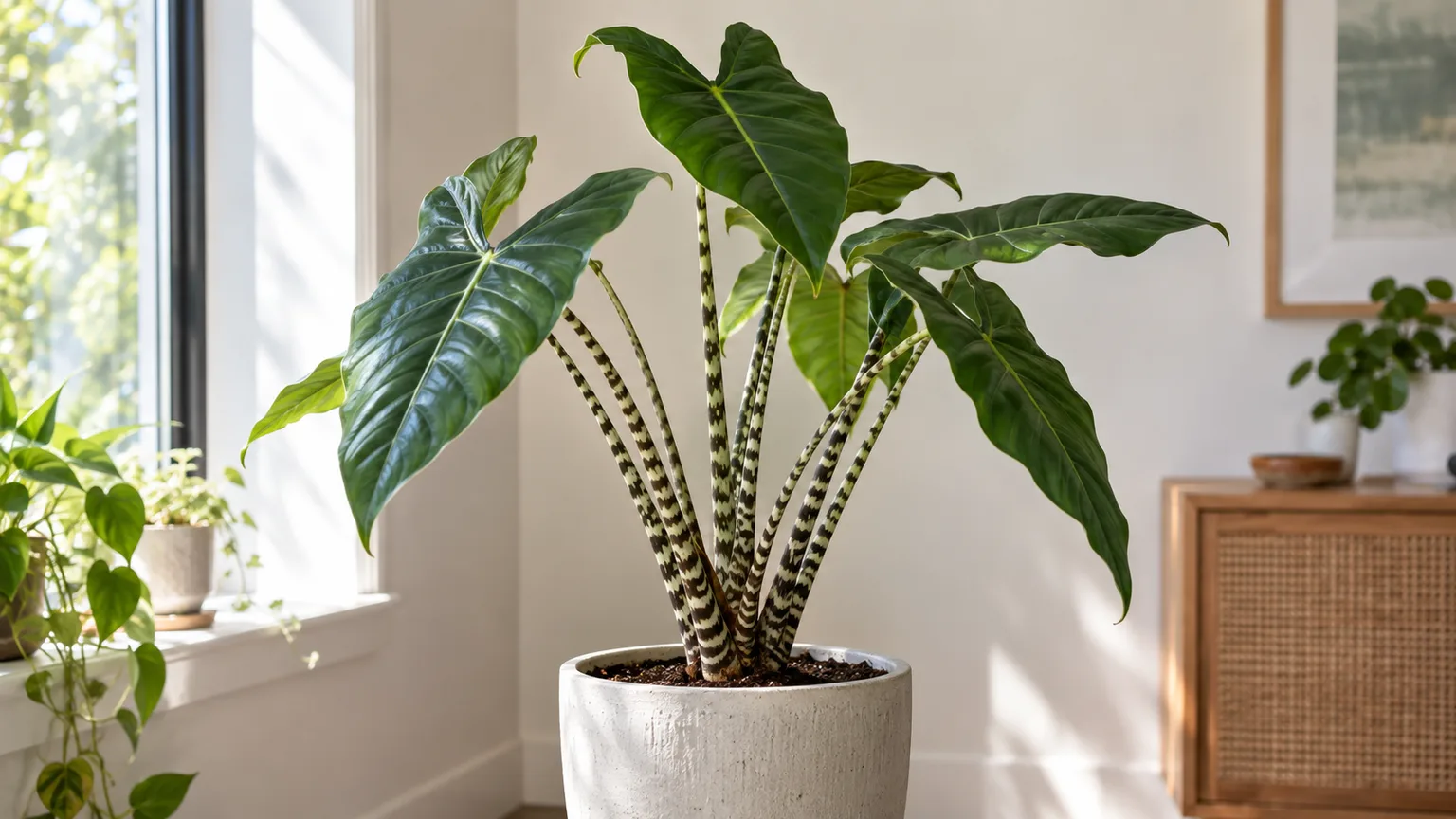
Alocasia Zebrina (Alocasia zebrina) is the houseplant people buy for its graphic stems — green-and-white zebra striping on upright petioles holding arrow-shaped leaves — and then struggle with because the care is corm-first, not leaf-first. Unlike forgiving vining philodendrons, this Philippine native stores energy in an underground corm, drops all its foliage in winter dormancy, and rots fast when the mix stays wet. Get bright indirect light, 60–75% humidity, and a chunky aroid mix that dries predictably, and Zebrina pushes new spears steadily. Miss any one of those, and the same plant sulks for months. This guide covers identity, the full care stack, dormancy, common failures, and where to go next in the cluster.
What Alocasia Zebrina Actually Is
Alocasia zebrina belongs to Araceae, the arum family shared with Monstera, Philodendron, and peace lilies. Kew’s Plants of the World Online lists its native range as the Philippines, where it grows as a wet-tropical understory subshrub on islands including Luzon, Mindanao, Leyte, and Samar. Indoors it typically reaches 60–120 cm (about 2–4 feet) with an upright habit — no trunk, leaves emerging directly from the corm on long petioles.
The signature feature is the zebra-striped petiole: alternating pale green and dark brown-to-black bands that make the stems as ornamental as the foliage. Leaves are arrow- to heart-shaped, held upright, and the plant usually carries a small fan of three to six leaves at a time rather than a dense canopy. Also sold as Zebra Alocasia or Zebra Plant, it should not be confused with unrelated “zebra plants” in other genera. The RHS plant profile describes it as a rhizomatous houseplant that drops older leaves as fresh ones emerge — normal turnover, not failure.
Like all alocasias, Zebrina grows from a corm — a compact underground storage organ that survives leaf loss and seasonal slowdowns. That corm is why an apparently dead pot in January can push a new spear in March, and why overwatering kills faster than underwatering: saturated mix suffocates the corm before the leaves show obvious distress.
Native Habitat: Why the Philippines Matters
Understanding where Zebrina comes from changes how you care for it. In the Philippine rainforest, this plant grows in the understory of wet tropical forest at low to medium elevation — consistently warm conditions (24–32°C year-round), high humidity (often above 80%), and filtered light that reaches the forest floor as dappled patches rather than direct sun. The Missouri Botanical Garden classifies alocasias as full-sun to part-shade outdoors, but indoors the equivalent is bright indirect light. The Philippines also has a distinct dry season that corresponds to the plant’s winter dormancy trigger: shorter days and slightly cooler nights tell the corm to withdraw. Mimicking that seasonal rhythm — bright, warm, and humid in summer; cooler and drier in winter — is the secret to keeping Zebrina healthy year after year.
Zebrina vs. Philodendron vs. Common Confusions
If you know philodendrons, Zebrina will feel familiar in one way and alien in three others. Both are tropical aroids that want bright indirect light and well-draining mix. The differences that change daily care:
Growth habit. Philodendrons climb or self-head from nodes along stems; Zebrina is upright and corm-based. There are no stem cuttings — propagation is division or corm harvest only.
Dormancy. Most philodendrons keep leaves through winter, slowing growth. Zebrina can drop every leaf when daylength shortens or nights cool, leaving a bare pot with a live corm below. That is normal, not death — and it is the single biggest source of panic for new owners.
Humidity demand. Philodendron hederaceum tolerates average home humidity; Zebrina wants 60–75% RH for clean leaf edges and steady new growth. Dry winter air brings brown tips and spider mites faster than on most philodendrons.
Commerce confusion. Nursery tags often mix up Alocasia zebrina (zebra petioles, Philippines) with Alocasia baginda and dragon-scale types (bullate leaves, Borneo). If your plant has textured, dragon-scale foliage rather than smooth arrow leaves on striped stems, you have a different species — care overlaps, but this guide targets true Zebrina.
Quick Care Card
| Factor | Target |
|---|---|
| Light | Bright indirect, 10,000–20,000 lux |
| Water | When top 2–3 cm dry; every 7–10 days in growth |
| Humidity | 60–75% relative humidity |
| Temperature | 18–26°C (65–80°F); minimum 15°C (59°F) |
| Soil | Chunky aroid mix: peat-free compost + perlite + orchid bark |
| Fertilizer | Balanced liquid at half strength, every 2–4 weeks in growth |
Light Requirements Indoors
Zebrina evolved in the dappled light of the Philippine rainforest understory, where taller trees block most direct sun. Bright, indirect light is the target — roughly 10,000–20,000 lux at leaf level, as measured by a light meter or smartphone app. The RHS alocasia guide recommends bright but indirect placement; strong sun scorches foliage, while deep shade produces long weak petioles and a plant that holds only one or two small leaves.
Measuring Light: Lux Targets and Window Placement
Practical placement: an east-facing window with gentle morning sun, a north window with bright ambient light, or a west or south window set back 1–2 metres or filtered with a sheer curtain. A dedicated Alocasia Zebrina light guide covers window-by-window detail. If natural light falls short, full-spectrum LED panels delivering 10,000–20,000 lux at 30–60 cm above the canopy for 10–12 hours daily work well — but if the leaf surface feels warm to the touch, the fixture is too close.
Warning Signs of Wrong Light
Too much light shows as bleached patches, crispy sun-facing edges, or sudden collapse after a move to a brighter spot. Too little light shows as leggy petioles, significantly smaller new leaves, and stalled growth. Rotate the pot a quarter turn weekly — petioles lean toward the brightest source.
Watering Rhythm and the Corm
Watering is the line between a thriving Zebrina and a rotting corm. The rule: water when the top 2–3 cm (about 1 inch) of mix is dry, then soak until water runs from drainage holes and empty the saucer within 30 minutes. NC State Extension notes that alocasias are prone to root rot and leaf spots from overwatering, and that yellowing can come from too much water, too little, or inadequate light — so always check moisture before reacting.
In active growth (spring through early autumn), most plants in moderate light need water roughly every 7–10 days, but pot size, humidity, and mix change that interval. A small daily sip is worse than a thorough soak: it keeps the surface wet while the corm zone stays inconsistently moist.
How to Check Soil Moisture Reliably
Use a finger, chopstick, or pot weight — not a calendar. Insert your index finger to the second knuckle: if the soil at that depth feels dry or barely cool, water thoroughly. If it feels damp, wait. Lift the pot occasionally — a dry Zebrina pot is noticeably lighter than a freshly watered one, and that weight difference becomes intuitive after a few weeks. The Alocasia Zebrina watering guide covers soak-and-drain technique in detail.
Seasonal Adjustments and Dormancy Watering
In late autumn and winter, stretch watering intervals significantly. A dormant corm pulls very little water from the soil; combined with lower light and reduced evaporation, the mix stays wet far longer. The most common dormancy mistake is overwatering — prolonged moisture creates anaerobic conditions where rot pathogens thrive. During dormancy, water roughly every 3–5 weeks with just enough to keep the corm from desiccating: about half your usual growing-season volume. Never a full drench.
Humidity and Temperature
Humidity separates plants that merely survive from plants that push leaf after leaf. Target 60–75% relative humidity — well above the 30–50% typical of heated or air-conditioned homes. The RHS classifies alocasias as medium- to high-humidity plants and suggests pebble trays, grouping, or a steamy bathroom with adequate light.
Measuring and Raising Humidity
A small hygrometer (digital models cost $10–15) is the only reliable way to know your humidity. In my experience, plants in rooms averaging 55% RH show brown edging on new leaves before they fully unfurl; at 70%+ the same leaves open clean and glossy. Misting alone is not a humidity fix — it raises RH for minutes and wets leaf surfaces, which can encourage fungal spots. A small humidifier on a hygrometer-controlled outlet is the reliable solution. Grouping plants, a pebble tray with the pot above the water line, or a bright bathroom all help measurably.
Temperature Zones That Matter
Temperature comfort zone: 18–26°C (65–80°F) during active growth. NC State Extension lists optimal daytime range around 68–77°F for the genus. Avoid sustained exposure below 15°C (59°F) — cold triggers dormancy; below 10°C (50°F) risks corm damage. The two worst indoor spots are a winter windowsill (cold glass plus draft) and directly under an AC vent (cold dry air across leaves). If leaves curl inward (“taco leaves”) despite moist soil, check humidity and drafts before watering again.
Soil and Pot Choice
Zebrina roots need air as much as moisture. Standard peat-heavy houseplant mix compacts within months, holds water too long, and is the fastest route to corm rot. Use a chunky aroid mix: equal parts peat-free potting compost (or coco coir), perlite, and orchid bark by volume. Some growers add a handful of horticultural charcoal for toxin absorption. Target pH 5.5–6.5, which most coco- or peat-free bases hit naturally.
Every pot needs drainage holes. Go up only one size (about 2 cm diameter) at repotting — an oversized pot holds water the slow root system cannot use. Signs the mix is wrong: soil stays wet more than 10 days after watering, water runs straight through without absorbing, or a sour smell after watering. The Alocasia Zebrina soil guide covers DIY recipes, charcoal additions, and when to refresh without repotting.
Fertilizer, Repotting, and Propagation Summary
Zebrina is a modest feeder. Apply balanced liquid fertilizer at half the label rate every 2–4 weeks during active growth only. Pause in dormancy, for the first month after repotting, and whenever the plant is stressed or recovering from pests. Over-fertilizing shows up as brown leaf margins and crusty white deposits on the soil surface — flush the pot with plain water if you see that pattern.
Repot every 1–2 years, or when roots circle drainage holes, the pot dries much faster than before, or the plant is top-heavy. Best season: early spring as new growth starts. One pot size up, fresh pre-moistened mix, same planting depth. Details in the Alocasia Zebrina repotting guide.
Propagation: division of offsets or corm propagation in spring — not leaf or stem cuttings, since what looks like a stem is actually a leaf petiole with no nodes. Each division needs a growth point and roots. Leave at least half the corms on the mother plant; they are energy reserves through dormancy. The Alocasia Zebrina propagation guide covers corm propagation in water and sphagnum moss step by step.
Winter Dormancy: When the Pot Looks Empty
In late autumn or winter, with shorter days and cooler nights, a healthy Zebrina may drop every leaf. The pot looks empty; the corm below the surface is still alive. This mirrors dry-season behaviour in Philippine forests and is a survival strategy, not a failure.
During dormancy: stop fertilizing, reduce watering to barely keep the corm from desiccating (roughly every 3–5 weeks), and keep the pot warm with bright indirect light. Do not repot, divide, or “rescue” with extra water. New spears usually appear when daylength and temperature rise in spring. If nothing emerges by mid-spring, unpot gently — a firm corm means wait; a soft or foul-smelling corm means the plant is lost.
Three Stages of Dormancy
Stage 1 (weeks 1–3): Growth slows and stops. Leaves become dull and slightly droopy. This is easy to misread as underwatering — check soil moisture before reacting.
Stage 2 (weeks 3–8+): Leaves yellow from outer edges inward, then brown and drop. The plant is pulling nutrients back into the corm. Do not remove yellowing leaves before they detach naturally — pulling them early interrupts nutrient retrieval.
Stage 3 (dormancy break, February–April): A small pointed growth tip emerges from the corm centre. This is the signal to resume normal care gradually.
Dormant or Dying? Quick Diagnostic
The squeeze test is most reliable. Gently press the corm — firm as a raw potato means alive and dormant. Mushy, yielding, or oozing means rot has set in. A dormant corm smells faintly earthy; a rotting one smells foul or sulfurous. The Blooming Expert dormancy guide notes that Zebrina is the most forgiving alocasia variety during dormancy, storing water reserves in its petioles.
Common Problems on Alocasia Zebrina
Most failures trace to moisture, light, or humidity — not mystery disease. Here is how to diagnose and fix each common issue in 2–3 steps:
Yellow leaves. One older leaf yellowing while new growth is healthy is normal turnover. Widespread yellowing, especially on new leaves, is almost always overwatering or dense mix. First step: check soil moisture and root health before changing anything. If roots are brown and mushy, unpot, trim rot, and repot into fresh chunky mix. If roots are fine and soil is dry, move the plant closer to a brighter window. See yellow leaves on Alocasia Zebrina.
Brown tips and edges. Low humidity (below 50% RH) is the most common cause, especially in heated winter homes. Flush the pot with low-mineral water to rule out salt buildup from tap water or over-fertilizing. Pair with a humidifier set to at least 60% — do not rely on misting. If browning persists on the newest leaves, check for spider mites. Low humidity on Alocasia Zebrina covers the full fix path.
Spider mites. Fine webbing on leaf undersides, stippling, and bronzed upper surfaces. Alocasia are prone to spider mites in hot dry indoor air. First step: isolate the plant and shower the foliage to knock off visible mites. Wipe leaf undersides with a damp cloth, then treat with insecticidal soap or dilute neem at five-day intervals for three rounds. Raise humidity above 60% to suppress reproduction — mites thrive below 50% RH.
Root rot. Yellow leaves, soft petiole bases, sour-smelling mix — almost always overwatering plus poor drainage. First step: stop watering immediately. Unpot, trim all mushy brown roots with clean scissors, and cut away any soft corm sections. Repot into dry chunky aroid mix, water sparingly after 3–5 days, and keep warm and humid until new growth appears. The root rot on Alocasia Zebrina guide has step-by-step photos.
For symptom-first troubleshooting, use the Alocasia Zebrina problems hub.
Pet and Human Toxicity
Every part of Alocasia zebrina is toxic to cats, dogs, and horses if chewed or ingested. The ASPCA lists Alocasia spp. as toxic, with clinical signs including oral irritation, pain and swelling of mouth, tongue and lips, excessive drooling, vomiting, and difficulty swallowing from insoluble calcium oxalate crystals. Sap can also irritate human skin — wear gloves when dividing or repotting.
Keep Zebrina on high shelves, in closed cabinets, or out of pet-accessible rooms. If ingestion is suspected, call ASPCA Animal Poison Control at (888) 426-4435 and your veterinarian. Do not induce vomiting unless instructed. The leaves are tough and not especially attractive to most pets, but any chew produces immediate pain — treat this as a real medical situation, not a wait-and-see.
Buying Tips and the First 30 Days
Choose plants with firm petioles, clean leaf undersides, and no webbing or sticky residue. Cosmetic damage on one older leaf is fine; collapsed crowns, mushy stems, or yellow new growth are not. Confirm the stems show zebra striping — if the plant has bullate dragon-scale leaves instead, you may have a baginda-type cultivar, not true Zebrina.
First 30 days: do not repot, fertilize, or propagate unless the mix is clearly failing or pests are obvious. Quarantine two weeks, learn how fast your pot dries, and change one variable at a time. A single dropped leaf in week one is often transport stress, not care failure — resist overwatering the bare corm.
A Note From the Author
I have grown Alocasia zebrina in conditions ranging from 40% RH (brown-edged leaves on every new spear) to 70%+ RH (flawless leaf expansion), and the difference is striking enough that I recommend every owner invest in a hygrometer before buying any other gear. The corm-first approach described here comes from observing what happens when the same plant is overwatered, underwatered, and finally watered on a root-zone signal rather than a calendar — it recovers faster every time. This guide was cross-referenced against RHS, NC State Extension, Kew POWO, Missouri Botanical Garden, and ASPCA sources before publication. Care parameters were reviewed against practical indoor growing constraints across multiple environments.
When to Use This Page vs Other Alocasia Zebrina Guides
This overview is the cluster hub — read it first for the full picture, then open a sibling guide when one topic needs depth.
- Alocasia Zebrina watering — soak-and-drain rhythm, dormancy dial, over/under recovery steps
- Alocasia Zebrina light — window placement, lux ranges, grow-light setup
- Alocasia Zebrina soil — mix recipes, drainage tests, wrong-soil fixes
- Alocasia Zebrina problems — symptom-first path when something is already wrong
Related Alocasia Zebrina Guides
- Alocasia Zebrina fertilizer
- Alocasia Zebrina repotting
- Alocasia Zebrina propagation
- Alocasia Zebrina pruning
Conclusion
Six months of corm-centred care — bright indirect light measured at 10,000–20,000 lux, 60–75% humidity, water only when the top 2–3 cm dries, and a respectful hands-off dormancy in winter — transforms a struggling Zebrina into a plant that reliably pushes four to seven new striped petioles each growing season. The zebra stems get brighter, the leaves larger, and the dormancy surprise becomes predictable rather than panic-inducing. Start with the fundamentals: a chunky aroid mix, a hygrometer, and a pot with drainage. Master those, and Alocasia zebrina rewards you with years of one of the most striking stem patterns in the houseplant world — not because it is easy, but because you learned to grow it the way its corm expects.
How to care for Alocasia Zebrina?
How much light does Alocasia Zebrina need?
bright indirect light
- bright indirect light - bright indirect light.
When should you water Alocasia Zebrina?
Water when the top 2–3 cm of soil is dry; reduce sharply in winter dormancy. Avoid overwatering — the corm rots fast in wet mix.
- Finger or chopstick to 2–3 cm depth; lift pot to gauge weight - Water when the top 2–3 cm of soil is dry; reduce sharply in winter dormancy.
- Drain excess water - Water when the top 2–3 cm of soil is dry; reduce sharply in winter dormancy.
What soil works best for Alocasia Zebrina?
Chunky, well-draining aroid mix with perlite and orchid bark; never use dense peat-heavy mix alone.
- perlite - Chunky, well-draining aroid mix with perlite and orchid bark; never use dense peat-heavy mix alone.
- orchid bark - Chunky, well-draining aroid mix with perlite and orchid bark; never use dense peat-heavy mix alone.
- peat-free potting mix - Chunky, well-draining aroid mix with perlite and orchid bark; never use dense peat-heavy mix alone.
Grower notes for Alocasia Zebrina
Dormancy and the corm
Alocasia Zebrina may drop all leaves in winter while the underground corm stays alive. Reduce watering to every 3–5 weeks, stop fertilizer, and wait for spring growth — do not discard a pot that looks empty.
The zebra-striped stems
The signature black-and-white banding on petioles is the fastest way to confirm true Zebrina — not a mislabeled Polly or Amazonica hybrid. Stems should feel firm; soft, collapsing petioles at the soil line usually mean rot, not normal leaf turnover.
What matters most with Alocasia Zebrina
Alocasia Zebrina is easiest to grow when you judge the whole plant: new growth, root-zone moisture, light exposure, and how quickly the pot dries after watering. The care checkpoint is bright indirect light paired with chunky aroid mix — this upright Philippine species rots faster than it looks thirsty when the mix stays wet.
Best placement in a real home
Alocasia Zebrina belongs where bright indirect light is realistic for most of the day. Water when the top 2–3 cm of soil is dry; reduce sharply in winter when dormancy is likely. Humidity target: 60–75%. Temperature comfort zone: 18–26°C (65–80°F). Keep above 15°C year-round.
Before you buy this plant
Choose Alocasia Zebrina with firm striped petioles, glossy arrow-shaped leaves, clean undersides, and soil that does not smell sour. Be cautious if you see collapsed crowns, mushy stems, or a pot that stays wet in poor light. Verify the zebra stem pattern — shops sometimes label similar arrowhead alocasias as Zebrina.
First month after bringing it home
Do not repot Alocasia Zebrina on day one unless the mix is failing or pests are obvious. Quarantine it, learn how fast the pot dries, and keep care boring while it adjusts. Older leaves may yellow and drop as new ones open — that turnover is normal on this species. If several leaves fail together with wet soil, check roots before adding water.
Pest watch after bringing one home
Alocasia Zebrina kept in dry indoor air can attract glasshouse red spider mite and mealybug. Inspect leaf undersides weekly during the first month — fine stippling or white cottony clusters at leaf axils are early signs. Isolate at the first hint; treating a small outbreak is far easier than clearing an established infestation from a multi-plant shelf.
Is it pet safe?
Alocasia Zebrina is toxic to cats and dogs and humans.
Contains insoluble calcium oxalate crystals causing oral irritation, drooling, and vomiting if ingested.
Watering Alocasia Zebrina
For Alocasia Zebrina, finger or chopstick to 2–3 cm depth; lift pot to gauge weight and water every 7–10 days in summer; every 2–4 weeks in winter. Reduce watering 60–70% in autumn/winter when dormancy is likely; keep corm from drying out.
| Detail | Information |
|---|---|
| How often | Every 7–10 days in summer; every 2–4 weeks in winter |
| How to check | Finger or chopstick to 2–3 cm depth; lift pot to gauge weight |
| Seasonal changes | Reduce watering 60–70% in autumn/winter when dormancy is likely; keep corm from drying out |
Signs of overwatering
- yellow leaves
- mushy petioles
- soggy soil
- root rot
Signs of underwatering
- drooping leaves
- dry crispy edges
- slow growth
Soil & potting for Alocasia Zebrina
Use a mix of perlite, orchid bark, peat-free potting mix, coarse sand for Alocasia Zebrina. Fast-draining; corm must never sit in saturated soil. Target soil pH around 5.5–6.5. Repot every 1–2 years, ideally in spring.
| Detail | Information |
|---|---|
| Recommended mix | perlite, orchid bark, peat-free potting mix, coarse sand |
| Drainage | Fast-draining; corm must never sit in saturated soil |
| Soil pH | 5.5–6.5 |
| Repotting frequency | Every 1–2 years |
| Best season to repot | Spring |
Signs it needs repotting
- roots circling pot
- rapid soil drying
- stunted growth
Humidity & temperature for Alocasia Zebrina
Alocasia Zebrina prefers 60–75%, though normal home humidity is usually fine. Keep temperatures around 18–26°C (65–80°F).
| Detail | Information |
|---|---|
| Humidity | 60–75% - normal home humidity is fine. |
| Ideal temperature | 18–26°C (65–80°F) |
Fertilizer & pruning for Alocasia Zebrina
Use stop fertilizing, reduce watering to roughly every 3–5 weeks (just enough to keep the corm from desiccating), and keep the pot warm with bright indirect light. for Alocasia Zebrina.
| Detail | Information |
|---|---|
| Fertilizer type | Stop fertilizing, reduce watering to roughly every 3–5 weeks (just enough to keep the corm from desiccating), and keep the pot warm with bright indirect light. |
Common problems on Alocasia Zebrina
Yellow Leaves
MediumLikely cause: Common on this plant type; confirm with recent watering, light, and root checks.
Quick fix: Inspect the plant and correct the most likely care stressor before stacking treatments.
Full fix guide →Brown Tips
MediumLikely cause: Common on this plant type; confirm with recent watering, light, and root checks.
Quick fix: Inspect the plant and correct the most likely care stressor before stacking treatments.
Full fix guide →Root Rot
MediumLikely cause: Common on this plant type; confirm with recent watering, light, and root checks.
Quick fix: Inspect the plant and correct the most likely care stressor before stacking treatments.
Full fix guide →Overwatering
MediumLikely cause: Common on this plant type; confirm with recent watering, light, and root checks.
Quick fix: Inspect the plant and correct the most likely care stressor before stacking treatments.
Full fix guide →Underwatering
MediumLikely cause: Common on this plant type; confirm with recent watering, light, and root checks.
Quick fix: Inspect the plant and correct the most likely care stressor before stacking treatments.
Full fix guide →Spider Mites
MediumLikely cause: Common on this plant type; confirm with recent watering, light, and root checks.
Quick fix: Inspect the plant and correct the most likely care stressor before stacking treatments.
Full fix guide →Mealybugs
MediumLikely cause: Common on this plant type; confirm with recent watering, light, and root checks.
Quick fix: Inspect the plant and correct the most likely care stressor before stacking treatments.
Full fix guide →Aphids
MediumLikely cause: Common on this plant type; confirm with recent watering, light, and root checks.
Quick fix: Inspect the plant and correct the most likely care stressor before stacking treatments.
Full fix guide →Leggy Growth
MediumLikely cause: Common on this plant type; confirm with recent watering, light, and root checks.
Quick fix: Inspect the plant and correct the most likely care stressor before stacking treatments.
Full fix guide →Slow Growth
MediumLikely cause: Common on this plant type; confirm with recent watering, light, and root checks.
Quick fix: Inspect the plant and correct the most likely care stressor before stacking treatments.
Full fix guide →Wilting
MediumLikely cause: Common on this plant type; confirm with recent watering, light, and root checks.
Quick fix: Inspect the plant and correct the most likely care stressor before stacking treatments.
Full fix guide →Drooping Leaves
MediumLikely cause: Common on this plant type; confirm with recent watering, light, and root checks.
Quick fix: Inspect the plant and correct the most likely care stressor before stacking treatments.
Full fix guide →Low Humidity
MediumLikely cause: Common on this plant type; confirm with recent watering, light, and root checks.
Quick fix: Inspect the plant and correct the most likely care stressor before stacking treatments.
Full fix guide →Not Enough Light
MediumLikely cause: Common on this plant type; confirm with recent watering, light, and root checks.
Quick fix: Inspect the plant and correct the most likely care stressor before stacking treatments.
Full fix guide →Fungus Gnats
MediumLikely cause: Common on this plant type; confirm with recent watering, light, and root checks.
Quick fix: Inspect the plant and correct the most likely care stressor before stacking treatments.
Full fix guide →Mold on Soil
MediumLikely cause: Common on this plant type; confirm with recent watering, light, and root checks.
Quick fix: Inspect the plant and correct the most likely care stressor before stacking treatments.
Full fix guide →Curling Leaves
MediumLikely cause: Common curling leaves pattern on Alocasia Zebrina under indoor care stress.
Quick fix: Inspect roots, watering, light, and pests; adjust one variable and monitor new growth.
Full fix guide →Brown Leaves
MediumLikely cause: Common brown leaves pattern on Alocasia Zebrina under indoor care stress.
Quick fix: Inspect roots, watering, light, and pests; adjust one variable and monitor new growth.
Full fix guide →Black Spots
MediumLikely cause: Common black spots pattern on Alocasia Zebrina under indoor care stress.
Quick fix: Inspect roots, watering, light, and pests; adjust one variable and monitor new growth.
Full fix guide →Holes in Leaves
MediumLikely cause: Common holes in leaves pattern on Alocasia Zebrina under indoor care stress.
Quick fix: Inspect roots, watering, light, and pests; adjust one variable and monitor new growth.
Full fix guide →Pale Leaves
MediumLikely cause: Common pale leaves pattern on Alocasia Zebrina under indoor care stress.
Quick fix: Inspect roots, watering, light, and pests; adjust one variable and monitor new growth.
Full fix guide →Distorted Leaves
MediumLikely cause: Common distorted leaves pattern on Alocasia Zebrina under indoor care stress.
Quick fix: Inspect roots, watering, light, and pests; adjust one variable and monitor new growth.
Full fix guide →Scale Insects
MediumLikely cause: Common scale insects pattern on Alocasia Zebrina under indoor care stress.
Quick fix: Inspect roots, watering, light, and pests; adjust one variable and monitor new growth.
Full fix guide →Thrips
MediumLikely cause: Common thrips pattern on Alocasia Zebrina under indoor care stress.
Quick fix: Inspect roots, watering, light, and pests; adjust one variable and monitor new growth.
Full fix guide →Whiteflies
MediumLikely cause: Common whiteflies pattern on Alocasia Zebrina under indoor care stress.
Quick fix: Inspect roots, watering, light, and pests; adjust one variable and monitor new growth.
Full fix guide →Leaf Miners
MediumLikely cause: Common leaf miners pattern on Alocasia Zebrina under indoor care stress.
Quick fix: Inspect roots, watering, light, and pests; adjust one variable and monitor new growth.
Full fix guide →Caterpillars
MediumLikely cause: Common caterpillars pattern on Alocasia Zebrina under indoor care stress.
Quick fix: Inspect roots, watering, light, and pests; adjust one variable and monitor new growth.
Full fix guide →Nitrogen Deficiency
MediumLikely cause: Common nitrogen deficiency pattern on Alocasia Zebrina under indoor care stress.
Quick fix: Inspect roots, watering, light, and pests; adjust one variable and monitor new growth.
Full fix guide →Iron Deficiency
MediumLikely cause: Common iron deficiency pattern on Alocasia Zebrina under indoor care stress.
Quick fix: Inspect roots, watering, light, and pests; adjust one variable and monitor new growth.
Full fix guide →Magnesium Deficiency
MediumLikely cause: Common magnesium deficiency pattern on Alocasia Zebrina under indoor care stress.
Quick fix: Inspect roots, watering, light, and pests; adjust one variable and monitor new growth.
Full fix guide →Potassium Deficiency
MediumLikely cause: Common potassium deficiency pattern on Alocasia Zebrina under indoor care stress.
Quick fix: Inspect roots, watering, light, and pests; adjust one variable and monitor new growth.
Full fix guide →Calcium Deficiency
MediumLikely cause: Common calcium deficiency pattern on Alocasia Zebrina under indoor care stress.
Quick fix: Inspect roots, watering, light, and pests; adjust one variable and monitor new growth.
Full fix guide →