Spider Mites on Alocasia Zebrina: Checks & Treatment
Quick answer
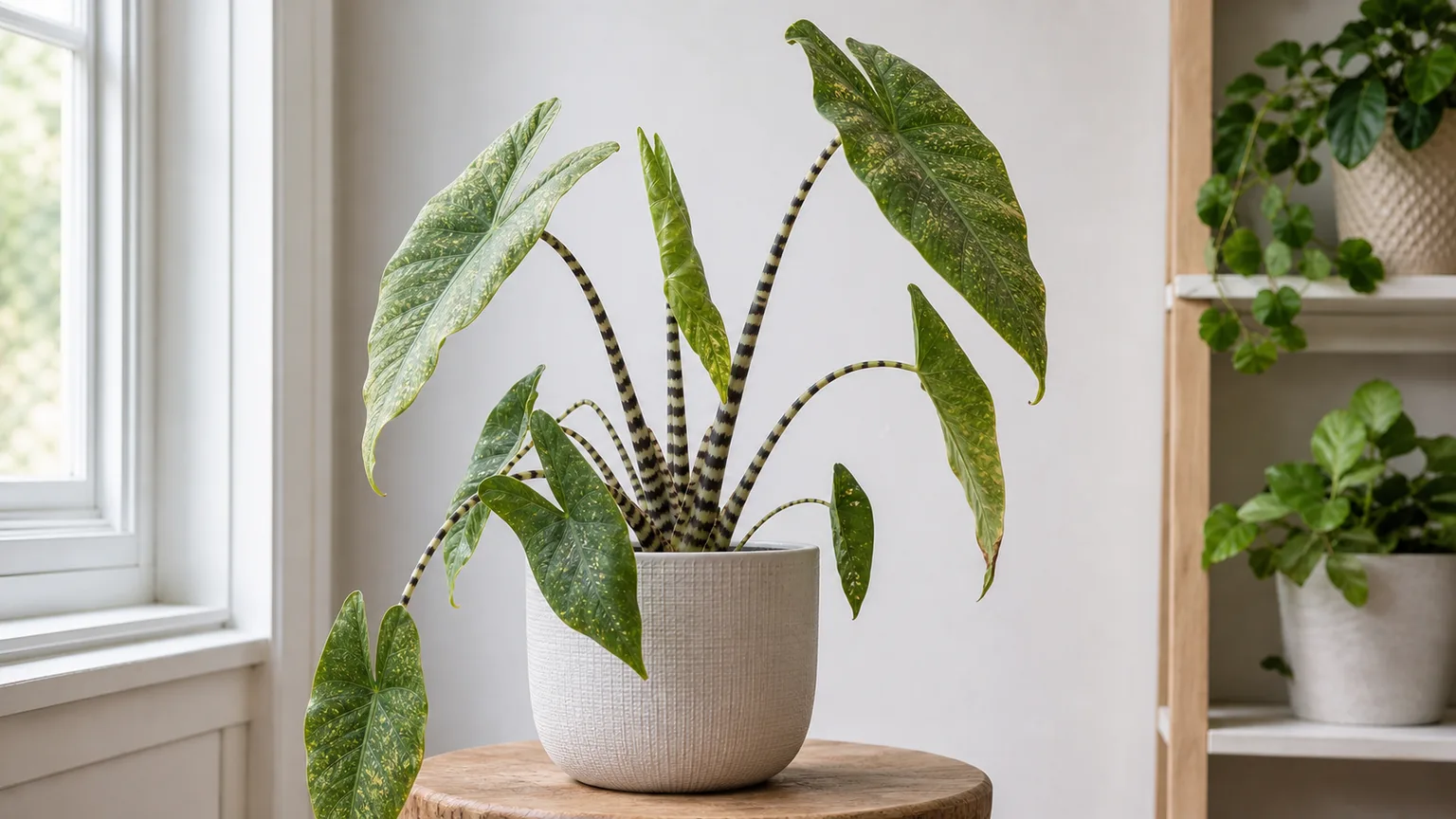
Spider mites on Alocasia Zebrina cause fine pale stippling across the arrow-shaped blades, with tiny moving specks, cast skins, or fine silk on the undersides and near the veins. First, isolate the entire pot from other plants. Then confirm live mites before rinsing the undersides or applying a product labeled for mites on indoor ornamental plants.
Spider Mites on Alocasia Zebrina: Checks & Treatment
This guide covers spider mites on Alocasia Zebrina. See also the general Spider Mites guide, watering, and light pages for this plant.
Spider Mites on Alocasia Zebrina: Checks & Treatment
Quick answer
Spider mites on Alocasia Zebrina (Alocasia zebrina) usually reveal themselves as fine cream or yellow stippling scattered over the glossy arrow-shaped blades. The pests feed mostly beneath the leaf, so the decisive evidence is on the underside: tiny moving specks, pale cast skins, round eggs, or delicate silk concentrated beside the midrib and branching veins. The RHS describes this pale upper-surface mottling and underside colony, with obvious webbing more typical of a heavy attack.
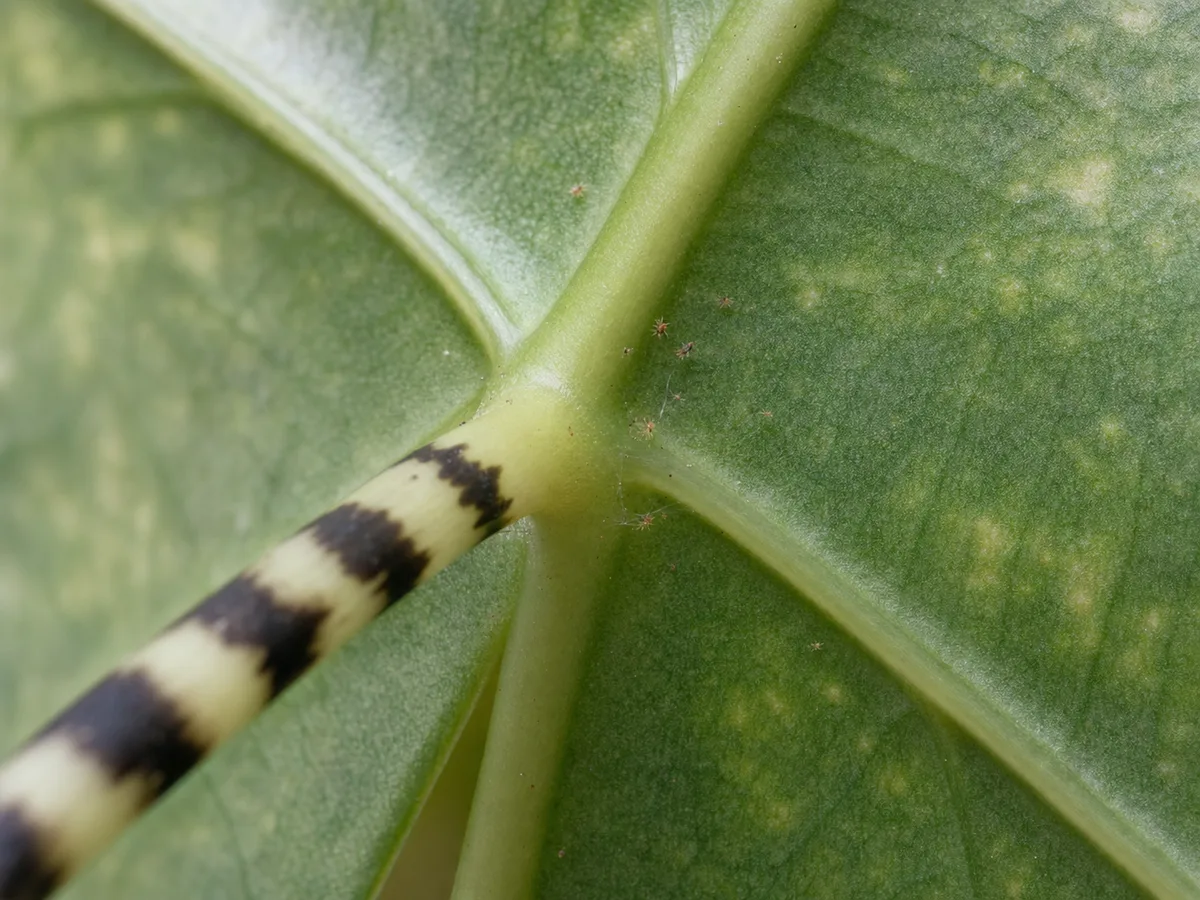
Illustrative generated diagnostic image, not a photograph of a documented infestation. Confirm live mites, eggs, cast skins, or silk on your plant before treating.
First action: isolate the whole pot from every other plant. Do that before carrying it to a sink, wiping a leaf, or applying any product. Zebrina’s long petioles hold broad blades well beyond the pot rim, so a plant that looks separate at soil level may still touch neighboring foliage.
After isolation, confirm live mites before treating. Then reduce the population with a careful rinse and escalate only to a product whose label permits mites, indoor ornamental plants, and your intended location. For shared pest biology, use the general spider-mite guide; the decisions below are narrowed to the Zebrina’s arrow blades, zebra-striped petioles, emerging spear, crown, and underground corm.
Evidence limit: This is a source-synthesized home inspection and IPM pathway, not a record of a controlled Zebrina treatment trial. Generated diagnostic images, when present, are illustrations rather than proof of an infestation; confirm mites on your own plant by finding moving specks, cast skins, eggs, or silk.
Match the severity to the next action
| What you find on Alocasia Zebrina | Working level | Next action |
|---|---|---|
| Pale stippling but no moving specks, cast skins, eggs, or silk | Suspected, not confirmed | Isolate and repeat the underside inspection and paper-tap test in bright light; do not spray on suspicion alone |
| Live mites on one or two blades, little or no silk, new spear still clean | Confirmed, light | Rinse every accessible leaf underside while keeping runoff out of the crown, then monitor |
| Live mites return after rinsing or after a label-led treatment | Persistent | Recheck coverage and apply only the next treatment allowed by the current label; inspect neighboring plants |
| Dense webbing, a colony inside inaccessible crown tissue, or several infested pots | Severe or collection-wide | Seek local extension or professional identification; bag affected material and consider disposal if control is impractical |
Inspect the underside of every arrow-shaped blade
Do not diagnose from the top of the plant alone. Support one blade in your hand, tilt it toward a bright lamp, and scan the underside from the petiole junction along the midrib, then outward along each vein. A 10× hand lens makes mites, eggs, and cast skins easier to separate from dust.
Use this inspection order:
- Compare a stippled area on top with the same position underneath.
- Examine the recessed vein junctions and the narrow zone where blade meets petiole.
- Hold white paper under the leaf and tap the blade; watch for specks that move after landing.
- Look for fine silk bridging a vein, the back edge of the blade, or two nearby petioles.
- Repeat on apparently healthy leaves and on plants that shared the same shelf.
Spider mites are arachnids rather than insects, and many species produce fine silk webbing. The Maine Department of Agriculture describes their four pairs of legs, oval body region, and silk production. You do not need to identify the exact mite species at home, but you do need to distinguish a moving colony from harmless residue before using a pesticide.
Read stippling on glossy Zebrina foliage
Early feeding empties individual leaf cells, producing white or silvery points that gradually merge into a dull, faded patch. Clemson Extension describes white stippling and a greyish cast as populations build. On Zebrina, damage often looks most obvious when the glossy blade is viewed at an angle rather than straight on.
Dense silk is not required for diagnosis. Waiting for webbing to cover the plant means waiting until the population is harder to reach. Conversely, one stray strand between petioles is not proof by itself; ordinary spiders can use the plant without producing leaf stippling or a colony of tiny mites below.
Striped petioles are not mite damage
The dark-and-pale banding on an Alocasia Zebrina petiole is normal, flat tissue. It follows the stem’s stripe pattern and does not brush away. Mites are much smaller than the bands and are more likely to be found on leaf undersides than displayed as fixed marks on the petiole.
Inspect the petioles for fine silk stretched between surfaces, not for the zebra pattern itself. A petiole that is soft, collapsing at soil level, or attached to persistently wet mix points away from mites and toward overwatering or root rot. Mites can weaken foliage, but they do not turn healthy striped tissue into a mushy stem base.
Spider mites versus common Zebrina lookalikes
| Pattern on the plant | More likely cause | Deciding check |
|---|---|---|
| Fine pale stippling above; moving specks, cast skins, eggs, or silk below | Spider mites | Inspect along the underside veins with a hand lens and use the paper-tap test |
| Papery brown margins without mites or webbing | Leaf browning | Damage follows the edge rather than forming scattered feeding points |
| Cottony white clusters at petiole joints or inside sheaths | Mealybugs | Wax lifts on a swab and hides a larger segmented insect |
| One oldest leaf yellows while a clean new spear opens | Normal leaf turnover | No live pests; crown and corm stay firm |
| Several yellow leaves above heavy wet mix | Yellow leaves from root-zone stress | Pot stays heavy and petiole bases may soften |
| Silvery scrape-like patches with black specks around new growth | Possible thrips | Look for narrow insects and black frass rather than webbing and round mites |
When the evidence is ambiguous, keep the plant isolated and recheck in bright light rather than spraying “just in case.” A pesticide injury on a clean leaf can add a second problem without resolving the first.
Rinse mites without soaking the crown or corm
Once mites are confirmed, carry the isolated plant to a sink, shower, or sheltered outdoor area in suitable weather. Cover the surface of the mix so the stream does not excavate it, support each long petiole, and direct lukewarm water across the underside of every blade. Work from the blade tip toward the petiole junction while angling runoff away from the crown.
Periodic hosing can physically remove many mites, and Colorado State Extension recommends washing small houseplants in a sink or shower. Rinsing is population reduction, not proof of eradication. It becomes much less effective once thick webbing shields a large colony.
The Zebrina-specific limit is its underground storage structure and crowded growing point. Do not fill the crown with water, saturate the pot repeatedly, or leave the plant standing in runoff. Return to the normal dry-down check in the Alocasia Zebrina watering guide; an extra pest rinse should not quietly become an extra soil watering.
Protect the emerging spear and crown
The rolled emerging spear deserves inspection because mites can shelter beside the sheath and transfer onto tender tissue as it opens. Shine a light into the visible seam and inspect the accessible surface, but do not prise the spear apart. Forced opening tears the blade and makes later distortion difficult to interpret.
If mites are visible on the exposed seam, rinse or wipe only what you can reach without bending the spear. Do not pour soap, oil, or a homemade mixture into the crown. A clean spear that is merely slow to open may reflect cool conditions, dormancy, or low light; check the Alocasia Zebrina light guide before treating slow growth as evidence of continuing mites.
Escalate with one labeled product, not a mixture
If live mites remain after physical cleaning, choose a commercial insecticidal soap, horticultural oil, or miticide only when its current label permits spider mites, the plant or indoor ornamental use, and the intended application site. The label controls concentration, coverage, interval, protective equipment, ventilation, re-entry, storage, and disposal. Clemson Extension emphasizes that the product label is the final authority on where and how a miticide may be used.
If the label allows treatment on this plant but does not address sensitivity, spot-test a small section of one mature leaf and watch it for injury before expanding coverage; there is no universal Zebrina waiting period, so use any interval the label gives. Clemson warns that soaps and oils can be phytotoxic to drought-stressed plants or in temperatures of 90°F (32°C) and above. Do not treat a thirsty, heat-stressed Zebrina, and keep it out of intense sun while sprayed foliage is wet.
These are contact treatments, so underside coverage matters; increasing concentration is not a substitute. Do not combine oil, soap, neem, alcohol, household detergent, or another pesticide unless the labels explicitly authorize the mixture. Do not assume a general insecticide controls mites. The Connecticut Agricultural Experiment Station lists insecticidal soap and ultrafine horticultural oil among houseplant mite options while stressing multiple applications and label directions.
Follow the product’s repeat interval rather than inventing a calendar. Mite eggs and sheltered stages can survive the first pass, so one clean-looking day is not an endpoint. Continue underside inspections between label-permitted applications and stop if the plant shows spray injury.
Humidity helps prevention but is not the treatment
Warm, dry conditions favor common houseplant spider mites, and Alocasia foliage also suffers when indoor air becomes very dry. Improving the placement—away from a heating vent or drying airflow—can reduce stress and make the environment less favorable. It does not remove eggs, mites, or protective webbing already on the plant.
The RHS states that raising humidity and spraying with water can reduce risk but will not control the mite on its own. Treat humidity as background care, not as a cure or a reason to postpone confirmation and physical removal. Avoid chasing a precise humidity number by keeping the pot constantly wet; the Alocasia Zebrina soil guide explains how the chunky mix and corm should drain.
Judge recovery by the next leaf
Existing stipples, bronzed patches, and scars will remain visible. Do not keep escalating treatment because an old leaf fails to turn glossy green again. Recovery means the active pest signs stop: paper taps show no moving specks, fresh silk does not appear, and damage does not expand onto previously clean tissue.
On an actively growing Zebrina, the best long-term evidence is a new spear that opens clean. Its blade should expand without new stippling along the veins, while its striped petiole remains firm at the crown. The RHS notes that alocasias can lose foliage during winter dormancy and produce fresh leaves when growth resumes, so a dormant plant may not provide a quick replacement leaf.
During that pause, rely on repeated negative inspections and a firm crown and corm. Do not force growth with extra fertilizer or water. If the plant loses leaves while its mix stays heavy or the petiole bases soften, switch from pest treatment to the root-rot guide and assess the root zone.
When rescue puts the collection at risk
Dense webbing around several blades, mites across multiple plants, or a colony deep in an inaccessible crown requires a stricter decision. Get help from a local extension service or qualified pest professional when identification is uncertain or the products available to you do not cover indoor ornamental use. Avoid an indefinite sequence of improvised treatments.
Removing heavily infested leaves may make coverage possible, but do not strip every blade from a small Zebrina merely to make spraying easier. Colorado State Extension advises growers to bag and remove heavily infested foliage and discard severely infested houseplants when control becomes impractical. Disposal is reasonable when one declining plant repeatedly reinfests a larger collection.
Prevent mites on the next Zebrina spear
Make underside inspection part of normal watering rather than waiting for a faded canopy. Rotate the pot, lift each arrow blade, check the vein junctions, and look beside the newest spear. Leave enough space around the long petioles to keep the blades from resting on neighboring plants and to make inspection possible.
Quarantine new additions and inspect nearby plants if one pot tests positive. Keep the Zebrina in stable bright indirect light, away from heat vents, while following its normal watering rhythm. The Alocasia Zebrina overview provides the seasonal baseline needed to distinguish a resting corm from pest-driven decline.
Related Alocasia Zebrina guides
- Alocasia Zebrina overview — use for the plant’s normal seasonal growth and leaf-turnover baseline.
- Alocasia Zebrina watering — use when repeated rinsing makes it difficult to judge the corm’s next watering.
- Alocasia Zebrina root rot — use for soft petiole bases, sour mix, or a declining corm rather than stippled blades.
- All Alocasia Zebrina problems — use when the symptom table and repeat inspection do not confirm mites.