Amla Fertilizer Guide: When, How & How Much
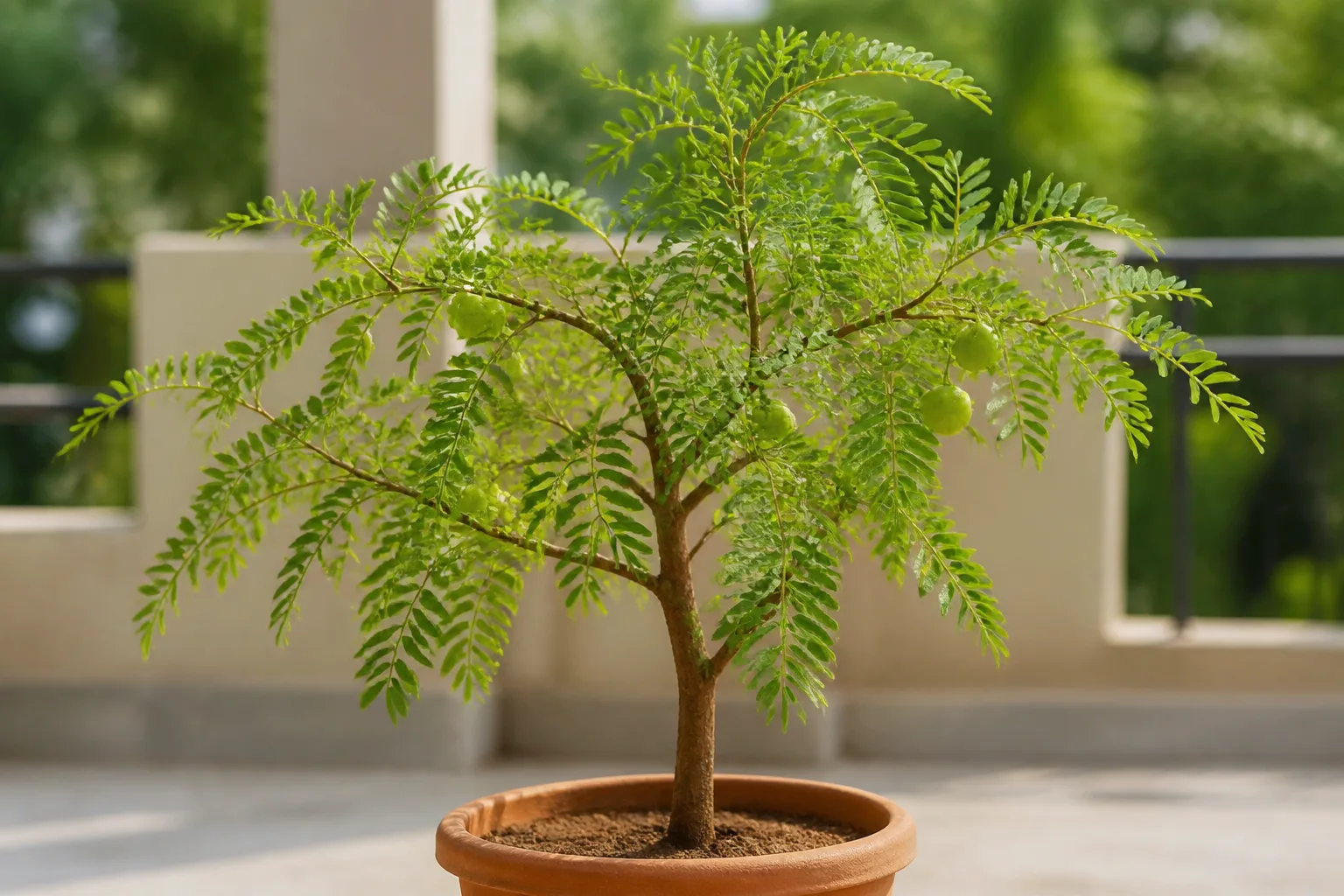
Amla Fertilizer Guide: When, How & How Much
Amla Fertilizer Guide: When, How & How Much
Amla fertilizer is about timing and restraint more than chasing the strongest bottle on the shelf. Phyllanthus emblica (also sold as Indian gooseberry, aonla, or Emblica officinalis) is a sun-loving deciduous fruit tree that can grow in nutritionally poor soil when drainage is good. Orchard practice still rewards manure and NPK — but home pots burn faster than open ground, so the useful default is seasonal feeding during active flush, not weekly full-strength doses year-round.
For most terrace and garden growers in India, that means well-rotted FYM or compost plus a balanced NPK schedule split across new flush and monsoon, scaled down sharply in containers to half-strength liquid about once a month while new shoots keep coming. Pause when growth stalls in cool weather, when the mix stays wet, or when the tree is newly repotted. Fertilizer cannot replace the full sun and deep watering rhythm Amla needs to use those nutrients.
This page is the dedicated feeding reference. Pair it with Amla soil for the mix that holds nutrients without waterlogging, and the Amla care hub for the full cluster.
Why Amla Prefers Seasonal Feeding, Not Constant Doses
Treat fertilizer as support for an already working system — sun, drainage, and a watering pattern that lets the upper mix dry — not as a rescue for weak light or soggy roots. Plants For A Future describes emblic as easy to grow on ground that is too dry and too poor for most other fruit crops, provided the soil stays well drained. A plant built for lean sites rarely needs the aggressive nitrogen schedules used for leafy kitchen herbs.
Tamil Nadu Agricultural University (TNAU) still lists concrete manure and fertilizer rates for bearing trees, and India’s National Horticulture Board (NHB) publishes a progressive annual NPK + FYM schedule — evidence that commercial aonla does respond to nutrition. The gap between “hardy on poor soil” and “responds to manure” is the point: feed enough to support flush and fruit, then stop before salts pile up in a closed pot.
Hardy fruit-tree biology and lean soils
Amla is deciduous, shedding its branchlets as well as its leaves in its seasonal cycle. Nutrient demand rises when new shoots flush and when fruit expands after monsoon release from dormancy; demand falls when the canopy rests. Clemson Extension’s tree-and-shrub guidance matches that biology: apply fertilizer when plants are actively growing, and avoid feeding drought-stressed woody plants because moisture is required for uptake.
ICAR agroforestry work on Emblica officinalis found that fertilization improved growth traits and survival, with sheep manure outperforming no-manure treatments in an agri-horticulture system. Use that as encouragement to feed — not as a license to double rates in a 30 cm terrace pot.
When to Fertilize Amla in Indian Climates
Feed when Amla is pushing new shoots or supporting fruit development, and hold feed when the tree is resting, waterlogged, or drought-wilted. In most of India, the practical window runs from late winter / early spring flush through the monsoon and early post-monsoon fruit swell, then tapers as cool weather slows growth.
New flush and monsoon split doses
NHB’s production guidance for aonla recommends giving one-year-old plants 10 kg farmyard manure with 100 g N, 50 g P, and 100 g K, then increasing that dose yearly through year ten. It also splits nutrients: full FYM and phosphorus plus half of N and K in the tree basin during January–February, with the remaining half of N and K in August (NHB aonla production technology). That two-split pattern — early flush plus monsoon — is the best orchard template to adapt for home ground trees.
TNAU’s Amla page lists a bearing-tree annual package of 10 kg FYM, 200 g N, 500 g P, and 200 g K, and notes that manuring should be done immediately after pruning. Numbers differ slightly between sources (common in regional horticulture bulletins), so treat them as order-of-magnitude orchard baselines, not rigid gram targets for every backyard tree. Align your first application with pruning and new flush; place the second near monsoon when moisture helps move nutrients into the root zone.
Cool-season pause and stress holds
From roughly November through deep winter in cooler Indian regions, taper to a stop unless a protected container still shows continuous new growth under strong sun. Resume only after consistent spring flush appears.
Also pause during acute drought stress — wilted leaflets, crispy margins, or a bone-dry root ball that has gone too far — and during chronic wet feet. Clemson warns that excess fertilizer can injure or kill plants through fertilizer burn, and that nutrients applied when plants cannot absorb them are wasted. Water first, restore turgor, fix drainage, then feed days later on moist — not soggy — mix. Never fertilize Amla sitting in a waterlogged saucer; correct watering first.
Best Fertilizer Types for Amla
The best Amla fertilizer for most home growers is a combination of well-rotted organic matter and a complete NPK source, adjusted for pot size. You do not need a specialty “Amla bottle.” You do need restraint and seasonal timing.
FYM, compost, and orchard NPK baselines
For in-ground or large patio tubs, well-rotted FYM, compost, or vermicompost worked lightly into the top few centimeters of the basin is the foundation. NHB’s planting-pit mix even includes farmyard manure and neem cake or bone meal at establishment — a reminder that organic matter is part of the nutrition story from day one.
Use orchard NPK rates only on established ground trees with a real root zone. Scale young trees toward NHB’s year-one numbers and increase gradually; do not dump a bearing-tree TNAU package into a seedling pot. Keep manure and granules off the stem collar, and water in after application so salts do not sit on dry roots.
Micronutrients matter more in sodic or chronically alkaline soils. NHB notes that in sodic soils, boron and zinc sulphate (roughly 100–500 g depending on tree age) may be incorporated with fertilizers. For typical home pots with pH near 6.0–7.5, a complete fertilizer plus compost is usually enough unless leaf symptoms persist after light and watering are fixed.
Balanced liquids for containers
In pots, prefer a balanced water-soluble fertilizer (for example 10-10-10 or 19-19-19) at half the label strength during active growth. Measure dilutions; if the label targets outdoor vegetables at full strength, start at half for container Amla and watch the next flush before increasing frequency.
Organic liquids such as diluted compost tea, seaweed extract, or fish emulsion can substitute at half strength or weaker in warm months. Use fish emulsion outdoors or with ventilation; skip it when pots stay damp and fungus gnats are already active. Avoid stacking full-strength liquid NPK on top of a heavy fresh manure load in the same week — pick one strong input at a time.
How Much and How Often: Pots vs Ground
Use this as a starting schedule, then adjust to flush quality and salt signs.
| Setup | Warm-season schedule | Strength / amount | Notes |
|---|---|---|---|
| Container 25–40 cm, full sun terrace | Every 4 weeks while flushing | Half-strength balanced liquid | Pause if tips brown or white crust appears |
| Large tub / half-barrel | Every 4–6 weeks | Half-strength liquid + light compost midseason | Bigger root volume buffers salts |
| Young in-ground tree | 2 splits (flush + monsoon) | Toward NHB year-1: 10 kg FYM + 100 g N / 50 g P / 100 g K, then increase with age | Water in after each application |
| Bearing ground tree | 2 splits per year | Near TNAU bearing package or NHB age-scaled rates | Prefer after pruning / at new flush, then monsoon |
Always apply liquid feed to moist soil, then water lightly so nutrients move into the root zone. After any strong feed — or if you see white crust — flush the pot thoroughly until water runs freely from drainage holes, then wait for the next dry-down before feeding again.
Seedlings and freshly transplanted plants need even less. Hold soluble fertilizer for several weeks after repotting or propagation until new growth confirms roots are working. Fresh mixes amended with compost rarely need day-one NPK.
Feeding for Flowering and Fruit Set
Amla flowers on new growth, and fruit development accelerates after the monsoon breaks fruit dormancy. Nutrition should support that cycle without forcing soft, overly leafy shoots that shade themselves or invite pests. Prefer balanced or slightly potassium-aware feeds during fruit swell rather than repeated high-nitrogen “green-up” doses.
Do not expect fertilizer to create fruit on a shaded balcony plant. Fruiting Amla needs strong sun first; feeding a low-light tree mostly produces lanky growth and salt stress. If flowers appear but fruit drops early, check watering extremes, heat, and pollination before doubling NPK. Budded or grafted trees typically start bearing from the third year, while seedling trees may take 6–8 years — that timeline is genetics and light, not a bigger fertilizer bag.
Underfeeding vs Overfeeding Warning Signs
Underfeeding on an otherwise healthy, sunny Amla usually looks like sparse or pale new flushes, smaller leaves than the previous cycle, and weak fruit set on a mature grafted tree that previously cropped — especially in containers that have been watered heavily for months. Confirm light and root health before reaching for a stronger bottle; pale growth in shade is often light hunger, not nitrogen hunger.
Overfeeding is the more common container mistake. Watch for white crust on the soil surface or pot rim, brown or scorched leaflet tips and margins after a feed, overly soft lush shoots from excess nitrogen, sudden leaf drop after fertilizing, or a plant that looks thirsty even when the mix is moist. Clemson explicitly links excess fertilizer to plant injury via fertilizer burn. If those signs appear, stop feeding, flush the pot, and correct watering before you resume at a weaker dilution.
Do not confuse seasonal deciduous leaf drop, cold damage, or waterlogging with a nutrient story. Soft roots and sour soil need a soil and watering reset, not more NPK.
How Light, Water, and Soil Change Nutrient Use
Nutrient demand tracks growth rate. Amla in full sun that dries every few days in summer uses fertilizer faster than the same cultivar in a dim corner with constantly damp mix. Weak light plus fertilizer is a classic path to salt burn and soft growth.
Watering controls whether nutrients reach roots or sit as concentrated salts. Deep soaks that drain freely move fertilizer through the root zone; frequent shallow sips leave salts near the surface. Feed only after you know the pot’s dry-down rhythm from the watering guide.
Soil texture decides buffering. A sandy, fast-draining mix needs more frequent light feeds; a denser loam with compost holds nutrients longer but risks waterlogging if drainage is poor. Fix the soil mix before blaming the fertilizer brand.
When to use this page vs other Amla guides
Use this page when you need what to feed, when to feed, how much, and how to read burn vs hunger. Use Amla watering when the question is dry-down timing or waterlogging. Use Amla light when growth is sparse despite feeding. Use Amla soil when drainage or mix structure is the limit. Use Amla repotting when roots are circling or the mix is exhausted. Use Amla overview for the full care picture.
Related Amla guides
- Amla care hub — species profile and cluster entry
- Amla overview — full care summary
- Amla light — sun that drives nutrient use
- Amla watering — dry-down before and after feeds
- Amla soil — mix that holds nutrients without soggy roots
- Amla repotting — when to refresh exhausted mix
- Amla propagation — aftercare before feeding new plants
- Amla pruning — timing that often pairs with manuring
Conclusion
Feed Amla like a hardy fruit tree with a seasonal appetite: organic matter plus measured NPK during flush and monsoon, then stop when growth slows. Ground trees can follow NHB/TNAU-style split doses; terrace pots should stay on half-strength monthly liquids and watch for salt crust. Get sun, drainage, and watering right first — fertilizer only finishes the job.