Amla Light Needs: Full Sun, Windows & Warning Signs
Amla Light Needs: Full Sun, Windows & Warning Signs
Amla Light Needs: Full Sun, Windows & Warning Signs
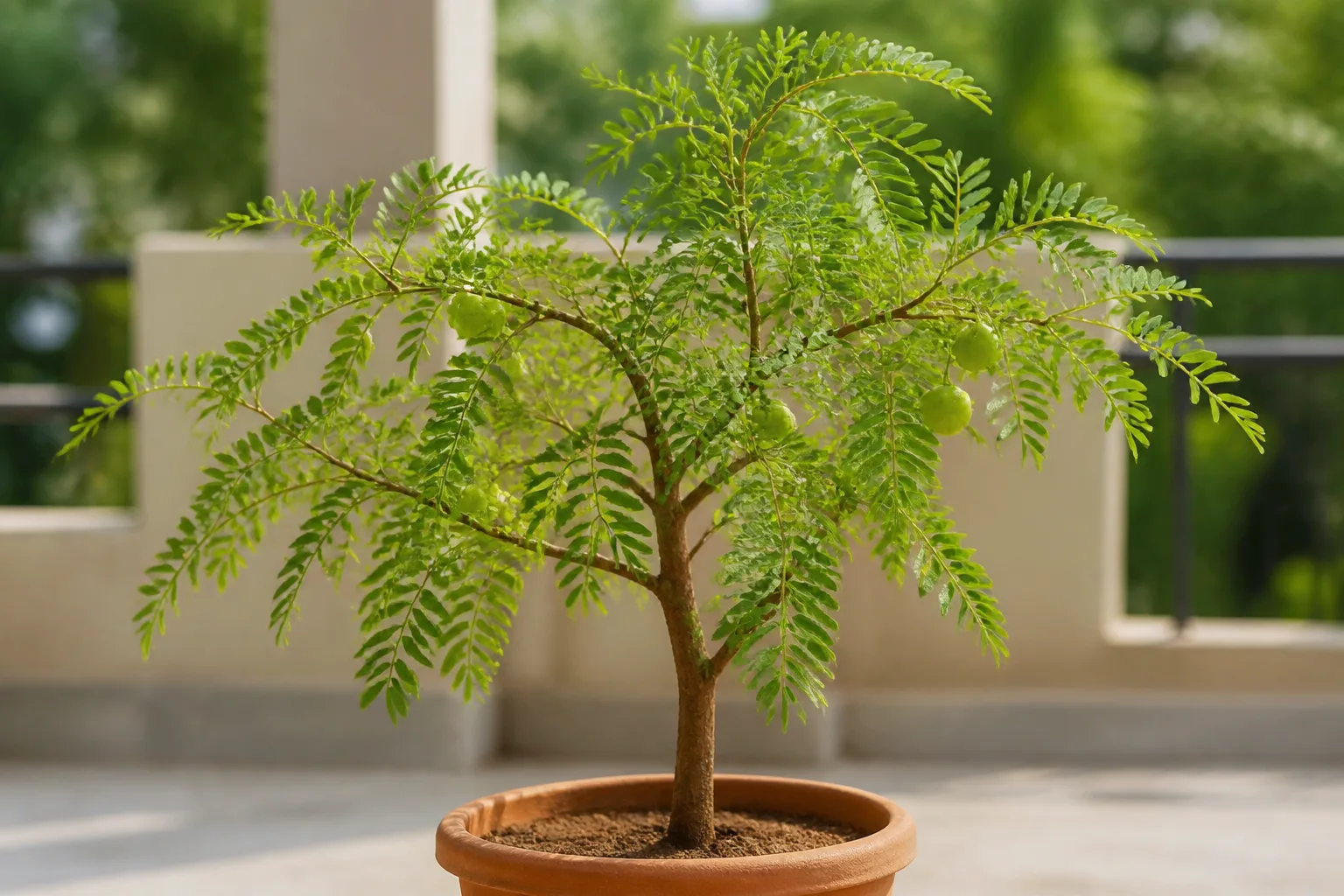
Amla (Phyllanthus emblica) is a sun crop first and a “houseplant” almost never. If you want firm branchlets, dense feathery foliage, and a realistic chance of fruit, treat light as the non-negotiable placement decision—not a detail you fix after fertilizer. Plants For A Future states the species cannot grow in the shade and needs full sun or, at most, part-day shade. That single line explains most sparse terrace trees that “get some light” but never thrive.
This guide covers how many hours of sun Amla needs, where to put pots on Indian balconies and terraces, honest indoor limits, seasonal daylength quirks, and the warning signs that mean move the plant before you change everything else. Pair it with the Amla plant hub for size, soil, and watering context.
How Much Light Amla Actually Needs
Aim for at least 6 hours of direct sun daily on the canopy for vigorous growth, and more whenever the site allows. Orchard and home fruiting both track total daily light more than a brief splash of afternoon brightness. National Horticulture Board guidance frames Aonla as a dry sub-tropical crop that fails under heavy winter frost—not as a deep-shade understory plant.
Useful Tropical Plants echoes the same cultural rule: place Amla in full sun or part-day shade on well-drained soil. “Part-day shade” means morning sun plus bright open sky, or light afternoon filter from a distant building—not a north-facing room, covered courtyard, or pot under a dense tree.
Judge success by new shoots and canopy density, not by whether old leaves remain green. A plant can look “alive” in weak light for months while it stops pushing growth and the mix stays wet far too long. Light and Amla watering are linked: shade slows drying and invites root stress that looks like a water problem.
Full Sun vs Part-Day Shade in Real Homes
Full sun for Amla means the leaves see the sun’s disk for most of the day—open terrace, roof, south or west balcony without heavy overhang, or an unobstructed garden bed. That is the default target for fruiting cultivars.
Part-day shade is a compromise for young plants or extreme midsummer heat on black pots: strong morning sun, then filtered afternoon light, while the plant still receives many hours of high sky brightness. It is not permanent deep shade. If neighboring walls block the sun until late morning and trees cut the afternoon, you are already below the productive range.
In measurable terms for curious growers, full outdoor sun often exceeds several thousand foot-candles at the leaf surface on a clear day. Indoor “bright” rooms people like for reading commonly sit far lower. Amla evolved for open tropical and subtropical sites across Tropical & Subtropical Asia, not dim interior corners.
Why Shade Fails This Fruit Tree
Shade does not merely slow Amla—it changes the whole care equation. Thin crowns are normal enough that plantations need weeding because canopy does not close tightly, but chronic shade makes that thinness worse: longer internodes, fewer fruitful branchlets, and pale foliage. PFAF’s habitat notes point to drier forests, dry open sparse forests, or scrub, not closed rainforest floor.
Weak light also masks drought tolerance. Established Amla handles short dry spells outdoors; in shade, growers often water on a schedule while roots sit cold and wet. Fix placement before you rewrite the watering calendar or reach for fertilizer from the Amla fertilizer guide.
Best Placement for Amla in India and Similar Climates
Match the plant to climate before you match it to décor. Kew places the species primarily in the wet tropical biome across India and much of tropical Asia. NHB’s bankable Aonla model stresses a dry sub-tropical climate without heavy frost. Both point to open, bright sites—not indoor display shelves.
USDA GRIN treats Emblica officinalis as a synonym of this crop plant (taxonomy detail), so nursery tags with either name still need the same sun placement. PFAF lists USDA hardiness zones 10–12: outdoors year-round only where frost is rare or brief, with containers moved under cover when cold snaps threaten.
Terrace, Balcony, and Open Garden Spots
For most Indian homes, the winning spots are open terrace, roof garden, or an unobstructed south- or west-facing balcony. Give the canopy clear sky exposure. Rails and glass balustrades are fine; solid overhangs that cut midday sun are not.
In the ground, plant where competing shade trees will not close over the young Amla. In large containers, keep the pot at the outer edge of the balcony where sun reaches the upper branchlets, not tucked against an interior wall. Rotate the container a quarter turn every few weeks if one side stretches toward the light.
If your only outdoor space is a shaded north balcony, Amla is the wrong crop for fruiting. Grow a true shade ornamental instead, or accept a survival-mode plant with little growth—and adjust watering so the mix does not stay soggy.
Window Direction for Container Trees
When Amla must live near glass (sunroom, enclosed balcony, temporary winter shelter), direction still matters.
South-facing exposures (northern hemisphere) deliver the longest daily light and are the best default for fruiting attempts. Set the pot as close to the glass as heat allows.
West-facing glass adds intense afternoon heat. Useful for light totals, risky for leaf scorch on unacclimated nursery plants. Pull pots a short distance back or use a sheer screen during peak summer heat waves if leaves feel hot to the touch.
East-facing windows give cooler morning sun. They can work for young plants if the rest of the day stays bright and open—less ideal as the only light for a fruiting tree.
North-facing windows rarely supply enough intensity for Amla. Use them only as short-term frost shelter, then return the plant outdoors when nights warm.
Direct Sun, Glass Heat, and Acclimation
Outdoor Amla wants direct sun. Problems arise when a shade-grown nursery plant meets sudden full west or south glass in peak summer. Soft tissue can bleach or crisp even though the species is a sun tree. Move gradually: increase daily direct exposure over 10–14 days, and water deeply when the top few centimeters of mix are dry so heat stress does not stack with drought.
Black plastic pots on hot terraces cook roots even when leaves handle sun. Elevate pots, use light-colored containers, or shade the pot wall—not the canopy—during extreme heat. That is heat management, not a reason to keep Amla in permanent shade.
Do not confuse seasonal deciduous thinning with sunburn. Useful Tropical Plants notes Amla is deciduous and sheds branchlets as well as leaves, yet is seldom entirely bare. Gradual cool-season thinning is expected. Sudden brown patches on the sun-facing side right after a move point to heat or scorch.
Indoor Limits and When Grow Lights Help
Amla is a poor long-term indoor foliage plant. A bright living room that works for snake plant or pothos will not drive productive Amla growth. Indoors, only a true sunroom, greenhouse, or floor-to-ceiling south glass with all-day sun approaches outdoor performance—and even then fruiting is harder without summer outdoor time.
Grow lights can bridge winter shelter periods or deep-shade apartments if you treat them seriously: full-spectrum LED panels close enough to light the whole canopy (often 30–60 cm depending on fixture intensity) for roughly 12–14 hours daily, matching the species’ reported flowering daylength band of about 12–13.5 hours. Ceiling room lights do not count.
Use grow lights as a supplement or temporary bridge—not as a permanent substitute for an outdoor terrace if your goal is fruit. When you move plants outdoors in spring, acclimate again to avoid shock.
Seasonal Light, Daylength, and Leaf Drop
Amla’s flowering physiology is partly daylength-driven. Sources compiled by Useful Tropical Plants note flowers form when daylength sits near 12–13.5 hours. In India that overlaps much of the year, but high-latitude winters with short days and weak sun will not behave like a Deccan terrace.
Expect slower growth and possible leaf thinning in cooler months even with decent sun. That is not an automatic call for more water. Check soil depth first via the Amla watering routine, and protect containers from frost as NHB warns against heavy frost for the crop.
In monsoon periods, cloud cover reduces light totals. You cannot control the sky, but you can avoid adding shade cloth or moving pots under dense cover “to protect” a sun tree that needs every bright hour available.
Warning Signs of Too Little or Harsh Light
Too little light usually shows as sparse, open canopy; long weak shoots; pale new foliage; stalled growth for months; little or no flowering; and soil that stays wet for many days after a normal soak. Fruiting fails quietly. Correct by moving to full sun before changing fertilizer or pot size.
Harsh light or heat stress (especially after a sudden move to west glass) shows as bleached or crisp patches on the sun-facing side, leaf edges browning within days of relocation, and wilting while the mix is still moist. Ease intensity temporarily, improve pot root cooling, then rebuild to full sun over two weeks.
Seasonal leaf and branchlet drop in cool weather, with the plant otherwise firm, is often normal deciduous behavior. Sudden off-season collapse with sour soil points more to wet roots than to a need for brighter light alone—though shade often caused the wetness. Stabilize drainage with the Amla soil guidance, then lock in sun placement.
First Moves Before Fertilizer or Repotting
First action when unsure: move the plant to the brightest safe outdoor spot you have, stop watering until the top 3–5 cm are dry, and wait two weeks before stacking fertilizer, repotting, and hard pruning together. Light fixes are free; a stressed rootball after an unnecessary pot change is not. Once new shoots appear in stronger sun, then consider mix refresh or a light feed.
When to Use This Page vs Other Amla Guides
Use this page when the question is where the plant lives relative to the sun, how many hours it needs, whether indoor light is enough, or how to read sparse canopy and scorch.
Use Amla watering when pots stay wet or dry too fast after you already fixed light. Use Amla soil when drainage fails even in full sun. Use Amla fertilizer only after growth is active in strong light. Use Amla repotting when roots circle or the mix collapses. Use Amla propagation when you want grafted or seedling plants. Use Amla pruning to keep terrace trees sized without stripping a stressed canopy. Start from the Amla overview if you need the full care map first.
Related Amla Guides
- Amla overview — identity, size, and full-care baseline
- Amla watering — deep soaks timed to how fast sun dries the mix
- Amla soil — drainage mixes that keep full-sun pots healthy
- Amla fertilizer — light feeding after placement is right
- Amla repotting — container upsizing without stacking stress
- Amla propagation — grafting and seed timelines
- Amla pruning — structure for terrace-scale trees
- Amla plant hub — profile, grower notes, and cluster entry
Conclusion
Amla light care is simple in principle and unforgiving in practice: give Phyllanthus emblica full sun for most of the day, accept only brief part-day shade as a compromise, and refuse deep indoor corners. Place pots on open terraces and bright balconies, acclimate nursery plants to harsh glass heat, and treat grow lights as a bridge—not a lifestyle. When growth stalls, move toward the sun first; then tune water, soil, and feed. That order is how home growers get dense canopies—and eventually fruit—instead of a polite but stalled ornamental.