Yellow Leaves on Amla: Causes, Checks & Fixes
Quick answer
Yellow leaves on Amla usually mean seasonal deciduous drop on firm wood, chronic wet terrace mix, drought stress, or nutrient lack—not a generic houseplant problem. First step: decide whether the tree is in cool-season rest with thinning canopy on firm branches, or actively flushing with yellowing on wet or dry mix; then match the pattern to watering, light, or a sibling nutrient page before fertilizing.
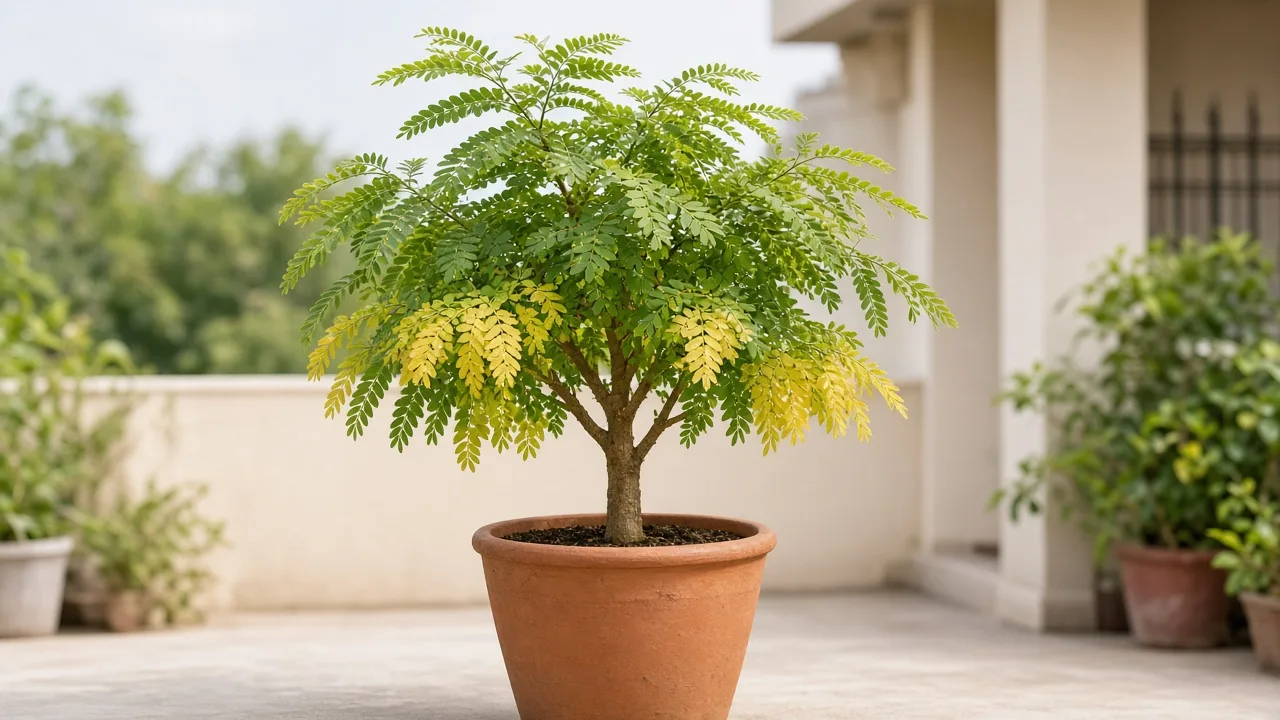
Yellow Leaves on Amla: Causes, Checks & Fixes
This guide covers yellow leaves on Amla. See also the general Yellow Leaves guide, watering, and light pages for this plant.
Yellow Leaves on Amla: Causes, Checks & Fixes
Quick answer
Yellow leaves on Amla (Phyllanthus emblica, Indian gooseberry) are often normal seasonal aging on a deciduous tree that sheds branchlets as well as leaves—but the same feathery yellowing can also signal wet roots, drought, shade stress, or nutrient lack on a terrace pot. Overwatering causes stunted growth with yellowing leaves when roots lose oxygen; Amla is especially vulnerable in closed containers even though it tolerates drought once established outdoors.
See our yellow leaves guide for general chlorophyll loss mechanics. On Amla, read whether yellowing starts on the lowest feathery branchlets, the newest tip cluster, or whole branchlets at once—and whether wood at the soil line stays firm during cool rest or softens on sour wet mix.
First step: confirm season and wood firmness, then check soil moisture at 3–5 cm depth before changing fertilizer, repotting, or pruning.
When to use this page vs other Amla guides
| Pattern | Read next |
|---|---|
| Lowest branchlets yellow uniformly, no green-vein pattern | Nitrogen deficiency |
| Newest tip cluster yellow with dark green veins | Iron deficiency |
| Interveinal yellow on older mid-canopy branchlets | Magnesium deficiency |
| Whole canopy washed-out lime-green, weak shoots | Pale leaves or not enough light |
| Yellow with wet heavy pot, sour smell, out-of-season drop | Overwatering or root rot |
| Limp branchlets, dry pot weight, wilting in heat | Underwatering or wilting |
| Canopy thinning on firm wood in cool dry months | Normal deciduous rest (this page—seasonal section) |
What yellow leaves look like on Amla
Healthy Amla carries feathery compound leaves along slender branchlets—many small leaflets per cluster, not one broad blade like a fiddle-leaf fig. Yellowing can show up in three distinct places, and each points to a different cause.
Typical yellowing patterns:
- Lowest oldest branchlets fade first — uniform pale yellow across the whole feathery cluster before leaflets drop; often normal aging or nitrogen deficiency when it happens during warm active growth
- Whole branchlet clusters yellow at once on several stems — common with chronic wet mix, root rot, or sudden drought after a dry spell
- Newest tip cluster pale with green veins — iron deficiency during warm flush after spring pruning
- Canopy washes lighter green without crisp yellow — weak light on a sun-loving terrace tree; see not enough light
- Scattered yellow with sticky shoots or honeydew — aphids or whiteflies on tender new growth, not a watering issue alone
Not a problem:
- Gradual thinning of lower branchlets on firm wood during cool or dry rest with no active flush at branchlet tips
- One or two yellow lower clusters before March–April pruning when the rest of the canopy looks normal
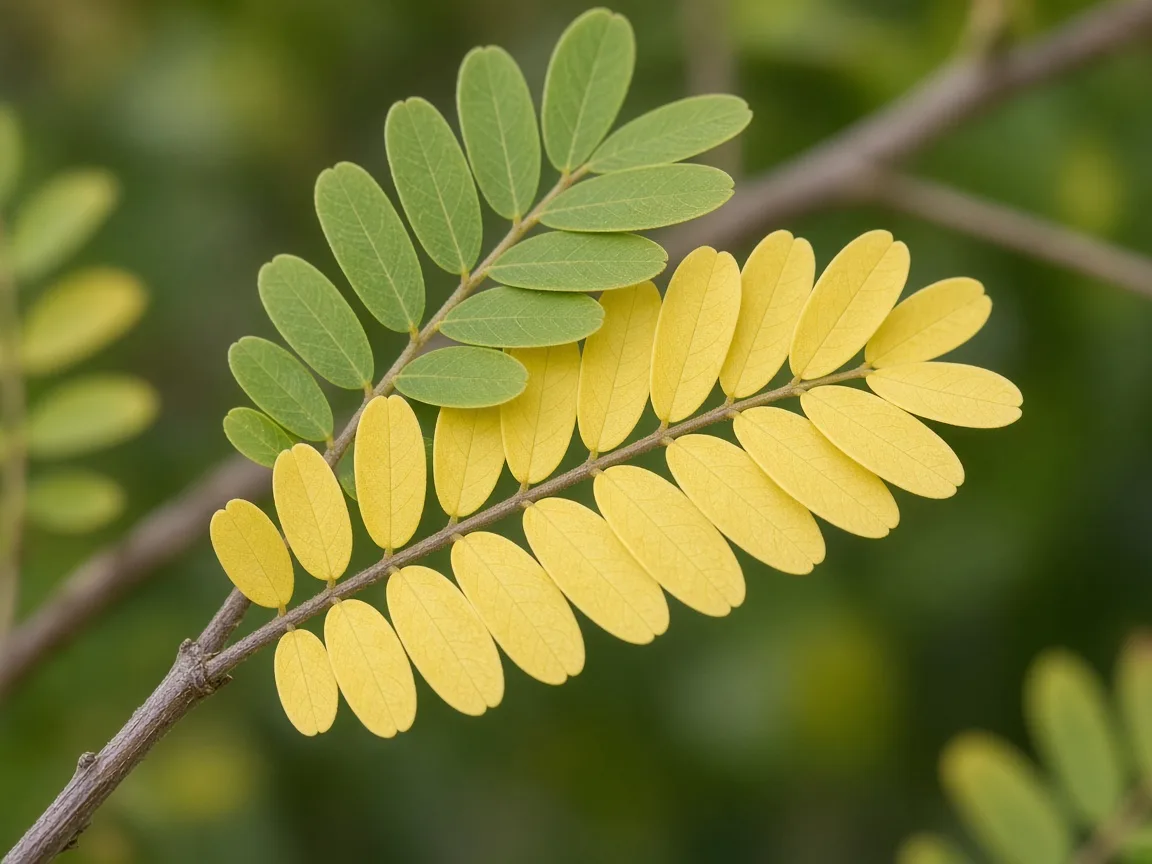
Lower feathery branchlet on Amla: small compound leaflets turning uniform pale yellow while wood above stays firm—often seasonal aging on a deciduous fruit tree, but check soil moisture if drop is off-season.
Seasonal branchlet drop: when yellow leaves are normal on Amla
Amla is deciduous, shedding its branchlets as well as its leaves, though the canopy is seldom entirely bare. Terrace growers often panic when lower feathery clusters yellow and fall in cool dry months—but on firm trunk and branches with no sour soil smell, that pattern is frequently normal rest, not root failure.
The diagnostic split:
- Seasonal rest — canopy thins from the bottom up, wood stays firm, cool or dry weather slows growth, no expanding feathery tips at branchlet ends. Hold fertilizer and heavy pruning until warm flush returns per watering guidance.
- Pathological yellowing — yellow spreads during warm active growth, soil stays wet or swings from bone-dry to saturated, wood softens, or new shoots emerge pale and weak despite six or more hours of sun.
TNAU notes no irrigation is required during rainy and winter season for established orchard trees; container growers should still check dry-down rather than stopping water entirely on a young pot that dries fast in terrace heat.
Feathery branchlet pattern: read yellowing by position on the stem
Unlike a snake plant where yellow means one rosette failing, Amla yellowing is read by branchlet age and position along each slender stem—a pattern meaningless on broad-leaf houseplants.
Work through this ladder on each affected branch:
- Lowest branchlet on the stem yellows uniformly, then drops — aging before seasonal rest, or nitrogen deficiency if it happens on multiple stems during warm flush
- Mid-canopy branchlets show interveinal yellow between veins on older tissue — magnesium deficiency
- Branchlet tip cluster still opening shows green-vein yellowing — iron deficiency during active growth
- Entire branchlet from base to tip yellows together — moisture stress (too wet or too dry), root damage, or pest drain on that shoot
Because Amla pushes flush growth in bursts after spring pruning and manuring and again around monsoon release from summer dormancy, compare two branchlets on the same stem—one lower, one at the tip—before treating.
Terrace pots: why Amla yellows faster in containers
Open-ground Amla is a hardy subtropical tree tolerant of dry heat and poor soils in pH 6.0 to 8.0. A terrace container concentrates every mistake:
- Chronic wet saucers — Amla fails in soggy mix; roots in waterlogged soil cannot absorb oxygen, and yellow branchlets follow within one or two watering cycles
- Calendar watering in monsoon — outdoor rain plus hand watering keeps mix saturated; TNAU recommends no irrigation during rainy season for field trees—terrace pots still need drainage checks, not automatic daily soaks
- Deep summer drought between soaks — established trees tolerate short dry spells, but a young grafted pot in six or more hours of sun can yellow whole branchlets if the top 3–5 cm stays dry too long during active flush
- Weak light in a corner — Amla is not a shade houseplant; washed-out yellow-green canopy with long weak shoots means move to full sun before feeding
Check whether watering rhythm matches finger-test dry-down at 3–5 cm depth. Firm wood on appropriate dry-down with only lower branchlet yellowing often means seasonal aging—not emergency repotting.
Why Amla gets yellow leaves
Most common causes on home terrace trees:
- Seasonal deciduous aging — lower feathery branchlets yellow and shed before cool rest; firm wood, no sour soil
- Overwatering and poor drainage — yellowing leaves are a classic overwatering symptom; Amla requires excellent drainage and fails in waterlogged pots
- Underwatering during hot flush — whole branchlets crisp or yellow after the pot dries hard between infrequent deep soaks in peak summer
- Nitrogen lack — oldest lowest branchlets pale first during warm growth, especially after skipped post-pruning feed
- Iron or magnesium chlorosis — distinct vein patterns on new or mid-canopy branchlets; see sibling pages above
- Insufficient light — entire canopy pale yellow-green, internodes stretch; common when Amla is kept indoors or shaded by a wall
- Pest drain on new shoots — aphids and mealybugs on tender flush cause spotty yellowing with stickiness, not uniform branchlet fade
- Repotting or relocation shock — temporary yellow drop one to two weeks after moving a sunny terrace pot to dim shade or repotting into wet heavy mix
Do not assume every yellow leaflet needs fertilizer—confirm wood firmness, season, and soil moisture first.
Lookalike symptoms
| Pattern | Check | Likely cause |
|---|---|---|
| Lowest branchlets yellow first, uniform | Branchlet position on stem | Seasonal aging or nitrogen deficiency |
| New tip yellow, green veins | Newest feathery cluster | Iron deficiency |
| Interveinal yellow on older mid-branchlets | Branchlet age | Magnesium deficiency |
| All yellow, wet soil, sour smell | Root-zone smell | Overwatering or root rot |
| Whole branchlet yellow, pot very light | Pot weight and soil depth | Underwatering |
| Washed-out canopy, weak long shoots | Hours of direct sun | Not enough light |
| Thinning canopy, firm wood, cool months | Season and growth stage | Normal deciduous rest |
| Sticky shoots, curled tips | Undersides of new growth | Aphids or whiteflies |
How to confirm the cause
Work through these checks in order. Amla responds on a seasonal pruning and monsoon rhythm; one change at a time makes the next branchlet flush easier to read over two to four weeks.
- Season and wood firmness — cool rest with firm trunk at soil line? Often normal. Warm flush with soft wood? Root or moisture problem.
- Soil moisture at 3–5 cm — wet and heavy with sour smell? Stop watering and check overwatering. Bone dry and light pot? Soak once, then reset rhythm per watering guide.
- Branchlet position — lowest first (nitrogen or aging), tips with green veins (iron), whole branchlet at once (moisture or pests).
- Light exposure — confirm six or more hours of direct sun during active growth per light guide.
- New growth direction — next branchlet flush greener and firmer? Recovery underway. Successive flushes paler? Nutrient or pH issue—see fertilizer guide.
- Pest signs — honeydew, white fluff, or distorted young shoots before assuming nutrient lack.
- Recent changes — repotting, move to shade, or doubled watering after monsoon rain often explain sudden yellowing without disease.
The first fix to try
Press the trunk at soil line. If wood is firm, check whether the tree is in seasonal rest—if yes, hold fertilizer and match reduced watering to cool weather. If wood is firm but yellowing spreads during warm active flush, stick your finger 3–5 cm into the mix: water only when dry at that depth, never leave the pot in a full saucer, and wait two weeks before feeding.
That single moisture correction fixes more terrace Amla yellowing than any fertilizer. Soil that has been too long without oxygen usually smells sour—if you smell it, skip feeding and address drainage before anything else.
Only after dry-down is stable and wood stays firm should you route to a sibling page: iron for green-vein tip chlorosis, nitrogen for lowest-branchlet uniform pale during flush, or pest treatment for sticky new shoots.
Step-by-step recovery
- Classify the pattern — seasonal rest, moisture stress, nutrient lack, light, or pest using the table above.
- Correct watering first — dry at 3–5 cm before soaking; empty saucers; reduce frequency in cool months and during heavy rain.
- Confirm light — move to the sunniest terrace spot with six or more hours of direct sun if the canopy is washed out and leggy.
- Rule out pests — inspect new shoot tips and leaflet undersides; treat aphids or mealybugs if honeydew or colonies are present.
- Feed only on firm roots during warm flush — light complete fertilizer with micronutrients per fertilizer guide after post-pruning manuring timing, not on a resting canopy.
- Repot if needed — fresh well-draining loam mix only when roots are compacted, mix smells sour despite corrected watering, or root rot is confirmed—not as a first response to a few yellow lower branchlets in winter.
Recovery timeline
Amla flush growth is seasonal—not year-round houseplant growth. Expect two to four weeks after corrected watering before the next branchlet cluster opens with normal colour. A full growing season may pass before the canopy looks full again after severe root rot or a bad repotting.
Signs of improvement: new feathery branchlet tips emerge green, wood stays firm, off-season drop stops, pot weight and dry-down become predictable.
Signs the problem is worsening: stems soften at the base, yellowing climbs the canopy during warm growth, sour smell persists, or successive new flushes stay pale despite sun and appropriate watering.
Yellowed leaflets that have already dropped do not reattach—judge recovery by new branchlet flush, not old tissue colour.
Mistakes to avoid
- Fertilizing a resting or waterlogged tree — nutrients on sour wet roots add salt stress without fixing yellowing.
- Treating seasonal drop as root rot — firm wood and cool weather thinning is normal; avoid unnecessary repotting.
- Assuming iron for every yellow tip — one pale lower cluster before seasonal drop is aging; green-vein pattern on active tips is iron.
- Keeping Amla indoors for winter — weak light yellows the whole canopy; protect from frost outdoors, do not move to a dim room.
- Daily watering through monsoon — saturated mix yellows whole branchlets; let rain count toward moisture and check drainage.
- Stacking repot, prune, and feed on one day — Amla needs one variable change at a time to read the response.
Prevention
- Water when the top 3–5 cm of soil is dry, roughly every 5–10 days in warm weather and less in cool months—never by calendar alone.
- Grow in full sun on a terrace with well-draining sandy loam mix; excellent drainage is essential.
- Manure after spring pruning with complete micronutrients during warm active flush per fertilizer guide.
- Empty saucers after watering; improve drainage holes before monsoon.
- Expect some lower branchlet yellowing before seasonal drop—do not chase it with fertilizer in cool rest.
- Repot young trees every one to two years before roots circle and mix collapses.
Related Amla guides
- Overview
- Problems hub
- Watering
- Soil
- Light
- Fertilizer
- Overwatering
- Root rot
- Iron deficiency
- Nitrogen deficiency
Scope note: Use this page as the multi-cause entry when feathery branchlets yellow and you need to separate seasonal rest from moisture, light, nutrient, or pest causes. Jump to iron deficiency for green-vein tip chlorosis, overwatering for wet sour mix with out-of-season drop, and not enough light for a washed-out leggy canopy.
Related tool
Use the Yellow Leaves Diagnosis Tool to narrow causes for yellow leaves on this plant before changing multiple variables at once.