Brown Tips on Amla: Causes, Checks & Fixes
Quick answer
Brown tips on amla are usually dry, crispy margins on the tiny leaflets of feathery compound leaves—not broad houseplant blade burn. On a terrace fruit tree, the top causes are missed summer watering, salt or fertilizer buildup in a container, harsh sun after a shade nursery move, or normal browning on leaflets about to drop in late-winter rest. First step: press your finger into the top 3–5 cm of mix and lift the pot—if the soil is dust-dry and the container feels light, deep-soak at soil level before changing anything else.
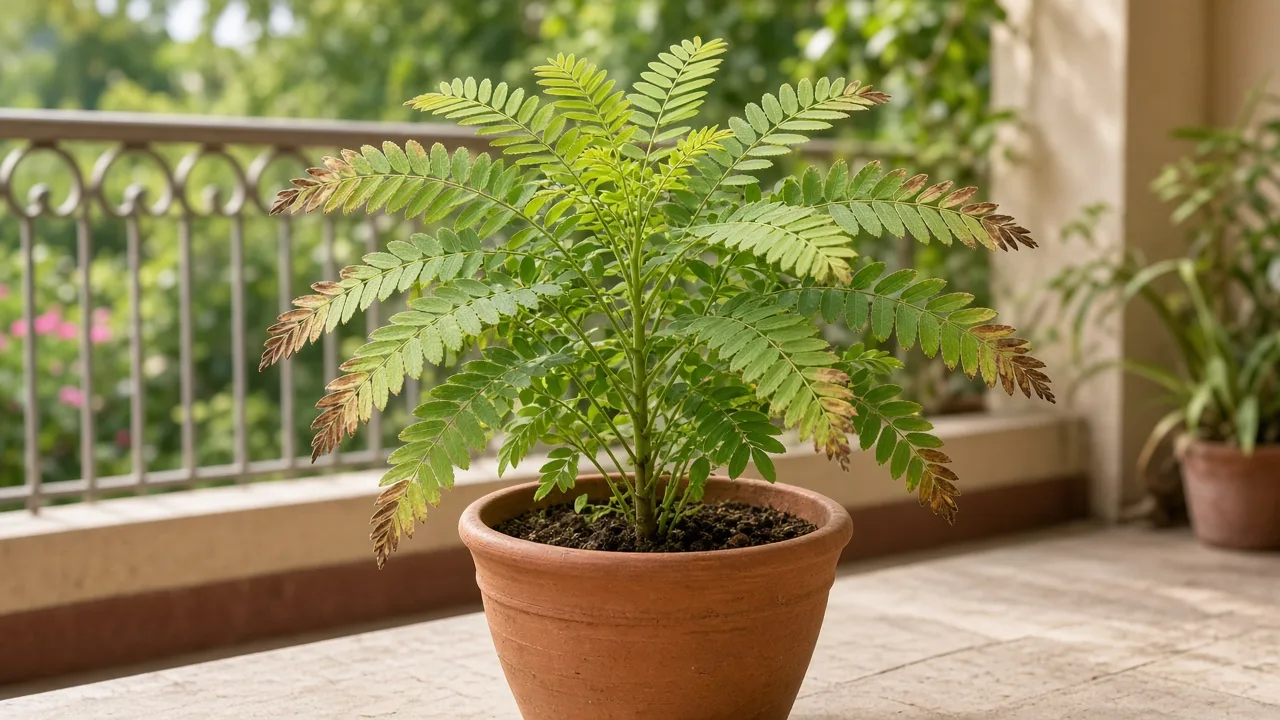
Brown Tips on Amla: Causes, Checks & Fixes
This guide covers brown tips on Amla. See also the general Brown Tips guide, watering, and light pages for this plant.
Brown Tips on Amla: Causes, Checks & Fixes
Quick answer
Brown tips on amla (Phyllanthus emblica, Indian gooseberry) are dry, tan-to-brown crispy margins on individual tiny leaflets along feathery pinnate branchlets—not the broad single-blade tip burn common on dracaena or spider plant. On this sun-loving deciduous fruit tree, the pattern usually splits five ways: dust-dry mix and a light terrace pot after a hot week point to underwatering, white crust on soil with brown leaflet edges tracks salt or heavy feed, outer branchlet tips crisp while inner leaflets stay green follows harsh terrace sun or a recent move from shade nursery stock, papery tips on a newly grafted sapling may be normal transplant stress for the first two months, and fixed dry tips on lowest leaflets before winter rest can precede normal deciduous drop. For how tip necrosis works in general, see our brown tips hub. On amla, each compound leaf carries dozens of narrow 2–4 cm leaflets, so the farthest leaflet point dries first when roots cannot keep up—often while the branchlet still looks green from across the terrace.
A few dry tips on one lower branchlet in late winter are cosmetic. Spreading crisp margins on new March flush leaflets, or wilting branchlets with a heavy wet pot, need action the same week—not extra fertilizer.
First step: press your finger into the top 3–5 cm of mix and lift the pot. If the soil is dust-dry and the container feels light, deep-soak at soil level until water runs from drainage holes—do not mist the feathery canopy. If the pot stays heavy and smells sour, route to overwatering or root rot before treating “dry tips.”
When to use this page vs other Amla guides
| Your question | Best page |
|---|---|
| Dry tan crispy margins on tiny leaflets only | This page |
| Whole leaflets or full branchlets turning brown | Brown leaves |
| Uniform yellowing, older leaflets first | Yellow leaves |
| Pot stays wet, sour smell, wilt on wet mix | Overwatering |
| Dust-dry mix, light pot, wilt in afternoon heat | Underwatering |
| Angular spots with borders, not just dry tips | Black spots |
What brown tips look like on Amla
Healthy amla carries feathery pinnate leaves on green branchlets—many small narrow leaflets per stem, not one broad blade. Brown tip damage breaks that pattern in recognizable ways:
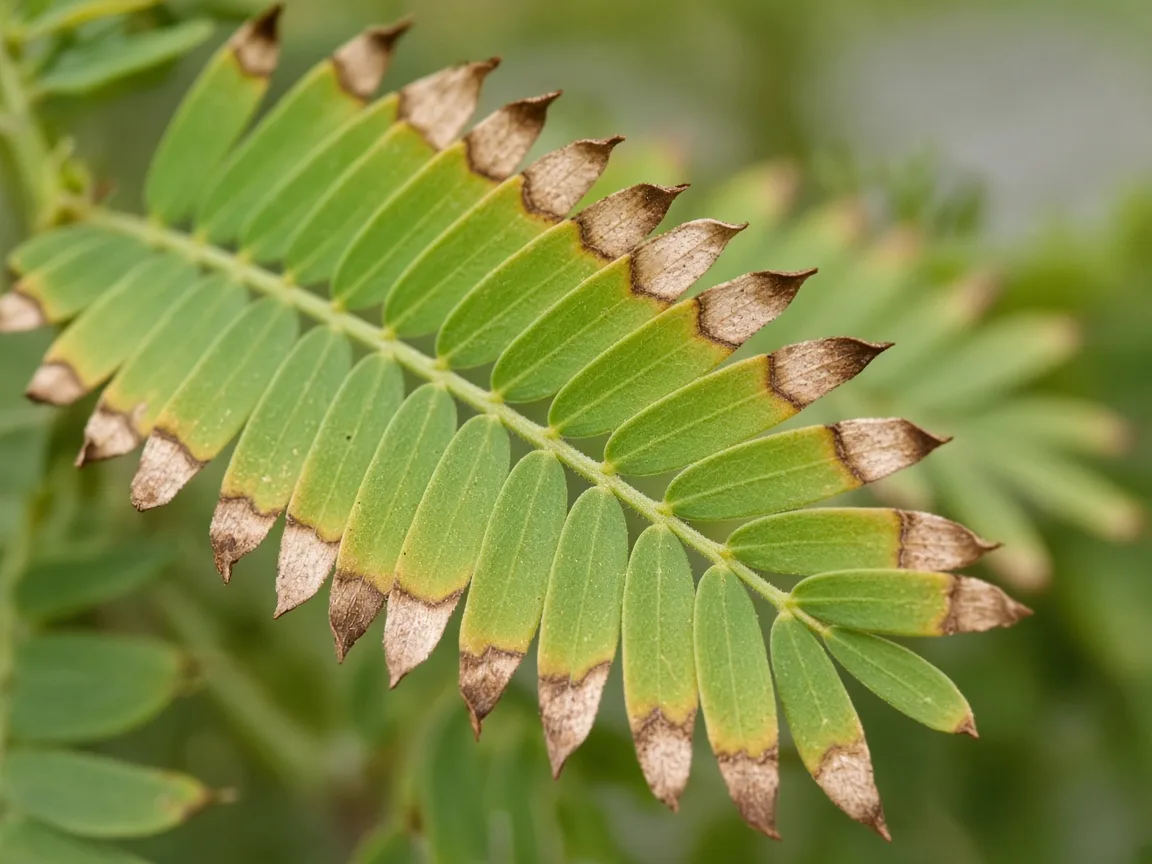
Dry tan margins on individual amla leaflets at the distal tip—compare crispy drought tips with soft dark edges from wet-root stress.
- Dry tan-to-brown crispy tips on individual leaflets — Tissue is papery and breaks when rubbed; the rest of the leaflet may stay light green. Common on outer branchlets after missed summer watering on a terrace pot.
- Brown tips spreading along one side of a branchlet — Often tracks afternoon sun on a south-facing railing while the shaded side stays clean—sun scorch on full-sun specimens, not disease.
- Tips brown with white mineral crust on soil surface — Salt or fertilizer buildup in a container; edges may look burnt while new flush is pale.
- Papery brown tips on a newly planted graft — Transplant stress on grafted saplings can show pale papery leaflet margins for 8–10 weeks without a watering crisis.
- Dry tips only on lowest ageing leaflets — May precede normal winter leaflet drop on a briefly deciduous tree—not a care emergency if March flush is still clean.
- Soft dark leaflet tips with yellow halos on wet mix — Less typical for simple tip burn; compare with black spots or overwatering.
Tips on new spring flush leaflets are more urgent than a few dry margins on leaflets about to drop during winter rest.
Why tiny amla leaflets brown at the tips before whole branchlets wilt
Amla is a slow-growing deciduous fruit tree with compound leaves made of many small leaflets—narrow and oblong, roughly 2–4 cm each—not one large transpiring blade. Each leaflet loses moisture from its farthest edge first. That is why growers see tip burn while the branchlet still looks fine from a distance, especially on a hot terrace where PFAF notes the species tolerates drought once established but young container trees cannot coast through a missed week the way an in-ground orchard tree might.
RHS guidance on brown leaf tips ties margins to under-watering or dry atmosphere more often than over-watering. Amla is not a humidity-craving calathea—missed deep soaks in 35°C terrace heat beat low humidity as the usual culprit on Indian balconies.
Terrace dry-down timing for a sun-loving fruit tree
Amla needs 6+ hours of direct sun on a terrace or south-facing spot. Full sun dries the top 3–5 cm of well-draining sandy loam faster than growers expect—especially in a dark nursery pot that heats up on concrete.
Use the finger test at 3–5 cm depth, not a calendar:
- Young grafted saplings and first-year terrace pots — Keep evenly moist through active growth; do not let the pot go bone-dry in flowering or early fruit set. Balcony Garden Web recommends watering when topsoil feels dry to the touch on young trees.
- Established large containers — Water deeply when the top layer is dry, then let the surface dry before the next soak—shallow daily sprinkles cause tip stress without recharging roots.
- Cool winter months — Reduce frequency per the watering guide; brown tips from drought are less common than senescence on ageing leaflets.
If tips crisp right after you moved the pot to the sunniest corner, suspect sun hardening before you increase watering—harden grafted stock gradually over two weeks.
March flush vs winter senescence: when brown tips are normal
Amla is deciduous in much of India. In late winter (often January–February), lowest branchlets may show dry fixed tips on leaflets about to drop while the tree looks thinner overall. That is senescence—not the same as drought burn on new growth.
| Timing | Pattern | Action |
|---|---|---|
| Late winter, uniform thinning | Dry tips on lowest leaflets, no wilt | Wait for March flush; do not fertilize |
| March–April new branchlets | Clean light-green leaflets | Baseline for judging future tip burn |
| May–June heat | Outer branchlet tips crisp, pot light | Deep soak; check underwatering |
| Post-monsoon | Tips plus angular spots | Route to black spots, not this page |
Why Amla gets brown tips
Summer drought on terrace containers
The most common cause on home terraces: several hot dry days without a deep soak while the tree fruits or flushes. Outer branchlets in afternoon sun show tip burn first. Plants Info notes wilting and yellowing from water stress are easily confused with other problems—check pot weight before assuming disease.
Salt and fertilizer buildup in pots
White crust on mix surface plus brown leaflet margins often tracks mineral salts or heavy nitrogen feed on a stressed tree. RHS links brown tips to root-zone checks—flush the pot before adding more fertilizer.
Sun scorch after shade nursery culture
Sudden exposure to harsh terrace sun can crisp outer leaflet tips dry and tan while inner canopy stays green. Common when a nursery-grown sapling moves to a railing with no acclimation—distinct from drought if the pot is still moist and heavy.
Transplant stress on grafted saplings
Grafted amla saplings are sensitive for 8–10 weeks after planting. Pale papery leaflet tips and slow growth in that window are normal—over-feeding to “push growth” burns young roots and extends the stress period.
Root stress from chronic wet mix
Paradoxically, soggy anaerobic roots also fail to hydrate leaflet tips. If the pot stays heavy, smells sour, and tips brown while branchlets wilt, route to overwatering or root rot—deep soaking will make this worse.
Low humidity alone (less common outdoors)
Amla tolerates moderate humidity (40–60%) on a windy terrace. Enclosed glass balconies with stagnant air can still dry leaflet tips when watering is already inconsistent—rare compared to missed soaks outdoors.
How to confirm the cause
Work through these checks before repotting or feeding:
- Finger test at 3–5 cm — Dust-dry = drought likely. Wet and cold = root stress likely.
- Pot weight — Light pot plus crisp tips = underwatering. Heavy pot plus wilt = overwatering overlap.
- Location on branchlet — Outer sun-facing tips only = scorch or drought. Random tips on new flush = salts or root issue.
- Soil surface — White crust = flush before fertilizing.
- Season — Late-winter lowest leaflets only = senescence. May–June outer tips = heat drought.
- Plant age — New graft within two months = include transplant stress.
- New flush condition — Clean March leaflets with tips on old wood only = lower urgency.
The first fix to try
Press your finger into the top 3–5 cm of mix and lift the pot.
If the soil is dust-dry and the container feels light, water deeply at soil level until water runs from drainage holes—empty any saucer after 30 minutes. Hold fertilizer and pruning for two weeks. Do not mist the feathery canopy; that wets leaflets without recharging roots.
If the pot is heavy, wet, and sour-smelling, stop watering and inspect drainage before any soak—see overwatering.
If the pot is moist but only outer sun-facing tips are crisp, shade the pot for morning-only sun for one week while you harden it back to full terrace placement.
Step-by-step recovery
For drought tip burn
- Deep-soak at soil level when the top 3–5 cm are dry.
- Empty standing water from saucers—monsoon cachepots trap wet roots.
- Mulch the pot surface lightly with compost to slow surface evaporation—not against the trunk.
- Re-check outer branchlets after 48 hours; tips will stay brown but new growth should stay clean.
- Trim fully dry leaflet tips only if cosmetic—optional.
For salt or fertilizer burn
- Stop all feed until new flush looks healthy for two weeks.
- Flush the pot with clean water at 2–3× pot volume; let it drain fully.
- Resume sparing fertilizer only after tips stop appearing on new leaflets.
- Switch to rain or filtered water if hard tap water leaves heavy crust repeatedly.
For sun scorch
- Move to morning sun plus afternoon light shade for 7–10 days.
- Increase exposure gradually back to full sun—two hours more every few days.
- Keep watering on dry-down rhythm; scorch is not fixed by over-watering.
For transplant stress
- Hold fertilizer for the first month after planting per Plants Info guidance.
- Keep soil evenly moist—not soggy—for young grafts through the first summer.
- Avoid repotting, hard pruning, and feed in the same fortnight.
For overwatering-related tip stress
- Stop watering until the top half of the pot dries noticeably.
- Confirm open drainage holes and no trapped monsoon runoff.
- Move to the sunniest outdoor spot the tree tolerates—slow drying in shade worsens wet mix.
- If branchlets wilt while soil stays wet, inspect roots for root rot.
Recovery timeline
| Severity | What to expect |
|---|---|
| One missed soak, light pot | Tips stay tan; new leaflets clean within 1–2 weeks after rhythm fixes |
| Salt crust, first flush after flush | New tips stop within 2–3 weeks; old margins stay brown |
| Sun scorch on outer branchlets | No regreen; new flush clean after hardening within 2–4 weeks |
| Transplant papery tips | Gradual improvement over 6–10 weeks with steady moisture |
| Root rot overlap | Weeks to months; tips are a late clue—fix roots first |
Judge recovery by clean new branchlet leaflets—not by old tan tips turning green.
Lookalike symptoms
| What you see | Likely cause | Check |
|---|---|---|
| Crispy dry tips, light pot | Drought | Underwatering |
| Tips plus wilt, heavy wet pot | Root stress | Overwatering |
| Outer tips only, moist soil | Sun scorch | Recent move to harsh sun |
| White soil crust | Salt burn | Flush pot |
| Papery tips, new graft | Transplant stress | Weeks since planting |
| Dry tips on lowest leaflets, winter | Senescence | Deciduous habit |
| Angular spots with borders | Leaf spot | Black spots |
Mistakes to avoid
- Misting feathery leaflets instead of soaking roots—canopy moisture does not fix terrace drought and can worsen fungal issues on crowded branchlets.
- Fertilizing a stressed tree because tips look “nutrient deficient”—feed only after new flush is clean per the fertilizer guide.
- Panicking during winter leaflet drop when only lowest leaflets show dry tips without spots—confirm season before treating dormancy as drought.
- Deep soaking a heavy sour pot—tips from root failure need drying and drainage, not more water.
- Stacking repotting, hard pruning, and feed on the same week on a young graft—fix one variable first.
How to prevent brown tips next time
- Water deeply when the top 3–5 cm of mix are dry per the watering guide.
- Keep terrace pots in full sun with open drainage—never standing in monsoon saucer water.
- Flush container mix twice a year if white salt crust appears.
- Harden nursery saplings into full sun gradually over two weeks.
- Inspect outer branchlets weekly in May–June heat—the highest drought window on Indian terraces.
Related Amla guides
- Amla overview — Species profile, sun placement, and fruit-tree baseline.
- Problems hub — All amla issue pages in one place.
- Underwatering — When crisp tips track a light dry pot in summer heat.
- Watering — Top 3–5 cm dry-down and seasonal reduction.
- Light — Full-sun terrace placement and acclimation after nursery shade.
Use the Plant Problem Diagnosis Tool to narrow causes for brown tips on this plant before changing multiple variables at once.