Root Rot on Amla: Wet-Pot Rescue for Indian Gooseberry
Quick answer
Root rot on Amla starts in waterlogged sandy loam while feathery compound leaves still look partly green—then yellowing spreads and branchlets fail on a heavy wet pot. First step: stop all watering and push a finger 3–5 cm into the mix; if it is cool and clings while the pot smells sour, unpot the same day.
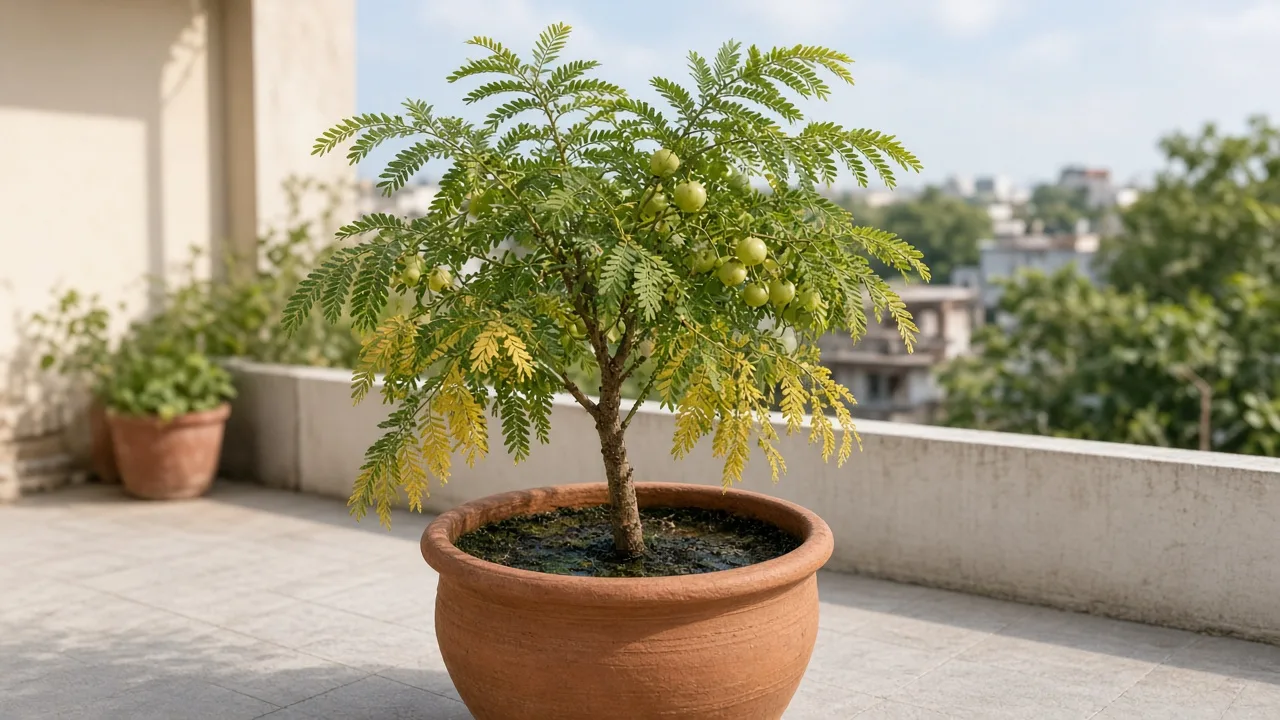
Root Rot on Amla: Causes, Checks & Fixes
This guide covers root rot on Amla. See also the general Root Rot guide, watering, and light pages for this plant.
Root Rot on Amla: Causes, Checks & Fixes
Quick answer
Root rot on Phyllanthus emblica (Amla, Indian gooseberry, Aonla) is root-crown failure from chronic wet mix—not a leaf spot disease you can spray away. This deciduous fruit tree prefers well-drained soil, tolerates drought once established, and stores less forgiveness in a small terrace pot than in deep orchard soil. When mix stays saturated, roots lose oxygen and die; decay then shows up as yellow feathery compound leaves, failing fine branchlets, and sour-smelling soil long before the trunk looks obviously sick.
For how chronic wet soil destroys roots in general, see our root rot guide. On Amla, the tell is a heavy wet pot after days without drying, yellowing on damp mix, premature fruit or flower drop, and mushy brown roots when you unpot—while normal winter leaf drop on dry soil is a separate seasonal pattern.
First step: stop all watering immediately. Then finger-test 3–5 cm deep. Cool, clinging soil on a heavy pot with a sour smell means unpot and inspect roots the same day—do not add water, fertilizer, or fungicide first.
When to use this page vs other Amla guides
| Pattern | Read next |
|---|---|
| Heavy wet pot, yellow leaves, firm trunk base | Overwatering — dry-down pause may be enough |
| Soft base + wet soil + mushy roots (this page) | Stay here for unpotting and salvage |
| Light dry pot, wilted tips, firm roots | Underwatering |
| Yellow leaves only, mix drying normally | Yellow leaves — nutrient or light cross-check |
| Whole branchlets limp on wet soil | Advanced rot—start surgery below |
| Fungus gnats + surface mold only | Fungus gnats or mold on soil — moisture alarm, not always crown rot yet |
What root rot looks like on Amla
Unlike compact houseplants, Amla carries fine feathery compound leaves on slender branchlets attached to a woody trunk. Root rot hides underground while upper foliage still looks partly green. The small leaflets yellow and drop from the lowest branchlets first—then rot climbs from mushy roots toward the trunk base.
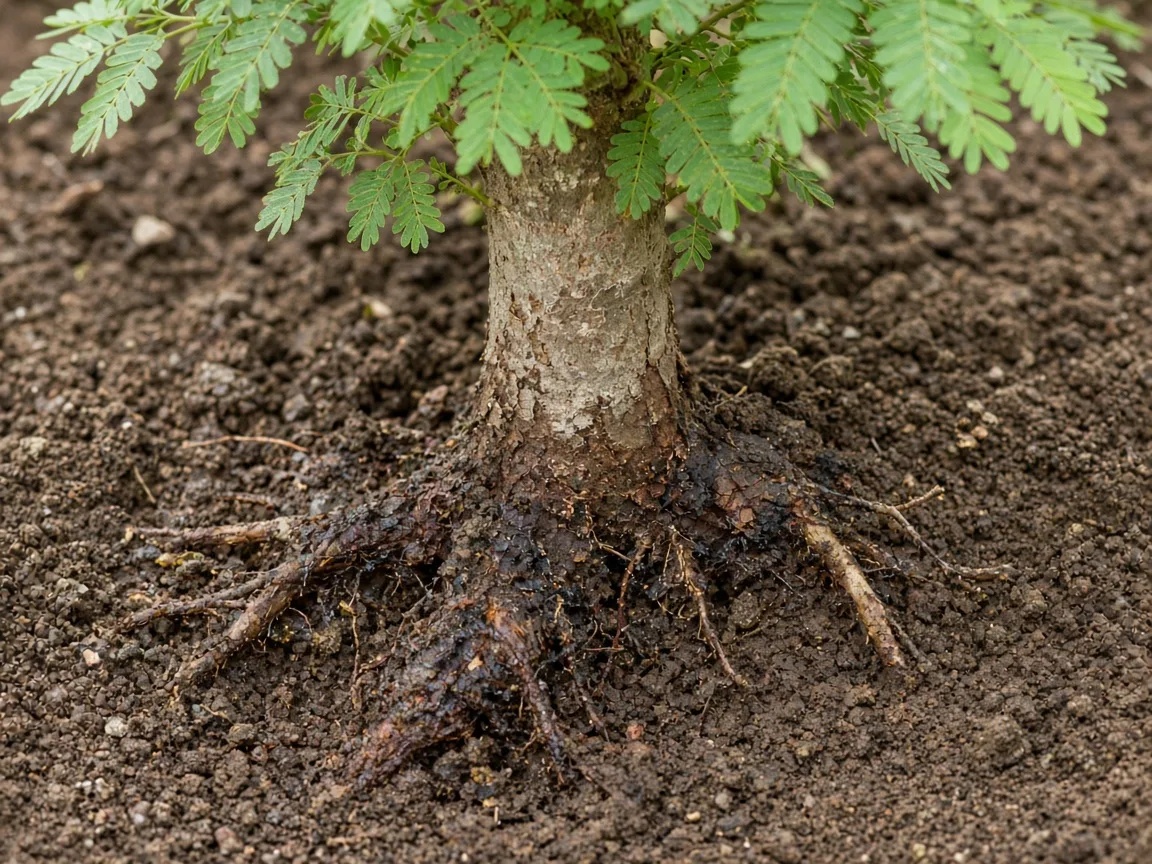
Root rot at the soil line—brown mushy roots and sour wet loam clinging to the trunk base while feathery leaflets above still show early yellowing.
Early signs (roots failing, canopy still partly green)
- Heavy pot days or weeks after watering; mix never fully dries at 3–5 cm depth
- Sour or swampy smell from drainage holes or when you tilt the pot
- Yellow feathery leaflets dropping from lower branchlets on damp mix—not the clean seasonal shed of dry winter soil
- Stalled new shoots along branch tips for weeks despite wet soil
- Premature fruit or flower abort when roots cannot support developing fruit
- Fungus gnats hovering over persistently wet surface mix
- Unpotting reveals brown, mushy, or translucent roots while the trunk base still feels mostly firm
Advanced signs (rot climbing the trunk)
- Mushy, hollow, or black tissue at the trunk base or main root flare
- Wilt paradox—limp branchlets and drooping wilting foliage despite wet soil because damaged roots cannot move water
- Mass yellowing spreading up branchlets while mix stays damp
- Soft bark near the soil line with no firm wood underneath
- Black decay visible on main roots; fine feeder roots slip off as brown string
Seasonal deciduous drop is not automatically root rot. Amla is a slow-growing deciduous tree that naturally sheds leaves in cooler months. Root rot adds wet mix + sour smell + yellowing on damp soil + mushy roots to that picture. Dry soil, firm roots, and orderly leaf fall without a swampy odor usually mean normal rest—not surgery.
Flowering-window watering trap (orchard vs terrace pot)
This plant-only section does not apply to pothos or snake plants. Indian aonla orchards follow a deliberate irrigation pause during flowering:
National Horticulture Board guidance states that irrigation is not provided during the flowering period, mid-March to April, with dry-summer intervals of about 15–20 days when irrigation is used. Field trees in deep soil can survive that rhythm.
Terrace pots break the same logic. A 30–40 cm container in full sun dries faster than an orchard basin—but monsoon rain, cachepots, or daily sympathy watering during flowering still floods the root zone. Home growers often interpret wilting branchlets during the flowering pause as thirst and keep soaking, which is one of the fastest paths to root rot on container Amla. Match your rhythm to finger depth at 3–5 cm, not to orchard calendar alone. Full context is in the Amla watering guide.
Branchlet and trunk-base triage
Before unpotting, map what is failing on this tree-shaped plant:
- Start at the lowest branchlets — yellowing that climbs from the soil line upward on wet mix points to root failure, not upper pest damage alone.
- Press the trunk base just above soil with a gloved finger — soft or spongy bark on wet mix confirms rot has left the root zone.
- Compare pot weight to your dry baseline — a half-rotted root ball still feels heavy while individual branchlets look only mildly unhappy.
- Sniff at the drainage holes — sour odor localizes anaerobic decay even when upper leaves still look green.
- Check graft union if present — rotting below the union may still leave a firm scion briefly; inspect both rootstock roots and the lower trunk.
Always trust root firmness and soil smell over how green the upper feathery canopy looks. Amla can carry a full crown while the base is already failing in a closed saucer.
Why Amla gets root rot
Phyllanthus emblica evolved across tropical and southern Asia on well-drained soils and tolerates drought better than chronic waterlogging. It cannot grow in shade and needs full sun—weak light slows water use and keeps mix wet longer. Root rot happens when roots sit in saturated, low-oxygen loam until tissue breaks down.
Calendar watering on a fruit tree. Watering every few days because “it is summer” ignores how fast your specific pot dries. See the watering guide for the 3–5 cm finger-test rhythm.
Monsoon and cachepot flooding. Continuous rain plus a closed saucer keeps terrace pots anaerobic for days. Empty standing water and move pots under partial shelter if mix stays wet through a wet week.
Heavy clay or peat-heavy mix in a decorative pot. Amla needs deep, well-draining sandy loam or loam with coarse sand or perlite—see the soil guide. Dense indoor blend in a glazed cachepot stays damp far longer than orchard loam.
Winter overwatering during slow growth. Cool months stretch dry-down intervals to 10–14 days or longer. A summer schedule in a cool room keeps roots wet while uptake has dropped.
Escalation from overwatering. Mild chronic wet mix often shows up first as overwatering—yellow leaves and a heavy pot. Root rot is confirmed once roots turn mushy and the trunk base softens. Treat overwatering with a dry-down pause only while tissue is still firm.
Low light on a balcony. Without the 6+ hours of direct sun this tree needs, the same watering volume keeps mix wet for weeks.
Fungal pathogens in wet soil accelerate breakdown, but the trigger is almost always excess moisture at the root crown—not airborne leaf disease.
How to confirm the cause
Work through these checks in order. Root rot is confirmed by mushy roots and sour wet mix—not by leaf color alone.
- Stop watering — Every additional soak spreads decay through stored root tissue.
- Lift the pot — Heavy days after watering means saturation; learn your dry weight.
- Finger-test 3–5 cm deep — Cool, clinging soil on a heavy pot supports rot risk even when the surface looks pale.
- Smell drainage holes — Sour or rotten odor means anaerobic decay, not a surface issue.
- Press the trunk base — Soft or hollow on wet mix confirms rot has climbed from roots.
- Unpot and inspect roots — Healthy roots are pale tan and firm. Rotted tissue is brown, black, mushy, or slips off the trunk.
- Compare to underwatering — Light pot, dusty dry mix at depth, and firm roots mean drought, not surgery.
If mix is wet, roots are mushy, and branchlets yellow despite moisture, you have confirmed root rot. No fungicide replaces removing wet soil and decayed tissue.
First fix for Amla
Stop all watering immediately. Move the pot to full sun with good airflow—do not leave it in a dim corner while roots are failing.
Then unpot the same day if the base is soft, black, or smells sour:
- Knock the plant out gently and shake off all wet mix. Discard foul soil entirely.
- Rinse roots lightly with lukewarm water only if mix is heavily compacted—work quickly so tissue does not sit wet longer.
- With sterilized shears, cut away every mushy root and any soft black tissue at the trunk base. Keep cutting until you reach firm wood and pale root tissue.
- If rot has entered the lowest inch of trunk, bevel-cut above firm bark only when green cambium is visible beneath.
- Let cut surfaces air-dry in shade for 24–48 hours so wounds callous.
- Repot remaining firm roots into dry well-draining sandy loam (about 50% loam, 25% compost, 25% coarse sand or perlite) in a pot sized to trimmed roots—not the original oversized container. See repotting.
- Wait one to two weeks before the first light edge soak.
That single sequence—stop water, remove decay, dry repot—is the rescue. Do not stack fertilizer, hard pruning, and pesticide on the same day.
Step-by-step recovery
Week 1–2: Stabilize without water
Keep the plant in full sun, not deep shade. Do not water—established Amla tolerates drought better than wet roots. Yellow leaflets will not re-green; judge by trunk firmness and whether soft spots stop spreading.
Week 3–4: First cautious drink
If mix is completely dry throughout the pot at 3–5 cm depth, give a light soak and empty the saucer within 30 minutes. Young container plants in summer often need deep soaks on a 10–15 day rhythm when dry—but only after the profile is dry, not on calendar autopilot.
Month 2–3: Watch for new branchlets
Fresh feathery shoots at branch tips are the best sign rot has stopped. A firm trunk base with no new soft spots is positive even when lower leaflets are gone.
Month 3+: Resume minimal care
Resume sparse feeding only after new growth looks healthy for several weeks. Follow the watering guide finger-test strictly—one wet spell through monsoon or a full saucer can restart rot on weakened roots.
Recovery timeline
| Stage | What to expect | Positive sign | Warning sign |
|---|---|---|---|
| Days 1–14 | Canopy looks unchanged or worse | Trunk base stays firm; soft spots do not spread | Sour smell returns; base softens further |
| Weeks 3–4 | First dry-down cycle completes | Mix dries evenly at 3–5 cm; no new black tissue | Pot stays heavy; mix never fully dries |
| Months 2–3 | New branchlet flush possible | Firm roots + fresh feathery shoots | Additional yellowing with wet-feeling mix |
| Month 3+ | Gradual fill-in if salvage succeeded | Steady shoot extension | Hollow trunk base after repotting |
Realistic expectation: mild cases caught while most roots remain firm often stabilize within one to three growing seasons on this slow tree. Severe crown loss on a young grafted plant may mean replacing the tree rather than expecting quick fruit.
Lookalike symptoms
| What you see | Likely cause | Key check | First action |
|---|---|---|---|
| Soft base, wet soil, mushy roots | Root rot | Trunk base gives under pressure | Stop water, trim, dry repot |
| Heavy wet pot, firm base, yellow leaflets | Early overwatering | Roots still firm on unpotting | Dry-down pause |
| Wilted branchlets, light pot, dry mix | Underwatering | Trunk firm; roots pale and dry | Soak when fully dry |
| Yellow leaflets, orderly drop, dry soil | Seasonal deciduous rest | No sour smell; firm roots | Reduce water; no surgery |
| Drooping leaves on wet soil, soft base | Advanced rot (this page) | Black tissue at soil line | Same-day surgery |
| Pale yellow-green on wet mix | Root stress—pale leaves | Check base firmness | Stop water; inspect roots |
Root rot specifically means mushy roots and sour wet mix. Firm trunk on dusty dry soil points elsewhere even when feathery leaves look unhappy.
Mistakes to avoid
- Keep watering wilted branchlets when soil is already wet. Wilt with saturated mix often means rotting roots cannot take up water—not thirst.
- Irrigate during the mid-March to April flowering window on a already-wet terrace pot because orchard trees “need care”—that pause assumes drainage, not flood.
- Repot into standard moisture-retentive peat mix. Amla fails in soggy or poorly aerated pots.
- Repot into a larger container. A bigger wet zone makes recovery harder—size to trimmed roots.
- Fertilize a stressed tree before the trunk base stays firm for two weeks.
- Water immediately after repotting. Fresh wounds on trimmed roots need callous time in dry mix.
- Assume fungicide replaces surgery. Wet soil and mushy tissue must be removed physically.
- Treat normal winter leaf drop as emergency rot without checking soil moisture and root firmness.
Amla care cross-check
Root rot is almost always a stacking failure of water, soil, sun, and pot choice—not bad luck.
Watering. Water deeply only when the top 3–5 cm are dry; empty saucers after every soak. Full rhythm details are in the watering guide.
Soil. Use deep, well-draining sandy loam with compost and coarse sand or perlite. Heavy clay or closed planters without drainage repeat the conditions that caused rot.
Light. Full sun on a terrace helps mix dry predictably. Dim corners slow water use—stretch intervals accordingly per the light guide.
Pot and drainage. Open drainage holes, right-sized containers, and no standing water in cachepots through monsoon weeks.
Season. Reduce watering in cool months when growth slows; respect the orchard flowering pause without letting pots sit flooded.
How to prevent root rot next time
- Finger-test 3–5 cm deep before every soak—not a calendar.
- Use well-draining loam mix in a pot with open drainage holes.
- Size pots to the root ball; avoid large decorative containers that hold excess soil moisture.
- Keep Amla in full sun so the profile dries between deep soaks.
- Empty saucers and cachepots after every watering; shelter pots during continuous monsoon rain if mix stays wet for days.
- Skip routine irrigation during mid-March to April flowering unless the profile is genuinely dry at depth—not because branchlets look slightly limp.
- Learn dry pot weight by lifting weekly.
Missouri Botanical Garden notes that waterlogged soil causes roots to die from lack of oxygen—that dry-down habit prevents most root rot cases on a tree built for drained loam and drought tolerance.
When to worry
Treat as urgent when the trunk base softens, the mix smells sour, branchlets collapse on wet soil, or fruit and flowers abort together on a soggy profile. Same-day trimming and dry repotting gives the best chance.
Salvage is unlikely when the main trunk base is hollow with no firm roots left. Mild cases caught while most roots remain firm recover well if you act before decay reaches the crown.
If the tree is grafted and rootstock roots are entirely mushy but the scion trunk is still firm, consult whether regrafting onto fresh rootstock is worth the effort—often replacing with a healthy grafted plant is faster for home fruit growers.
Related Amla guides
- Overview — culture and placement
- Overwatering — dry-down pause before rot advances
- Watering — finger-test rhythm after recovery
- Soil — sandy loam mix that drains fast
- Repotting — downsizing after root trim
- Light — full sun that drives dry-down
- Yellow leaves — early stress before roots fail
- Problems hub — full symptom index
Conclusion
Root rot on Amla is a root-crown and trunk-base problem hidden by feathery compound leaves. Stop water, finger-test 3–5 cm deep, and unpot when mix is sour and roots are mushy. Firm trunk wood, dry gritty loam, and fresh branchlet shoots are the recovery signals; yellow leaflets below will not re-green, and that is normal once the root zone stabilizes.
Related tool
Use the Root Rot Risk Checker to narrow causes for root rot on this plant before changing multiple variables at once.