Nitrogen Deficiency on Amla: Causes, Checks & Fixes
Quick answer
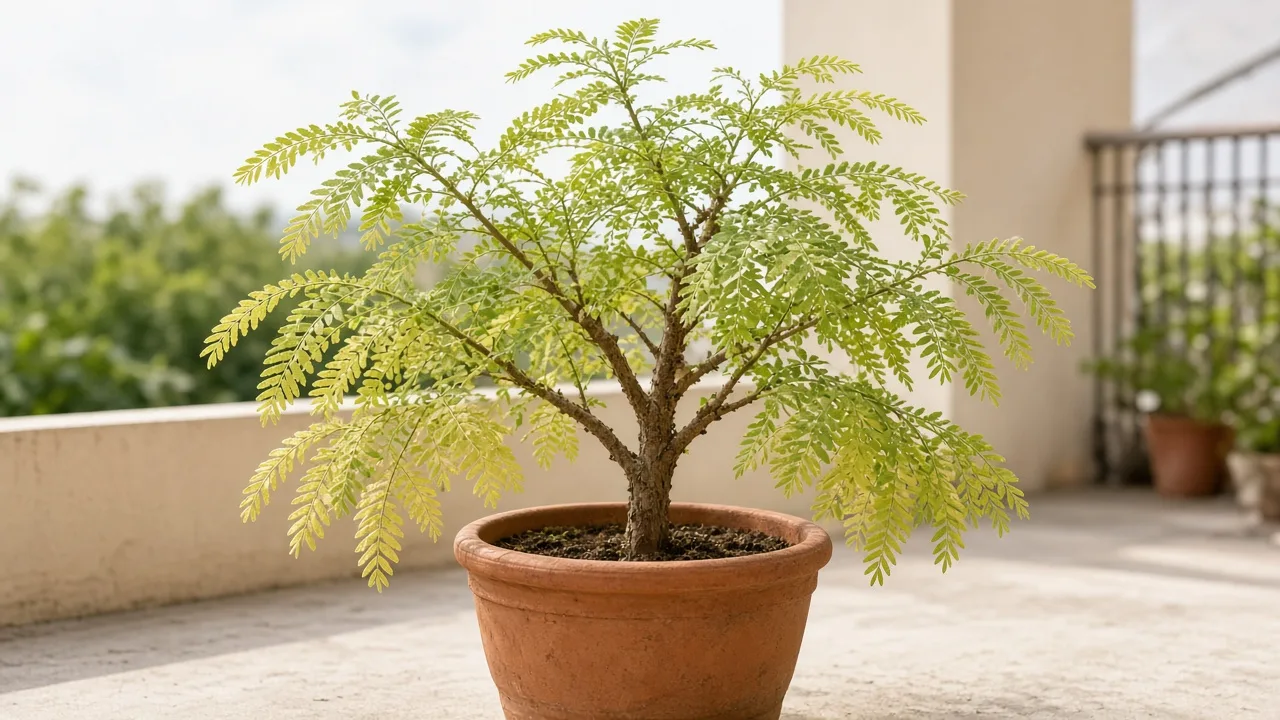
Nitrogen deficiency on Amla shows as uniform pale yellow-green on the oldest lower feathery branchlets, with smaller or lighter new leaf clusters at shoot tips and slow warm-season growth while wood stays firm. First step: confirm the pattern during active flush—not normal seasonal branchlet drop—then check years without manure or NPK in a leached terrace pot before feeding.
Nitrogen Deficiency on Amla: Causes, Checks & Fixes
This guide covers nitrogen deficiency on Amla. See also the general Nitrogen Deficiency guide, watering, and light pages for this plant.
Nitrogen Deficiency on Amla: Causes, Checks & Fixes
Quick answer
Nitrogen deficiency on Amla (Phyllanthus emblica, Indian gooseberry) shows as uniform pale yellow-green on the oldest lower feathery branchlets, with smaller or lighter new leaf clusters at shoot tips and stalled warm-season growth while wood stays firm. Nitrogen is mobile in plants, so deficiency symptoms show up first on the lower leaves as a general yellowing—veins and tissue fade together, unlike iron deficiency (green veins on new branchlet tips) or magnesium deficiency (interveinal banding on old branchlets).
See our nitrogen deficiency guide for general mobile-nutrient mechanics. On Amla, inspect the lowest mature feathery branchlets on each limb during warm active flush—even washout there, with shoot tips still pushing smaller new clusters, is classic nitrogen starvation before wet-root failure or low-light pale leaves.
First step: confirm uniform pale color on the oldest lower branchlets—not interveinal chlorosis, new-tip green veins, or cool-season deciduous drop—then check wood firmness and years without FYM or dilute NPK in a leached terrace pot.
When to use this page vs other Amla guides
| Pattern | Read next |
|---|---|
| Uniform pale oldest lower branchlets, smaller shoot-tip leaf clusters | Nitrogen deficiency (this page) |
| Yellow between veins on oldest branchlets | Magnesium deficiency |
| Yellow new branchlet tips with green veins | Iron deficiency |
| Cupped or margin-burned newest leaves | Calcium deficiency |
| Brown scorched margins on old branchlets | Potassium deficiency |
| Washed-out green across whole canopy, dim terrace | Pale leaves or not enough light |
| All branchlets yellow on persistently wet soil | Overwatering |
| Yellowing + branchlet drop in cool dry rest, firm wood | Watering guide — seasonal dormancy |
| Pale after heavy feed or white salt crust | Review Amla fertilizer — possible salt buildup |
What nitrogen deficiency looks like on Amla
Healthy Amla holds deep green, feathery compound leaves on slender branchlets along an open woody framework. Nitrogen stress breaks that pattern on mature foliage on the lower part of each limb, not with a vein-retained banding pattern.
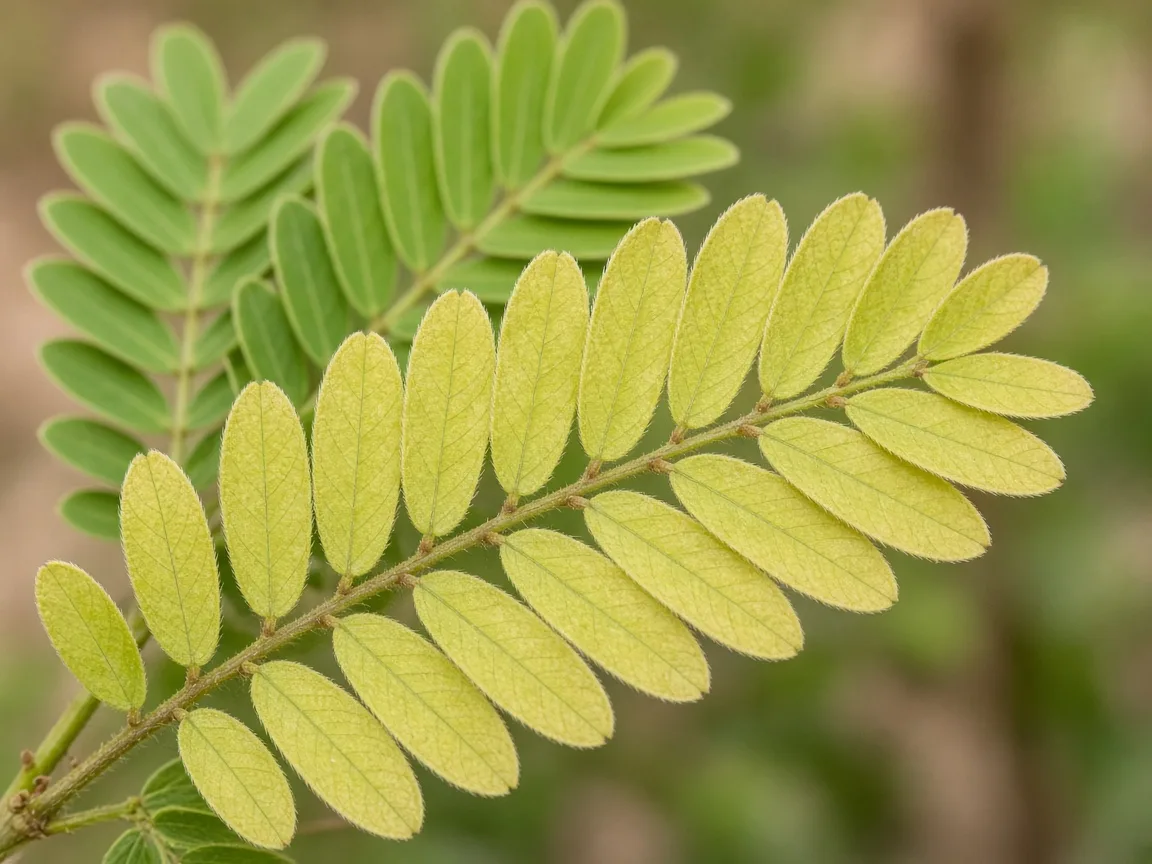
Oldest lower Amla branchlet with uniform pale yellow-green chlorosis—veins and tissue faded together, unlike interveinal magnesium banding.
Typical signs:
- Uniform pale yellow-green on the oldest lower feathery branchlets—veins and tissue lose color together
- Progressive climb upward over months as the tree strips nitrogen from old tissue to fund shoot-tip growth
- Smaller or thinner new leaf clusters at branchlet tips and slower internode extension during summer active flush
- Firm woody stems when roots are healthy; soft sour soil at the base suggests overwatered Amla instead
- Reduced flowering or fruit set on a sun-soaked terrace tree that otherwise has enough light for bloom
Not nitrogen deficiency:
- Yellow tissue between dark green veins on oldest branchlets—magnesium deficiency (magnesium deficiency initially develops on lower or older foliage with interveinal chlorosis)
- Yellow new branchlet tips with dark green veins—iron deficiency
- Seasonal yellow and branchlet drop when nights cool and growth stalls—normal deciduous rest for this fruit tree, not hunger
- Uniform washed-out green across the whole canopy in a shaded corner—not enough light before assuming starvation
- All branchlets yellow at once on persistently wet soil—overwatering or root rot
- One old lower branchlet only while shoot tips push full-size green clusters—normal aging on yellow leaves
Slow growth and uniform yellowing of older leaves are usually the first symptoms of nitrogen deficiency. On a slow-to-moderate Amla, that lower-branchlet washout is easiest to read on the lowest mature feathery cluster on each woody limb during warm months when the tree should be actively flushing.
Why Amla gets nitrogen deficiency
Amla is a hardy deciduous fruit tree that tolerates dry, nutritionally poor soils when drainage is good—but terrace pots and years of leaching still strip mobile nitrogen faster than many owners replace it. Nitrogen is a core component of chlorophyll and proteins; when soil reserves run low, the tree dismantles chlorophyll in older lower branchlets and redirects nitrogen to shoot tips and flower buds.
Amla-specific causes:
- Never fed or skipped years — Owners follow “hardy on poor soil” advice too literally and skip all feeding while a terrace Amla sits in the same pot for multiple seasons. See the Amla fertilizer guide for conservative seasonal rhythm.
- Monsoon and summer leaching — Each deep soak per the Amla watering guide flushes soluble nitrogen through drainage holes faster than owners replace it in sandy loam mix.
- Post-pruning flush without manure — TNAU notes manuring should be done immediately after pruning; skipping FYM or NPK when March–April pruning triggers new branchlets starves the first warm-season flush.
- Low-nitrogen-only products — Bloom or “fruit booster” formulas with very low first NPK numbers can starve foliage if used exclusively without occasional balanced feed.
- Blocked uptake from wet roots — Chronic saturation in a closed saucer prevents absorption even when nitrogen is present; see overwatering before feeding a waterlogged terrace pot.
- Cool-season feeding gaps — Correct winter pause is necessary, but some growers never resume measured feed when spring flush returns.
Do not diagnose nitrogen deficiency on sour wet soil with widespread off-season drop—that is root or seasonal stress until you confirm mostly firm wood and appropriate dry-down.
Reading pale color on feathery branchlets, not single blades
Amla does not carry one simple oval leaf per node. Each woody limb bears slender branchlets clothed in rows of tiny feathery leaflets—a compound pattern that confuses owners used to pothos or mango.
For nitrogen diagnosis, treat one branchlet as the inspection unit, not an individual leaflet. Walk each major limb and compare the lowest mature branchlet (fully expanded, no longer the active tip) to the newest expanding cluster two or three nodes above it.
Nitrogen signal: the lowest branchlet washes uniformly pale while the tip cluster still pushes growth—but those new clusters emerge smaller and lighter green than last season’s flush. Not nitrogen: only the oldest leaflet on one branchlet yellows while the rest of that branchlet and all shoot tips stay deep green (normal senescence); or every branchlet on the tree yellows together on wet mix (root failure).
This branchlet-level reading is nonsense on a snake plant rosette or a fern frond—it is the correct diagnostic lens on Indian gooseberry.
Seasonal branchlet drop vs nitrogen starvation
Amla is deciduous, shedding branchlets and leaves in its seasonal cycle. That normal rest is the biggest lookalike for “my tree is starving.”
Seasonal drop (not nitrogen deficiency): canopy thins when nights cool and growth stalls; wood stays firm; soil dries on your normal watering schedule; yellowing is widespread and timed with dormancy, not isolated to oldest lower tissue during active flush.
Nitrogen deficiency: shows during warm active growth when new shoot tips should be expanding, monsoon or spring flush is underway, and the tree receives regular deep soaks. Pale color concentrates on oldest lower branchlets first, then climbs, while tips push undersized new clusters.
If the whole tree is leafless in winter with firm wood, wait for spring flush before diagnosing nitrogen. Clemson Extension recommends applying fertilizer when plants are actively growing—feeding a dormant Amla builds salts without uptake.
Terrace pot leaching and the monsoon nitrogen gap
Ground orchard Amla receives split FYM and NPK in basin applications. NHB recommends 10 kg farmyard manure with 100 g N, 50 g P, and 100 g K for one-year-old plants, increasing yearly, with full FYM and P plus half of N and K in January–February and the remaining half in August (NHB aonla production technology).
A terrace pot has none of that buffering:
- Smaller root volume — Nutrients deplete faster than orchard baselines suggest.
- Drainage-first mix — Sandy loam that saves Amla from rot also flushes nitrogen every monsoon downpour.
- No winter irrigation pause in some regions — Container mix still leaches between feedings even when ground trees rest.
Home fix: scale orchard logic down sharply—half-strength balanced liquid about once every four weeks during active warm-season flush, plus a thin top-dress of well-rotted compost after spring pruning—not bearing-tree gram rates dumped into a 30 cm pot. Pause when growth stalls in cool weather or when soil stays wet.
How to confirm nitrogen deficiency on Amla
Work through these checks in order before changing feed, repotting, and pruning on the same weekend.
- Pattern check — Oldest lower branchlets uniformly pale; veins and tissue faded together; shoot tips still growing but with smaller clusters.
- Season check — Tree in warm active flush, not cool-season deciduous drop.
- Root-zone check — Top 3–5 cm dries between soaks; no sour smell; wood firm at the base.
- Feed history — No FYM, compost, or dilute NPK through last spring flush and monsoon.
- Light check — Full sun terrace placement; dim shade causes pale leaves across the whole canopy, not lower-branchlet washout only.
- Lookalike rule-out — No interveinal banding (magnesium), no green-vein new tips (iron).
UC IPM notes that nitrogen deficiency symptoms may be confused with agents that restrict root growth and reduce nutrient uptake, including poor drainage and too little or too much irrigation. If soil stays wet and branchlets drop out of season, fix watering before assuming hunger.
The first fix to try
Apply one measured half-strength balanced water-soluble fertilizer to moist—not soggy—soil during active warm-season flush.
That single action tests whether the tree can use nitrogen once roots are functional:
- Water normally if the top 3–5 cm is dry; do not feed bone-dry mix.
- Mix balanced NPK at half the label strength for container trees (see Amla fertilizer).
- Pour slowly at the dripline; empty any standing water from the saucer after the soak drains.
- Wait four weeks and judge the next branchlet flush at shoot tips—not whether old yellow branchlets re-green.
Do not stack repotting, hard pruning, and full-strength NPK on the same day. Do not feed a waterlogged pot. Do not use bearing-tree orchard gram rates in a small terrace container.
Step-by-step recovery if the first feed helps
When the next flush emerges larger and greener at shoot tips:
- Resume seasonal rhythm — Light balanced feed about monthly during active growth; pause in cool rest.
- Top-dress compost after spring pruning when TNAU-style orchard practice would apply FYM—scaled to pot size.
- Second split near monsoon — A small August follow-up feed mirrors NHB’s second N/K split for ground trees, at container dilution.
- Flush salts mid-season if white crust appears on the rim—plain water soak, then hold feed two weeks.
- Refresh mix at next repot if roots circle and the pot dries within a day in heat—see Amla repotting.
If two measured feeds during active flush produce no greener new branchlets, stop guessing nitrogen—test for iron or magnesium patterns, or inspect roots for rot.
Recovery timeline
Judge progress by new branchlet flush, not old tissue color.
| Stage | What to expect |
|---|---|
| Week 0–2 | No visible change on yellowed lower branchlets; avoid second feed |
| Week 3–4 | Next shoot-tip cluster may emerge slightly larger and greener |
| Week 5–8 | Two to three flushes often show clearer deep green if nitrogen was the limiter |
| Month 3+ | Old pale branchlets may drop in normal renewal; canopy density improves from tips |
Yellowed lower feathery branchlets rarely return to deep glossy green once chlorophyll is dismantled. Recovery means the problem stops climbing and new growth at shoot tips looks normal.
Mistakes to avoid
- Feeding wet, sour soil — Fix drainage first; nitrogen cannot fix root rot.
- Full-strength orchard NPK in a pot — TNAU lists 200 g N per bearing tree per year in the ground (TNAU Amla cultivation)—not a single terrace dose.
- Diagnosing nitrogen in winter dormancy — Wait for spring flush.
- Confusing iron chlorosis — Green veins on new tips mean iron deficiency, not this page.
- Chasing nitrogen in deep shade — Move to full sun before feeding a dim terrace tree.
- Ignoring leaching — Hardy-on-poor-soil reputation does not mean zero replacement after years of monsoon flushes.
How to prevent nitrogen deficiency next season
- Time FYM or compost plus dilute NPK with spring pruning and monsoon flush per Amla fertilizer.
- Repot young terrace trees every one to two years into fresh sandy loam before mix is exhausted.
- Match feed to growth — Pause when cool weather stalls flush; resume when consistent new shoots appear.
- Track oldest lower branchlets monthly in summer—a uniform pale washout is easier to correct than a fully stunted woody framework.
- Flush container salts if you use hard tap water or feed frequently in bright outdoor summer culture.
Related Amla guides
- Amla overview — species baseline and care hub
- Amla fertilizer — seasonal FYM and NPK splits scaled for pots
- Amla watering — deep soak rhythm that pairs with nutrient uptake
- Amla soil — sandy loam that drains fast but needs nitrogen replacement
- Amla problems — full symptom index for this species
- Magnesium deficiency — when older branchlets band between veins
- Iron deficiency — when new branchlet tips yellow with green veins
- Pale leaves — light-first diagnosis when color shifts broadly
- Yellow leaves — moisture and dormancy when yellowing is widespread
- Slow growth — when stalled flush has multiple causes
Conclusion
Uniform pale yellow-green on the oldest lower Amla branchlets, with smaller new leaf clusters at shoot tips during warm active flush, is a nitrogen signal—confirm the pattern is not interveinal or new-tip chlorosis, rule out wet-root failure and cool-season drop, then apply one measured balanced feed on moist mix.
Related tool
Use the Fertilizer Dilution Calculator to narrow causes for nitrogen deficiency on this plant before changing multiple variables at once.