Potassium Deficiency on Amla: Marginal Scorch Checks & Fixes
Quick answer
Potassium deficiency on Amla shows as yellow or brown scorch along the margins of older lower feathery leaflets along mature branchlets, while new branchlet flush at shoot tips may stay greener. First step: confirm marginal burn on multiple old leaflets—not interveinal yellow bands from magnesium—and review seasonal feeding before adding fertilizer.
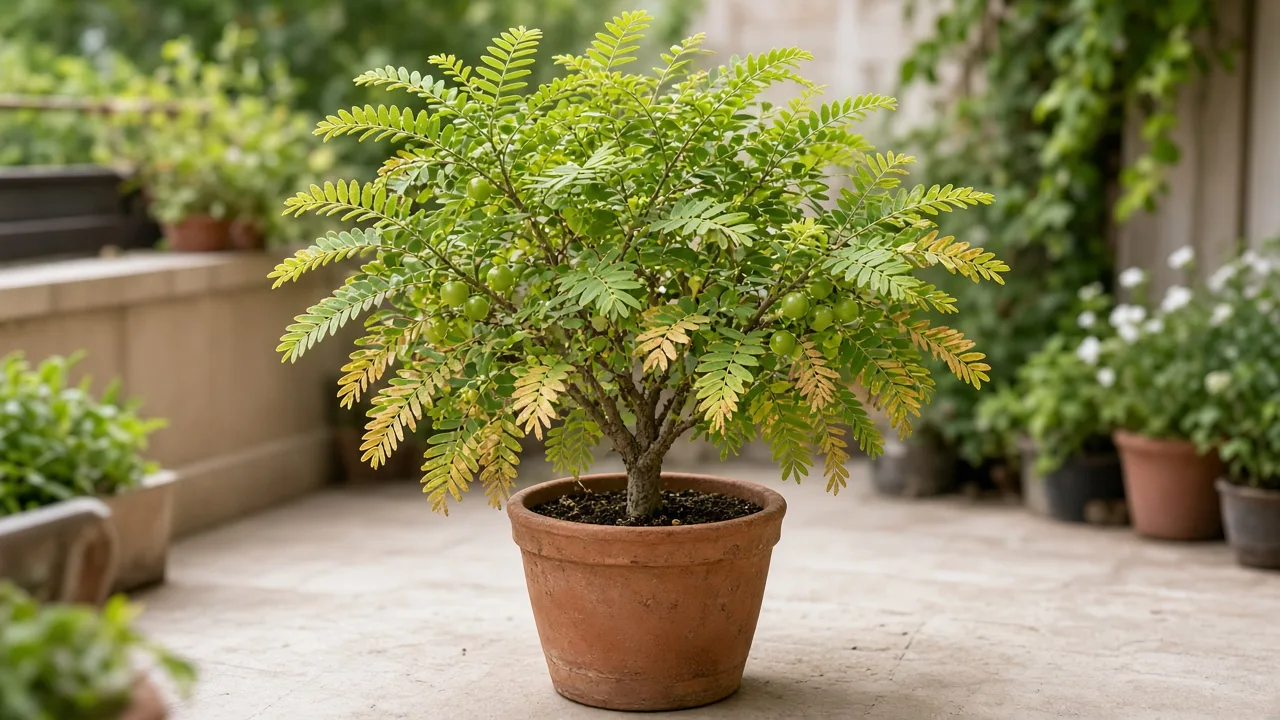
Potassium Deficiency on Amla: Causes, Checks & Fixes
This guide covers potassium deficiency on Amla. See also the general Potassium Deficiency guide, watering, and light pages for this plant.
Potassium Deficiency on Amla: Causes, Checks & Fixes
Quick answer
Potassium deficiency on Phyllanthus emblica (Amla, Indian gooseberry, aonla) shows as yellow or brown scorch along the margins of older lower feathery leaflets along mature branchlets, while new branchlet flush at shoot tips may stay relatively green. Potassium is very mobile in plants and deficiency symptoms show up first on lower leaves as flecking or mottling on the leaf margins—the deciduous fruit tree pulls potassium from old leaflet tissue to fund new branchlet growth and fruit swell during warm-season flush.
See our potassium deficiency guide. On Amla, inspect the outer edges of the oldest oblong leaflets on each woody branchlet—dry marginal scorch there differs from magnesium deficiency, which bands yellow between green veins on mid-canopy tissue, and from brown tips from salt crust or underwatering stress.
First step: confirm marginal scorch on multiple older lower leaflets along mature branchlets, not interveinal chlorosis or tip-only crisping from salt burn.
When to use this page vs other Amla guides
| Pattern | Read next |
|---|---|
| Brown scorch at leaflet margins on older tissue | Potassium deficiency (this page) |
| Yellow between veins on oldest lower leaflets | Magnesium deficiency |
| Uniform pale lower branchlets without edge band | Nitrogen deficiency |
| Pale new branchlet tips with dark green veins | Iron deficiency |
| Cupped or necrotic newest pinnae at shoot tips | Calcium deficiency |
| Marginal burn right after heavy feed | Salt injury—flush before more fertilizer; see Amla fertilizer |
| Yellow lower leaves on wet mix with soft roots | Overwatering or Root rot |
| Whole canopy pale in deep shade | Not enough light or Pale leaves |
| Multiple yellow causes at once | Yellow leaves |
What potassium deficiency looks like on Amla
Amla carries fine feathery compound leaves—rows of small oblong leaflets (roughly 1–3 cm) along slender woody branchlets on a sun-loving deciduous fruit tree. Healthy leaflets hold deep green color with firm texture. Potassium stress breaks that pattern at the margins of older leaflets lower on each branchlet, not at the active growing tip first.
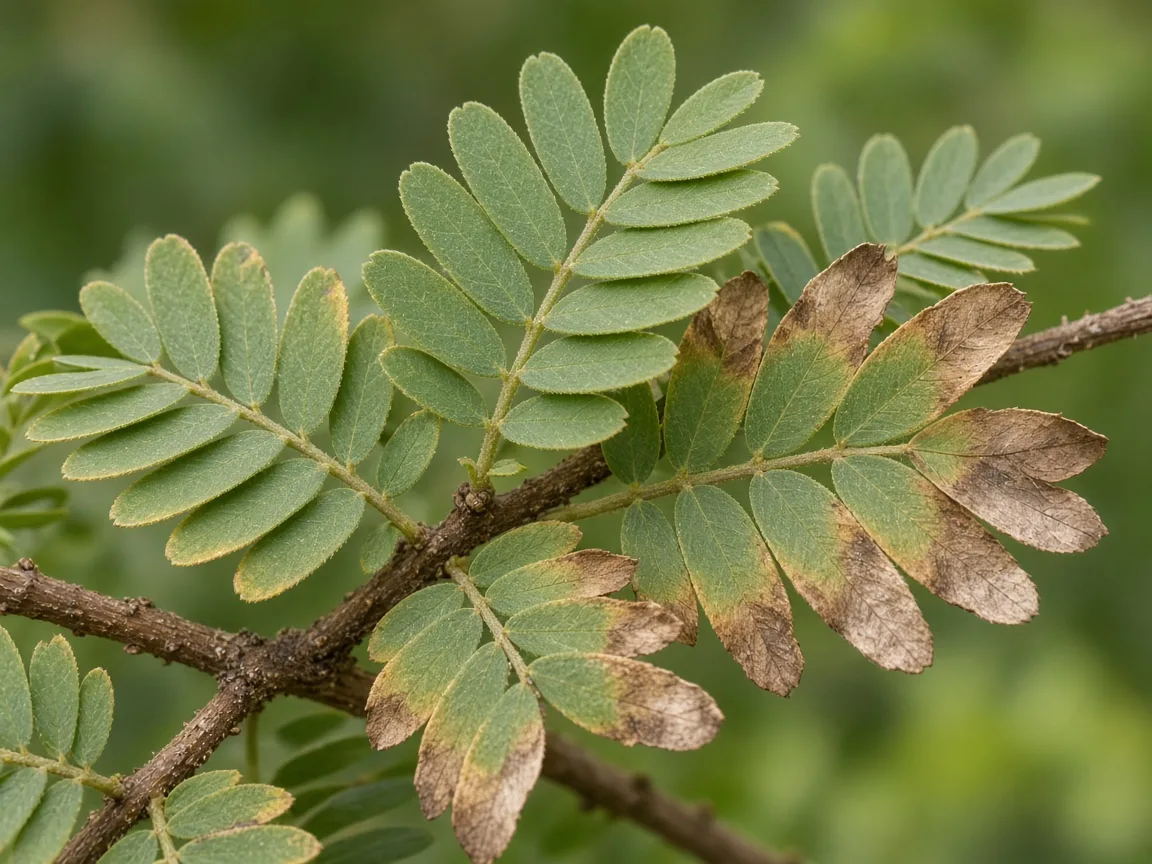
Tan-brown scorch band along the outer margin of older oblong leaflets on a mature branchlet—newer feathery flush above may still look greener.
Typical signs:
- Yellow or tan scorch along outer leaflet margins on the oldest lower leaflets along mature woody branchlets—the damage often starts at the edge and creeps inward while the mid-blade stays greener longer
- Crisp brown marginal tissue on small oblong leaflets, not soft mushy blades from rot
- New branchlet flush stays greener than the lowest leaflets on the same shoot for weeks
- Slow spread up the branchlet as deficiency advances—more old leaflets gain similar edge burn
- Weak branchlet extension in advanced cases when potassium cannot support water regulation during hot monsoon growth
- Smaller or poorly colored fruit on heavily stressed bearing terrace trees during swell if canopy cannot maintain turgor
Not potassium deficiency:
- Yellow or pale green between dark green veins on older mid-canopy leaflets—magnesium deficiency (interveinal chlorosis starts on older leaves for mobile nutrients)
- Uniform pale washout across whole lower branchlets without a dry edge band—nitrogen deficiency
- Pale new branchlet tips with dark green veins at the softest unfurling growth—iron deficiency
- Tip-only crisp brown on one exposed leaflet face—brown tips from salt buildup or dry air
- All leaflets yellow at once on persistently wet soil with soft stems—overwatering or root rot
- Seasonal yellowing and branchlet drop in cool dry months—normal deciduous rest; see yellow leaves if drop is off-season
Older leaves show chlorosis with browning of tips, scorching of margins, and brown spots near the margins in classic potassium shortage. On Amla’s tiny compound leaflets, marginal scorch is easiest to read when you hold a lower branchlet against bright sky and look for a dry tan band around the perimeter rather than vein striping through the blade center.
Why Amla gets potassium deficiency
Amla is a subtropical deciduous fruit tree that prefers dry weather and can grow in variable soil conditions when drainage is good. Potassium regulates stomatal function and water balance in leaves—when soil reserves run low, the tree strips potassium from older feathery leaflet tissue to fund new branchlet flush and fruit swell during monsoon.
Common triggers on terrace pots and home orchards:
- Skipped or incomplete feeding — seasons without FYM or balanced NPK in a closed container deplete mobile potassium; see the Amla fertilizer guide
- Leaching through frequent summer watering — each thorough soak on a terrace pot flushes mobile potassium through drainage holes faster than owners replace it
- Nitrogen-heavy feeding without potassium — bloom or growth formulas applied repeatedly without the August potassium split orchard schedules use for aonla
- Old, depleted mix — Amla soil past two years in the same large pot loses structure and nutrient buffering
- Salt accumulation — minerals concentrate on pot rims when frequent dilute feeds never get flushed; overlaps with brown tips
- Root stress limiting uptake — UC IPM notes container plants often show deficiency symptoms when root uptake is restricted, not only when soil lacks potassium
- Shade-stalled growth with continued feeding — weak light slows uptake while salts build in wet mix
TNAU recommends manuring immediately after pruning for bearing Amla, with annual packages around 10 kg FYM plus 200 g N, 500 g P, and 200 g K per tree—orchard rates, not container doses. NHB splits nutrients for aonla with FYM and phosphorus in January–February and remaining N and K in August. Home pots should follow the same seasonal rhythm at scaled-down strength, not constant high-nitrogen feeding that leaves potassium behind.
Monsoon fruit swell and potassium demand
Bearing Amla trees pull extra potassium into developing fruit during monsoon swell. Marginal scorch that appears on lower branchlets just as fruit sets enlarge often traces to depleted soil K after a nitrogen-heavy spring feed without the August potassium window. If fruit stays small and leaf margins scorch simultaneously, potassium shortage is more likely than slow growth from shade alone.
Reading edge burn on feathery compound leaflets
Unlike large simple leaves where scorch is obvious at a glance, Amla’s compound feathery clusters spread symptoms across dozens of tiny leaflets on one branchlet. Step back for canopy pattern (lower branchlets first), then move in and inspect individual leaflet margins. If the whole branchlet washes pale without a dry perimeter band, suspect nitrogen deficiency or chronic shade before treating potassium.
How to confirm the cause
Work through these checks in order before adding supplements:
- Map leaflet age first. Mobile nutrients like potassium show deficiency on older leaves first. Yellow between veins on mid-canopy leaflets instead suggests magnesium deficiency.
- Inspect margin pattern under bright sky. Dry tan scorch around the outer edge on multiple old leaflets supports potassium; uniform pale washout fits nitrogen better.
- Feel branchlets at the soil line. Firm woody stems with dry-to-moderate soil support a nutrient diagnosis. Soft mushy stems on wet mix mean overwatering—fix roots before fertilizing.
- Review fertilizer history. Long gaps without feed, or repeated high-nitrogen products without adequate potassium in the guaranteed analysis, raise the odds. Check whether your last feed included K.
- Rule out salt crust. White deposits on the pot rim suggest accumulated fertilizer salts—flush with plain water before adding more potassium.
- Check seasonal context. Active warm-season growth with firm roots is the window for correction; cool deciduous rest is not the time to heavy-feed.
If outer-leaflet marginal scorch is clear, branchlets are firm, and watering is stable, potassium deficiency is a strong working diagnosis.
First fix for Amla
Apply one half-strength dose of complete fruit-tree liquid fertilizer with adequate potassium in the guaranteed analysis on already-moist mix—only after confirming marginal scorch on multiple older lower leaflets and ruling out salt crust or recent heavy feeding.
Water normally first so roots are hydrated, then apply diluted feed until a small amount drains from the terrace pot. Clemson Extension recommends feeding trees when they are actively growing—match your dose to warm-season flush, not cool dormancy when roots are slow.
Do not feed a waterlogged Amla, a tree you repotted within the last month, a leafless dormant specimen, or a plant with white salt crust on the soil surface. Flush salts or fix drainage first, then apply one measured potassium correction through a complete balanced formula.
Container dose and seasonal timing
| Timing | Action | What to watch |
|---|---|---|
| Day 0 | One half-strength complete feed with K on moist mix | Old scorched leaflet margins will not re-green—ignore them |
| Weeks 2–4 | Resume normal diluted seasonal feeding per fertilizer guide | New branchlet flush should open with cleaner edges |
| August window | Include potassium in the monsoon split for bearing trees | Fruit swell coincides with peak K demand per NHB aonla schedule |
| Weeks 4–8 | Maintain measured feeding through active growth | Next feathery clusters should show normal green margins |
| After 8 weeks | Stop extra feeds if new growth is clean | If new tips still scorch, reassess magnesium competition or root health |
For a young terrace pot, half-strength complete liquid feed every four to six weeks during active growth is safer than a single heavy potassium-only drench. Ground trees can receive well-rotted FYM plus a measured K supplement in the basin under the canopy drip line on moist soil—never as a foliar spray on hot sunny afternoons when leaflet tissue can scorch.
If mix is older than two years or heavily crusted, plan repotting into fresh soil as the next step—not on the same day as the first feed.
Recovery timeline
New feathery branchlet flush should show cleaner leaflet margins within four to eight weeks after potassium and feeding are corrected. Lower scorched leaflets with brown necrotic edges will not fully recover—judge progress by the next ring of branchlet growth, not by waiting for damaged lower tissue to heal.
| Week | What changed on the plant |
|---|---|
| 0 | Lower branchlets show tan scorch along leaflet margins; new tips still firm |
| 1 | Balanced feed applied; no visible repair on week-0 leaflets (normal) |
| 2–6 | Next feathery clusters open with intact green margins |
| 6+ | Steady branchlet extension; lower scars remain but do not spread |
If marginal scorch persists on new branchlet leaflets after one measured treatment, eight weeks of proper feeding, and stable watering, suspect magnesium deficiency, chronic salt buildup, or root rot rather than repeating high-potassium feeds.
What not to do
Do not pile on high-nitrogen fertilizer hoping lower leaflet margins re-green—that can worsen salt buildup and push soft, weak branchlets. Do not apply potassium sulfate weekly without confirmed deficiency. Do not repot, hard-prune, and fertilize on the same day when the tree is already stressed—make one change at a time. Do not assume every scorched lower leaflet needs potassium when branchlets are soft and soil is wet—rule out root rot first.
How to prevent potassium deficiency next time
Feed with seasonal FYM and balanced NPK splits during active warm-season growth—including the August potassium window for bearing trees—see the fertilizer guide for scaled container rates. Flush with plain water mid-season if you feed frequently in a terrace pot. Repot into fresh mix every one to two years while young to keep nutrients available in the limited soil volume container trees depend on.
Match light to the species’ needs—Amla wants full sun for firm growth and efficient nutrient use. Align manuring with post-pruning windows per TNAU guidance, and pause feed through cool dormancy when roots are not actively growing.
What to read next on Amla nutrients
- Magnesium deficiency — yellow between green veins on older mid-canopy leaflets, not edge scorch
- Nitrogen deficiency — uniform pale outer canopy without green vein contrast
- Iron deficiency — pale new branchlet tips with green veins when lower leaflets look fine
- Calcium deficiency — cupped new pinnae at shoot tips; excess K can compete with Ca uptake
- Brown tips — tip-only crisping from salt or dry air, not full marginal band
- Yellow leaves — multi-cause entry when symptoms overlap
- Amla fertilizer — formula, strength, and seasonal schedule
- Amla overview — species context and care hub
How this guide was reviewed: Written by sai-ananth and reviewed by the LeafyPixels Review Board on 2026-08-05. Nutrient symptom patterns and feeding protocols cross-checked with UF/IFAS, WVU Extension, UC IPM, TNAU, NHB, and Clemson HGIC resources cited inline above. See methodology note in frontmatter.
When to use this page vs other Amla guides
- Amla watering guide — Use for routine moisture checks before assuming potassium deficiency is the main issue.
- Amla problems hub — Browse all common issues on this species.
- Pale leaves on Amla — Different entry point when symptoms overlap with potassium deficiency.
Related Amla guides
- Amla overview
- Amla watering
- Amla light
- Amla soil
- Yellow leaves on Amla
- Amla problems
- Overwatering on Amla
Related tool
Use the Fertilizer Dilution Calculator to narrow causes for potassium deficiency on this plant before changing multiple variables at once.