Holes in Leaves on Banana: Causes, Checks & Fixes
Quick answer
Holes in Banana paddle leaves are tissue damage, not a natural leaf pattern—Musa acuminata keeps whole broad blades unless something tears or chews them. First step: look at the hole edge, then inspect the emerging cigar leaf and leaf undersides under bright light before you spray or change watering.
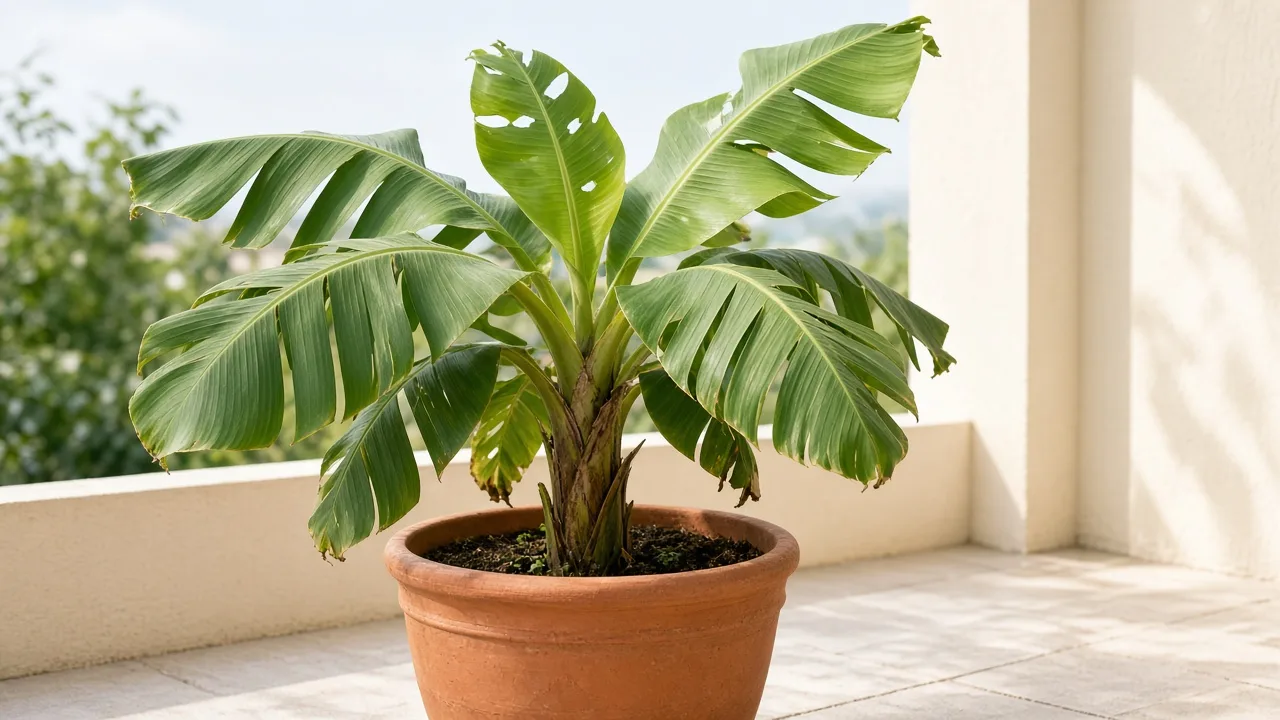
Holes in Leaves on Banana: Causes, Checks & Fixes
This guide covers holes in leaves on Banana. See also the general Holes in Leaves guide, watering, and light pages for this plant.
Holes in Leaves on Banana: Causes, Checks & Fixes
Quick answer
Holes in Banana (Musa acuminata) paddle leaves mean something removed or tore tissue—wind shredding along veins, chewing insects, leaf miners, thrips rasping, mechanical snags on huge arching blades, stuck cigar-leaf unfurling in dry air, or pet damage. Unlike fenestrated monsteras, banana keeps whole broad paddle leaves on a trunk-like pseudostem. Any open hole is damage, not a natural perforation pattern.
For how chewing pests and mechanical tears work in general, see our holes in leaves guide. On Banana, the diagnostic clue is usually at the pseudostem top—the emerging cigar leaf and overlapping sheaths where caterpillars hide, where wind first shreds the largest blades, and where dry air can split tissue as a new paddle unfurls.
First step: look at the hole edge, then inspect the newest cigar leaf and leaf undersides under bright light. Clean vein-aligned splits need a different fix than ragged chew marks with frass.
When to use this page vs other Banana guides
| Pattern | Start here | Or route to… |
|---|---|---|
| Ragged holes with frass on cigar leaf or sheaths | This page | Caterpillars |
| Serpentine tunnels inside the paddle | Leaf miners | This page if holes are full-thickness |
| Silver streaks, black specks, scarred new tips | Thrips | — |
| Sticky honeydew on soft new growth | Aphids | Mealybugs |
| Brown halos before tissue drops out | Black spots | — |
| Long splits along veins after wind, no frass | This page | Banana light for placement |
| Crispy edges without open holes | Brown tips | Low humidity |
What holes in leaves look like on Banana
Banana grows as a fast-growing tropical herb with a pseudostem built from overlapping leaf sheaths and huge paddle-shaped blades that can reach several feet long on mature outdoor specimens. When you see a hole, sort it by pattern:
Wind shredding along veins — Long, clean splits or tattered sections that follow the main leaf veins, often on the largest lower paddles after a breezy day on a terrace or balcony. No frass, no insects, and damage often appears on several leaves at once after wind exposure. Banana is intolerant of constant wind; a small amount of lamina tearing can occur in normal outdoor culture, but heavy shredding reduces the leaf’s useful surface.
Caterpillar chewing — Irregular holes and notched margins, often starting on soft tissue at the cigar leaf or young paddle edges. Dark frass pellets on leaves, sheaths, or the pot rim below. You may find a larva tucked between overlapping sheaths. See caterpillars on Banana. The banana moth (Opogona sacchari) is a serious greenhouse pest whose larvae make passages and holes in succulent tissue.
Leaf miner trails — Winding pale or brown tunnels inside the paddle with only a small exit hole—not a large ragged chew. Miners are less common indoors but appear after outdoor summer placement. See leaf miners on Banana.
Thrips rasping — Tiny scrape marks, silvery streaks, and black varnish-like specks; new cigar-leaf tissue may look scarred before it fully opens. Full-thickness holes are less common than stippling. See thrips on Banana.
Mechanical tears on arching paddles — Clean linear splits or one-time holes on outer blades that brush walls, door frames, shelf lips, or neighboring plants. Damage stays on the same leaf after you rotate the pot; no frass, no trails.
Cigar-leaf unfurl tears in dry air — Small holes or splits at the center of a newly opened paddle where the blade stuck together while unfurling from the pseudostem. Often paired with crispy margins in winter conservatories. See low humidity on Banana.
Pet chewing — Torn sections on lower, accessible paddles without insect signs. Musa acuminata is listed as non-toxic to cats and dogs, but chewing fibrous leaves can still upset an individual animal—isolate the plant if pets are the cause.
Fungal leaf spots that fall out — Dark spots with yellow margins may precede small holes when necrotic centers drop, leaving a shot-hole appearance—usually with preceding brown halos, unlike clean wind splits. Route persistent spotting to black spots on Banana.
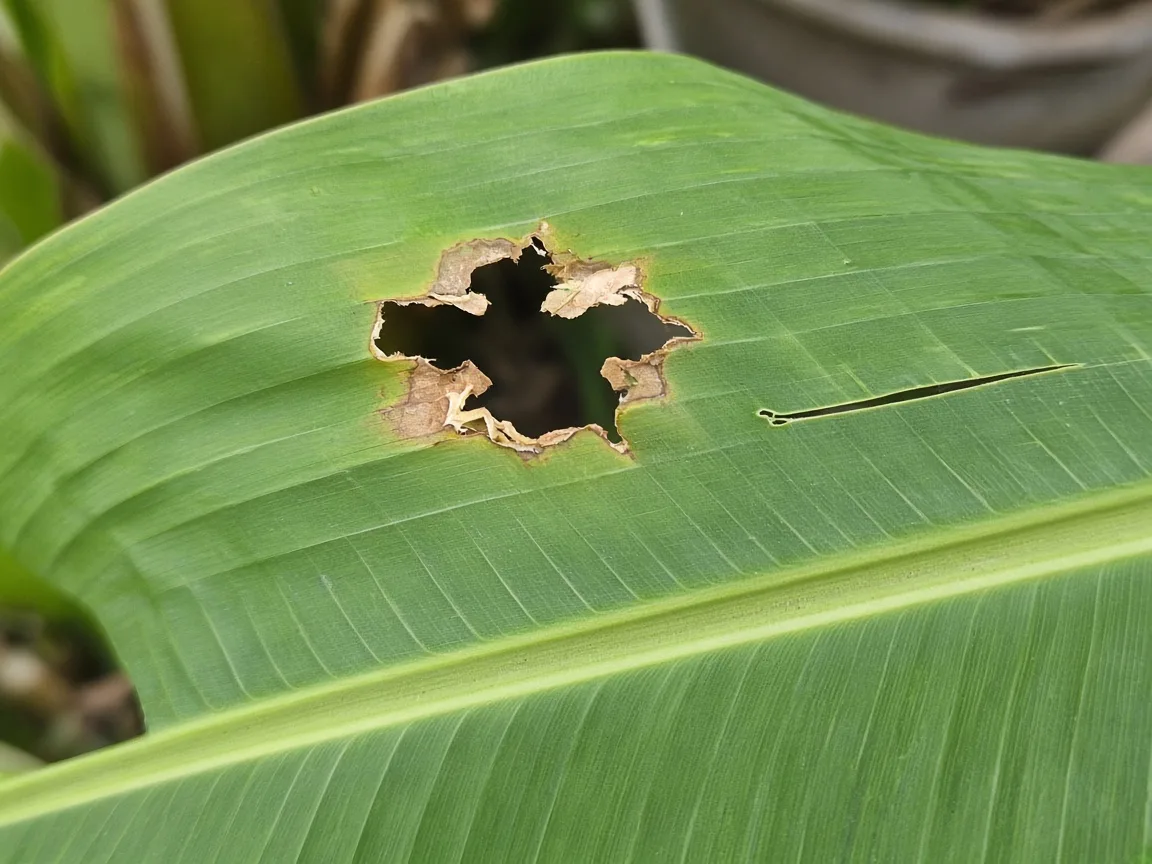
Irregular caterpillar chew marks beside a clean wind split along a main vein—compare torn margins with intact tissue on the same paddle.
Wind shredding along paddle veins (banana only)
Banana paddle leaves are among the largest in common container culture, and they act like sails in wind. Tears typically run parallel to the main veins, creating fringe-like strips that still photosynthesize. UF/IFAS notes that a small amount of leaf lamina tearing can occur on banana without stopping growth, but heavy shredding, tattering, or constant wind stress is not beneficial and can coincide with toppling risk in gusts above roughly 25 mph. Outdoor terrace bananas often look shredded while the pseudostem stays firm—that is usually cosmetic, not a disease.
Cigar-leaf unfurl tears on massive emerging paddles (banana only)
Each new banana leaf emerges as a tightly rolled cigar leaf from the pseudostem center before unfurling into a full paddle. In dry winter conservatories or near heating vents, the rolled blade can stick to itself and split as it opens, leaving a small hole or linear tear through the center of the newest leaf. No frass, no night feeding pattern, and damage limited to the one or two youngest paddles on a dry-room plant points here—not caterpillars. Pair with the low humidity guide if margins also crisp.
Caterpillar hiding in pseudostem sheaths (banana only)
The trunk-like pseudostem is not wood—it is a stack of overlapping leaf sheaths. Caterpillars and moth larvae shelter in the shaded bases where sheaths meet the stem and inside the cigar leaf before it unfurls. A quick glance at the broad paddle surfaces misses the main feeding site. When holes appear on soft new tissue, peel back the outer sheath at the pseudostem top with bright light before assuming wind or drought caused the damage.
Why Banana gets holes in leaves
Chewing pests are the most common cause of true ragged holes indoors and on patios. Banana plantations face many insect pests, and container specimens pick up caterpillars on houseplants after nursery stock, open windows, patio season, or neighboring outdoor plantings. Caterpillars chew irregular full-thickness holes; leaf miners tunnel between leaf surfaces.
Huge paddle leaves amplify wind damage outdoors. Banana is intolerant of constant wind. Terrace and balcony placements expose broad blades to gusts that shred tissue along veins. This is not infectious and does not spread leaf to leaf like pest feeding—it appears after wind events.
Rapid warm-season growth concentrates soft tissue at the top. When warmth, sun, and moisture align per the Banana watering guide, new paddles push quickly from the cigar leaf. That soft tissue is the first target for caterpillars and thrips. Lower, older paddles may look fine while the top is being chewed.
Outdoor summer brings eggs indoors. Bananas on shaded patios pick up moth eggs; damage often appears weeks after the plant returns to a sunroom. One larva can chew through several tender paddles in sequence because banana concentrates new growth at the pseudostem apex.
Dry air splits unfurling tissue. Low humidity causes brown tips and mechanical damage on houseplants; on banana it can tear the cigar leaf apart as it opens. This is environmental, not a pathogen.
Arching lower paddles snag on furniture. Container bananas in tight corners tear cleanly when a paddle catches a doorway or shelf lip on the way in from outdoors.
Fungal leaf spots can fall out. Dark necrotic centers on paddles may drop, leaving small holes with halos—route to black spots when brown margins preceded the hole.
Banana does not develop natural perforations indoors the way mature Monstera deliciosa fenestrates. If someone suggests “your banana is supposed to have holes,” that advice applies to different species—not Musa acuminata paddle leaves.
How to confirm the cause
Work through these checks before spraying or repotting:
- Hole edge exam — Ragged with chewed margins and possible frass? Think caterpillars. Clean straight split along a vein? Think wind or mechanical snag. Serpentine trail visible inside the blade? Leaf miners.
- Cigar leaf inspection — Peel back the outer sheath at the pseudostem top. Look inside the rolled cigar leaf and along sheath joints with bright light.
- Underside scan — Thrips and some caterpillars feed from the lower surface of young paddles; stippling and silver streaks support thrips over wind.
- Timing and weather — Did damage appear overnight with frass (pests) or after a windy afternoon (shredding)?
- Pot rotation test — If only blades along one physical path are holed and damage has not spread to new growth elsewhere, rotate the container away from the snag.
- New growth watch — Unfurl tears stay on the youngest one or two leaves in dry rooms; caterpillar damage keeps appearing on each new cigar leaf until the insect is removed.
- Pseudostem firmness — A firm pseudostem with shredded lower paddles but a clean emerging cigar leaf usually means past wind or cosmetic damage, not active borers in the stem.
If the pseudostem is firm, the rhizome smells earthy rather than sour, and the next cigar leaf opens without new holes for two weeks, you have likely fixed the cause.
Lookalike comparison
| What you see | Likely cause | How to tell apart |
|---|---|---|
| Long splits along main veins, several paddles after wind | Wind shredding | No frass; pattern follows veins; new cigar leaf clean |
| Irregular holes with dark pellets on sheaths | Caterpillars | Frass present; damage on soft new tissue; larva possible |
| Pale winding trail inside paddle, tiny exit hole | Leaf miners | Trail visible when leaf is backlit |
| Silver streaks, black specks, scarred cigar leaf | Thrips | Stippling more common than large holes |
| Single clean tear on one lower paddle | Mechanical snag | Same leaf only; no spread to cigar leaf |
| Small center hole on newest paddle only, dry room | Unfurl tear | Paired with crispy margins; no insects |
| Holes with preceding brown halos | Fungal leaf spot | Spots visible before tissue drops out |
First fix for Banana
Inspect the hole edge and the cigar leaf under bright light before you change watering, fertilize, or spray.
That single diagnostic pass prevents treating wind shredding with pesticide or drowning a stressed plant because you assumed root rot from tattered lower leaves.
Once you have a working cause:
- If you find a caterpillar or fresh frass — Remove the larva by hand when possible, isolate the plant, and rinse sheath joints and the cigar leaf with a firm lukewarm stream. Then follow the caterpillars on Banana guide for follow-up treatment if feeding continues.
- If holes are clean vein splits after wind — Move or shelter the pot, stake if top-heavy, and monitor the next cigar leaf. Do not prune every shredded paddle; lower damaged blades still photosynthesize until the plant sheds them naturally.
- If damage is a mechanical snag — Rotate the pot or trim the single caught paddle at the base once, then watch new growth.
- If unfurl tears appear in dry air — Raise humidity around the pseudostem and ease off heat vents; see low humidity on Banana.
Do not apply broad-spectrum pesticide on day one without confirming live insects. Do not repot because lower paddles look tattered from wind.
Step-by-step recovery
After the first fix:
- Isolate outdoor-return or nursery plants for two weeks if insects were confirmed.
- Scout weekly at the pseudostem top while warm growth continues—one missed cigar leaf can restart caterpillar damage.
- Rinse sheath joints after confirmed pest removal rather than soaking the crown repeatedly; banana likes moisture at the root zone per Banana watering, but a constantly wet crown invites rot.
- Shelter from wind on balconies—group with taller windbreak plants or move to a leeward corner.
- Hold fertilizer on a heavily chewed plant until the next cigar leaf opens clean for about two weeks; feed active specimens per the Banana fertilizer guide once growth stabilizes.
For persistent caterpillar feeding indoors, insecticidal soap or horticultural oil applied to contacted insects is a lower-toxicity step before stronger pesticides—always follow label directions for food plants if your banana is ornamental-edible.
Recovery timeline
Cosmetic wind shredding on lower paddles — Stable immediately once sheltered; old fringed blades remain until the plant sheds them naturally over weeks to months.
Single mechanical tear — No spread expected; next cigar leaf should open clean within one to two weeks.
Caterpillar damage — One to three weeks to see clean unfurling after the larva is gone; heavily notched paddles do not fill in.
Unfurl tears from dry air — Often improves within one to two new leaves after humidity rises.
Fungal shot holes — Weeks to months; requires addressing the leaf-spot cause in the black spots guide.
Judge recovery by clean cigar leaves and firm pseudostem tissue, not by perfect lower paddles.
What not to do
Do not spray pesticide because lower outdoor paddles look shredded from wind—there may be no insect.
Do not remove every tattered leaf at once; banana needs leaf area for energy, and lower damaged paddles still contribute until replaced.
Do not drench the pseudostem crown repeatedly after rinsing pests; pooled water between sheaths risks rot.
Do not fertilize heavily while caterpillars are actively feeding on soft new tissue.
Do not assume holes mean overwatering—check the hole edge first. Wet soil problems show as yellowing and soft pseudostem base; see overwatering on Banana only when those signs match.
Avoid treating with oil or soap in harsh midday sun on the same day you rinsed large paddles—thin banana blades scorch easily.
Banana care cross-check
Hole recovery goes faster when baseline care is stable:
- Water — even moisture at the root zone per Banana watering; drought-stressed plants produce brittle new paddles that tear more easily
- Light — bright warm placement per Banana light; weak light slows replacement of damaged leaves
- Soil — rich, well-drained mix per Banana soil; a firm rhizome supports new clean paddles
- Wind protection — shelter terrace pots; constant breeze shreds blades and slows growth
- Humidity — steady air around unfurling cigar leaves in heated rooms
How to prevent holes next time
Shelter outdoor bananas from prevailing wind or accept cosmetic vein shredding on exposed terraces.
Quarantine new plants and patio-return pots for two to three weeks, scouting the cigar leaf weekly before placing them beside other tropicals.
Rinse foliage and inspect sheaths before bringing containers indoors in fall—caterpillars are common hitchhikers on outdoor banana collections.
Scout the pseudostem top every warm week while a cigar leaf is emerging; one sheath check prevents a shredded canopy later.
Rotate pots away from doorways and furniture that catch arching lower paddles.
Raise humidity when heating runs and a new paddle is unfurling—see low humidity on Banana.
For outdoor growers, remove accumulated frass and fallen leaf debris at the pot base where larvae hide between seasons.
When to worry
Most single-container hole problems are manageable once you match the pattern. Escalate when:
- Fresh ragged holes appear on multiple paddles within a week despite rinsing
- Frass returns at the pseudostem top after you removed a larva
- Leaf-miner trails spread through each new cigar leaf
- The pseudostem feels soft or smells sour at the base—borers or rot may be involved; see root rot on Banana
- Lower paddles shred while the cigar leaf stays clean after every windy week—placement needs a permanent windbreak, not pesticide
A firm pseudostem with historically shredded lower blades and a clean emerging cigar leaf is usually cosmetic wind damage on an otherwise healthy banana—not a reason to discard the plant.
Related Banana guides
- Banana overview — placement, pseudostem growth, and care baseline
- Banana watering — moisture rhythm that supports clean new paddles
- Banana light — sun and warmth for steady cigar-leaf growth
- Banana soil — rich mix that keeps the rhizome firm
- Caterpillars on Banana — ragged holes with frass
- Leaf miners on Banana — tunnels inside the paddle
- Thrips on Banana — silver streaks and scarred new tips
- Low humidity on Banana — unfurl tears in dry air
- Banana problems hub — all common issues on this species
Related tool
Use the Plant Problem Diagnosis Tool to narrow causes for holes in leaves on this plant before changing multiple variables at once.