Overwatering on Banana: Pseudostem Checks
Quick answer
Overwatering on Banana shows as a heavy wet pot, yellowing lower paddle leaves, limp droop on saturated mix, and—most critically—a soft or water-soaked pseudostem base while soil stays damp. First step: stop all watering immediately and press the lowest 5 cm of pseudostem above the soil line.
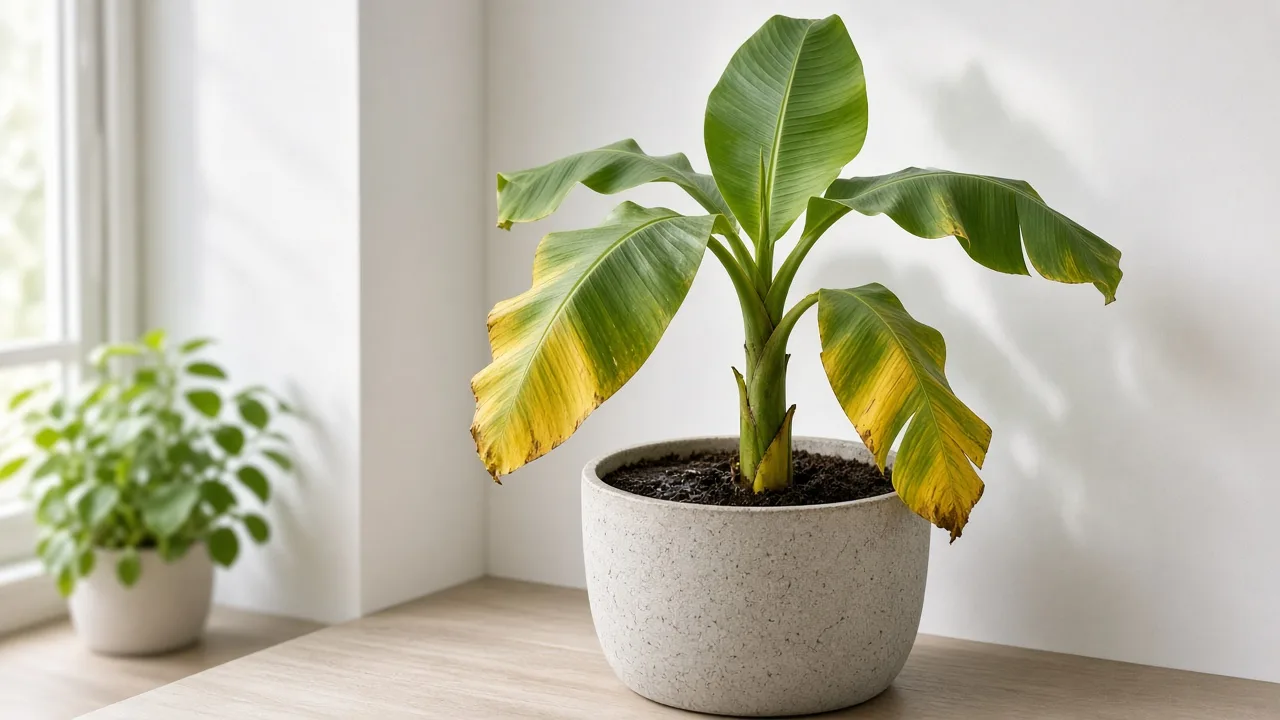
Overwatering on Banana: Causes, Checks & Fixes
This guide covers overwatering on Banana. See also the general Overwatering guide, watering, and light pages for this plant.
Overwatering on Banana: Causes, Checks & Fixes
Quick answer
Overwatering on Musa acuminata is the tropical-thirst trap: a fast-growing herb with enormous paddle leaves that screams for water—until the fibrous root mass and pseudostem base sit in stagnant mix and begin to fail. Banana evolved in humid tropics with steady moisture but excellent drainage; in a pot, roots need both water and oxygen, and continuously wet soil causes stunting, leaf yellowing, and reduced vigor.
For how chronic wet mix damages roots in general, see our overwatering guide. On banana, the pattern is a heavy pot long after watering, yellowing lower paddle leaves, limp droop on saturated mix—and most importantly—a soft or water-soaked pseudostem base while soil is still damp, not folded blades on a light dry pot.
First step: stop all watering immediately. Press the lowest 5 cm of the pseudostem above the soil line before you add water, fertilizer, or repot. If the base is already mushy, escalate to the root rot protocol the same day.
When to use this page vs other Banana guides
| Pattern | Read next |
|---|---|
| Light dry pot, folded paddle blades | Underwatering |
| Heavy wet pot + soft base (this page) | Stay here; escalate to root rot if base is mushy |
| Whole paddles yellowing on wet soil | Yellow leaves |
| Limp blades on heavy pot | Wilting or drooping leaves |
| Tan crispy tips only, firm base | Brown tips |
| White mold or gnats on wet surface | Mold on soil or fungus gnats |
| Lowers yellow after repot into heavy mix | Soil guide |
What overwatering looks like on Banana
Unlike small-leaved houseplants, banana carries huge paddle-shaped leaves on a trunk-like pseudostem made of tightly packed leaf sheaths—not a woody trunk. Overwatering damage often starts at the lowest living tissue (roots and pseudostem base) while upper paddles still look green.
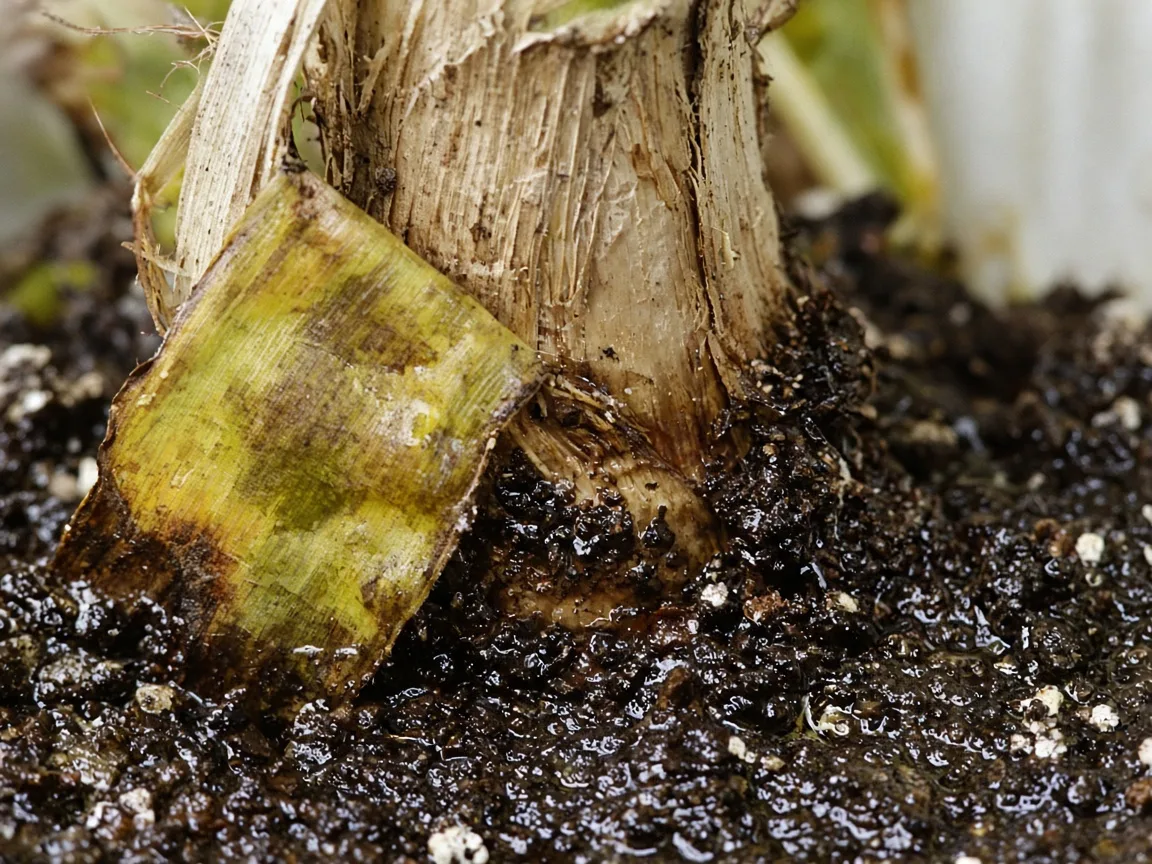
Early overwatering at the soil line—yellowing lower paddle tissue on clinging wet mix; the pseudostem above may still look upright until the base softens.
Early signs
- Heavy pot that stays waterlogged days after the last soak
- Yellowing lower paddle leaves while the mix surface still looks dark and cool
- Limp, hanging blades without the crisp fold of drought—leaves feel soft and heavy, not papery
- Slowed or stuck cigar leaf at the crown—the newest rolled blade fails to unfurl cleanly
- Fungus gnats or surface mold on constantly damp mix; see mold on soil if white patches spread
- No new paddle for weeks while soil stays wet and the plant is in warm bright conditions
Advanced signs
- Soft, water-soaked, or collapsing pseudostem base on wet mix—rot climbing the functional trunk
- Sour or rotten smell from the pot or when you probe near the rhizome
- Wilting paradox—limp paddles despite wet soil because damaged roots cannot move water; see wilting
- Several outer paddles yellow at once on a heavy pot
- Plant listing to one side as the pseudostem base loses structural integrity
A single yellowing outer paddle on a firm pseudostem is not automatically overwatering—banana naturally sheds older blades. Overwatering adds wet mix + progressive yellowing + soft base or limp crown to that picture.
Pseudostem base vs paddle droop: the banana fork
This plant-only check does not apply to succulents or ferns. On Musa acuminata, the pseudostem is the structural core:
- Folded blades + light dry pot + firm base — Thirst path; see underwatering.
- Limp hanging paddles + heavy wet pot + firm base — Early root stress; stop water now and improve drainage.
- Soft or water-soaked base + wet pot — Confirmed overwatering; inspect roots before rot climbs the pseudostem.
- Clean unfurling cigar leaf + stable pot weight — Recovery signal even if lower paddles are yellow.
Always trust pseudostem firmness at the soil line over how green the upper leaves look. A banana can carry several upright paddles while the underground rhizome and fibrous roots are already failing in anaerobic mix.
The cigar-leaf crown check
New growth on banana arrives as a cigar leaf—a tightly rolled paddle emerging from the top of the pseudostem. This crown tissue is the fastest read on whether wet roots are starving the plant:
- Cigar leaf unfurling green with clean edges — Root zone is still functional even if one outer paddle yellows.
- Cigar leaf limp, brown-tipped, or stuck inside the sheath — Escalate; crown stress often follows days of saturated mix in a cool dim room.
- No cigar leaf movement for weeks on wet heavy soil — Growth has stalled; check base firmness and drainage before fertilizing.
Compare the cigar leaf to the lowest outer paddle. Yellowing only on the bottom leaf while the cigar leaf opens clean often means senescence on an otherwise healthy mat. Yellowing climbing into every new unfurl on a wet pot is urgent.
Heavy-tub trap: why container bananas drown quietly
Large ceramic tubs are popular for top-heavy indoor bananas, but they hide the classic overwatering mistake:
- Peat-heavy mix in a deep pot stays wet at the bottom while the top 2–3 cm feels merely cool—not bone dry.
- Cachepots without drainage trap runoff; the outer decorative pot becomes a reservoir.
- Winter slowdown in a dim room means the plant uses little water while the calendar still says “water every few days.”
- Low light after a move reduces transpiration; the same soak that worked in summer now saturates the root zone for a week.
Bananas are extremely susceptible to damage from flooding and continuously wet soils. They are not flood tolerant—stagnant water kills plants quickly—and that sensitivity applies equally to a waterlogged patio tub or a glazed indoor container with blocked holes.
Before repotting, run the soil guide check: rich organic mix is correct, but it must drain fast enough that the pot weight drops noticeably between waterings.
Why Banana gets overwatering
Musa acuminata is a fast-growing tropical herb with a broad leaf canopy and fibrous roots concentrated in the upper soil layer. That combination makes growers assume “more water is always safer”—but confined roots in a pot cannot escape stagnant mix the way field plants cannot survive flooded ground.
Calendar watering in cool seasons. Banana slows below about 60°F (16°C). A soak that matched summer evaporation can leave mix saturated for days indoors, triggering plant stunting and leaf yellowing.
Poor drainage and over-irrigation. UF/IFAS warns to exercise caution against over-irrigation even though bananas need large amounts of water during active growth. “Moist” means water plus air in pore spaces—not a permanently soggy root ball.
Oxygen loss at roots. When mix stays saturated, roots lose oxygen and die. Damaged roots cannot supply the huge leaf surface, so paddles wilt on wet soil—the opposite of drought fold.
Repotting into oversized heavy tubs. Fresh peat holds moisture longer; a banana pushed into a much larger pot with wet mix often yellows from the lowers upward before new roots colonize the extra volume.
Low light after overwatering. Dim rooms reduce water use; pairing reduced light with the same watering rhythm is a common indoor failure. Cross-check the light guide if only lower paddles yellow in a north-facing winter spot.
How to confirm the cause
- Pot weight — Heavy versus your learned dry weight days after the last watering.
- Pseudostem squeeze — Press the lowest 5 cm above soil; firm versus soft or water-soaked.
- Cigar leaf — Clean unfurl versus limp or stuck growth at the crown.
- Blade texture — Folded papery blades = dry; limp soft hang on wet mix = root stress.
- Soil smell and skewer — Cool clinging mix with sour odor confirms saturation below the surface.
- Drainage check — Water should exit holes freely; standing water in a saucer or cachepot counts against you.
First fix for Banana
Stop all watering immediately—do not “balance” with extra light or fertilizer on the same day.
- Heavy wet pot + yellow lowers + firm pseudostem base — Pause irrigation until the top 2–3 cm dry and the pot feels materially lighter per the watering guide. Improve drainage: empty saucers, remove cachepots, confirm holes are open.
- Soft or water-soaked base on wet mix — Same-day escalation: unpot, inspect roots, trim mushy tissue, and follow the root rot guide. Do not wait for every paddle to collapse.
- Wilting paddles on wet soil — Treat as root failure, not thirst; soaking again accelerates rot.
- Surface mold or gnats — Let the top inch dry and address chronic wetness; see fungus gnats if adults persist after dry-down.
Do not fertilize a stressed banana to push new growth. Do not repot into a bigger pot on day one unless the mix is sour or roots are clearly failing—sometimes a dry-down in the current container is enough.
Recovery timeline
Yellow or brown paddle tissue does not re-green. Judge recovery by firm pseudostem base, stable pot-weight dry-down, and a cigar leaf that unfurls with clean edges. Mild early stress on a firm base often stabilizes within one to two watering cycles after you stop saturating the mix. A new paddle may take two to six weeks to fully open once moisture, warmth, and light match the season—banana can produce a leaf weekly in hot active growth but slows sharply in cool rooms.
If the base stays soft or the plant lists after two weeks of corrected care, assume advanced root rot and salvage the rhizome or firm suckers rather than waiting for upper paddles alone.
Mistakes to avoid
- Soaking because paddles look limp while the pot is still heavy and the base is firm-wet
- Watering on a calendar without checking top 2–3 cm dryness or pot weight
- Leaving the plant in a cachepot that holds runoff
- Fertilizing yellow stressed paddles to “push” new growth
- Repotting into a much larger wet tub before roots recover
- Confusing one fading outer paddle with whole-plant failure when the cigar leaf is still clean
How to prevent overwatering next time
Match watering to top 2–3 cm dry-down and pot weight, use rich draining soil in a stable container with open holes, give adequate light so the plant actually uses water, and stretch intervals when growth slows in cool months. UF/IFAS recommends about 1 to 1.5 inches of water per week during active growth—that is a field reference for established plants, not a license to keep container mix soggy daily.
Inspect weekly while problems are small. See the Banana overview and problems hub for sibling guides.
Related Banana guides
Related tool
Use the Root Rot Risk Checker to narrow causes for overwatering on this plant before changing multiple variables at once.
Conclusion
Overwatering on banana is wet-root failure on a thirsty-looking giant herb—firm pseudostem base first, cigar leaf second. Stop water before you stack repotting, fertilizer, or extra soaks. Dead yellow paddles will not recover; watch for a clean unfurling cigar leaf and a pot that finally dries on a normal rhythm.