Brown Tips on Banana: Paddle-Leaf Checks
Quick answer
Brown tips on Banana are dry tan edges on huge paddle leaves—not the pseudostem itself. First step: lift the pot, finger-test the top 2–3 cm of mix, and inspect the newest cigar leaf; light dry pot plus folded blades means thirst, while wet heavy mix with spreading margins points to root stress or salt buildup.
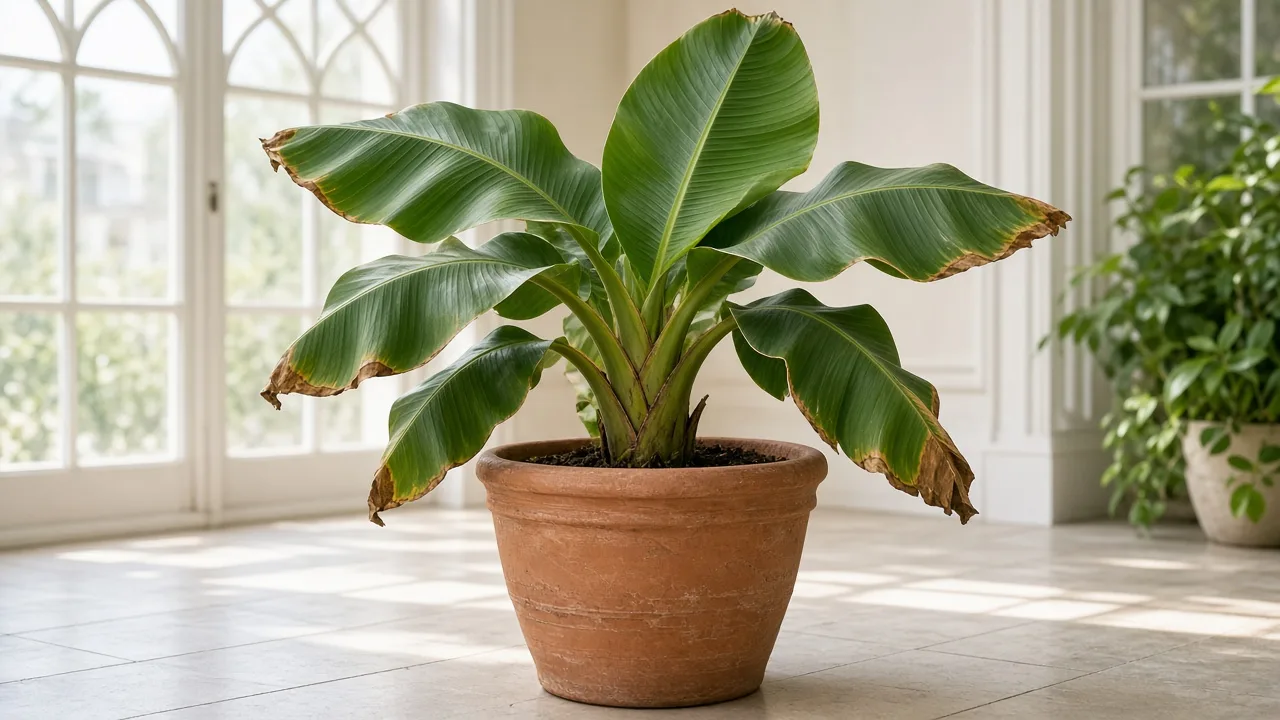
Brown Tips on Banana: Causes, Checks & Fixes
This guide covers brown tips on Banana. See also the general Brown Tips guide, watering, and light pages for this plant.
Brown Tips on Banana: Causes, Checks & Fixes
Quick answer
Brown tips on Musa acuminata mean dry tan tissue at the edge or tip of a huge paddle leaf while the trunk-like pseudostem is still firm—not rot at the base of the plant. For how leaf-edge burn works on houseplants in general, see our brown tips hub. On banana, the first fork is pot weight plus the newest cigar leaf: thirst shows on a light dry pot with folded blades, while salt or wet-root stress browns margins on heavy wet mix.
First step: lift the container and finger-test the top 2–3 cm of mix. Light pot + crispy tips only = underwatering path. Heavy wet pot + margins dying back = overwatering or salt path. Tips on the highest sun-facing leaf after a window move = pull back from harsh glass per the light guide before you soak.
When to use this page vs other Banana guides
| Pattern | Read next |
|---|---|
| Whole paddle yellowing, not just the edge | Yellow leaves |
| Wrinkled folded leaves, very light pot | Underwatering |
| Soft base, sour wet soil | Overwatering or root rot |
| Tips plus stippling and fine webbing | Spider mites |
| Winter crisping near a heater vent | Low humidity |
| Most of the blade brown, not just the tip | Brown leaves |
What brown tips look like on Banana
Unlike spider plant or dracaena, banana carries enormous paddle-shaped leaves on a pseudostem made of tightly packed sheaths—not a woody trunk. Brown tips show at the farthest point of those blades:
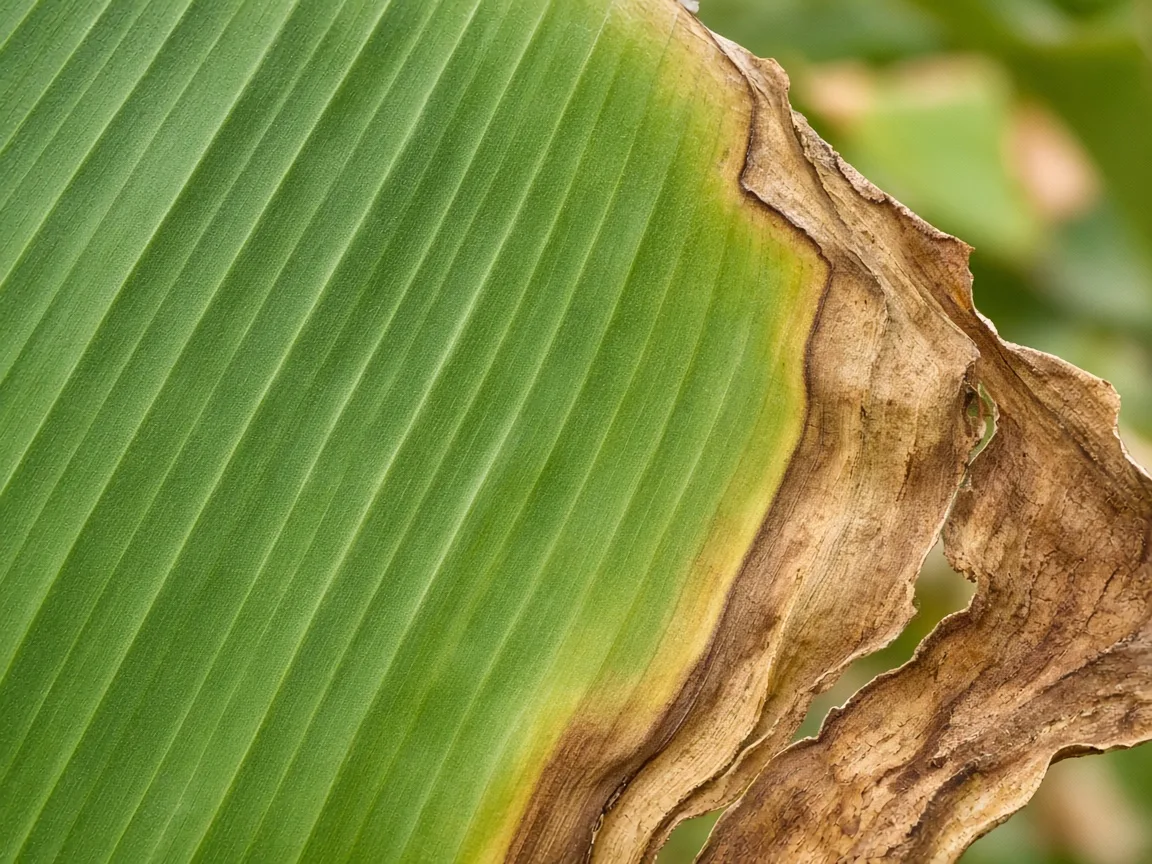
Tan crispy tissue at the leaf margin—the dead edge will not re-green; watch the next cigar leaf for clean unfurling.
- Tan crispy tip or margin only, green leaf base, firm pseudostem — Drought, low humidity, salt buildup, or normal aging on an older outer leaf.
- Brown tips on the highest sun-facing leaf after a sunny move — Heat or light scorch on tender tissue.
- Margins brown with white crust on soil surface — Salt or fertilizer residue; see the fertilizer guide.
- Tips plus pale stippling on leaf undersides — Spider mites before blaming dryness alone.
- Ragged splits mid-blade but green tips — Wind damage, not classic tip burn.
A firm upright pseudostem with a few tan-tipped outer leaves is common on container bananas and not automatically a crisis—banana is a thirsty tropical herb that loses older blade edges quickly when conditions wobble.
Paddle-leaf tip anatomy: why banana edges go first
This section is banana-specific and does not apply to small-leaved houseplants.
- Each leaf can span well over a meter on mature plants, so the tip and margin are the farthest points from the underground rhizome and fibrous root mass.
- New growth arrives as a cigar leaf—a tightly rolled blade emerging from the pseudostem crown. That unfurling tissue is thin and shows scorch or drought damage at the tip before older leaves do.
- Banana is a fast-growing tropical herb with a pseudostem built from overlapping leaf sheaths, not a drought-tolerant succulent. Brief dryness at the leaf edge is common when the huge surface area loses water faster than roots can supply it.
- Outer leaves naturally age out as the mat sends up new blades; tan tips on the lowest leaf while the cigar leaf opens clean often means senescence, not active decline.
Always compare the cigar leaf to one outer paddle. Tip burn climbing into every new unfurl is more urgent than one fading bottom leaf on an otherwise firm plant.
Wind splits vs true brown tips
Banana growers often confuse two different leaf problems:
- Wind shredding — Continuous windy weather can cause severe leaf shredding and drying with tears through the middle of the blade. The torn edges may tan, but the damage pattern is mechanical, not a uniform margin burn from the tip inward.
- True tip or margin burn — Even color change starting at the leaf edge or tip, often paired with folded leaves (drought) or white soil crust (salts).
If only the highest wind-exposed leaf is ragged but margins on sheltered blades stay green, move the pot to a sheltered corner before you change watering. See the Banana overview for placement away from drafty balcony gaps.
The pot-weight and cigar-leaf check
Large ceramic tubs hide both drought and rot on a top-heavy banana. Before you mist leaves or add fertilizer:
- Lift or tilt the pot when you think it is dry versus two days after a deep watering. Learn your dry weight.
- Finger-test the top 2–3 cm per the watering guide. Surface dust-dry on peat-heavy mix can still mean wet soil below.
- Inspect the cigar leaf at the crown. Clean unfurling edges = stable. Tan tips on the leaf still rolled inside the sheath = escalate.
- Press the lowest 5 cm of pseudostem above soil. Firm = tip-level stress. Soft on wet mix = stop water and see root rot.
Do not prune every paddle for cosmetics before you fix moisture, light, or salts.
Why Banana gets brown tips
Musa acuminata evolved in humid tropics with steady warmth and large water demand. Container life amplifies any mismatch between huge leaves and a finite root zone.
Underwatering and uneven dry-down. Drought stress includes folding of the leaves, pale green to yellow color, and premature leaf death. On banana, crisp margins on a light pot often appear before the pseudostem collapses because the plant sheds edge tissue first.
Salt and fertilizer buildup. Banana is a heavy feeder, but excess minerals hurt too. Salt damage symptoms include yellowing and death of the leaf margins. Indoor growers who feed through winter or skip flushing see tip burn with white crust at the pot rim.
Low humidity and heater drafts. Broad paddles lose moisture fast in dry indoor air. Winter heat vents can crisp the highest leaf margins even when the pot is correctly moist—see low humidity when only upper blades are affected in heated rooms.
Heat and light scorch. Temperatures at or above 98°F (37°C) may result in leaf scorch, and sudden harsh afternoon sun through glass can tan the tip of the topmost leaf without softening the pseudostem.
Wind drying. Even without shredding, windy conditions dry banana leaves. Balcony bananas often show tan margins on the windward side first.
Spider mite stippling. Spider mites affect many indoor plants and can bronze leaf edges with pale speckling—confirm with a magnifier before soaking a dry pot.
Normal outer-leaf aging. The lowest paddle on a firm pseudostem may tan at the tip as it senesces, especially after cool slow-growth periods. This is not the same as progressive burn on every new cigar leaf.
How to confirm the cause
- Pot weight — Light versus heavy relative to your last watering.
- Leaf fold — Folded blades point to drought; limp droop on wet mix points to overwatering.
- Cigar leaf — Clean unfurl = stable; tip burn on newest growth = escalate.
- Soil crust — White mineral ring at the rim points to salt stress.
- Blade position — Windward or topmost sun leaf only suggests exposure, not root failure.
- Pest signs — Stippling and webbing on undersides before you blame humidity alone.
First fix for Banana
Weigh the pot, then either deep-water dry mix or move the plant back from harsh wind or glass—do not do both on the same day.
- Light pot + folded leaves + crispy tips only, firm pseudostem — Water deeply until runoff, then resume the watering guide rhythm when the top 2–3 cm dry again. Bananas need about 1 to 1.5 inches of water per week during active growth.
- Heavy wet pot + margins browning inward — Stop watering; improve drainage and see overwatering. Bananas are extremely susceptible to damage from flooding and continuously wet soils.
- White soil crust + tip burn — Flush with plain water at 2–3× pot volume, then hold fertilizer for one month per the fertilizer guide.
- Upper tips scorched after a sunny move — Shift to bright indirect light per the light guide; do not compensate with extra water on a heavy pot.
- Stippled tips with webbing — Isolate and treat per spider mites.
Do not fertilize to “heal” dead tips. Do not repot on day one unless the mix is sour or roots are clearly failing.
Recovery timeline
Brown tip tissue on a banana paddle does not re-green. Judge recovery by firm pseudostem, stable pot-weight dry-down, and a cigar leaf that unfurls with clean edges. Mild drought tip burn often stabilizes within one to two watering cycles after a proper soak. A new paddle may take two to six weeks to fully open once moisture, warmth, and light match the season—banana can produce a leaf weekly in hot active growth but slows sharply below about 16°C (60°F).
Mistakes to avoid
- Soaking because leaf tips look dry while the pot is still heavy and the pseudostem base is firm-wet
- Leaving the plant on an exposed windy balcony because “bananas love sun”
- Fertilizing brown-tipped stressed plants to push new growth
- Confusing wind-shredded mid-blade tears with uniform margin burn
- Trimming every paddle before fixing water, salts, or light
How to prevent brown tips next time
Match watering to top 2–3 cm dry-down and pot weight, use rich draining soil in a stable heavy container, give adequate light without baking the cigar leaf, feed only during active growth per the fertilizer guide, and shelter broad leaves from strong wind. Flush salts periodically if you feed heavily indoors. See the Banana overview and problems hub for sibling guides.
Related Banana guides
Related tool
Use the Plant Problem Diagnosis Tool to narrow causes for brown tips on this plant before changing multiple variables at once.
Conclusion
Brown tips on banana are edge stress on disposable paddle leaves, not pseudostem failure—firm stem first, cigar leaf second. Match soak, flush, shelter, or light adjustment to what pot weight and blade position tell you. Dead tan tips will not recover; watch for a clean unfurling cigar leaf as your success marker.