Spider Mites on Banana: Causes, Checks & Fixes
Quick answer
Spider mites on Banana cause pale stippling and fine webbing on the undersides of large paddle leaves, often in dry winter sunrooms—not folded drought leaves from an underwatered rhizome. First step: isolate the plant and rinse every paddle underside thoroughly with lukewarm water before applying any spray.
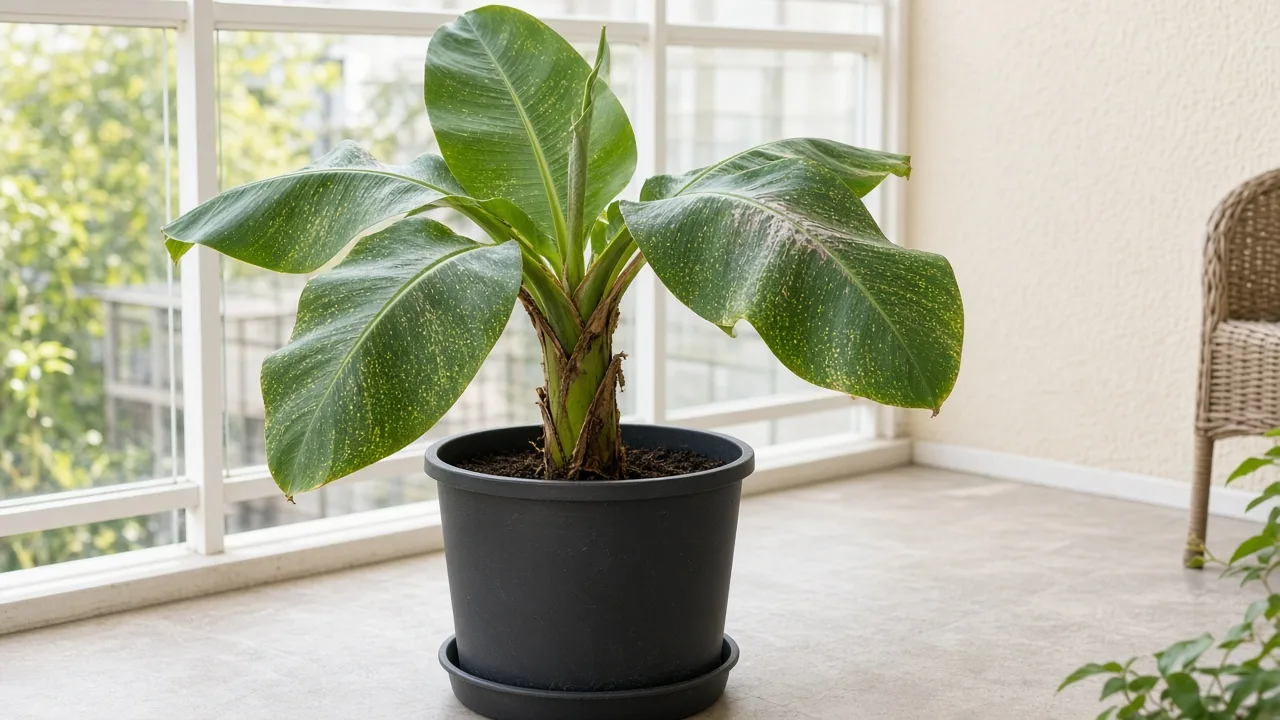
Spider Mites on Banana: Causes, Checks & Fixes
This guide covers spider mites on Banana. See also the general Spider Mites guide, watering, and light pages for this plant.
Spider Mites on Banana: Causes, Checks & Fixes
Quick answer
Spider mites are microscopic sap-feeding arachnids that thrive in warm, dry indoor air. On Banana (Musa acuminata), they pierce the thin tissue of huge paddle leaves and leave pale stippling, dull bronzing, and fine silk webbing along midribs and pseudostem sheaths—not the whole-paddle folding that follows a dry rhizome during underwatering.
First step: isolate the plant and rinse every paddle underside thoroughly with lukewarm water. Support the pseudostem, spray from below, and work from the oldest paddles up to the cigar leaf. Only after you confirm live mites with a tap test or magnifier should you follow with insecticidal soap on labeled intervals.
For how spider mites reproduce, why dry air accelerates outbreaks, and when repeated rinses beat sprays in general, see our spider mites pest guide. On Banana, the diagnostic pattern is fine speckling and webbing on massive leaf undersides in a thirsty tropical herb kept in a dry room—not mushy pseudostem bases from overwatering.
Why Banana gets spider mites
Banana is a fast-growing tropical herb with broad, thin paddle leaves that transpire heavily in heat and sun. That physiology does not protect the plant from spider mites—it creates enormous feeding surfaces that are easy to inspect poorly from across a room.
Mites favor the same dry heated environments where container bananas often spend winter: bright sunrooms with forced-air heat, terrace doors that dry the air, and crowded plant shelves with poor airflow. Spider mites thrive in hot, dry conditions and reproduce quickly when humidity drops and dust coats leaf surfaces.
The banana leaf structure makes early damage easy to miss. Each paddle hangs from a long petiole on an upright pseudostem; the backs of upper leaves face inward and stay shaded unless you lift them deliberately. The tightly rolled cigar leaf at the stem top is soft, fast-growing tissue mites colonize early—yet owners often inspect only the oldest yellowing paddles at the bottom.
Because Musa acuminata grows rapidly in sustained warmth, mite populations can expand quickly once established. UF/IFAS reports strongest shoot growth around 26–28°C—temperatures that also favor mite reproduction indoors. A plant pushing new paddles weekly can look vigorous while stippling spreads on leaves you are not checking.
Introduction from other plants remains the other common path. Mites walk between touching paddles, drift on silk strands, and hitch rides on hands, watering cans, or clothing. Quarantine newly purchased plants before placing them beside a large banana that dominates a display corner.
What spider mites look like on Banana
Early mite feeding:
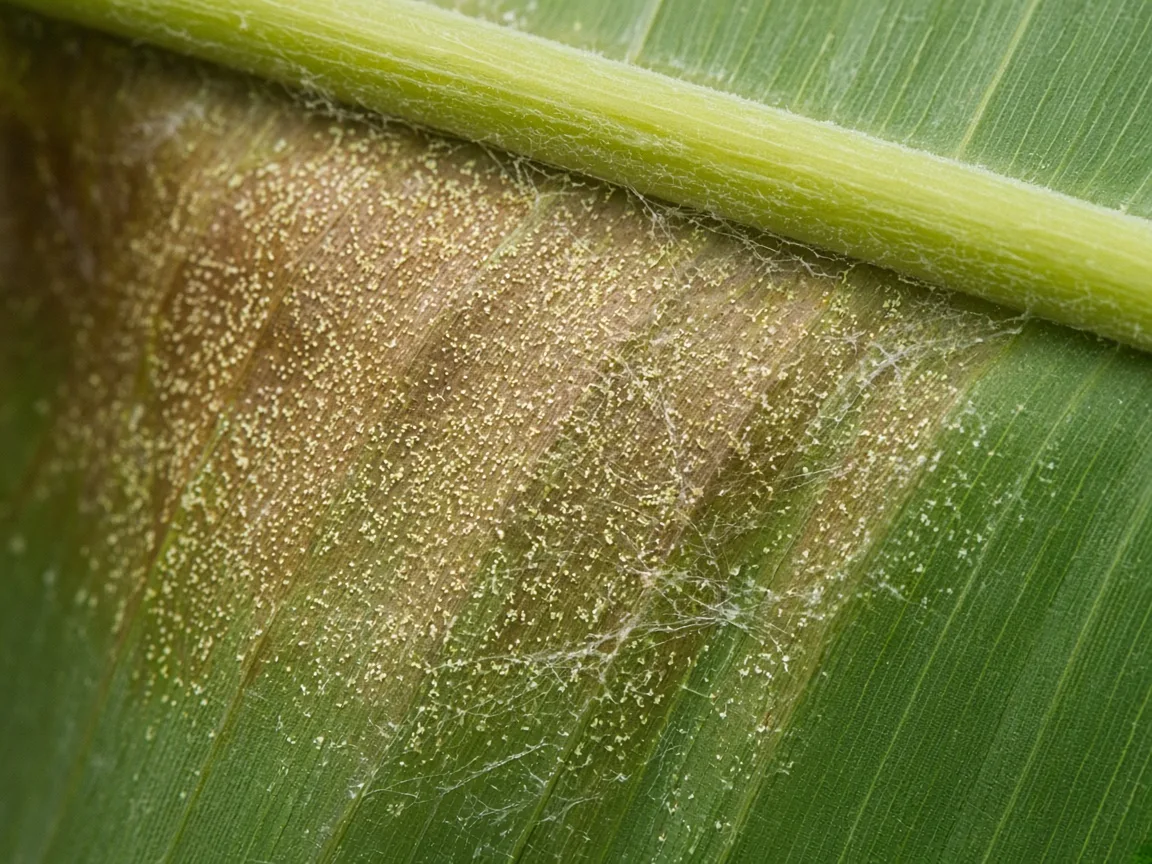
Spider mite stippling on a banana paddle underside—compare speckled tissue with healthy green on the same blade.
- Fine pale yellow or white dots scattered across green paddle surfaces
- Dull, dusty-looking blades that lose their fresh gloss
- Damage often starts on one side of the pseudostem or on lower paddles first
- No webbing yet; the cigar leaf may still look clean
Established infestation:
- Bronze or bleached stippling across many paddles
- Fine silk webbing along midribs, petiole bases, and overlapping pseudostem sheaths
- Tiny moving specks visible with a hand lens on paddle undersides
- Tap test: hold white paper under a paddle and tap sharply—moving dots confirm mites
What banana mite damage is not:
- Whole paddles folding lengthwise with a firm pseudostem and very dry, light pot weight—that pattern fits underwatering, not mites
- Yellowing older paddles while mix stays wet and the base smells sour—overwatering or root rot, without fine stippling or silk
- White cottony masses in sheath seams—mealybugs, not mites
- Distorted, silvery-scraped new growth without webbing—consider thrips and inspect with a lens
Stippled paddle tissue stays marked permanently. New paddles and a clean cigar leaf emerging after treatment are your recovery signals.
Where mites hide on a banana pseudostem
Banana is not a typical houseplant with small leaflets. Mite inspection has to follow Musa architecture:
- Paddle undersides along midribs — the primary feeding zone; spray and inspect here first.
- Petiole bases where blades meet the pseudostem — webbing collects in these sheltered angles.
- Overlapping leaf sheaths on the pseudostem — dust and mites accumulate in dry sheath seams, similar to mealybug hiding spots but with stippling and silk instead of wax.
- The cigar leaf and the paddle unfurling above it — soft new tissue shows damage early; protect this zone during treatment.
- Young sword suckers at the rhizome — side shoots touching the main stem can harbor colonies that reinfect the parent plant.
Skip the rhizome unless you have a separate soil pest issue. Spider mites primarily inhabit foliage, especially undersides—not potting media.
How to confirm the cause
Work through these checks in order:
- Tap test — Hold white paper under a suspect paddle and tap sharply. Watch for tiny moving creatures falling onto the paper.
- Underside inspection — Lift each petiole and examine paddle backs with a magnifier. Look for mites, eggs, cast skins, and early webbing from midrib to edge.
- Stippling pattern — Mites create uniform speckling across the blade surface. Underwatering folds entire paddles without fine dots; low humidity may crisp margins but not produce moving specks or silk.
- Moisture cross-check — Finger-test the top 2–3 cm of mix and lift the pot. Even moisture with firm pseudostem base supports a pest diagnosis; soggy mix with soft base means solve drainage before blaming mites alone.
- Cigar leaf check — Inspect the central emerging leaf. Mite damage here threatens the next month of growth; drought stress usually spares the cigar leaf until later paddles fold.
- Environment and neighbors — Note heating vents, winter glass, and plants on the same terrace. Mites rarely stay on one pot in a shared dry zone.
If stippling appears but the tap test shows nothing and no webbing develops after a week of monitoring, reconsider mechanical dust, fertilizer salts, or nutrient stress before committing to repeated sprays.
First fix for Banana
Isolate the plant and rinse every paddle underside thoroughly with lukewarm water.
Move the banana away from other plants immediately. Mites spread by contact and drifting silk. In a shower or outdoors in mild weather, support the pseudostem with one hand and spray forcefully from below, targeting the backs of all paddles from oldest to newest. Wrap the pot in plastic if needed so soil does not spill and clog the drain while you soak the canopy.
This single step physically removes mites, webbing, and debris before any chemical treatment. Let paddles air-dry the same day. Do not repot, fertilize, or remove half the canopy on day one—those add stress without addressing the pest.
Do not flood the rhizome trying to “wash mites from soil.” Keep the root zone on its normal even-moisture schedule after the rinse; waterlogging weakens Musa while doing little to eliminate foliar mites.
Step-by-step recovery
After the initial rinse:
- Repeat water rinses every five to seven days for at least three cycles. Mite eggs survive single washes; repeat applications are usually necessary.
- Apply insecticidal soap if live mites persist after two thorough rinses. Spray paddle undersides until runoff—soaps only kill on contact. Use products labeled for spider mites; avoid homemade soap concentrations that can burn thin banana tissue in hot sun.
- Treat neighboring plants on the same terrace, shelf, or sunroom at the same time. Mites reinfest from asymptomatic neighbors quickly in dry collections.
- Raise local humidity without waterlogging — rest the pot on a pebble tray or run a humidifier nearby, but do not overwater while chasing humidity. Banana needs moisture at the root zone, not a saturated rhizome.
- Inspect and rinse sword suckers — dab or rinse side shoots that touch the main pseudostem; hidden colonies there restart the infestation.
- Remove severely bronzed paddles only when mostly dead tissue—cut with clean shears once mites are knocked back to improve spray coverage. Leave green stippled paddles; they still photosynthesize until replacements emerge.
Horticultural oil can work on mites but test one paddle first—oils on heat-stressed plants in direct afternoon sun can scorch thin blades. Never spray during peak sun through glass.
Recovery timeline
Water rinses show results within a few days when colonies are moderate—you should see fewer live mites on tap tests. A full soap course with label-interval repeats typically takes two to three weeks because mite generations overlap.
Stippled paddles will not regain their original colour. Watch for a clean cigar leaf and new blades without fresh speckling—on a warm banana that may appear within one to two weeks because growth is rapid in favorable conditions. If new paddles stay stippled after three treatment cycles, reinfestation or insufficient underside coverage is likely—escalate inspection of suckers and nearby plants before adding more sprays.
Lookalike symptoms to rule out
| What you see | Likely cause | Where to go |
|---|---|---|
| Whole paddles folding, pot very light, dry top 2–3 cm | Underwatering | Underwatering on Banana |
| Yellow older paddles, wet mix, soft pseudostem base | Overwatering / rot | Root rot on Banana |
| Crisp margins, no stippling or webbing | Low humidity / salts | Low humidity on Banana |
| White cotton in sheath seams | Mealybugs | Mealybugs on Banana |
| Silvery scrapes on new paddles, no silk | Thrips | Thrips on Banana |
Mistakes to avoid
Do not assume yellow or folded banana tissue means mites—check rhizome firmness and watering rhythm first. Underwatering and overwatering both stress Musa and mimic decline.
Do not spray only the tops of paddle blades. Mites congregate on undersides; target the underside of leaves or treatment fails on large bananas.
Do not stop after one rinse or one soap application. Eggs hatch in cycles; single treatments leave survivors on sheath seams and suckers.
Do not overwater trying to increase humidity. Wet rhizomes weaken banana and invite root problems while doing little to eliminate foliar mites.
Do not repot during an active mite fight unless mix is genuinely failing. Repotting stress on a large container banana delays recovery and spreads mites via tools and scattered mix.
Banana care cross-check
While treating mites, keep baseline care stable:
- Maintain even moisture during active growth—check every few days in heat, less often in cool weather, without alternating drought and flood.
- Provide the brightest realistic light; weak light slows replacement paddles after damage. See the Banana light guide if new leaves are small or widely spaced.
- Hold fertilizer until new paddles look clean. Feeding stressed plants does not speed mite recovery and can burn thin tissue.
- Confirm drainage holes are open and the pot is not oversized—chronic wet mix weakens plants against pests.
How to prevent spider mites on Banana
Quarantine new bananas and outdoor-return containers for two to three weeks before mixing them into a display. Inspect paddle undersides and the cigar leaf weekly during quarantine.
Rinse dusty paddles occasionally in dry seasons—large blades collect dust in sunrooms, and dusty foliage in hot rooms favors mite buildup. A quick underside rinse every few weeks on a healthy plant also removes early colonists.
Keep containers away from heating vents when possible. If the only bright spot is near a vent, use a pebble tray or small humidifier nearby without soaking the rhizome.
Inspect the full collection monthly in winter when indoor air is driest. Lift petioles and check backs of upper paddles—the surfaces most often skipped on tall pseudostems.
Maintain spacing between pots so paddles do not touch. Mites walk between plants on contact; a banana canopy overlapping a neighbor is a bridge.
When to worry
Treat as urgent when webbing spans multiple paddles, stippling reaches the cigar leaf within a week, or several plants in the same room show matching damage. Mites multiply faster than a stressed banana replaces damaged tissue in cool, dim conditions.
Consider discarding a severely defoliated container banana in a shared sunroom if three full treatment cycles fail—heavily infested plants may pose a risk to other plants in the household. The underground rhizome may survive, but reinfection from retained suckers is common.
A few stippled lower paddles on an otherwise firm, evenly watered banana near a winter vent is manageable with isolation and repeated rinsing—not an emergency if you act within days.
Conclusion
Spider mites on Banana show up as stippled, dull paddles and fine webbing in dry heated rooms—not as a soft pseudostem from overwatering. Isolate first, rinse every paddle underside thoroughly, confirm with a tap test, then repeat rinses or insecticidal soap on labeled intervals until the cigar leaf and new paddles emerge clean. Because Musa acuminata grows quickly in warmth, recovery can be faster than on slow houseplants— but only if you inspect the massive leaf undersides and sheath seams mites actually use.
When to use this page vs other Banana guides
- Banana watering guide — Use for routine moisture checks when paddles fold but you see no stippling or webbing.
- Banana problems hub — Browse all common issues on this species.
- Low humidity on Banana — Different entry point when margins crisp without speckled dots or mites on tap tests.
- Underwatering on Banana — Use when the pot is light and mix is dry, not when stippling and silk are present.
Related Banana guides
- Banana plant hub
- Banana watering
- Banana light
- Banana soil
- Low humidity on Banana
- Mealybugs on Banana
- Thrips on Banana
- Banana problems
Related tool
Use the Pest Identifier Tool to narrow causes for spider mites on this plant before changing multiple variables at once.