Underwatering on Banana: Paddle Fold Checks
Quick answer
Underwatering on Banana shows as folded paddle leaves, a feather-light pot, dusty dry mix in the top 2–3 cm, and pale green to yellow blades while the pseudostem base stays firm—not a heavy wet pot with soft tissue. First step: lift the container and finger-test the surface before you pour; if the base is firm and mix is dry throughout, give one thorough soak until water drains freely.
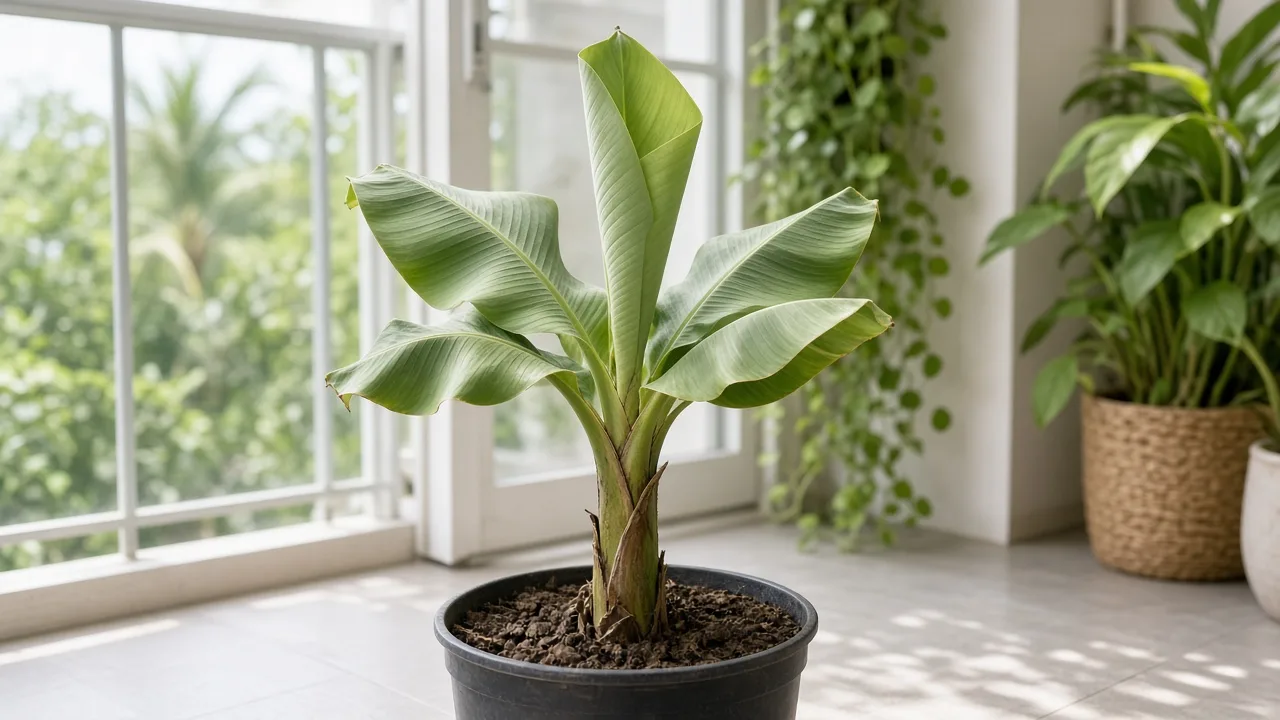
Underwatering on Banana: Causes, Checks & Fixes
This guide covers underwatering on Banana. See also the general Underwatering guide, watering, and light pages for this plant.
Underwatering on Banana: Causes, Checks & Fixes
Quick answer
Underwatering on Musa acuminata is the thirst trap on a giant leaf canopy: a fast-growing tropical herb that evaporates water through enormous paddle blades faster than many houseplants, yet still needs oxygen between soaks. Bananas require large amounts of water and are very sensitive to drought; in a confined pot, a missed watering day in hot sun can fold every blade while the pseudostem still feels firm.
For how chronic dryness damages roots and leaf turgor in general, see our underwatering guide. On banana, the pattern is a light dry pot, dusty mix in the top 2–3 cm, paddle leaves folded lengthwise like a closed fan, and pale green to yellow tissue—not limp hanging blades on heavy wet soil with a soft base.
First step: lift the container and finger-test the top 2–3 cm of mix. Do not water, feed, or repot until you confirm dry soil and a firm pseudostem base. If the pot stays heavy and the base softens, switch to overwatering instead.
When to use this page vs other Banana guides
| Pattern | Read next |
|---|---|
| Heavy wet pot, soft pseudostem base | Overwatering or root rot |
| Light dry pot, folded paddle blades (this page) | Stay here |
| Limp hanging paddles on wet soil | Drooping leaves or wilting |
| Whole paddles yellowing after dry spell | Yellow leaves |
| Tan crispy tips only, firm base | Brown tips |
| Bronze stippling with dry heat indoors | Low humidity or spider mites |
| Brown tissue after prolonged drought | Brown leaves |
What underwatering looks like on Banana
Healthy banana paddles are broad, arching, and held at a graceful angle from the pseudostem. When the root zone runs dry, the change is dramatic on such large blades—UF/IFAS lists drought stress symptoms as folding of the leaves, pale green to yellow leaf color, and premature leaf death.
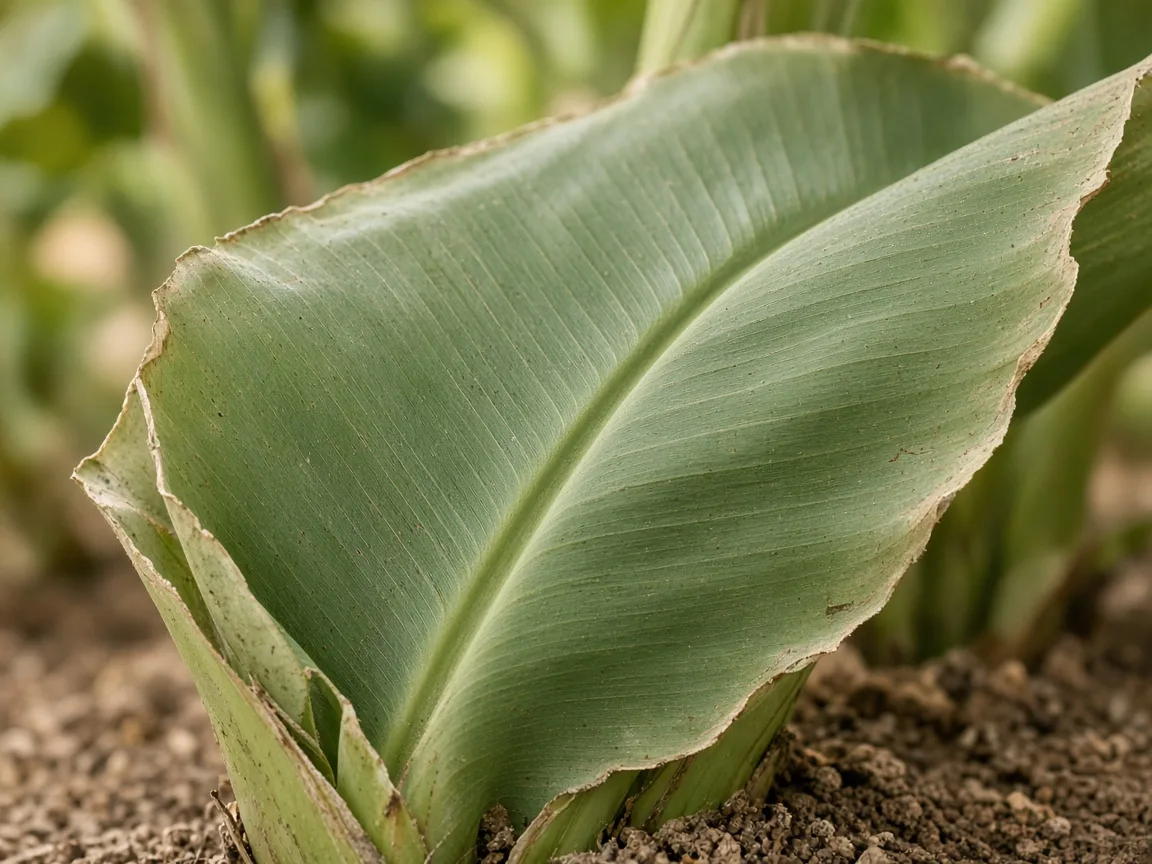
Paddle blade folded along the midrib with pale margins—compare with a still-green cigar leaf at the pseudostem crown.
Early signs
- Feather-light pot compared to its weight right after a thorough soak
- Paddles fold lengthwise like a closed fan, especially in hot afternoon sun
- Top 2–3 cm of mix dusty dry when probed—not just a dry crust over moist soil below
- Pseudostem firm at the soil line; cigar leaf still green and upright
- Pale green to yellow lower paddles before full browning
Advanced signs
- Crispy brown margins on folded blades; see brown tips if only edges are affected
- Premature leaf death—outer paddles brown and hang while new growth stalls
- Cigar leaf limp or brown-tipped before unfurling—crown stress from prolonged thirst
- Pseudostem thinning at the base on a bone-dry pot; severe drought may cause choking and pseudostem collapse
- No new paddle for weeks despite warm bright light and dry mix throughout
A single outer paddle yellowing on an otherwise firm plant is not automatically underwatering—banana naturally sheds older blades. Thirst adds light pot + dry mix throughout + progressive folding to that picture.
Paddle fold vs pseudostem collapse: the banana fork
This plant-only check does not apply to succulents or ferns. On Musa acuminata, the pseudostem is the structural core made of tightly packed leaf sheaths:
- Folded blades + light dry pot + firm base — Confirmed thirst path; one thorough soak after dry-down check.
- Limp hanging paddles + heavy wet pot + firm base — Early root stress from too much water; see overwatering.
- Soft or water-soaked base + wet pot — Root failure, not thirst; inspect for root rot.
- Folded blades + firm base + pot weight normal — Afternoon heat wilt; may recover by evening without extra water if mix is moist below the surface.
Always trust pseudostem firmness at the soil line over how green the upper paddles look. A banana can carry several upright paddles while the confined root ball has been dry for days.
The cigar-leaf crown check
New growth on banana arrives as a cigar leaf—a tightly rolled paddle emerging from the top of the pseudostem. This crown tissue is the fastest read on whether drought is starving the plant:
- Cigar leaf unfurling green with clean edges — Root zone still functional even if outer paddles folded.
- Cigar leaf limp, brown-tipped, or stuck inside the sheath — Escalate; crown stress often follows prolonged dry spells during active warm growth.
- No cigar leaf movement for weeks on light dry soil — Growth has stalled; soak thoroughly before fertilizing.
Compare the cigar leaf to the lowest outer paddle. Folding only on the bottom leaf while the cigar leaf opens clean often means senescence on an otherwise healthy mat. Folding climbing into every new unfurl on a light dry pot is urgent thirst.
Giant-canopy trap: why container bananas dry out fast
Large paddle leaves and a restricted root volume create a mismatch many growers underestimate:
- Huge transpiring surface — A single mature paddle can lose water rapidly in direct sun and wind; NC State recommends moist well-drained soil and warns not to let it dry out.
- Small pot relative to canopy — A top-heavy banana in a modest container may need inspection daily in heat above about 26°C (79°F), not weekly calendar watering.
- Wind on balconies — Constant breeze dries and shreds leaf tissue, increasing water demand beyond what indoor schedules assume.
- Winter pause confusion — RHS advises letting compost dry out before the next watering indoors over winter, but bone-dry mix for weeks in a heated room still stresses roots.
Match watering to pot weight and season, not a fixed interval copied from a smaller houseplant.
How to confirm underwatering on Banana
Run this sequence before you soak:
- Lift the pot off the saucer. A noticeably lighter container than after your last thorough water supports thirst.
- Finger-test or skewer the top 2–3 cm. Dusty dry mix that stays dry when pushed deeper—not just surface crust—confirms drought.
- Press the lowest 5 cm of pseudostem above the soil line. Firm green tissue on dry mix points here; soft tissue on wet mix points to overwatering.
- Read the cigar leaf. Green and unfurling = salvageable; brown and stuck = prolonged stress.
- Check recent changes. New south window, heat wave, smaller pot after division, or missed vacation watering all raise demand without changing the plant’s biology.
Rule out lookalikes:
| Pattern | Likely cause | Next page |
|---|---|---|
| Folded blades, light pot, firm base | Underwatering (this page) | Stay here |
| Limp blades, heavy pot, yellow lowers | Wet-root stress | Overwatering |
| Folded blades, normal pot weight, evening recovery | Heat or wind wilt | Drooping leaves |
| Crispy tips on every paddle, dry heat indoors | Low humidity | Low humidity |
| Pale stretched growth before folding | Insufficient light | Not enough light |
RHS notes that limp leaves are usually a sign of under- or over-watering—the pot weight split above is how you tell them apart on banana.
The first fix to try
Give one thorough soak until water runs freely from the drainage holes—only after confirming dry mix and a firm pseudostem base.
Steps:
- Take the pot to a sink or outdoors. Remove any cachepot that traps runoff.
- Water slowly until the entire root ball rewets and excess drains out the bottom. Dry peat can repel water on first contact—a second slow pass may be needed if water runs straight through.
- Empty the saucer. Never leave the pot standing in runoff.
- Place back in bright warm conditions and recheck pot weight in 24 hours.
Do not fertilize, repot, or prune multiple paddles on the same day. One correction, then read the response.
If mix was dry only at the surface but heavy and wet below, you were not underwatered—see overwatering.
Recovery timeline
| Stage | What to expect |
|---|---|
| Hours 0–24 | Folded paddles often regain stiffness after a proper soak if the pseudostem stayed firm |
| Days 2–7 | Cigar leaf resumes unfurling; outer yellow or crispy paddles may stay damaged |
| Weeks 2–4 | New clean paddle blades open; judge success by crown growth, not old tissue re-greening |
| Beyond 4 weeks | If no cigar leaf movement on previously dry soil, inspect roots and soil before assuming thirst alone |
UF/IFAS notes drought increases time to flowering and reduces fruit size—even ornamental container bananas stall growth when the root zone stays dry too long during warm active months.
Mistakes to avoid
- Watering on a calendar instead of pot weight—banana use changes daily with heat, wind, and canopy size.
- Misting folded paddles instead of rewetting the root ball—surface moisture does not replace a dry rhizome zone.
- Assuming droop always means thirst on a heavy wet pot—wet-root failure looks similar; lift first.
- Feeding a drought-stressed plant before moisture is restored—fertilizer on dry roots burns fine root hairs.
- Repotting into a much larger tub as the first fix—extra dry mix can stay bone dry around a stressed root ball; stabilize watering first.
- Letting winter dry-down become weeks of neglect in a heated room—reduce frequency, not elimination.
How to prevent underwatering next time
Align routine with the Banana watering guide:
- Check every 2–3 days in hot active growth; weekly or less may suffice in cool indoor conditions.
- Water when the top 2–3 cm is dry and the pot feels lighter—UF/IFAS recommends about 1 to 1.5 inches of water per week during active growth as a field reference, but container size and heat override any calendar.
- Use organically rich, moisture-retentive but freely draining mix per the soil guide.
- Shelter from constant wind on exposed balconies to reduce transpiration loss.
- Learn the pot’s weight right after a thorough soak versus when dry—that tactile check beats guessing.
Inspect weekly while problems are small. See the Banana overview and problems hub for sibling guides.
Related Banana guides
Related tool
Use the Plant Watering Calculator to narrow causes for underwatering on this plant before changing multiple variables at once.
Conclusion
Underwatering on banana is dry-root thirst on a water-hungry giant herb—firm pseudostem base first, cigar leaf second, pot weight third. One thorough soak after confirmation beats daily dribbles or panic repotting. Folded yellow paddles will not fully re-green; watch for a clean unfurling cigar leaf and a pot that regains normal weight rhythm within days.