Brown Leaves on Banana: Causes, Checks & Fixes
Quick answer
Brown leaves on Banana usually mean cold or wind damage on broad paddles, drought crisp on dry mix, rot brown on a wet heavy pot, or normal aging of lower leaves on an otherwise firm pseudostem. First step: squeeze the pseudostem base and check the emerging cigar leaf before cutting anything.
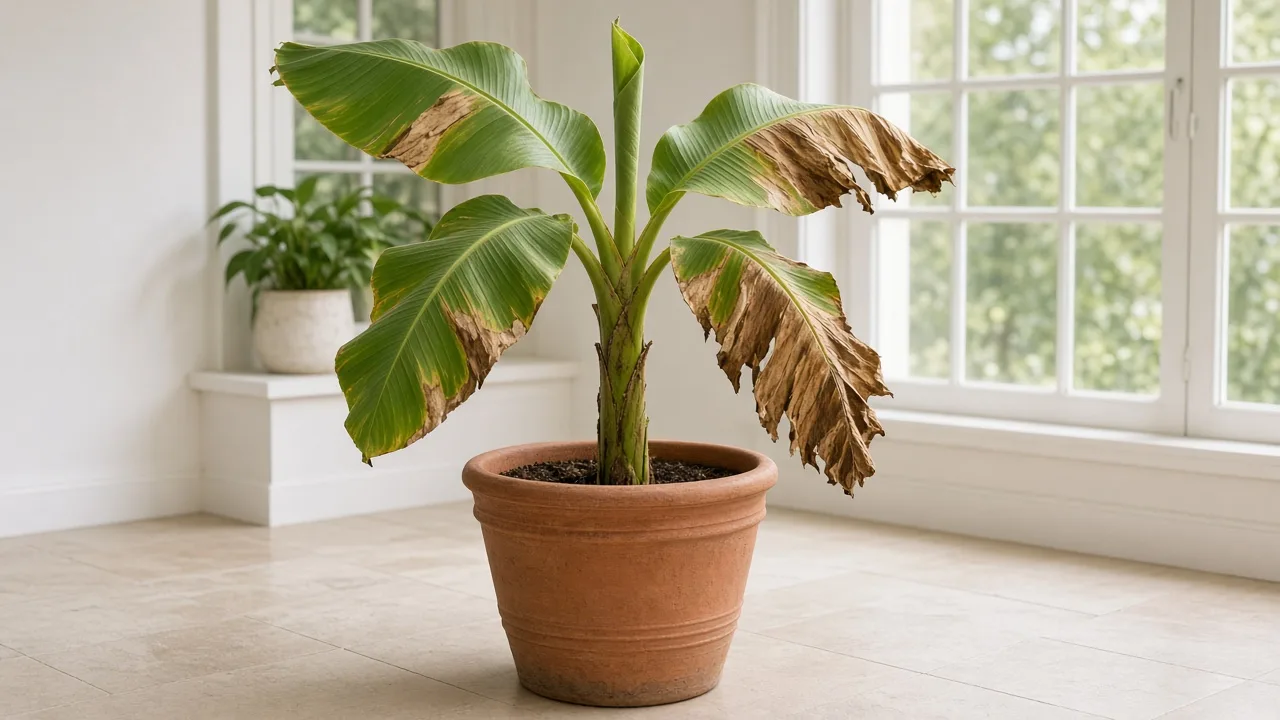
Brown Leaves on Banana: Causes, Checks & Fixes
This guide covers brown leaves on Banana. See also the general Brown Leaves guide, watering, and light pages for this plant.
Brown Leaves on Banana: Causes, Checks & Fixes
Quick answer
Brown leaves on Banana (Musa acuminata) alarm owners because the plant looks tropical and indestructible until a cold night or a waterlogged pot proves otherwise. Huge paddle blades should stay deep green while the pseudostem stays firm. Brown tissue is dead tissue—from chill, wind shred, drought crisp, rot on wet mix, leaf disease, or the natural death of older leaves on a fast-growing stem.
For how broad leaf browning works across houseplants, see our brown leaves guide. On Banana, squeeze the pseudostem base and read the emerging cigar leaf first: soft brown with a heavy wet pot points to overwatering or root rot; crispy brown margins on a light dry pot points to underwatering; water-soaked brown patches after a cold spell points to chill or freeze injury on exposed paddles.
When to use this page vs other Banana guides
- Yellow leaves — yellow before brown on wet soil or during drought fade
- Brown tips — margin-only crisp without full paddle death
- Wilting or drooping leaves — folded paddles before tissue turns fully brown
- Black spots — Sigatoka-style leaf spots rather than whole-blade browning
- Not enough light — pale stretched growth before lower leaves senesce
- Overview and problems hub — care baseline and sibling symptoms
What brown leaves look like on Banana
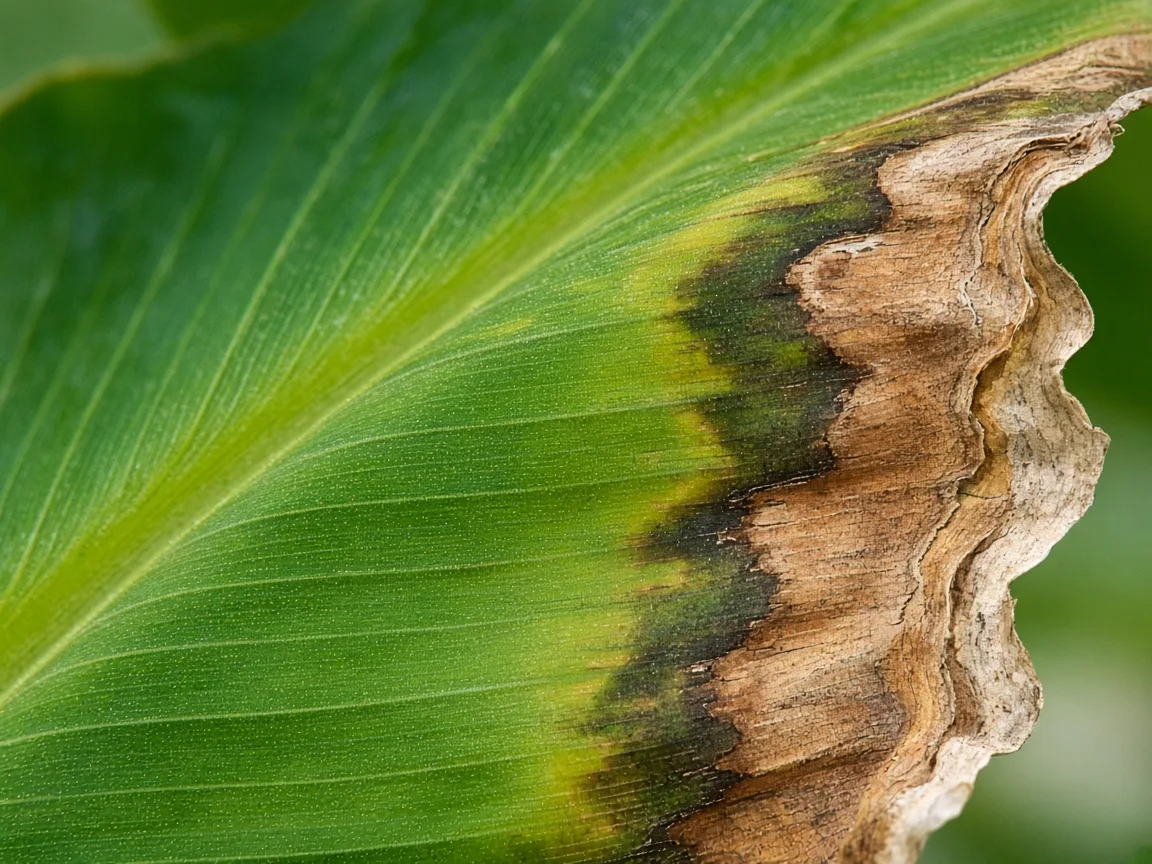
Tan-to-brown necrosis along banana paddle margins and between wind-ripped sections—compare with the still-green cigar leaf at the pseudostem crown.
Cold and chill brown:
- Water-soaked tan patches that dry to crisp brown overnight
- Entire paddles collapse and hang limp after frost or a cold draft
- Pseudostem may look bruised; emerging cigar leaf may stall
- Often follows exposure below about 16°C (60°F) indoors or near an open window
Wind-shred brown:
- Torn paddle edges turn brown along rips and dry strips
- Leaves look shredded but pseudostem stays firm
- Common on balconies and terraces without wind shelter
Drought brown:
- Crispy brown margins and tips on otherwise green paddles
- Pot feels light; mix dry below the top 2–3 cm
- Leaves may fold before edges fully necrose
Wet-soil rot brown:
- Yellowing lower paddles turn soft brown while soil stays wet
- Pseudostem base feels spongy or smells sour
- New cigar leaf may brown before unfurling
Normal aging brown:
- One or two lowest paddles brown slowly from the petiole outward
- Rest of pseudostem firm; cigar leaf green and upright
- No wet soil, no overnight collapse after cold
Why chill and wind brown Banana paddles before other houseplants
Banana is a true tropical herb with broad, easily torn leaves on a fleshy pseudostem—not a woody trunk with a protective bark layer. UF/IFAS reports that growth slows below 16°C (60°F) and stops near 10°C (50°F). Chilling injury between freezing and 16°C can dull fruit and distort growth; at or below 0°C, freeze symptoms include a water-soaked look and desiccation, browning, and death of leaves and pseudostems.
That physiology explains why a banana on a winter windowsill can brown overnight while a pothos beside it looks fine. The same guide notes that continuous wind shreds paddles, dries leaf tissue, and can distort the crown—so brown after a stormy week on an exposed terrace is often mechanical drying, not disease.
Reading the pseudostem base and cigar leaf
Each pseudostem is a stack of overlapping leaf sheaths rising from an underground rhizome. The cigar leaf—the tightly rolled new paddle at the crown—is your best early warning. If it stays bright green and upright while one lower paddle browns, aging or localized damage is likely. If the cigar leaf browns, stalls, or fails to unfurl while the base softens, the rhizome zone is under stress from cold, waterlogging, or vascular disease.
Press the pseudostem 10–15 cm above the soil line. Firm and solid supports cosmetic trimming of dead paddles. Soft, waterlogged tissue on a heavy pot demands dry-down and inspection before you remove more leaves—cutting away living sheaths cannot fix saturated mix.
How to confirm the cause
| Pattern | Pseudostem base | Pot weight | Cigar leaf |
|---|---|---|---|
| Chill / freeze brown | Firm or bruised, not spongy | Normal | Stalled or limp after cold night |
| Wind shred brown | Firm | Normal | Green; paddles torn at edges |
| Drought crisp brown | Firm | Light, dry | May fold; still green if caught early |
| Wet rot brown | Soft, sour | Heavy, wet | Browns before unfurling |
| One lower paddle aging | Firm | Normal dry-down | Green and active |
Lift the container and finger-test the top 2–3 cm per your watering guide. Check whether brown appeared after a weather event versus after a watering change. Inspect leaf undersides for spider mite stippling if paddles bronze in dry indoor heat without cold or wind exposure.
First fix for Banana
Feel the pseudostem base and read the cigar leaf before cutting anything. That single check routes you to the right next step:
- Soft base + wet heavy pot: stop watering, confirm drainage holes are open, and move to a brighter warm spot to speed dry-down—see overwatering before repotting.
- Crispy margins + light dry pot: one deep soak until water drains freely, then resume even moisture per watering—not daily splashes on dry surface only.
- Water-soaked brown after cold: move to a frost-free position above 16°C, shelter from drafts, and delay heavy leaf removal until you see whether the cigar leaf resumes growth.
- Wind-shredded edges only: stake or relocate to a sheltered corner; trim fully dead brown strips without stripping the whole crown.
Do not fertilize a browned plant until new paddles unfurl cleanly for several weeks.
Step-by-step recovery
- Identify the pattern using the table above and recent weather or watering history.
- Cold damage: move indoors or away from glass on cold nights; keep rhizome zone warm. UF/IFAS notes that plants killed to the ground often resprout from the rhizome when warmth returns—patience matters.
- Drought: soak once, then maintain even moisture without leaving the pot saturated.
- Rot: stop water, inspect roots if the base stays soft, repot into fresh airy mix only if tissue is actively decaying.
- Wind: relocate and remove fully dead torn sections; keep the cigar leaf intact.
- Monitor new paddles over four to eight weeks—clean unfurling confirms recovery.
Lookalikes to rule out on Banana
| What you see | Likely cause | Next page |
|---|---|---|
| Yellow lower paddles on wet soil | Oxygen loss at roots | Yellow leaves / overwatering |
| Brown margins only, firm stem | Drought or salt edge burn | Brown tips / underwatering |
| Dark spots with yellow halos | Leaf spot disease | Black spots |
| Bronze stippling, fine webbing | Spider mites in dry heat | Spider mites |
| Overnight limp paddles after frost | Chill injury | This page — cold protocol |
Rot vs. cold: Soft pseudostem with sour wet soil is a root-zone emergency. Firm pseudostem with water-soaked paddles after one cold night is chill damage—do not repot and soak on the same day.
Aging vs. crisis: One lowest paddle browning over weeks while the cigar leaf stays green is normal on a pseudostem that may carry 40 or more leaves in its lifetime. Multiple paddles failing within days is not.
What not to do
- Do not cut the pseudostem to the ground after the first cold night if the rhizome zone stayed warm—wait for the cigar leaf to show whether the stem can recover.
- Do not keep watering a soft, waterlogged base hoping green tissue returns—brown will climb the sheaths.
- Do not expose a chilled plant to hot afternoon sun immediately—scorch can brown recovering paddles.
- Do not assume brown margins always mean underwatering on a heavy wet pot—confirm pseudostem firmness first.
- Do not stack repotting, heavy pruning, and pesticide on the same day unless pest ID is confirmed.
When to worry
Treat as urgent when the pseudostem base goes soft, several paddles brown within a week on wet soil, the cigar leaf dies before unfurling, or sour smell rises from the pot—rot or severe vascular stress is advancing.
Lower urgency: one lower paddle slowly browning on a firm pseudostem with a healthy cigar leaf and normal light and moisture rhythm.
Recovery timeline
Wind and drought damage usually stops spreading within one to two weeks after shelter or corrected watering. Chill injury may take several weeks before a new paddle unfurls; rhizome resprout after hard freeze can take months in warm conditions.
Judge recovery on the cigar leaf and the next unfurling paddle, not on old brown blades you already trimmed. NC State Extension describes large arching green paddles as the healthy norm—persistent brown on wet soil means the rhizome zone still needs rescue.
How to prevent brown leaves
Shelter Banana from strong wind on balconies and use a windbreak where RHS guidance recommends it for container plants. Keep the plant frost-free and avoid cold windows in winter—growth below 16°C slows and chill browning becomes likely.
Water for even moisture without saturation using your watering and soil guides. In cool seasons, reduce water as growth slows so cold roots are not sitting in wet mix. Acclimate nursery paddles gradually to full sun so heat scorch does not brown new unfurling leaves above 37°C (98°F).
Related Banana guides
- Overview — warmth, light, and moisture baseline
- Problems hub — all sibling symptoms
- Pruning — when and how to remove spent pseudostems
- Watering — dry-down checks for thirsty paddles
- Root rot — soft base rescue protocol