Not Enough Light on Banana: Causes, Checks & Fixes
Quick answer
Not enough light on Banana shows as long thin petioles, pale or undersized paddle leaves, and a slow or weak cigar leaf even when the mix stays damp. First step: move the container to the brightest spot with at least six hours of direct sun on the foliage, acclimating gradually if the plant was in deep shade.
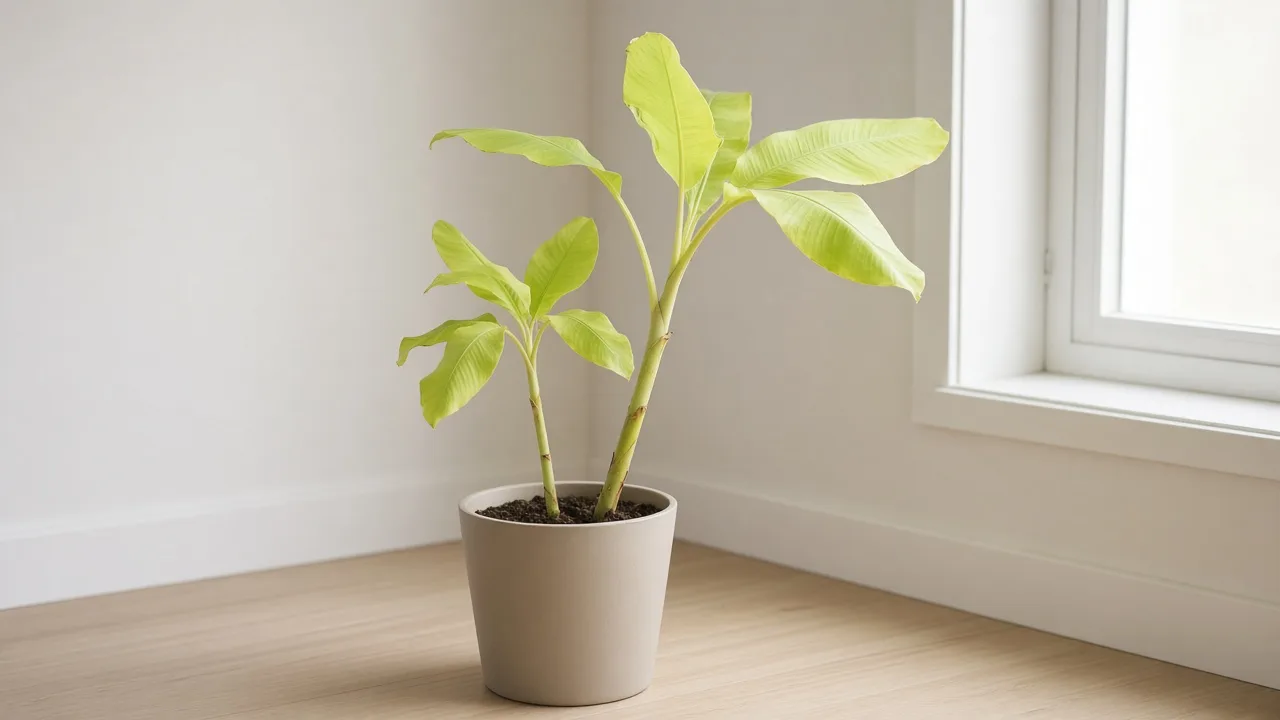
Not Enough Light on Banana: Causes, Checks & Fixes
This guide covers not enough light on Banana. See also the general Not Enough Light guide, watering, and light pages for this plant.
Not Enough Light on Banana: Causes, Checks & Fixes
Quick answer
Banana (Musa acuminata) is a fast-growing tropical herb that builds huge paddle leaves from a fleshy pseudostem when warmth, moisture, and bright light align. In too little light, the plant survives longer than many houseplants—but paddles stay pale, small, or far apart, the cigar leaf at the crown unfurls slowly, and the whole container leans toward the brightest gap.
For how chronic low light limits photosynthesis in general, see our not enough light hub. On Banana, the decisive check is direct sun hours on the paddle leaves—not whether the room looks bright to you.
First step: move the container to a site with at least six hours of direct sun on the foliage, introducing stronger light gradually if the plant lived in deep shade.
When to use this page vs other Banana guides
This page is the symptom-first entry for shade-stressed banana—pale paddles, thin stretched petioles, and stalled crown growth without necessarily obvious pest damage.
- Leggy growth — go here when elongated petioles and strong directional lean are the main pattern
- Pale leaves — go here when washed-out color dominates but petiole length looks normal
- Slow growth — go here when cool soil below 16°C (60°F) is slowing everything despite good light
- Yellow leaves — go here when older paddles fade on wet soil or during drought stress
- Light guide — go here for long-term placement, acclimation, and grow-light backup
- All banana problems — full cluster index
What not enough light looks like on Banana
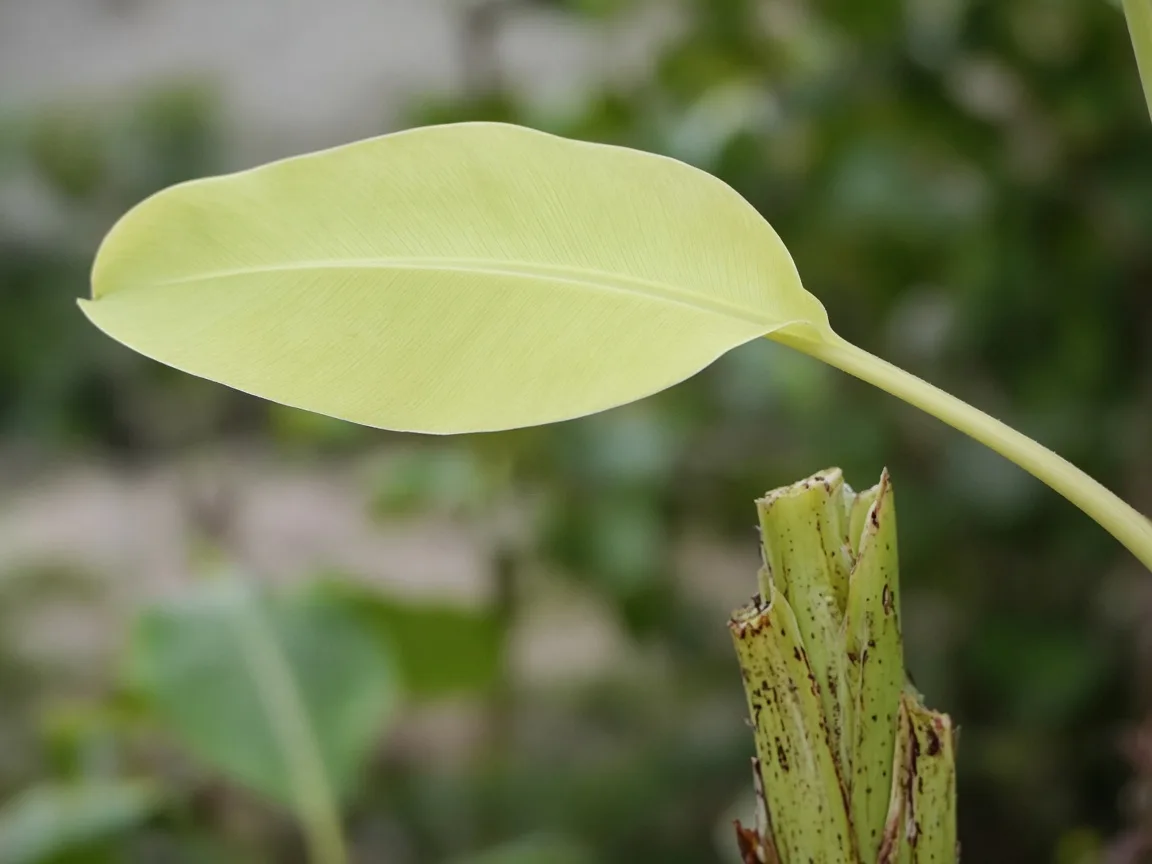
Pale yellow-green paddle blade on a noticeably long thin petiole—the classic etiolation pattern on a shade-stressed pseudostem before the next leaf unfurls.
Healthy banana in strong light produces broad deep-green paddles on relatively short stiff petioles, with a cigar leaf that pushes steadily during warm weather. Shade-stressed plants break that pattern in ways that differ from a dry succulent:
- Long thin petioles between paddles, sometimes with the whole pseudostem leaning toward a window or terrace opening
- Undersized paddle blades compared with leaves the same plant made in a brighter season—even when water and feed seem adequate
- Pale yellow-green color that never deepens to the rich green of sun-grown foliage
- Slow or weak cigar leaf at the pseudostem crown; unfurling may take weeks in a dim room while the mix stays damp
- Wide gaps between new leaves on an otherwise firm pseudostem
- Soft, thin new tissue that aphids and other pests colonize more easily than firm sun-grown blades
- No flower or fruit on mature pseudostems indoors, even after years of care—often the clearest long-term light-stress signal
This differs from drooping leaves when paddles fold from drought, from overwatering when the pseudostem base goes soft on heavy wet soil, and from low humidity when crisp brown margins appear on otherwise well-lit paddles.
Why Banana gets not enough light
UF/IFAS reports that banana plants are moderately shade tolerant up to about 50% shade, but shading delays plant and fruit growth and development. In subtropical production, full or near-full sun is recommended for best growth; excessively shaded plants are stunted and produce small, poor-quality fruit. UF/IFAS also lists the landscape light requirement as full sun to partial shade—tolerance is not the same as thriving.
Banana evolved as an upright tropical herb with enormous leaves that must capture intense equatorial light. When photons fall short, the plant extends petioles to reach a brighter patch and reduces blade area—classic etiolation—while the underground rhizome burns stored energy to keep the pseudostem alive.
Banana-specific triggers:
- Bright room, no direct sun — many living rooms look luminous to human eyes while paddle leaves receive far less energy than outdoors. A banana can keep leaves in bright indirect light while growth stalls.
- North-facing or tree-shaded windows — partial shade is workable in very hot climates, but a container that never receives direct rays through glass rarely supports vigorous Musa acuminata.
- Moved indoors for winter without supplemental light — the RHS growing guide expects a warm sunny room, conservatory, or heated greenhouse over winter; an ordinary dim interior corner stretches petioles by spring.
- Outdoor summer shade creep — a terrace that was sunny in early spring can become partially shaded once nearby trees leaf out, causing mid-season pale paddles and stalled cigar leaves.
- Dwarf Cavendish in a dim corner — compact cultivars need less height, not less sun. Labels that say “indoor banana” still describe a full-sun crop bred for containers.
- Competition from taller plants — grouped patio displays often shade the banana’s crown while lower pots still receive light at soil level.
Do not assume slow growth in cool weather is always light-related. Growth below about 16°C (60°F) slows sharply; confirm warmth before blaming shade alone.
Reading the cigar leaf in dim light
Each pseudostem is a stack of overlapping leaf sheaths topped by the cigar leaf—the tightly rolled new paddle. That crown tissue is a banana-only diagnostic you cannot use on compact houseplants.
| What you see at the crown | What it usually means | First adjustment |
|---|---|---|
| Green cigar leaf unfurling slowly in a dim room | Light limiting photosynthesis; water use is also low | Move to brighter direct sun; do not water on a calendar |
| Cigar leaf pale, thin, or stalled for weeks | Chronic shade etiolation | Relocate to six or more hours of direct sun at leaf height |
| Cigar leaf browns before unfurling on wet heavy soil | Rot or chill overlapping shade stress | Check pseudostem firmness; see root rot if base is soft |
| Strong green cigar leaf but tiny paddles below | Recent shade after a bright season, or nitrogen issue | Confirm sun hours; cross-check nitrogen deficiency only after light is adequate |
Press the pseudostem 10–15 cm above the soil line. Firm and solid with a pale slow cigar leaf points to placement, not emergency repotting. Soft and waterlogged on a heavy pot demands dry-down first regardless of light.
Paddle size vs petiole length: a banana-only light check
Banana etiolation shows up in the ratio between petiole length and paddle width—not just overall paleness.
Compare the newest fully unfurled paddle to one from last summer in a sunnier spot, or to a neighbor container in full terrace sun:
- Long petiole + small paddle — strong shade signal; the plant is reaching
- Normal petiole + pale paddle — may overlap with iron deficiency or cool roots; confirm sun first
- Normal petiole + deep green paddle — light is likely adequate; look at water, pests, or temperature
- Paddles leaning all one direction — trace the lean line to the brightest gap; that is where the plant wants to live
If the pot dries slowly while leaves look weak, low light is reducing transpiration—do not interpret damp mix alone as overwatering without checking how many direct sun hours the canopy receives.
Sword suckers in shade
Banana renews itself from the underground rhizome through sword suckers—narrow upright shoots—and broader water suckers. In good light, sword suckers grow vigorously and can replace a fruiting pseudostem after harvest. In chronic shade:
- Sword suckers stay thin and pale with long leaves close together
- Water suckers may dominate because the mat lacks energy for strong upright growth
- New suckers lean toward the brightest side of the pot
Correct sun on the mother pseudostem before dividing weak shade-grown suckers for propagation. A sucker etiolated in dim light will not suddenly thicken without brighter placement.
How to confirm the cause
Work through these checks in order:
- Sun-hour count at paddle height — on three clear days, note when direct rays first hit the leaves and when shade takes them. Under six hours strongly points to light stress per NC State full-sun guidance referenced in our light guide.
- Cigar leaf pace — in warm weather above about 20°C (68°F), a well-lit banana should push visible crown growth regularly. A stalled cigar leaf in a dim room is a classic shade signature.
- Petiole comparison — measure or photograph petiole length on the newest leaf versus an older sun-grown paddle on the same pseudostem.
- Lean direction — walk the angle the pseudostem tilts; find the window, wall opening, or terrace edge it reaches for.
- Water-use cross-check — finger-test the top 2–3 cm per your watering guide. Shade-stressed bananas use water slowly; confirm you are not keeping cold wet mix because the calendar says “tropical plant.”
- Temperature context — growth below 16°C slows even in good light. If the room is cool, pair light correction with warmer placement before expecting new paddles.
If the plant receives six or more hours of direct sun at leaf height, the pseudostem is firm, and paddles stay pale, move to nutrition, pests, or root issues—not more shade.
First fix for Banana
Move the container to the brightest available position with at least six hours of direct sun on the paddle leaves.
If the banana lived in deep shade or behind glass with no direct rays, acclimate over seven to fourteen days: start with gentle morning sun or bright shade, then add direct exposure incrementally so existing paddles do not bleach. UF/IFAS recommends full sun for best growth; abrupt moves from a dim interior to harsh midday terrace sun in summer can scorch tender blades.
Do not repot, divide suckers, or push fertilizer on the same day you notice stretch—that stacks variables and can burn a fragile cigar leaf. Fix placement first and read the next unfurling paddle.
Step-by-step recovery
After the light correction:
If shade was the main issue:
- Hold the new placement stable for two to three weeks so incoming leaves can respond.
- Rotate the container slightly each week if one-sided window light caused lean, once most of the canopy receives direct sun.
- Resume feeding only after several firm greener paddles unfurl—fertilizer cannot replace photons on a dim plant.
- Remove only fully spent lower paddles; keep as much green blade area as the pseudostem can support while it rebuilds.
If the plant was indoors:
- Move to the brightest unobstructed window or add a broad-spectrum grow light if direct sun never reaches the leaves.
- Expect fruiting to remain unlikely unless you can provide conservatory-level brightness year-round; foliage recovery is a realistic indoor goal.
If wet soil compounded shade stress:
- Let the top 2–3 cm dry before the next watering once brighter light increases water use.
- Improve soil drainage only if mix stays soggy for days after correction—not on day one.
Recovery timeline
Existing pale or stretched paddles usually do not fully resize. Judge success on the next one to three unfurling leaves:
- Shorter, stouter petioles
- Deeper green paddle color
- Faster cigar leaf emergence in warm weather
Mild shade correction often shows in two to four weeks during active growth. A banana that spent a full dim winter indoors may need the entire warm season to rebuild canopy density. Flower stalks, if they ever form, require a long sunny growing season on a mature uninterrupted pseudostem—do not expect buds from a chronically shaded container.
Lookalike symptoms
| Pattern | Likely cause | Where to go |
|---|---|---|
| Long petioles, pale small paddles, firm base | Not enough light | This page |
| Pale paddles, normal petiole, cool room | Temperature or iron stress | Slow growth or iron deficiency |
| Yellow lower paddles on wet heavy soil | Overwatering / rot | Overwatering |
| Folded paddles, light dry pot | Drought | Underwatering |
| Crisp brown margins in bright dry heat | Low humidity or sun scorch | Low humidity or brown tips |
What not to do
- Do not keep watering on a tropical schedule when low light has slowed water use—cold wet mix plus shade invites rot.
- Do not fertilize heavily hoping darker green returns without brighter placement.
- Do not place a shade-grown banana in harsh midday sun in one step—acclimate to prevent bleached paddles.
- Do not assume a dim room is fine because leaves are still green—banana can linger in suboptimal light while petioles lengthen every month.
- Do not repot into a larger container to fix stretch; root room does not replace sun.
How to prevent not enough light
Site outdoor containers in full sun during frost-free months with wind shelter for the broad paddles. Indoors, use the brightest unobstructed window and supplement with grow lights if direct rays never touch the leaves—details in the light guide.
Re-check placement after spring tree leaf-out on terraces and when moving plants back indoors in fall. Group displays should not let taller neighbors shade the banana crown. Treat dwarf cultivars as space-saving, not shade-tolerant.
Related Banana guides
- Overview — warmth, light, and moisture baseline
- Problems hub — all sibling symptoms
- Watering — dry-down checks that change with light level
- Fertilizer — feed only when active growth and sun align
- Pruning — removing spent pseudostems after decline