Nitrogen Deficiency on Banana: Causes, Checks & Fixes
Quick answer
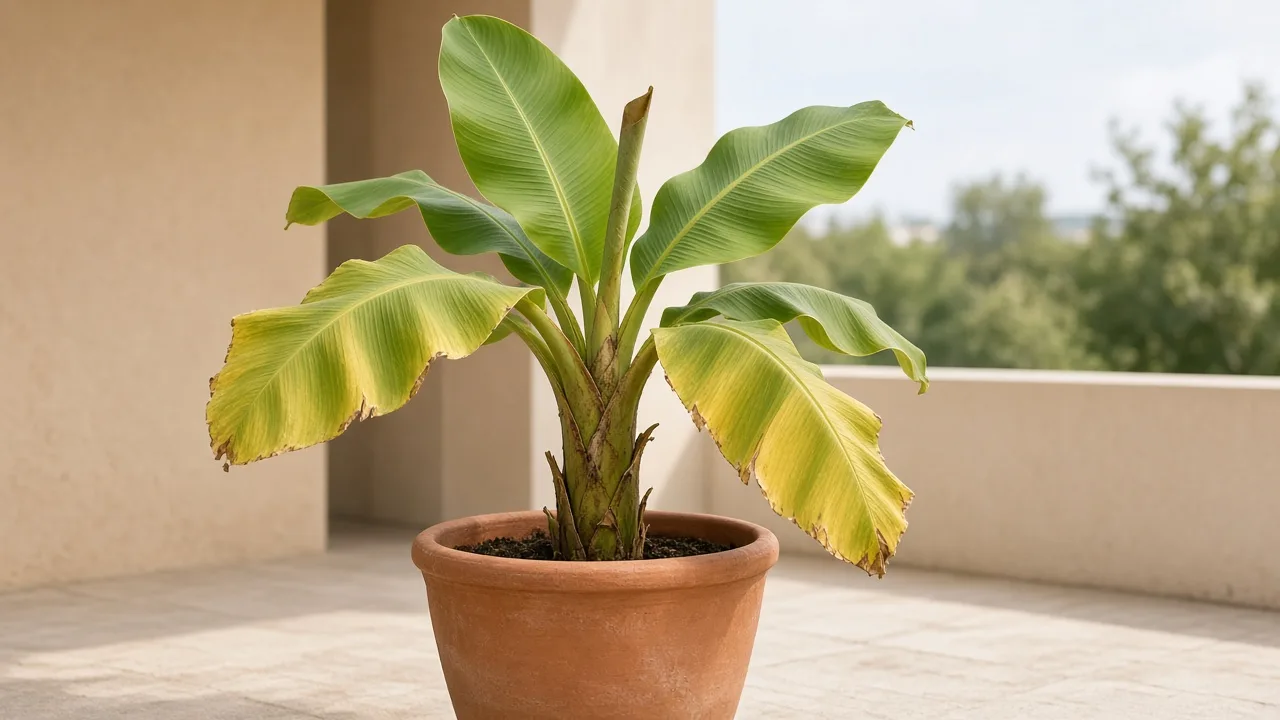
Nitrogen deficiency on Banana shows as uniform pale yellow-green on the oldest lower paddle leaves while newer blades at the pseudostem crown stay greener, often with smaller new paddles and slower pseudostem elongation despite warm sun. First step: confirm even chlorosis on lower mature tissue—not green-veined new leaves or all-leaf yellowing in wet soil—then check whether firm roots have gone a full warm season without complete fertilizer in a leached container mix.
Nitrogen Deficiency on Banana: Causes, Checks & Fixes
This guide covers nitrogen deficiency on Banana. See also the general Nitrogen Deficiency guide, watering, and light pages for this plant.
Nitrogen Deficiency on Banana: Causes, Checks & Fixes
Quick answer
Nitrogen deficiency on Banana (Musa acuminata) shows as uniform pale yellow-green on the oldest lower paddle leaves while newer blades at the pseudostem crown stay greener, often with smaller new paddles and slower pseudostem elongation despite warm sun. Nitrogen is mobile in plants, so deficiency symptoms show up first on the lower leaves as a general yellowing—veins and tissue fade together, unlike magnesium deficiency (interveinal banding on old paddles) or iron deficiency (green veins on new crown tissue).
See our nitrogen deficiency guide for general mobile-nutrient mechanics. On Banana, inspect the huge paddle-shaped blades lowest on the same trunk-like pseudostem—even washout there, with a greener cigar leaf still emerging above, is classic nitrogen starvation before wet-rhizome failure or low-light pale leaves.
First step: confirm uniform pale color on the oldest lower paddles—not interveinal chlorosis or new-tip green veins—then check pseudostem firmness and whether the plant has gone a full warm season without complete fertilizer in leached mix.
When to use this page vs other Banana guides
| Pattern | Read next |
|---|---|
| Uniform pale oldest lower paddle leaves, smaller new blades | Nitrogen deficiency (this page) |
| Yellow between veins on oldest lower paddles | Magnesium deficiency |
| Yellow new paddle with green veins at crown | Iron deficiency |
| Tip necrosis, torn margins, spike-leaf narrowing on newest paddle | Calcium deficiency |
| Brown scorched margins, midrib fracture on mature leaves | Potassium deficiency |
| All leaves yellow on persistently wet soil, soft pseudostem base | Overwatering or root rot |
| Folded leaves, crispy margins after dry spell | Underwatering |
| Washed-out green, long bare petioles, dim room | Not enough light or leggy growth |
| One bottom paddle only while green cigar leaf unfurls above | Normal aging—yellow leaves |
What nitrogen deficiency looks on Banana
Healthy Banana pushes huge paddle-shaped leaves from a trunk-like pseudostem above an underground rhizome. Each blade unfurls from a tight cigar leaf at the crown. Nitrogen stress breaks that pattern on mature foliage lowest on the pseudostem, not with a vein-retained banding pattern on new tissue.
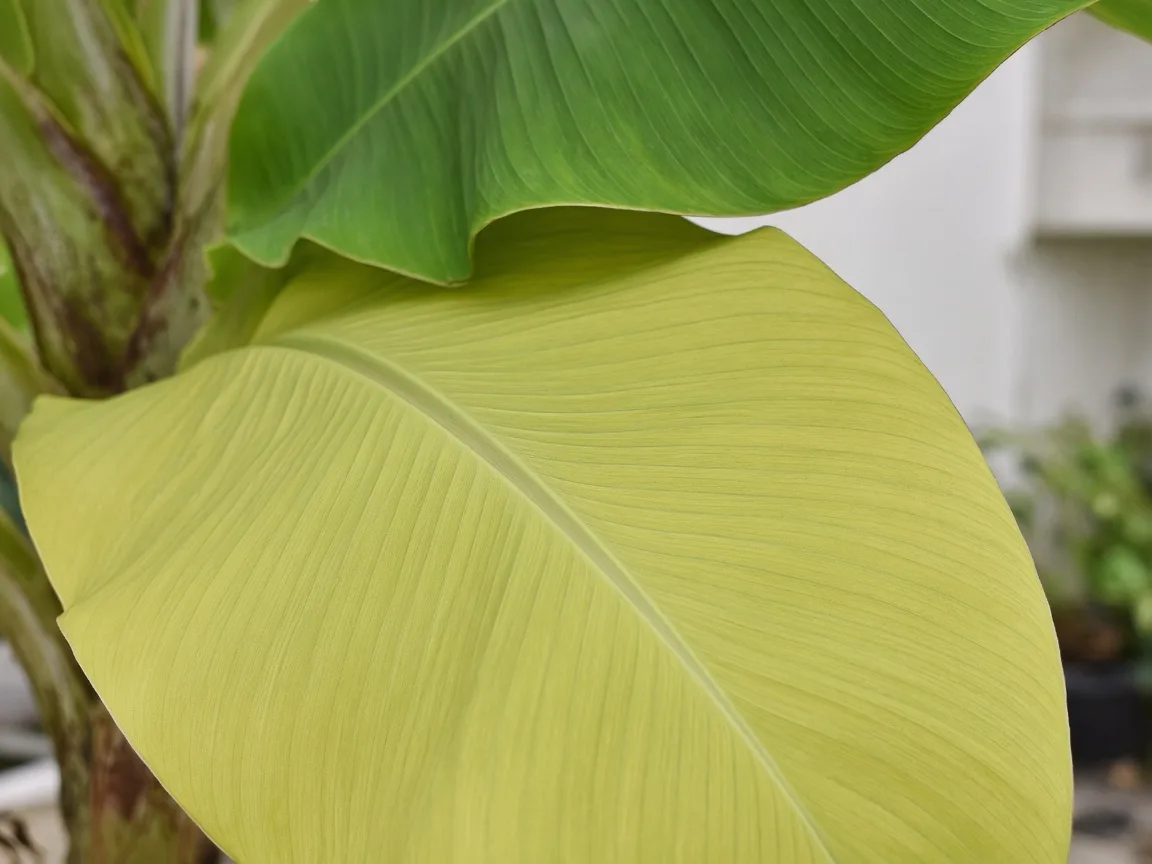
Oldest paddle-shaped leaf low on the pseudostem with uniform pale yellow-green chlorosis—newer greener blade and cigar leaf above still hold more nitrogen.
Typical signs:
- Uniform pale yellow-green on the oldest lower paddle leaves—veins and tissue lose color together
- Progressive climb up the lower pseudostem over weeks as the plant strips nitrogen from old paddles to fund new cigar-leaf growth
- Smaller new paddles and shorter internodes between leaf scars on the pseudostem
- Thin, papery feel on fully chlorotic lower blades before they senesce and hang down
- Firm pseudostem base unlike mushy overwatered Banana on sour wet mix
Not nitrogen deficiency:
- Yellow tissue between dark green veins on oldest lower paddles—magnesium deficiency (magnesium deficiency initially develops on lower or older foliage with interveinal chlorosis)
- Yellow new paddles with dark green veins at the unfurling cigar leaf—iron deficiency
- Tip necrosis or spike-leaf narrowing on the newest expanding paddle—calcium deficiency
- One bottom paddle yellow while a green cigar leaf unfurls above—often normal senescence; see yellow leaves
- All leaves pale at once on persistently wet soil—overwatering or root rot (UF/IFAS notes leaf yellowing under continuously wet soil conditions)
- Folded leaves and crisp margins after drought—underwatering (drought stress includes pale green to yellow leaf color)
- Uniform washed-out green with weak paddle size in a dim room—not enough light before assuming starvation
Why Banana gets nitrogen deficiency
Banana is a fast-growing tropical herb that builds an enormous leaf canopy from a non-woody pseudostem. Nitrogen is found in chlorophyll, amino acids, and proteins—when soil reserves run low, the plant dismantles chlorophyll in older paddle tissue and redirects nitrogen to the cigar leaf and newest unfurling blade.
Banana-specific causes:
- Never fed or skipped warm seasons — Owners treat container bananas as “just add water” and skip fertilizer while the pseudostem pushes a new paddle every few weeks in summer heat.
- Leached compost-rich mix — Each deep watering per the Banana watering guide flushes soluble nitrogen through drainage holes on a sunny terrace faster than owners replace it.
- Years in the same pot — A mat with sword suckers crowding the container sits in depleted mix while the rhizome still demands nitrogen for rapid leaf production; the RHS notes nitrogen is easily washed out of compost by watering.
- Potassium-heavy feeding without balanced nitrogen — UF/IFAS recommends high-potash fertilizer for banana (roughly 3-1-6 N-P-K), but repeated potassium-forward doses without adequate nitrogen can leave lower paddles pale while the pseudostem still elongates weakly.
- Water-only recovery after stress — Owners hold feed after relocation, wind damage, or cool indoor storage, then forget to resume complete fertilizer when the cigar leaf returns in spring.
- Blocked uptake from wet roots — Chronic saturation in a cachepot prevents absorption even when nitrogen is present; see overwatering before feeding a waterlogged rhizome.
Do not diagnose nitrogen deficiency on sour wet soil with a soft pseudostem base—that is root failure until you confirm mostly firm tissue and white fibrous roots.
Lower canopy paddle fade on the pseudostem
Nitrogen deficiency on Banana shows on the oldest paddle leaves lowest on the same pseudostem—a pattern that would be nonsense on a calcium-stressed crown where the newest cigar leaf cups first. The huge lamina makes even, vein-free pale yellow highly visible against normally deep green tropical foliage: the whole paddle surface lightens together, sometimes from the tip backward, without the dark green vein rails of magnesium or iron chlorosis.
That lower-pseudostem locus distinguishes nitrogen from iron, which appears on the paddle still unfurling at the crown. It also differs from calcium, which damages expanding new tissue while older lower blades may look normal. Because Banana sheds lower paddles naturally as the pseudostem grows taller, owners sometimes dismiss two or three uniformly pale lower blades as normal aging—when pale color climbs steadily and new paddles stay undersized, starvation is more likely than senescence alone.
One uniformly pale lower paddle—firm pseudostem base, normal top-2-to-3-cm dry-down rhythm—is enough to anchor your diagnosis before changing fertilizer, mix, or pot size.
Rhizome mat and sword sucker nutrient drain
Banana renews itself from an underground rhizome that sends up replacement sword suckers and water suckers. In a crowded container mat, multiple shoots compete for the same finite nitrogen pool in depleted mix. The main fruiting pseudostem may show pale lower paddles while a vigorous sword sucker beside it stays greener—or every shoot may pale together when the whole mat has gone unfed through a warm terrace season.
UF/IFAS notes bananas should not be crowded because plants compete for water, light, and nutrients. A single Dwarf Cavendish in a generous pot with one dominant pseudostem is easier to feed consistently than a mat of four weak shoots in an unchanged tub from three seasons ago. If only one sucker shows pale lower leaves while others on the same rhizome open normal paddles, inspect that shoot’s root pocket—it may sit in a dry or compacted corner of an oversized container.
Removing excess water suckers and keeping one or two strong sword suckers per mat reduces nitrogen demand until you refresh mix or increase feeding per the repotting guide.
Warm-season leaf turnover and the skipped-feed trap
Banana metabolism tracks heat and light. UF/IFAS reports strongest shoot growth around 78–82°F (26–28°C) and growth slows below about 60°F (16°C). Correct winter care means reduced watering and no fertilizer while the pseudostem rests—but owners who skip feed through dormancy sometimes never resume when the first spring cigar leaf appears.
That seasonal gap matters because Banana can push a new paddle every few weeks in peak summer sun. Each undersized pale-green blade after dormancy represents weeks of missed uptake, not a one-day mistake. A plant that unfurls two successive small pale paddles in spring on stable terrace care has likely depleted nitrogen in the same pot for more than one season.
Wait for the second new paddle after temperatures rise, then apply one measured dose—not full-strength fertilizer dumped on a cool indoor banana the day a single pale cigar leaf emerges. NC State recommends regular fertilization and warns not to let soil dry out on Musa acuminata during active growth; nitrogen correction only works when the plant is actively transpiring and taking up water.
Lookalike symptoms
| Pattern | Check | Likely cause |
|---|---|---|
| Oldest lower paddles uniformly pale | Leaf position on pseudostem | Nitrogen deficiency (this page) |
| Yellow between veins on old paddles | Vein pattern | Magnesium deficiency |
| New paddle yellow, green veins | New vs old tissue | Iron deficiency |
| New paddle tip necrosis, spike leaf | Expanding cigar leaf | Calcium deficiency |
| Folded leaves, crisp margins | Recent drought | Underwatering |
| All leaves yellow, wet soil, soft base | Root-zone feel | Overwatering |
| Washed-out green, weak paddle size, dim room | Light level | Not enough light |
| Brown scorched old leaf margins | Margin pattern | Potassium deficiency |
How to confirm
- Old vs new tissue — Uniform pale color confined to the oldest lower paddles while the cigar leaf and newest unfurling blade hold more green strongly suggests nitrogen.
- Vein pattern — Even chlorosis without dark green vein rails rules out magnesium and iron before feeding.
- Pseudostem health — Firm base and fibrous white roots vs brown mush from soggy soil.
- Feeding history — Complete balanced fertilizer during last warm season vs years of water-only or micronutrient-only products on a hungry container banana.
- Watering rhythm — Deep terrace watering that flushes nitrogen vs drought folding that mimics pale color (UF/IFAS lists pale green to yellow foliage among drought symptoms).
- Soil moisture pattern — Evenly moist mix vs persistently wet sour soil that yellows every leaf at once.
- Successive new paddles — Two or more undersized pale unfurls in a row on stable summer care points to depleted nitrogen, not one bottom leaf aging out.
- Sucker competition — Crowded mat in unchanged pot vs single vigorous pseudostem with adequate root space.
First fix for Banana
One half-strength dose of complete balanced or moderately potassium-forward fertilizer on already-moist mix—only after confirming uniform pale lower paddles, firm pseudostem base, stable even rhizome moisture, and warm active growth.
Do not repot, remove sword suckers, and triple-feed a recently relocated banana the same week. Stabilize watering per the Banana watering guide first—keep the rhizome evenly moist without saturation, and empty cachepot standing water after each drink.
UF/IFAS AG462 notes nitrogen deficiency appears as light green or yellow color on older leaves because nitrogen is mobile—feeding alone will not correct uptake failure on waterlogged roots or a cool stalled pseudostem.
Step-by-step recovery
- Rule out iron, magnesium, and wet roots — Inspect vein pattern on pale paddles and pseudostem base feel before any feed.
- Apply half-strength complete feed once on moist mix during active growth; repeat at two- to four-week intervals through the warm season if the next paddle responds per the fertilizer guide.
- Maintain consistent rhizome moisture—uptake fails when roots alternate between saturated and desiccated in heavy decorative pots on a hot terrace.
- Repot into fresh compost-rich mix if roots and suckers fill the pot and pale lower paddles persist after two measured feeds on a firm pseudostem—see Banana repotting.
- Thin crowded suckers if multiple weak shoots compete in one tub—keep one or two vigorous sword suckers.
- Move the plant gradually into stronger direct sun if not enough light is slowing growth and nitrogen demand does not match feeding.
- Monitor the next two paddles—fully chlorotic lower blades rarely re-green; recovery shows on subsequent unfurls and wider lamina.
- Flush white salt crust at the pot rim before resuming feeding if buildup blocks uptake—overlap with brown tips on overfed specimens.
Recovery timeline
Fully chlorotic lower paddles rarely return to deep green once the huge blade hardens along the pseudostem. The next one or two paddles after corrected complete feeding and stable moisture usually emerge larger and brighter within four to eight weeks on a firm pseudostem—faster than woody shrubs because Banana can push a new paddle every few weeks in peak summer heat.
Severe rhizome damage from chronic overwatering may delay recovery a full warm season. If successive new paddles stay undersized despite complete feed and stable summer care, inspect roots for rot before repeating fertilizer or repotting again.
Mistakes to avoid
- Do not confuse drought-folded leaves with nitrogen chlorosis—check recent watering and soil dryness first.
- Do not feed a banana on sour wet soil or during cool stalled growth below about 16°C.
- Do not expect pale lower paddles to re-green—judge the next unfurl from the cigar leaf.
- Do not use nitrogen-only doses on a potassium-hungry banana without reading the fertilizer guide—balance matters on long-term container culture.
- Do not stack repotting, sucker removal, and full-strength feed the same week on a stressed rhizome.
- Do not mistake all-leaf yellowing in waterlogged mix for nitrogen deficiency—fix drainage first.
Prevention
- Feed with complete balanced or moderately potassium-forward fertilizer during active warm-season growth per the Banana fertilizer guide—NC State recommends regular fertilization on Musa acuminata in organically rich moist soil.
- UF/IFAS home-landscape banana programs call for nitrogen-phosphate-potash fertilizer every four to eight weeks during active growth, reduced in cool months when nutrient demand drops.
- Maintain consistent rhizome moisture per the watering guide so nitrogen moves with water to new paddles.
- Refresh depleted compost-rich mix every two to three years when roots and sword suckers crowd the pot per the soil guide.
- Inspect lower paddles monthly during spring and summer—early uniform pale wash is easier to correct than a pale pseudostem with undersized new blades.
- Pause or reduce feeding when temperatures fall below about 16°C; resume only when new cigar leaves return.
Related Banana guides
- Banana overview
- Banana fertilizer
- Banana watering
- Banana soil
- Banana light
- Magnesium deficiency
- Iron deficiency
- Banana problems hub
- All plant symptoms
Conclusion
Uniform pale yellow-green on the oldest lower Banana paddles—with greener cigar-leaf growth above—points to mobile nitrogen depletion in a hungry, fast-growing pseudostem. Confirm the old-vs-new leaf pattern, rule out wet-root yellowing and interveinal lookalikes, stabilize rhizome moisture and pseudostem health, apply one measured complete feed during warm active growth, and judge recovery by the next paddle unfurl from the crown.
Related tool
Use the Fertilizer Dilution Calculator to narrow causes for nitrogen deficiency on this plant before changing multiple variables at once.