Calcium Deficiency on Banana: Causes, Checks & Fixes
Quick answer
Calcium deficiency on Banana shows on the newest paddle leaves and cigar leaf—chlorotic tips, torn or curled margins, thickened secondary veins, or a narrow spike-leaf shape while older blades may look normal. First step: confirm damage is on expanding new tissue (not wind-split or boron streaks), then check whether soft water, incomplete fertilizer, or wet rhizome stress has limited calcium uptake during active warm growth.
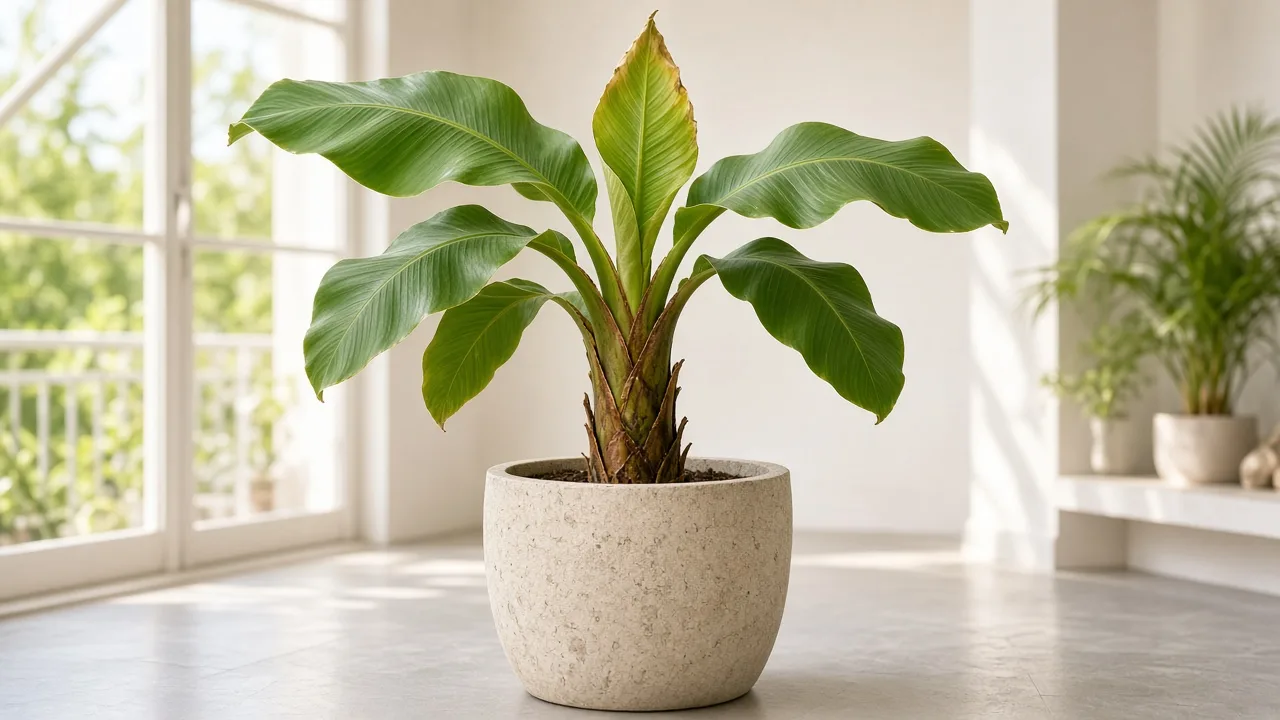
Calcium Deficiency on Banana: Causes, Checks & Fixes
This guide covers calcium deficiency on Banana. See also the general Calcium Deficiency guide, watering, and light pages for this plant.
Calcium Deficiency on Banana: Causes, Checks & Fixes
Quick answer
Calcium deficiency on Banana (Musa acuminata) shows on the newest paddle leaves and cigar leaf—chlorotic tips, torn or inward-curling margins, thickened secondary veins, or a narrow spike-leaf shape while older blades on the same pseudostem may look fine. Calcium is plant-immobile, so deficiency appears on young expanding tissue first—not on mature lower foliage the way nitrogen deficiency does.
See our calcium deficiency guide for general new-tissue distortion mechanics. On Banana, inspect the cigar leaf and the paddle still unfurling from the pseudostem top—tip necrosis, marginal tearing, and failure to expand point to calcium before magnesium banding or potassium scorch on older leaves.
First step: confirm chlorotic or necrotic damage on the newest expanding paddle or cigar leaf, not wind-split mature blades or boron streaks perpendicular to veins.
When to use this page vs other Banana guides
| Pattern | Read next |
|---|---|
| New paddle tip necrosis, torn margins, spike-leaf narrowing | Calcium deficiency (this page) |
| Streaks perpendicular to veins, malformed heart leaf | Distorted leaves — consider boron |
| Old lower leaves pale uniformly | Nitrogen deficiency |
| New leaves yellow with green veins | Iron deficiency |
| Green banding at margin, yellow mid-leaf on older paddles | Magnesium deficiency |
| Brown scorched margins on old leaves, midrib fracture | Potassium deficiency |
| Yellowing in wet soil, soft pseudostem base | Overwatering or root rot |
| Crispy edges after heavy feed, white crust on soil | Brown tips |
What calcium deficiency looks like on Banana
Healthy Banana pushes huge paddle-shaped leaves from a trunk-like pseudostem above an underground rhizome. Each new leaf emerges as a tight cigar leaf at the crown before unfurling into a broad blade. Calcium supports cell wall formation in that expanding tissue, so when uptake fails, the newest paddle or cigar leaf shows damage while older canopy on the same stem often stays greener.
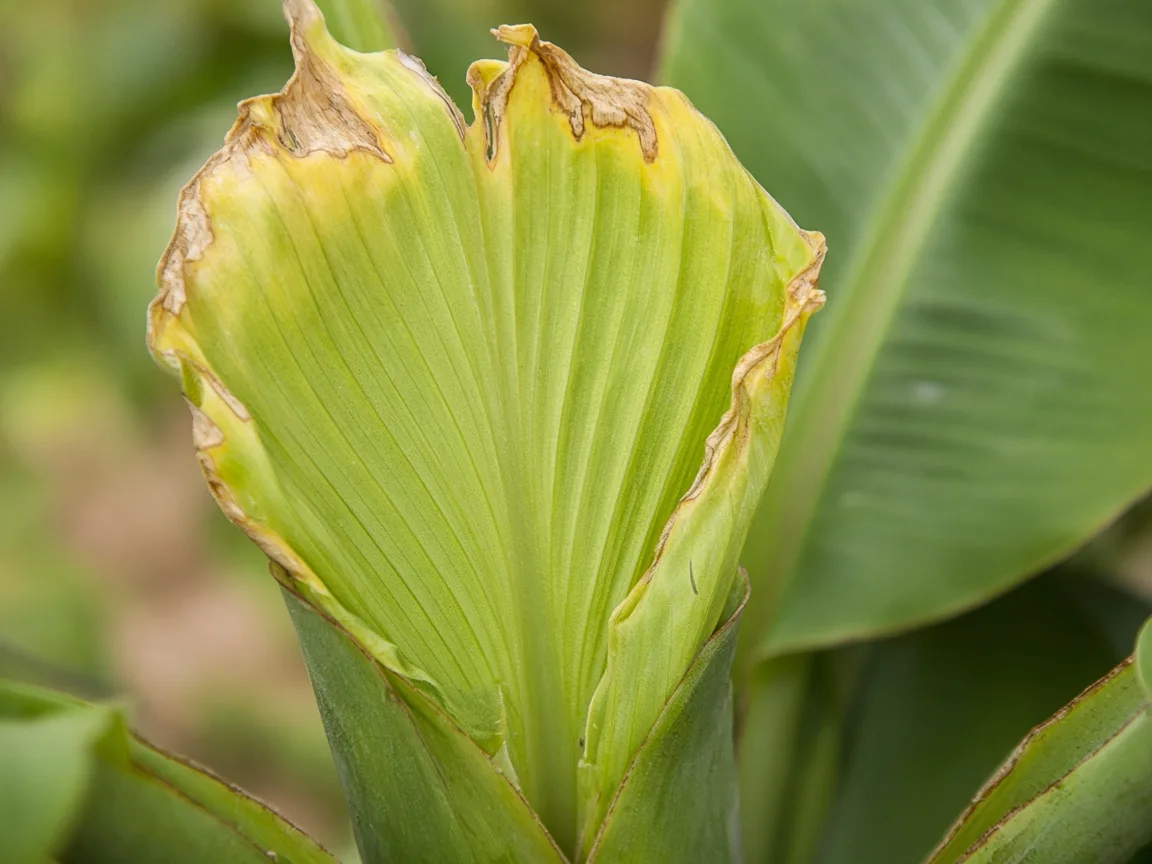
Distorted new Banana paddle at the pseudostem crown—chlorotic tip necrosis and torn inward-curling margins on expanding tissue while older blades below may look normal.
Typical signs:
- Chlorotic young paddles that later develop light brown necrosis from the leaf tip or margin
- Torn, ragged, or inward-curling margins on the leaf still unfurling from the pseudostem
- Narrow spike-leaf appearance where the lamina fails to expand to full paddle width
- Thickened secondary veins on the youngest leaves
- Splitting or curling along leaf edges; distal midrib interveinal and marginal chlorosis
- Smaller-than-normal new paddles despite warm active growth
- Older lower leaves on the same pseudostem may look completely normal
- On fruiting plants, peel splitting or reduced fruit size when deficiency is advanced (Yara crop nutrition notes)
Not calcium deficiency:
- Random shredding on mature blades only—wind damage on broad paddles in exposed terraces
- Streaks running perpendicular to veins with malformed heart tissue—boron deficiency (see distorted leaves)
- Pale lower old leaves without tip distortion on new growth—nitrogen deficiency
- New leaves yellow with dark green veins—iron deficiency
- Green banding around margins on older mid-stem paddles—magnesium deficiency
- Purplish-brown petiole patches with midrib fracture on mature leaves—potassium deficiency
- All leaves yellow on persistently wet soil—overwatering or root rot
Why Banana gets calcium deficiency
Banana is a fast-growing tropical herb that builds an enormous leaf canopy from a non-woody pseudostem and renews itself from a rhizome. Each unfurling paddle still demands calcium for rigid cell walls. Very soft water, incomplete fertilizer, depleted compost-rich mix, drought stress, or root damage from chronically wet soil limits uptake—and shows on the newest expanding leaf while older foliage stays healthier.
Banana-specific causes:
- Distilled or reverse-osmosis water only — Irrigation removes the small calcium contribution tap water normally supplies unless fertilizer replaces it. Owners chasing salt-sensitive brown tips sometimes create uptake gaps on a plant pushing new paddles every few weeks in summer heat.
- Potassium-heavy feeding without complete secondary nutrients — Banana has a high potassium demand, but repeated potassium-forward doses without calcium and magnesium in the program can imbalance uptake on sandy or leached container mix. See the Banana fertilizer guide for conservative complete feeding.
- Incomplete micronutrient fertilizer — Nitrogen-only or bloom formulas pushed on a hungry container banana during rapid leaf production leave cell-wall calcium short even when the pseudostem looks vigorous.
- Inconsistent moisture at the rhizome — Calcium moves with water through the xylem to the growing cigar leaf. Alternating bone-dry drought with sudden heavy soaking in an oversized pot starves the apical paddle even when the rhizome absorbed enough for mature tissue. Match rhythm to the watering guide.
- Depleted organically rich mix — Compost-heavy blend that started fertile composts down over seasons in an unchanged pot. Roots stay alive but calcium availability drops until you refresh mix per the soil guide.
- Root stress blocking uptake — NC State notes banana prefers moist but well-drained soil and should be fertilized regularly; chronic overwatering or cool waterlogged roots limit calcium transport regardless of what is in the fertilizer bottle.
- Cool or dim indoor conditions — Growth slows below about 16°C and transpiration drops; feeding during stalled growth builds salts without correcting uptake. Calcium correction works when the plant is actively making leaves in warmth and strong light per the light guide.
- Acidic or sandy leached mix — Yara notes calcium deficiency is worsened by acidic, sandy, or drought-stressed soils—common in small containers that dry fast on a sunny terrace.
Cigar leaf and paddle unfurling distortion
Banana allocates calcium to each expanding paddle as it opens from the tight cigar leaf at the pseudostem crown. When uptake fails, the center of the new blade may expand while margins stay stunted—producing torn edges, inward curling, or the narrow spike-leaf shape where the lamina never reaches full width. Calcium is extremely immobile in plants, and NC State calcium deficiency work notes marginal curling on new expanding leaves before older tissue is affected.
That pattern differs from nitrogen or magnesium deficiency, which show on older lower paddles first. It also differs from one bottom leaf yellowing while a green paddle unfurls above—a normal aging pattern covered on yellow leaves.
Judge severity by successive new leaves on the same pseudostem: one slightly ragged unfurl after a dry spell differs from three consecutive spike-leaf paddles on stable summer care.
Rhizome moisture before feeding
Banana stores energy in an underground rhizome and fibrous roots that need even moisture without saturation. Before any fertilizer correction, finger-test the top 2–3 cm of mix and lift the pot—water when dry, but never let the root zone stay sour-smelling wet for days.
Firm pseudostem base with white roots when you tip the pot supports a measured half-strength complete feed during active growth. Soft, darkened base on persistently wet mix means root rot—not a nutrient label problem. Correct drainage and moisture per the watering guide before any feed on soggy rhizomes.
If only one sucker shows narrow spike leaves while sword suckers on the same mat open normal paddles and the pseudostem stays firm, inspect that shoot’s root zone separately—it may sit in a wet pocket of an overcrowded container.
Warm-season growth window and feeding gaps
Banana metabolism tracks heat and light. NC State describes Musa acuminata as fast-growing with huge paddle leaves that should not dry out and need regular fertilizer during active growth. Calcium correction only works when the plant is actively transpiring and taking up water—feeding a cool, dim indoor banana in winter does not fix spring cigar-leaf cupping and risks salt injury on sluggish roots.
When new paddles emerge in spring and summer, calcium demand spikes at the pseudostem crown. Growers who skipped complete fertilizer through the prior season and then push heavy potassium doses in May sometimes see distorted new shoots—the potassium drives expansion faster than available calcium can support cell walls.
Closing the gap means half-strength complete feed every two to four weeks during active growth per the fertilizer guide and RHS container banana guidance, not more nitrogen alone to force wider leaves the cell walls cannot support.
Lookalike symptoms
| Pattern | Check | Likely cause |
|---|---|---|
| New paddle tip necrosis, torn margins, spike leaf | New vs old tissue | Calcium deficiency (this page) |
| Streaks perpendicular to veins, heart leaf white | Vein pattern on cigar leaf | Boron — distorted leaves |
| Old lower paddles pale first | Leaf position | Nitrogen deficiency |
| New paddles yellow, green veins | Vein pattern | Iron deficiency |
| Green banding at margin on old paddles | Mid-stem pattern | Magnesium deficiency |
| Midrib fracture, purplish petiole base | Mature leaf pattern | Potassium deficiency |
| Soft pseudostem base, wet soil | Base feel | Root rot |
| Shredded mature blades only, new growth clean | Wind exposure | Physical damage — not deficiency |
How to confirm
- New vs old tissue — Distortion confined to the newest cigar leaf or unfurling paddle while older blades on the same pseudostem look normal strongly suggests calcium.
- Boron check — Streaks perpendicular to veins or a white, soft heart leaf point to boron, not calcium—see distorted leaves.
- Water source — Distilled-only or very soft water without calcium listed on the fertilizer label.
- Fertilizer completeness — Secondary nutrients and calcium on the label vs nitrogen-only or years without any feed on a hungry container banana.
- Rhizome health — Firm pseudostem base and fibrous white roots vs brown mush from soggy soil.
- Watering rhythm — Alternating extreme drought and heavy soaking that interrupts xylem flow to the cigar leaf.
- Successive new leaves — Two or more distorted paddles in a row on stable summer care points to uptake failure, not one-time wind tear.
- Season — Symptoms appearing during warm active growth with continuous new leaves fit deficiency better than winter leaf loss alone.
First fix for Banana
One half-strength dose of complete balanced or potassium-forward fertilizer that lists calcium and secondary nutrients on already-moist mix—only after confirming firm pseudostem base, stable even moisture, warm active growth, and no boron streaks on the cigar leaf.
Do not repot, remove suckers, and triple-feed a recently relocated banana the same week. Stabilize watering per the Banana watering guide first—keep the rhizome evenly moist without saturation, and empty cachepot standing water after each drink.
If you use distilled or reverse-osmosis water exclusively, ensure your feed supplies calcium. Penn State notes calcium deficiency symptoms appear first on younger leaves and growing points when supply fails—water alone will not correct deficiency on a pseudostem pushing new paddles in full sun.
Step-by-step recovery
- Rule out boron and wind — Inspect the cigar leaf for perpendicular streaks; separate mature wind-shredded blades from new-tissue necrosis.
- Apply half-strength complete feed once on moist mix during active growth; repeat at two- to four-week intervals through the warm season if the next paddle responds per the fertilizer guide.
- Maintain consistent rhizome moisture—uptake fails when roots alternate between saturated and desiccated in heavy decorative pots on a hot terrace.
- Repot into fresh compost-rich mix if roots fill the pot and distortion persists after two measured feeds on a firm pseudostem—see Banana repotting.
- Move the plant gradually into stronger direct sun if not enough light is slowing transpiration and calcium transport to the cigar leaf.
- Monitor the next two paddles—the currently torn or spike leaf rarely flattens; recovery shows on subsequent unfurls and wider lamina.
- Flush white salt crust at the pot rim before resuming feeding if buildup blocks uptake—overlap with brown tips on overfed specimens.
Recovery timeline
The currently distorted paddle rarely flattens once cell walls set as the huge blade hardens. The next one or two leaves after corrected complete feeding and stable moisture usually emerge wider and greener within four to eight weeks on a firm pseudostem—faster than woody shrubs because Banana can push a new paddle every few weeks in peak summer heat.
Severe rhizome damage from chronic overwatering may delay recovery a full warm season. If successive new paddles stay spike-narrow despite complete feed and stable summer care, inspect roots for rot before repeating fertilizer or repotting again.
Mistakes to avoid
- Do not confuse wind-shredded mature blades with calcium tip necrosis on the cigar leaf—check tissue age first.
- Do not use distilled water without ensuring fertilizer supplies calcium.
- Do not heavy-feed a banana on wet soil or during cool stalled growth—fix drainage and wait for active leaf production.
- Do not expect the current torn paddle to flatten—judge the next unfurl from the pseudostem crown.
- Do not stack repotting, sucker removal, and full-strength feed the same week on a stressed rhizome.
- Do not push plantation potassium rates into a small container—that path leads to salt injury and brown tips, not faster paddle expansion.
Prevention
- Feed with complete balanced or moderately potassium-forward fertilizer including secondary nutrients during active warm-season growth per the Banana fertilizer guide—NC State recommends regular fertilization on Musa acuminata in organically rich moist soil.
- If using soft or distilled water, choose a feed that lists calcium—do not rely on irrigation water alone.
- Maintain consistent rhizome moisture per the watering guide.
- Refresh depleted compost-rich mix every two to three years when roots and suckers crowd the pot.
- Inspect the cigar leaf monthly during spring and summer—early tip chlorosis is easier to correct than repeated spike-leaf paddles.
- Pause or reduce feeding when temperatures fall below about 16°C and growth slows; resume only when new paddles return.
Related Banana guides
- Banana overview
- Banana fertilizer
- Banana watering
- Banana soil
- Banana light
- Distorted leaves
- Magnesium deficiency
- Banana problems hub
- All plant symptoms
Conclusion
Chlorotic tip necrosis, torn margins, or spike-leaf narrowing on the newest Banana paddle point to calcium uptake failure on expanding tissue—confirm the new-vs-old leaf pattern, rule out boron streaks on the cigar leaf, stabilize rhizome moisture and pseudostem health, ensure complete fertilizer supplies calcium especially on soft water during warm active growth, and judge recovery by the next paddle unfurl from the crown.
Related tool
Use the Fertilizer Dilution Calculator to narrow causes for calcium deficiency on this plant before changing multiple variables at once.