Distorted Leaves on Banana: Causes, Checks & Fixes
Quick answer
Distorted leaves on Banana mean emerging paddles open narrow, twisted, cupped, or bunched at the pseudostem crown instead of unfurling into broad blades. First step: inspect the newest cigar leaf and leaf sheaths at the pseudostem tip with a magnifier for aphids, thrips scarring, and dark vein streaks before adjusting watering or fertilizer.
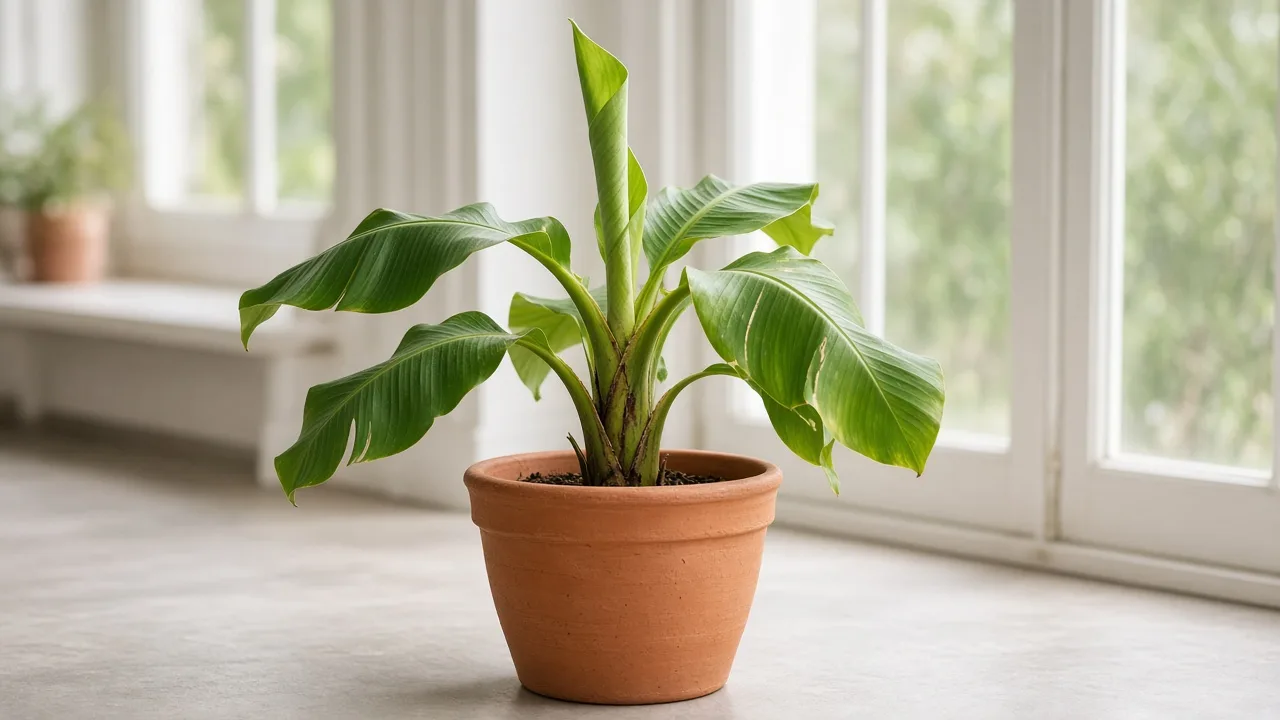
Distorted Leaves on Banana: Causes, Checks & Fixes
This guide covers distorted leaves on Banana. See also the general Distorted Leaves guide, watering, and light pages for this plant.
Distorted Leaves on Banana: Causes, Checks & Fixes
Quick answer
Distorted leaves on Banana (Musa acuminata) are paddle blades that open narrow, twisted, cupped, stiff, or bunched at the pseudostem crown instead of unfurling into the plant’s usual broad tropical leaves. On this fast-growing herb, the damage almost always scars while the cigar leaf expands from the center of the pseudostem—the tissue hardens in the warped shape and cannot be pressed flat later. For general causes of misshapen foliage, see our distorted leaves guide. On Banana, inspect the newest cigar leaf and pseudostem tip with a magnifier before changing watering, light, or fertilizer.
First step: peel back the outer leaf sheaths slightly and examine the emerging cigar leaf and crown for aphids, silvery thrips scarring, and dark green vein streaks. Isolate the plant if insects or virus-like streaking is present.
What distorted leaves look like on Banana
Healthy banana leaves unfurl from a tight vertical cigar at the pseudostem center into long paddle blades with smooth margins. Distortion breaks that pattern:
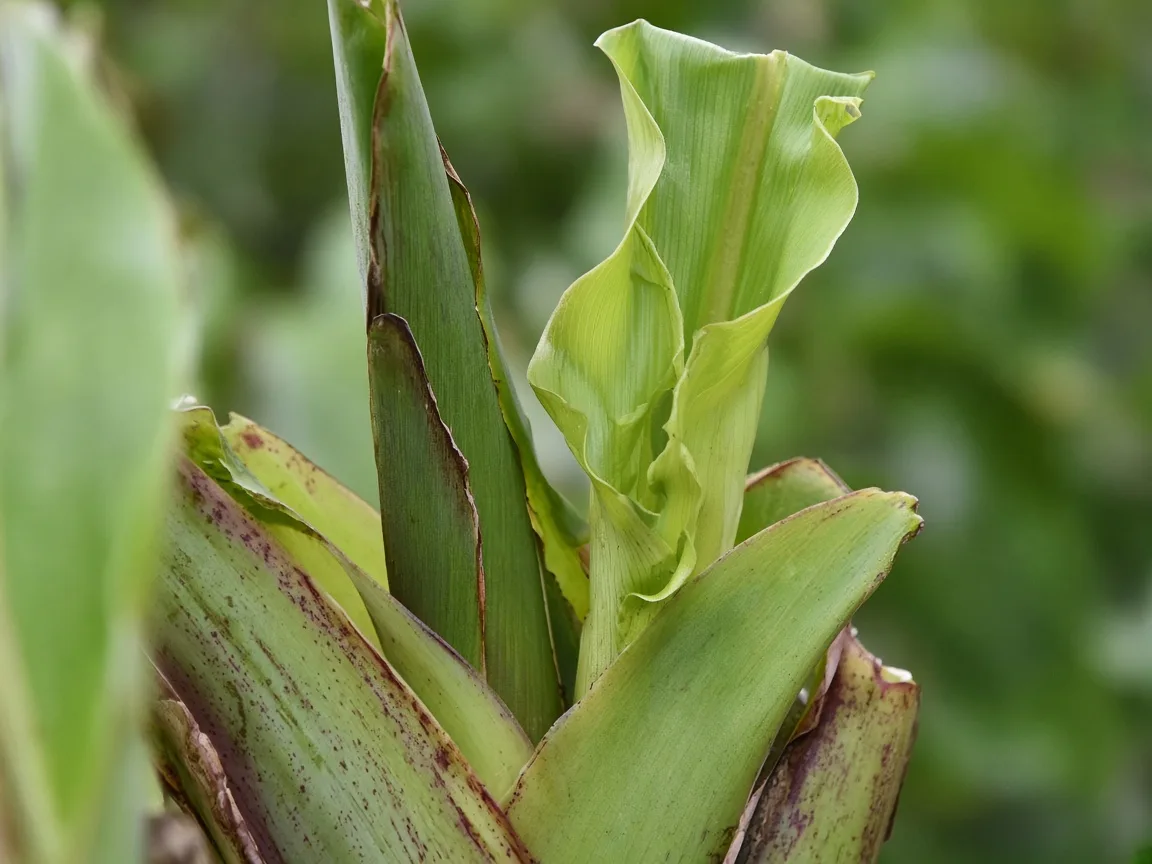
Distorted leaves on Banana — compare warped emerging paddles with older blades below.
Typical distortion patterns:
- Narrow, upright, bunched young leaves at the crown — Leaves stay erect with yellow fringes instead of arching outward. Classic banana bunchy top virus (BBTV) on young plants and suckers.
- Dark green dots and dashes along veins — Hold a young leaf up to diffuse light; morse-code streaks on veins or petioles strongly suggest BBTV, not a care mistake.
- Twisted, cupped, or wavy newest paddle only — Mature blades below look normal. Aphids or thrips feeding on the soft cigar leaf before it hardens.
- Very narrow blades on emerging leaves after a heat spike — UF/IFAS reports temperatures at or above 98°F (37°C) can produce extremely narrow new leaf blades.
- Stiff inward-curled center leaves — BBTV can also show as stiff, turned-in, yellow-fringed paddles on older pseudostems.
- Fan-like crown twist after constant wind — Continuous wind may cause crown distortion and shredded margins; distortion may involve several leaves, not just the cigar tip.
The pseudostem crown and cigar leaf are the diagnostic focal point. Distortion confined there points to pests, virus, or unfurling stress; distortion across many mature paddles after a cold snap or drought points to environment or root-zone failure.
When to use this page vs other Banana guides
This page is the symptom-first entry for warped, narrow, or bunched paddles on a banana mat.
| Your question | Best page |
|---|---|
| Narrow, twisted, bunched, or cupped paddles | This page |
| Inward rolling on mature leaves without warping | Curling leaves |
| Silver scarring, thrips-specific signs | Thrips |
| Sticky crown, clustered insects | Aphids |
| Pale, washed-out new growth | Pale leaves or nutrient guides |
| Yellowing across older paddles | Yellow leaves |
| Long-term moisture rhythm | Watering guide |
Reading the cigar leaf and pseudostem crown
Banana is not a woody shrub with a branching canopy. New growth pushes straight up through overlapping leaf sheaths that form the trunk-like pseudostem. The cigar leaf is the still-rolled paddle at the very top; it is the most vulnerable tissue on the plant.
Work in this order:
- Stand at the crown and look down into the center of the pseudostem. The cigar should be upright, green, and swelling evenly.
- Gently part the outer sheaths at the tip with clean hands. Do not yank or unroll the cigar leaf—you will tear it permanently.
- Use a magnifier on the inside of the youngest sheath and the base of the cigar. Aphids often hide where the petiole meets the pseudostem.
- Backlight one young leaf against soft daylight. Dark green dots and dashes along veins—the morse-code symptom—point to BBTV rather than thrips silvering.
- Check every sucker on the mat. Virus and heavy aphid pressure spread to replacement pseudostems from the shared rhizome.
If only one pseudostem shows narrow warped leaves while a nearby sword sucker opens normally, you are likely dealing with localized pest or early virus on that stem—not a whole-mat watering error.
Why Banana gets distorted leaves
Aphids and thrips on the cigar leaf
Aphids feed on tender shoots and can curl or stunt new growth. On banana, the banana aphid (Pentalonia nigronervosa) is especially important because it vectors banana bunchy top virus—even a small colony at the crown matters. Thrips distort or scar leaves, flowers, or fruit, and damage on herbaceous plants often shows on buds and shoot tips before you see the insects. Distorted ripples and silver scarring on the unfurling cigar leaf are common thrips signatures.
Banana bunchy top virus (BBTV)
BBTV is named for its most visible sign: young leaves that remain bunched, erect, and narrow at the top with yellow fringes. The University of Hawaii CTAHR program notes that infected plants may show cupped, twisted, stiff center leaves and the subtle morse-code vein streaks. There is no cure; infected mats must be destroyed to protect neighboring plants. This is the one cause where repotting, feeding, or extra water will not help.
Heat and chilling during unfurling
Banana is a tropical herb that grows fastest in sustained warmth. UF/IFAS notes that extreme heat can scorch leaves and narrow emerging blades, while chilling injury below about 60°F (16°C) disrupts normal development—including failure of the flowering stalk to emerge and misshapen fruit on fruiting plants. A banana pushed against hot afternoon glass or left in a cold draft may show distorted newest paddles even when soil moisture is fine.
Wind and mechanical damage at the crown
Broad banana paddles catch wind easily. Continuous windy weather can shred leaves and distort the crown. Indoors, a top-heavy container wedged where the cigar leaf scrapes a wall or ceiling can scar the paddle as it unfurls. That damage is mechanical, not infectious—but the warped blade is equally permanent.
Root-zone stress and nutrient problems
Banana needs consistently moist, fertile soil without waterlogging. Chronic overwatering or saturated mix weakens the rhizome and slows clean leaf expansion. Heavy feeders deprived of nitrogen, magnesium, or calcium during rapid spring growth may produce pale, thin, or irregular new paddles. Treat nutrient distortion only after pests and virus are ruled out and fertilizer matches active growth.
How to confirm the cause
| What you see | Likely cause | Confirm with |
|---|---|---|
| Bunched erect narrow leaves, yellow fringes, vein streaks | BBTV | Backlit morse-code veins; aphids at crown; spread to suckers |
| Silvery scars, black specks, ruffled cigar leaf | Thrips | Shake cigar leaf over white paper; inspect sheath axils |
| Sticky residue, soft insects on cigar base | Aphids | Magnifier at pseudostem tip; check all suckers |
| Very narrow blade after heat wave | Heat stress | Hot window or greenhouse spike; several paddles affected |
| Crown twist, shredded margins | Wind or scrape | Recent storm, fan blast, or tight placement |
| Pale thin leaves on whole mat, weak growth | Nutrient or root stress | Soil moisture, feed history, rhizome firmness |
If rhizomes feel firm, moisture has been steady per the watering guide, and distortion stays on the newest cigar leaf with insect signs, treat pests first. If morse-code streaks and bunchy crown appear on multiple suckers, assume virus and act accordingly.
First fix for Banana
Inspect the pseudostem crown and newest cigar leaf with a magnifier, and isolate the plant if you find aphids, thrips, or dark vein streaks suggestive of bunchy top.
Do not repot, fertilize, or prune heavily on day one. Peel outer sheaths only enough to see the cigar base. If aphids or thrips are confirmed, follow the dedicated aphid or thrips guides—banana aphids warrant control partly because of virus risk. If morse-code streaks and bunchy upright leaves match CTAHR BBTV symptoms, contact your local extension office for disposal guidance; do not share suckers from that mat.
For heat- or wind-scarred paddles with no pests, move the container to a sheltered bright spot with stable warmth and protect the crown from scraping. Correct light and soil only after the diagnostic inspection is complete.
Step-by-step recovery
- Isolate if insects or suspected virus are present.
- Photograph the crown before treatment so you can compare the next cigar leaf.
- Treat confirmed pests on the label repeat schedule—not a single rinse.
- Move off hot glass or cold drafts if environmental scarring is the pattern.
- Stake or relocate top-heavy pots away from wind tunnels and tight corners.
- Hold fertilizer until two new leaves show whether distortion has stopped.
- Remove only fully shredded paddles that block new growth; keep partially warped green blades for photosynthesis.
For BBTV-positive plants, recovery is not the goal—containment is. Destroy infected pseudostems per local agriculture guidance rather than waiting for the mat to outgrow the virus.
Recovery timeline
Pests controlled: The next one to two cigar leaves should unfurl noticeably cleaner within three to six weeks in warm active growth. The current warped paddle stays warped.
Heat or wind corrected: The following leaf after conditions stabilize is the first reliable read—often two to four weeks in summer.
BBTV: Symptoms intensify on young suckers; do not expect healthy broad paddles to return on infected stems.
Worsening: Every new cigar leaf narrow and bunched for multiple cycles despite pest treatment suggests re-check virus signs or root failure from root rot.
Lookalike symptoms
| Pattern | Likely cause | How to tell apart |
|---|---|---|
| Narrow upright bunch at crown | BBTV | Vein morse-code streaks; spreads to suckers |
| Ruffled cigar leaf, silver scars | Thrips | Insects or specks on white paper shake test |
| Sticky cigar base, curled tip | Aphids | Visible colonies; honeydew on sheaths |
| Inward roll on mature paddles | Curling leaves | Older leaves cup; cigar may be normal |
| Long shredded splits | Wind damage | Tears along veins, not narrow bunched crown |
| Pale washed-out whole mat | Low light or nutrients | Stretching and thin blades, not stiff bunchy crown |
What not to do
Do not force-open a cigar leaf by hand—you will tear the paddle permanently.
Do not fertilize distorted growth hoping leaves will flatten.
Do not share sword suckers from a mat with bunchy crown symptoms or unexplained vein streaks.
Do not stop after one pest spray—banana produces new cigar leaves quickly, and eggs hatch on repeat cycles.
Do not mistake a healthy tight cigar for distortion; a green upright roll for a few days before unfurling is normal.
How to prevent distorted leaves next time
Quarantine new bananas for two weeks and inspect the crown before placing them near other plants. Keep the mat in full sun or the brightest realistic indoor position with even moisture from the watering guide. Shelter containers from strong wind and hot glass. Scout the pseudostem tip weekly during spring and summer growth. Control aphids early because of bunchy top risk. Buy clean sword suckers or tissue-culture plants rather than divisions from unverified sources.
When to worry
Treat as urgent if young leaves stay bunched and erect with yellow fringes on multiple suckers, dark vein streaks appear on backlit leaves, aphids are present on a mat you intend to keep long term, or every new cigar leaf is narrow for more than three unfurling cycles despite pest treatment. A single warped paddle after a known heat day is less urgent than a spreading bunchy crown.
Related Banana guides
Conclusion
Distorted leaves on Banana are permanent once the paddle hardens—focus on protecting the next cigar leaves at the pseudostem crown. Magnify the youngest tissue, rule out bunchy top before tweaking fertilizer, and treat confirmed aphids or thrips on repeat schedules. Success is broad, cleanly unfurling new paddles on sword suckers—not flattening old warped blades.
Related tool
Use the Plant Problem Diagnosis Tool to narrow causes for distorted leaves on this plant before changing multiple variables at once.