Pale Leaves on Banana: Causes, Checks & Fixes
Quick answer
Pale leaves on Banana show as washed-out yellow-green paddle blades instead of deep tropical green—often on the whole canopy, oldest lowers only, or the newest cigar leaf depending on cause. First step: compare color on the emerging cigar leaf at the pseudostem crown to the oldest lower paddles, then finger-test the top 2–3 cm of mix before changing water, light, or feed.
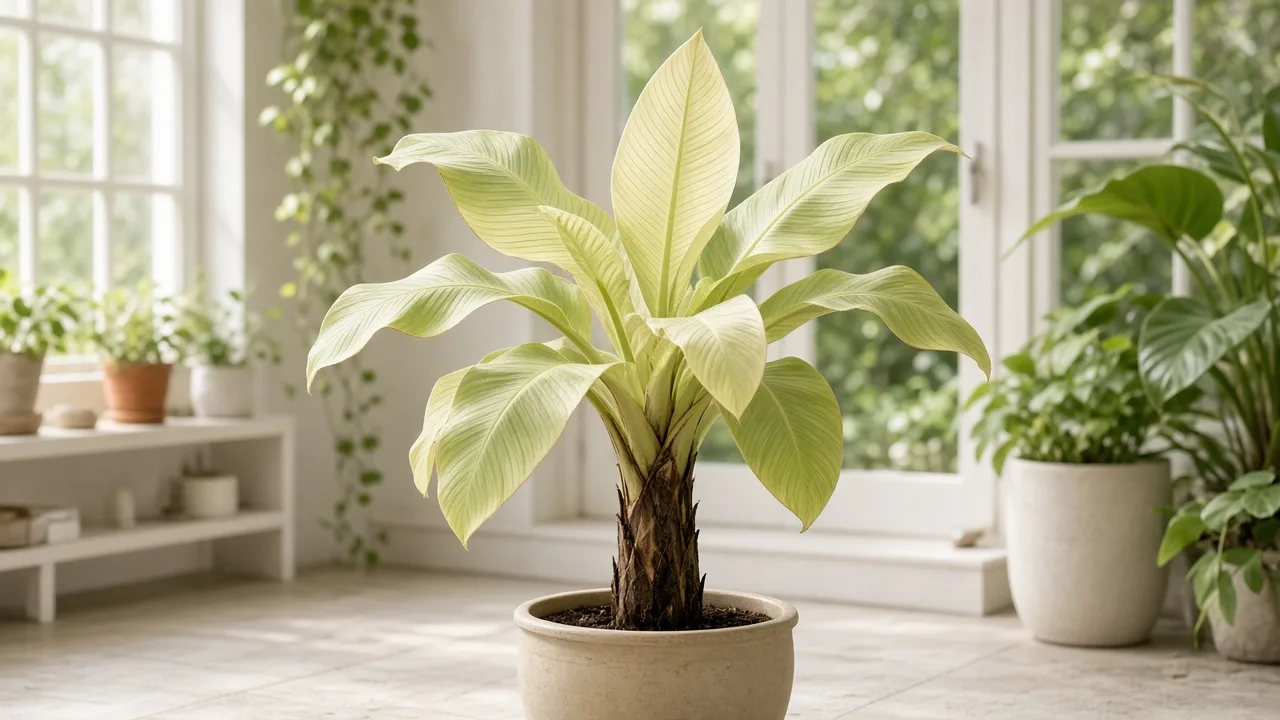
Pale Leaves on Banana: Causes, Checks & Fixes
This guide covers pale leaves on Banana. See also the general Pale Leaves guide, watering, and light pages for this plant.
Pale Leaves on Banana: Causes, Checks & Fixes
Quick answer
Pale leaves on Banana (Musa acuminata) look washed-out, yellow-green, or dull instead of the deep tropical green healthy paddles show in strong sun. The same faded color can mean drought, shade, nitrogen loss, iron chlorosis, wet-root stress, or normal aging of the lowest blade—where on the pseudostem the pale tissue sits tells you which branch to follow.
For general chlorosis mechanics, see our pale leaves guide. On Banana, compare the emerging cigar leaf at the crown to the oldest paddle low on the same trunk-like pseudostem before you change anything.
First step: read that color ladder on one pseudostem, then finger-test the top 2–3 cm of mix. Pale new tissue with green veins, uniform pale oldest lowers only, folded paddles on dry mix, and washed-out blades in a dim room are four different problems—not one generic “pale leaves” fix.
When to use this page vs other Banana guides
| Pattern | Read next |
|---|---|
| Washed-out paddles, long thin petioles, dim placement | Not enough light or leggy growth |
| Uniform pale oldest lower paddles, smaller new blades | Nitrogen deficiency |
| Yellow new paddle with dark green veins at crown | Iron deficiency |
| Yellow between veins on oldest lowers | Magnesium deficiency |
| Folded paddles, crisp margins after dry spell | Underwatering |
| All leaves pale on persistently wet soil, soft base | Overwatering or root rot |
| One bottom paddle only while green cigar leaf above | Normal aging—yellow leaves |
| Fine speckles with webbing on undersides | Spider mites |
What pale leaves look like on Banana
Healthy Banana pushes huge paddle-shaped leaves from a trunk-like pseudostem above an underground rhizome. Each blade unfurls from a tight cigar leaf at the crown. Pale foliage breaks that pattern in recognizable ways depending on cause.
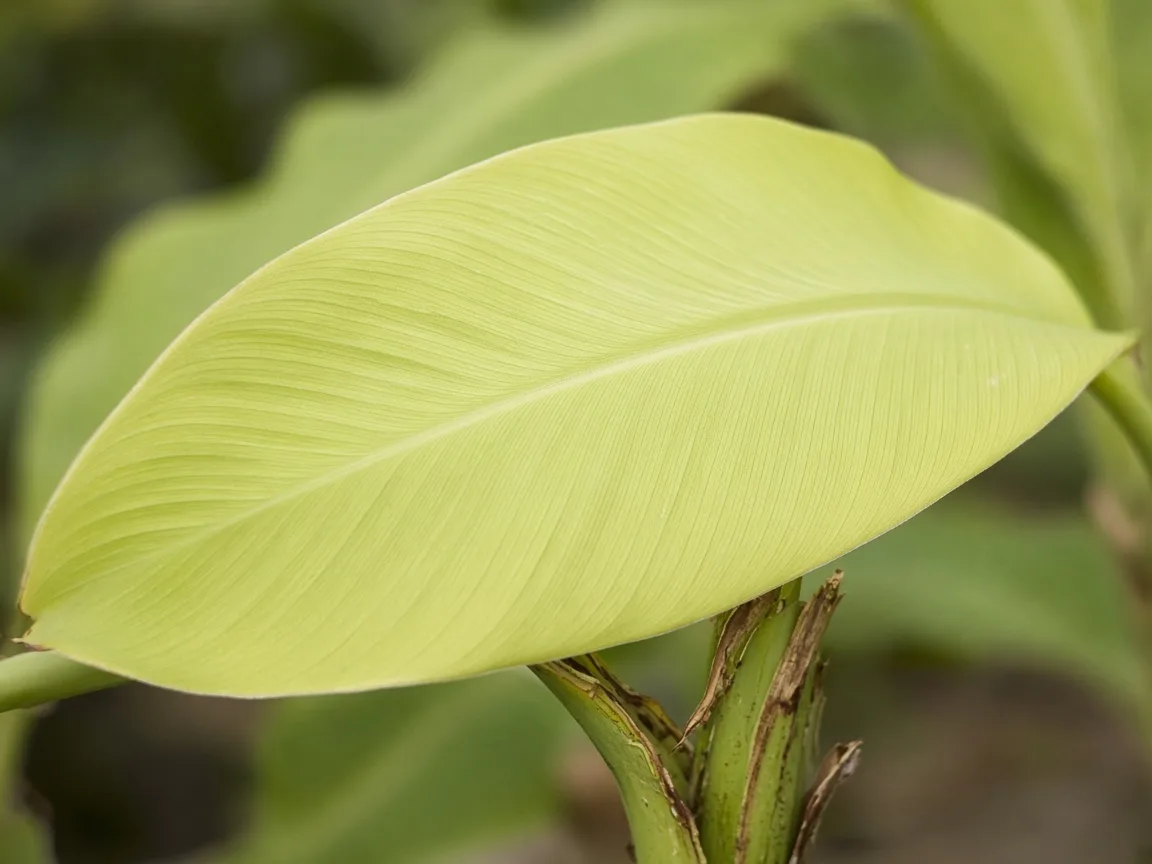
Washed-out yellow-green paddle blade low on the pseudostem—compare color with the greener cigar leaf and newest unfurling tissue above before treating.
Typical pale-leaf patterns:
- Whole-canopy washout — several paddles on the same pseudostem fade to yellow-green at once, often with long thin petioles in a dim room
- Oldest lowers only — uniform pale color confined to the bottom one to three paddles while the cigar leaf and newest blade above stay greener
- New-tissue chlorosis — the paddle still unfurling at the crown opens pale with dark green veins
- Drought fade — paddles fold vertically, feel thin, and lighten before crisp brown margins appear on bone-dry mix
- Wet-root fade — pale yellow-green lowers on soil that stays damp many days while growth stalls
- Speckled pale from a distance — fine yellow dots across the lamina with possible webbing underneath, unlike even washout
Not pale leaves:
- Deep green paddles with one naturally yellowing bottom blade as the pseudostem grows taller—see yellow leaves
- Brown scorched margins on sun-exposed blades after sudden harsh light—see brown tips
- Pale green flecks that become brown spots with yellow haloes—sigatoka-type leaf disease, not general chlorosis
- Distorted or cupped new paddles—see distorted leaves and calcium deficiency
Why Banana gets pale leaves
Banana is a fast-growing tropical herb that builds enormous leaf area from a non-woody pseudostem. Each huge paddle demands steady photosynthesis, water, and mobile nutrients. When any input falls short, chlorophyll production drops—and on Banana the symptom shows on the massive lamina long before the pseudostem looks obviously sick.
Banana-specific causes:
- Insufficient direct sun — UF/IFAS recommends full sun for best growth; Banana tolerates light shade but paddles stay pale and undersized when rays never reach the canopy. Indoor specimens in bright-looking rooms without direct sun on the leaves are a common source of washed-out green.
- Drought stress — UF/IFAS lists pale green to yellow leaf color among drought symptoms, along with folding leaves and premature leaf death. A thirsty pseudostem in a hot terrace pot can fade before obvious crisp brown edges appear.
- Nitrogen depletion — Nitrogen is mobile; deficiency shows first on older lower leaves as uniform pale yellow-green while the cigar leaf stays greener. Container bananas pushed hard through summer without complete fertilizer often show this ladder pattern.
- Iron or magnesium deficiency — Iron chlorosis hits new crown tissue with green veins; magnesium shows interveinal banding on old paddles. Both read as “pale” from across the room but need different fixes.
- Chronically wet rhizome — Continuously wet soil causes leaf yellowing and stunting even without obvious flooding. Pale lowers on heavy damp mix in a dim room compound shade stress with poor root uptake.
- Cool stalled growth — Growth slows below about 60°F (16°C); a banana held in a cool conservatory through winter may look pale and static while metabolism is paused—not hungry, just cold.
- Pest stippling — Spider mites extract chlorophyll from paddle undersides, creating a pale speckled look that differs from even washout when you inspect up close.
Do not diagnose nutrient deficiency on sour wet soil with a soft pseudostem base—that is root failure until you confirm firm tissue and healthy fibrous roots.
The cigar-leaf color ladder on the pseudostem
Banana diagnosis lives on one vertical stem. The cigar leaf at the crown is the youngest tissue; the oldest paddle hangs lowest on the same pseudostem. Pale color confined to lowers with a greener cigar leaf above strongly suggests mobile nitrogen loss or normal bottom-leaf senescence—not iron trouble, which appears on the newest unfurling blade.
That ladder would be nonsense on a rosette succulent or trailing vine where old and new leaves share the same plane. On Banana, walk the pseudostem from bottom to top: if pale wash climbs steadily week after week while new paddles stay undersized, starvation or chronic stress is more likely than one aging bottom blade. If only the lowest paddle is pale and the next two above are deep green, senescence is plausible.
The huge paddle surface makes even yellow-green wash highly visible—owners sometimes panic at the first faded lower blade when the cigar leaf above is still vigorous. Anchor your diagnosis on two or three leaves on the same stem, not one blade viewed in isolation.
Drought folding vs wet-soil fade on a thirsty giant herb
Banana needs large amounts of water during active growth but cannot survive saturated rhizomes. Both extremes fade foliage—but the feel of the pseudostem and mix separates them faster than hue alone.
Drought pale arrives with folded paddles, a lighter pot, and mix dry well below the top 2–3 cm. The plant loses turgor before every margin crisps. Owners who water on a calendar while the pseudostem sits in weak indoor light often underwater in cool months and overwater in summer—pale folded leaves on unexpectedly dry mix point to the drought branch per the underwatering guide.
Wet-root pale shows limp or pale lowers on heavy damp soil that has not dried for many days, sometimes with a sour smell at the drainage hole. Growth stalls; the cigar leaf may stay green but unfurl slowly. This pattern belongs on overwatering before you feed a faded canopy. Banana in dim light uses little water—soil that stays wet while paddles wash out is a compound trap, not a single-variable pale-leaf mystery.
Warm-season paddle turnover and normal lower fade
Banana can push a new paddle every few weeks in peak summer heat on a sunny terrace. Each pseudostem sheds lower blades as it elongates—one pale yellowing paddle at the base while a green cigar leaf unfurls above is often normal turnover, not deficiency. Worry when pale color climbs the stem, new paddles open smaller than the previous two, or the same washed-out tone appears on crown tissue.
UF/IFAS reports strongest shoot growth around 78–82°F (26–28°C). In that window, pale lowers that never progress upward may simply be aging out. In a cool stalled pseudostem, every paddle may look dull without any one cause beyond low metabolism—resume diagnosis only when warmth and light return in spring.
Lookalike symptoms
| Pattern | Check | Likely cause |
|---|---|---|
| Pale oldest lowers, greener cigar leaf | Position on pseudostem | Nitrogen deficiency or normal aging |
| Pale new paddle, green veins | Crown tissue | Iron deficiency |
| Yellow between veins on old paddles | Vein pattern | Magnesium deficiency |
| Long petioles, dim room, slow cigar leaf | Direct sun hours | Not enough light |
| Folded paddles, dry mix, light pot | Moisture depth | Underwatering |
| Pale lowers, wet heavy soil | Root-zone feel | Overwatering |
| Fine speckles, webbing | Leaf undersides | Spider mites |
| All paddles dull below 16°C | Temperature | Cool dormancy—reduce water, wait for spring |
How to confirm
- Color ladder — Compare cigar leaf, newest unfurled paddle, and oldest lower blade on the same pseudostem.
- Vein pattern — Even wash vs dark green veins vs interveinal banding rules out iron and magnesium before feeding.
- Soil moisture — Finger-test top 2–3 cm; lift pot weight; note days since last deep watering per the watering guide.
- Direct sun — Count hours when rays hit paddle surfaces, not floor brightness—see the light guide.
- Pseudostem base — Firm vs soft on wet or dry mix.
- Feeding history — Complete warm-season fertilizer vs years of water-only on a hungry container mat.
- Pest scan — Stippling and webbing on paddle undersides and cigar-leaf sheaths.
- Temperature — Growth active above about 16°C (60°F) or stalled in cool storage.
First fix for Banana
Read the color ladder on one pseudostem—cigar leaf vs oldest lower paddle—then finger-test the top 2–3 cm of mix before changing water, light, or feed.
Do not dump fertilizer, relocate to full terrace sun, and soak a dry pot the same afternoon. One diagnostic pass routes you to the right sibling guide:
- Dry mix + folded pale paddles → deep water once, then fix the watering rhythm
- Dim room + long petioles → move toward six hours of direct sun per not enough light
- Uniform pale oldest lowers on moist mix in full sun → one measured complete feed per fertilizer after ruling out wet roots
- Wet heavy soil + pale lowers → stop watering and inspect roots per overwatering
Step-by-step recovery
- Complete the ladder-and-moisture check on the main pseudostem before any treatment.
- Correct the primary stressor—water, light, drainage, or one measured feed—not all four at once.
- Maintain even rhizome moisture during recovery; uptake fails when roots alternate between saturated and desiccated in heavy pots on hot terraces.
- Acclimate to stronger sun over one to two weeks if shade was the driver—sudden harsh afternoon exposure can scorch paddles already weakened by chlorosis.
- Monitor the next two unfurling leaves from the cigar leaf; existing faded paddles rarely re-green.
- Repot into fresh compost-rich mix only if roots are firm but pale lowers persist after corrected feed and light—see repotting.
- Treat confirmed pests before assuming pale color is cultural—rinse undersides and isolate if stippling is present.
Recovery timeline
Fully faded paddle blades rarely return to deep green once the huge lamina hardens along the pseudostem. The next one to three paddles after corrected care usually show richer color and normal size within four to eight weeks on a firm pseudostem in warm active growth—faster than woody shrubs because Banana can push new leaves every few weeks in summer heat.
Severe rhizome damage from chronic overwatering may delay recovery a full warm season. If successive new paddles stay washed-out despite good sun, even moisture, and measured feeding, inspect roots before stacking more treatments.
Mistakes to avoid
- Do not feed a pale banana on sour wet soil or during cool stalled growth below about 16°C.
- Do not blast full terrace sun onto a shade-grown plant in one day—acclimate gradually.
- Do not confuse one naturally aging lower paddle with canopy-wide chlorosis.
- Do not treat speckled pest damage as uniform nutrient washout—inspect undersides first.
- Do not expect faded paddles to re-green—judge the next cigar-leaf unfurl.
- Do not water on a summer calendar while the pseudostem sits in dim light with slow metabolism.
Prevention
- Site containers in full sun outdoors during frost-free months and the brightest unobstructed window indoors—NC State classifies Musa acuminata as full-sun to partial-shade with best growth in strong light.
- Keep rhizome moisture even but not saturated per the watering and soil guides.
- Feed complete balanced fertilizer during active warm-season growth per the fertilizer guide—hungry fast-growing pseudostems deplete nitrogen quickly in leached container mix.
- Inspect lower paddles monthly in spring and summer—early uniform pale wash on oldest lowers is easier to correct than a pale pseudostem with undersized new blades.
- Pause or reduce feeding when temperatures fall below about 16°C; resume when new cigar leaves return.
Related Banana guides
- Banana overview
- Banana light
- Banana watering
- Banana fertilizer
- Not enough light
- Nitrogen deficiency
- Underwatering
- Banana problems hub
Conclusion
Pale paddles on Banana are a position-and-context symptom, not a single disease. Read the color ladder from oldest lower blade to cigar leaf, pair it with soil moisture and direct sun hours, route to the matching sibling guide, and judge recovery on the next unfurling leaves—not on blades that have already faded.
Related tool
Use the Plant Problem Diagnosis Tool to narrow causes for pale leaves on this plant before changing multiple variables at once.