Magnesium Deficiency on Banana: Causes, Checks & Fixes
Quick answer
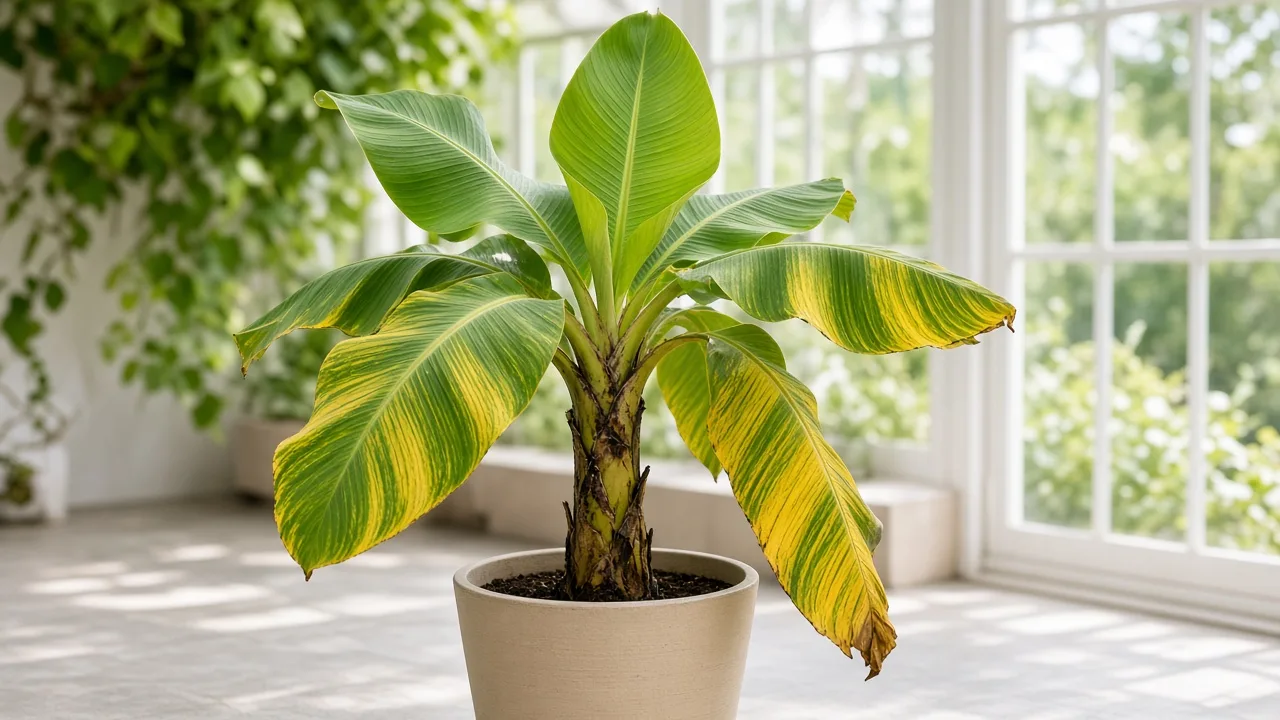
Magnesium deficiency on Banana shows on older mid-stem paddle leaves first—green banding along the margin and next to the midrib, yellow interveinal areas between green veins, and sometimes purplish mottling on petioles—while the newest cigar leaf and upper paddles often stay greener. First step: confirm the pattern is on mature lower leaves (not new-tissue calcium damage or iron chlorosis on young paddles), then apply one measured dose of magnesium sulfate in water on moist mix during warm active growth.
Magnesium Deficiency on Banana: Causes, Checks & Fixes
This guide covers magnesium deficiency on Banana. See also the general Magnesium Deficiency guide, watering, and light pages for this plant.
Magnesium Deficiency on Banana: Causes, Checks & Fixes
Quick answer
Magnesium deficiency on Banana (Musa acuminata) shows on older mid-stem paddle leaves first—green banding along the margin and next to the midrib, yellow interveinal areas between green veins, and sometimes purplish mottling on leaf petioles—while the newest cigar leaf and upper paddles often stay greener. Magnesium is mobile in plants, so the banana withdraws it from mature blades to fuel new paddle expansion at the pseudostem crown.
See our magnesium deficiency guide for general interveinal chlorosis mechanics. On Banana, inspect mid-stem and lower paddles on the same pseudostem—green marginal bands with yellow tissue between veins point to magnesium before calcium tip necrosis on the cigar leaf or iron chlorosis on young paddles.
First step: confirm yellow banding and interveinal chlorosis on older mature paddle leaves, not on the newest unfurling blade or cigar leaf alone.
When to use this page vs other Banana guides
| Pattern | Read next |
|---|---|
| Green banding at margin, yellow mid-leaf on older paddles | Magnesium deficiency (this page) |
| New paddle tip necrosis, torn margins, spike-leaf narrowing | Calcium deficiency |
| New paddles yellow with dark green veins | Iron deficiency |
| Old lower paddles pale uniformly | Nitrogen deficiency |
| Brown scorched margins, midrib fracture on mature leaves | Potassium deficiency |
| General yellowing in wet soil, soft pseudostem base | Overwatering or root rot |
| Pale overall canopy, weak growth in dim room | Not enough light or pale leaves |
What magnesium deficiency looks like on Banana
Healthy Banana pushes huge paddle-shaped leaves from a trunk-like pseudostem above an underground rhizome. Each new leaf emerges as a tight cigar leaf at the crown before unfurling into a broad blade. Magnesium sits at the center of the chlorophyll molecule, so when uptake fails, older paddles lose green tissue first while the plant moves magnesium upward to support new growth at the crown.
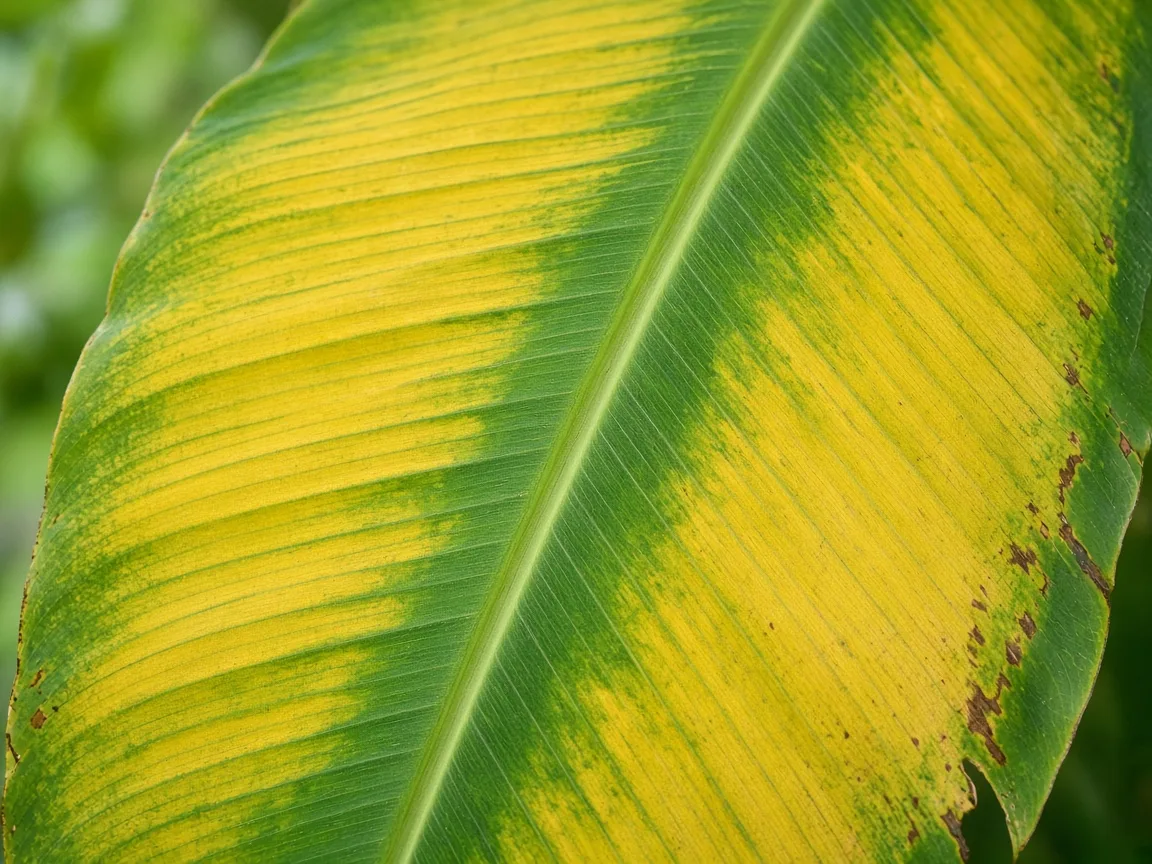
Older Banana paddle showing classic magnesium pattern—green band along the margin and beside the midrib with yellow interveinal tissue between green veins.
Typical signs:
- Green banding around the leaf margin and next to the midrib on mature mid-stem or lower paddles
- Yellowish interveinal chlorosis between green veins—veins stay greener than the tissue between them (ICL notes this as a key diagnostic feature)
- Marginal yellowing that extends inward toward the midrib over time
- Light brown necrotic spots or goods along the leaf margin on advanced cases (TNAU banana magnesium notes)
- Purplish mottling on leaf petioles and occasional leaf malformation
- Striated or washed-out appearance from the paddle edges inward
- Reduced plant height or smaller mid-stem paddles despite warm active growth
- Newest cigar leaf and upper paddles often stay greener longer—symptoms climb from below
- On fruiting outdoor plants, poor ripening and bland fruit when deficiency is severe (TNAU)—rare on indoor foliage specimens
Not magnesium deficiency:
- Tip necrosis and torn margins on the newest unfurling paddle or cigar leaf—calcium deficiency
- New paddles uniformly yellow with dark green veins—iron deficiency
- Uniform pale lower old leaves without green marginal banding—nitrogen deficiency
- Scorched brown margins and midrib fracture on mature paddles—potassium deficiency
- One bottom paddle yellowing while a green paddle unfurls above—normal aging; see yellow leaves
- Crispy edges after heavy feed with white salt crust—brown tips from overfertilization
Why Banana gets magnesium deficiency
Banana is a fast-growing tropical herb that builds an enormous leaf canopy from a non-woody pseudostem. Each huge paddle demands magnesium for chlorophyll, and UF/IFAS recommends fertilizers containing magnesium for home landscape bananas—young plants start on a 6-2-12 or similar formula with 2–3% magnesium. Container bananas that receive incomplete or potassium-heavy feeding without magnesium replenishment often show deficiency on mid-stem paddles during peak summer leaf production.
Banana-specific causes:
- Potassium-heavy feeding without magnesium — Banana has a high potassium demand, but repeated potassium-forward doses without magnesium in the program can antagonize magnesium uptake on leached container mix. See the Banana fertilizer guide for balanced complete feeding.
- Incomplete fertilizer labels — Nitrogen-only or bloom formulas pushed on a hungry container banana during rapid paddle production leave mobile magnesium depleted from older leaves even when the pseudostem looks vigorous.
- Leached sandy or perlite-heavy mix — UF/IFAS notes sandy Florida soils need frequent fertilization; magnesium washes from light, fast-draining container blends that dry within a day on a hot terrace.
- Acidic depleted mix — Very low pH in aged compost-heavy blend reduces magnesium availability; refresh mix when roots crowd the pot per the soil guide.
- Inconsistent moisture at the rhizome — Magnesium moves with water through the xylem. Alternating drought and heavy soaking in an oversized decorative pot limits uptake to expanding paddles even when fertilizer sits in the saucer. Match rhythm to the watering guide.
- Cool or dim stalled growth — Feeding during winter slowdown without active transpiration builds salts without correcting uptake; symptoms often appear when warm weather returns and the banana resumes pushing paddles.
- Root stress blocking uptake — NC State notes banana prefers moist but well-drained soil and should be fertilized regularly; chronic overwatering or cool waterlogged roots limit magnesium transport regardless of what is in the bottle.
Mid-stem paddle chlorosis vs the cigar leaf
Banana allocates mobile magnesium from mature lower and mid-stem paddles to the expanding cigar leaf and newest blade at the pseudostem crown. When supply fails, you see the classic green band along the margin and beside the midrib on older tissue while the unfurling paddle above may still look acceptable.
That pattern differs sharply from calcium deficiency, which hits new expanding tissue first with tip necrosis and spike-leaf narrowing. It also differs from iron deficiency, where young paddles yellow between veins while older blades stay greener.
Walk the pseudostem from bottom to top: magnesium banding on paddles three to six leaves below the crown, with a greener cigar leaf, is the textbook banana pattern. If every paddle including the newest shows the same wash-out, rule out nitrogen deficiency or general pale leaves from low light before treating magnesium.
Petiole mottling and marginal necrosis on mature blades
Advanced magnesium deficiency on Banana can add purplish mottling on leaf petioles and light brown necrotic patches along paddle margins as chlorophyll loss progresses. The broad Banana blade makes the striated edge pattern easy to spot from across a terrace—yellow tissue radiates inward from the margin while veins and the rim stay greener.
Do not confuse marginal brown goods with potassium deficiency scorch, which often pairs with midrib fracture and purplish-brown patches at the petiole base on fully mature leaves in heavy-fruiting plants. Magnesium banding keeps greener tissue along the margin and beside the midrib even when yellow fills the blade center.
Heavy potassium feeding on fast-growing container bananas
Outdoor plantation bananas receive potassium-forward formulas at flowering, but container growers sometimes copy those rates on a young Dwarf Cavendish in a 30 cm pot. Excess potassium without magnesium replenishment reduces magnesium availability in the root zone just as the pseudostem pushes a new paddle every few weeks in July heat.
The fix is not to stop feeding a hungry banana—it is to return to a complete formula that lists magnesium at half strength during active growth, then monitor whether mid-stem banding stabilizes on the next two paddles. Pair that with consistent rhizome moisture so the correction actually reaches the fibrous roots.
Rhizome moisture before magnesium correction
Banana stores energy in an underground rhizome and fibrous roots that need even moisture without saturation. Before any magnesium dose, finger-test the top 2–3 cm of mix and lift the pot—water when dry, but never let the root zone stay sour-smelling wet for days.
Firm pseudostem base with white roots when you tip the pot supports a measured magnesium sulfate solution or complete feed with magnesium on already-moist mix during active growth. Soft, darkened base on persistently wet mix means root rot—not a nutrient label problem. Correct drainage and moisture per the watering guide before dissolving Epsom salt on soggy rhizomes.
Lookalike symptoms
| Pattern | Check | Likely cause |
|---|---|---|
| Green banding at margin on older mid-stem paddles | Leaf age on pseudostem | Magnesium deficiency (this page) |
| New paddle tip necrosis, torn margins | New vs old tissue | Calcium deficiency |
| New paddles yellow, green veins | Young leaf pattern | Iron deficiency |
| Old lower paddles pale uniformly | Lower canopy only | Nitrogen deficiency |
| Midrib fracture, purplish petiole base scorch | Mature fruiting stem | Potassium deficiency |
| Soft pseudostem base, wet soil | Base feel | Root rot |
| One bottom paddle yellow, new growth clean | Single old leaf | Normal aging — yellow leaves |
How to confirm
- Leaf position on the pseudostem — Banding and interveinal yellowing on mid-stem or lower mature paddles while the cigar leaf stays greener strongly suggests magnesium.
- Vein pattern — Green veins with yellow tissue between them on older blades; not uniform whole-leaf yellow or new-leaf tip necrosis.
- Fertilizer history — Months of potassium-heavy or incomplete feed without magnesium listed on the label during warm active growth.
- Rhizome health — Firm pseudostem base and fibrous white roots vs brown mush from soggy soil.
- Watering rhythm — Alternating extreme drought and heavy soaking that interrupts uptake to expanding paddles.
- Season — Symptoms appearing or worsening during warm active growth when the banana is pushing continuous new leaves.
- Potassium overlap — Recent heavy potassium doses without magnesium in the same feeding cycle.
- Successive paddles — Yellowing climbing one or two leaf positions up the pseudostem over several weeks on stable care points to depletion, not a single stressed blade.
First fix for Banana
One measured dose of magnesium sulfate (Epsom salt) dissolved in water at roughly 1 tablespoon per gallon (15 ml per liter), applied to already-moist mix during warm active growth—only after confirming banding on older mid-stem paddles, firm pseudostem base, stable even moisture, and no new-tissue calcium damage on the cigar leaf.
Do not repot, remove suckers, and triple-feed a recently relocated banana the same week. Stabilize watering per the Banana watering guide first—keep the rhizome evenly moist without saturation, and empty cachepot standing water after each drink.
If your regular fertilizer already lists magnesium, switch to half-strength complete balanced feed on moist mix instead of stacking Epsom salt and full-strength potassium on the same day. TNAU notes foliar MgSO4 sprays can correct banana magnesium deficiency; for container plants, a single soil drench or foliar mist on older affected paddles in early morning is usually enough to test response.
Step-by-step recovery
- Rule out calcium and iron — Inspect the cigar leaf for tip necrosis and young paddles for green-vein chlorosis before treating magnesium.
- Apply one magnesium correction — Epsom salt drench at the rate above, or half-strength complete feed with magnesium on moist mix during active growth.
- Resume balanced feeding every two to four weeks through the warm season if the next mid-stem paddle holds green longer—see the fertilizer guide and RHS container banana guidance.
- Maintain consistent rhizome moisture—uptake fails when roots alternate between saturated and desiccated in heavy decorative pots on a hot terrace.
- Repot into fresh compost-rich mix if roots fill the pot and banding persists after two measured corrections on a firm pseudostem—see Banana repotting.
- Move the plant gradually into stronger direct sun if not enough light is slowing transpiration and nutrient transport.
- Monitor paddles three to six leaves below the crown—currently banded blades rarely re-green fully; recovery shows on the next mid-stem leaves holding chlorophyll longer.
- Flush white salt crust at the pot rim before resuming feeding if buildup blocks uptake—overlap with brown tips on overfed specimens.
Recovery timeline
Banded or yellowed paddle tissue on leaves that already expanded rarely re-greens fully once interveinal chlorosis advances. The next one or two mid-stem paddles after corrected magnesium and balanced feeding usually hold green margins and fuller chlorophyll within four to eight weeks on a firm pseudostem—faster than woody shrubs because Banana can push a new paddle every few weeks in peak summer heat.
Severe rhizome damage from chronic overwatering may delay recovery a full warm season. If banding climbs to the cigar leaf despite magnesium doses and stable summer care, inspect roots for rot and review whether potassium-heavy feeding continues without magnesium in the program.
Mistakes to avoid
- Do not treat new cigar-leaf tip necrosis as magnesium—check calcium deficiency first.
- Do not heavy-feed potassium without magnesium on a leached container mix—that path worsens antagonism and brown tips.
- Do not apply Epsom salt to bone-dry mix or during cool stalled growth—water and warmth come first.
- Do not expect currently banded paddles to fully re-green—judge the next mid-stem leaves.
- Do not stack repotting, sucker removal, and full-strength feed the same week on a stressed rhizome.
- Do not confuse one bottom paddle yellowing with deficiency—normal senescence happens on a maturing pseudostem.
Prevention
- Feed with complete balanced or moderately potassium-forward fertilizer that lists magnesium during active warm-season growth per the Banana fertilizer guide—UF/IFAS recommends magnesium-containing formulas for home bananas.
- NC State recommends regular fertilization on Musa acuminata in organically rich moist soil during active growth.
- Maintain consistent rhizome moisture per the watering guide.
- Refresh depleted compost-rich mix every two to three years when roots and suckers crowd the pot.
- Inspect mid-stem paddles monthly during spring and summer—early green banding is easier to correct than canopy-wide chlorosis.
- Pause or reduce feeding when temperatures fall below about 16°C and growth slows; resume complete feed only when new paddles return.
Related Banana guides
- Banana overview
- Banana fertilizer
- Banana watering
- Banana soil
- Potassium deficiency
- Calcium deficiency
- Banana problems hub
- All plant symptoms
Conclusion
Green banding and interveinal yellow chlorosis on older mid-stem Banana paddles point to magnesium depletion on a fast-growing pseudostem—confirm the old-leaf-first pattern, rule out calcium and iron on new tissue, stabilize rhizome moisture, apply one measured magnesium correction during warm active growth, and judge recovery by the next mid-stem paddles holding green longer rather than expecting banded blades to fully re-green.
Related tool
Use the Fertilizer Dilution Calculator to narrow causes for magnesium deficiency on this plant before changing multiple variables at once.