Yellow Leaves on Banana: Paddle Ladder Checks
Quick answer
Yellow leaves on Banana usually mean one of three things on Musa acuminata: normal shedding of the oldest outer paddle while the cigar leaf stays green, drought stress with folded blades on a light dry pot, or wet-soil root failure with yellowing on a heavy pot and soft pseudostem base. First step: count which paddles are yellow from bottom to top and press the lowest 5 cm of pseudostem above the soil line before you water, feed, or repot.
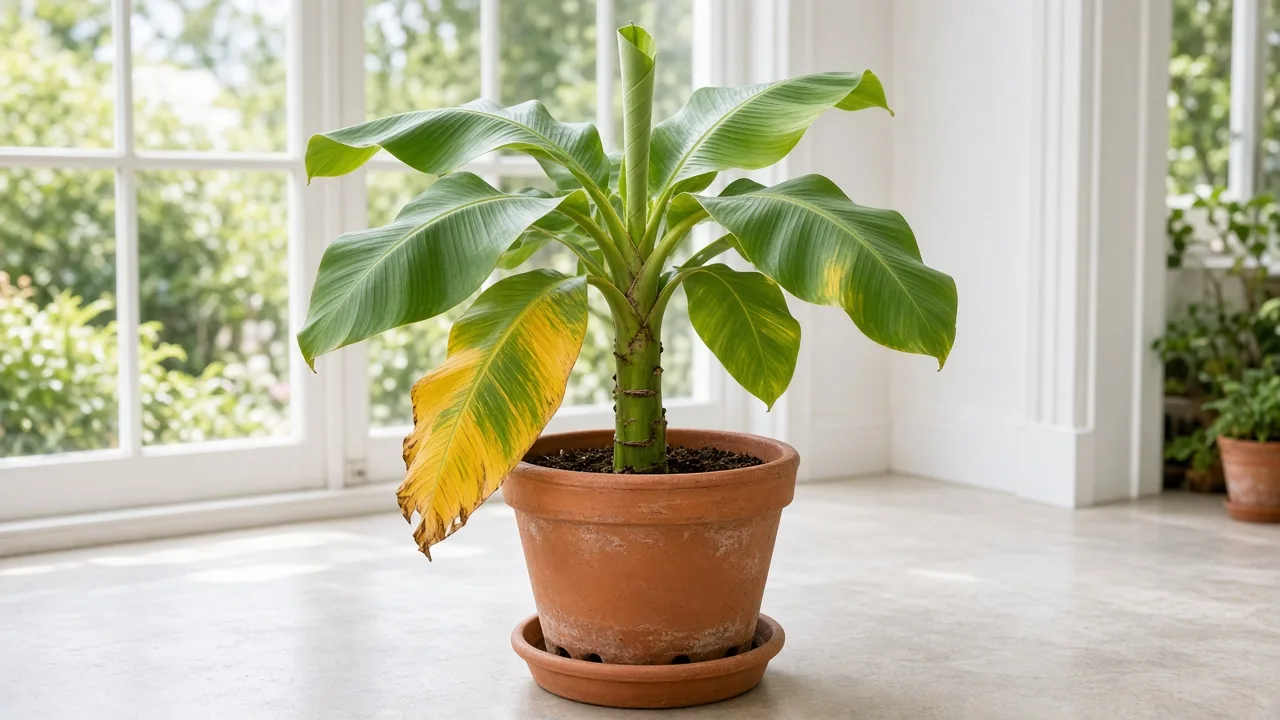
Yellow Leaves on Banana: Causes, Checks & Fixes
This guide covers yellow leaves on Banana. See also the general Yellow Leaves guide, watering, and light pages for this plant.
Yellow Leaves on Banana: Causes, Checks & Fixes
Quick answer
Yellow leaves on Banana (Musa acuminata) are not one diagnosis—they are a paddle-ladder pattern on a fast-growing tropical herb whose trunk-like pseudostem is made of overlapping leaf sheaths, not wood. Each pseudostem may carry 40 or more huge paddle-shaped blades during its life, and the lowest outer leaves naturally senesce as new cigar leaves unfurl from the crown.
For how chlorosis spreads from old to new tissue in general, see our yellow leaves guide. On banana, the first job is to read which paddles are yellow from bottom to top, then check cigar-leaf color, pot weight, and pseudostem firmness at the soil line—not to treat every yellow blade as starvation or every dry spell as thirst.
First step: walk the paddle ladder from the lowest outer blade to the cigar leaf, then press the lowest 5 cm of pseudostem above the soil line and lift the pot. One yellow bottom paddle on a firm base with a green unfurling crown is often normal aging. Yellow climbing through several lower paddles on a heavy wet pot is a watering emergency; folded yellow blades on a light dry pot is underwatering.
When to use this page vs other Banana guides
| Pattern | Read next |
|---|---|
| One bottom paddle only, firm base, green cigar leaf | Normal senescence (this page) |
| Yellow climbing on heavy wet pot, soft base | Overwatering or root rot |
| Folded blades, light dry pot, crispy margins | Underwatering |
| Uniform pale oldest lower paddles, smaller new blades | Nitrogen deficiency |
| Yellow between veins on oldest lower paddles | Magnesium deficiency |
| Yellow new paddle with green veins at crown | Iron deficiency |
| Washed-out green, long bare petioles, dim room | Not enough light or leggy growth |
| Brown flecks with yellow haloes on blades | Sigatoka-style leaf disease—inspect undersides; see black spots |
| Limp paddles despite wet soil | Wilting or drooping leaves |
What yellow leaves look like on Banana
Healthy banana pushes huge paddle-shaped leaves from a pseudostem above an underground rhizome. New growth arrives as a tight cigar leaf at the crown. Yellowing can be one aging outer paddle, a drought-stressed canopy, wet-root chlorosis, or nutrient banding—and the ladder position tells them apart.
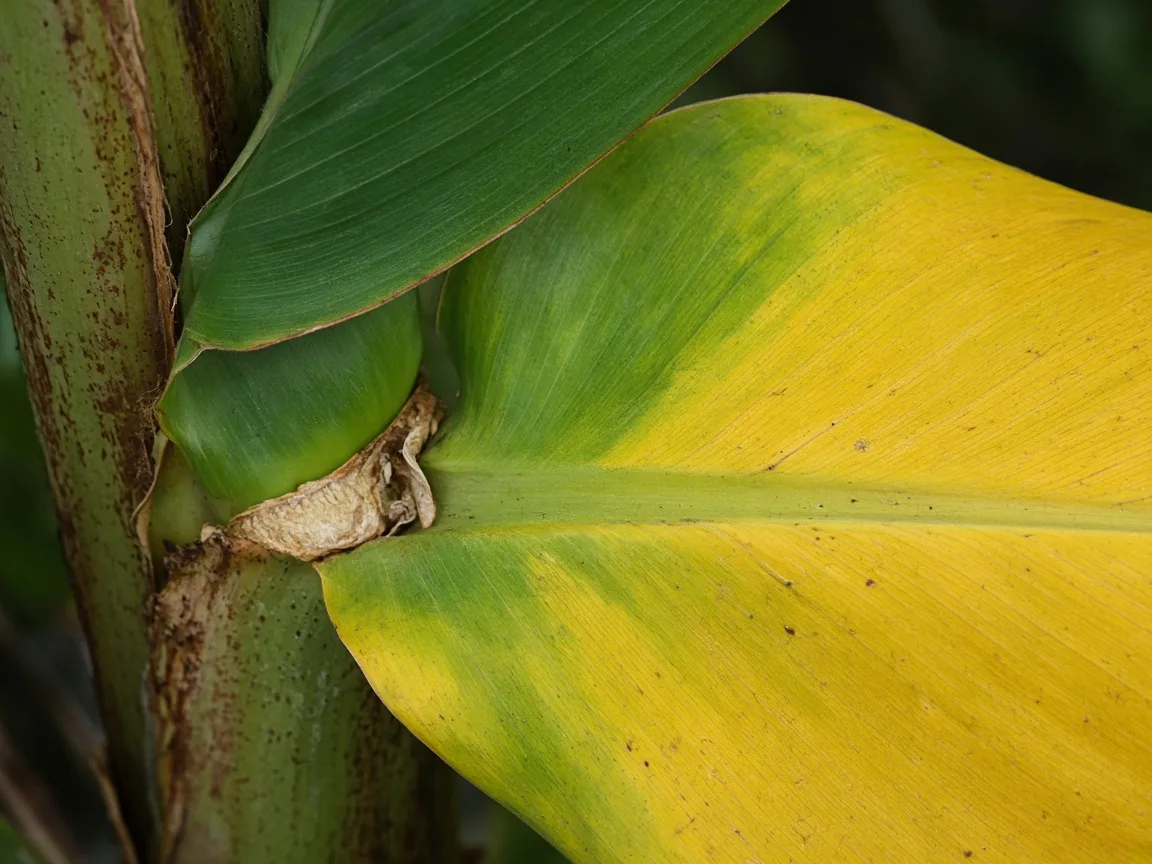
Oldest paddle-shaped leaf low on the pseudostem turning yellow while the next blade and cigar leaf above remain green—classic outer-leaf senescence on an otherwise healthy mat.
Common patterns:
- Single lowest paddle fading yellow-green, then tan, while the cigar leaf above stays green—often normal senescence on a fast mat
- Several lower paddles yellowing together on a heavy wet pot with dark cool surface mix—overwatering or early root rot (continuously wet soil causes leaf yellowing and stunting)
- Folded or drooping blades with pale green to yellow color on a light dry pot—drought stress (drought symptoms include folding leaves and pale green to yellow foliage)
- Uniform pale wash on oldest lowers while crown stays greener—nitrogen deficiency (nitrogen deficiency shows on lower leaves first)
- Interveinal yellow banding on oldest lowers—magnesium deficiency
- Yellow new paddle with dark green veins at the unfurling cigar leaf—iron deficiency
- Dull yellow-gray ripening look or narrow new blades after cold exposure—chilling stress below about 60°F (16°C)
- Brown flecks with yellow haloes spreading along paddles in humid wet weather—Sigatoka-type leaf disease (yellow sigatoka begins as pale flecks becoming brown with yellow haloes)
The paddle-ladder read: which leaf yellows first
This plant-only diagnostic does not transfer to rosette succulents or ferns. On Musa acuminata, each new paddle emerges above the last, leaving a vertical ladder of leaf scars on the pseudostem:
- Bottom rung only — Usually senescence. The mat sheds its oldest functional blade to fund the cigar leaf. No fix needed if base is firm and mix dries normally between soaks.
- Bottom three to five rungs, firm base, normal pot weight — Often nitrogen or magnesium drift in leached container mix; see fertilizer guide after ruling out wet soil.
- Bottom rungs on a heavy wet pot — Root-zone failure first; see overwatering.
- Whole canopy pale at once on dry light pot — Drought or severe underwatering.
- Newest unfurl yellow while old paddles stay green — Iron or calcium stress at the crown—opposite of mobile nitrogen pattern.
Always pair ladder position with cigar-leaf condition. A green cigar leaf unfurling above one yellow outer paddle is the classic “keep calm” picture on an actively growing container banana in summer sun.
Cigar leaf vs outer paddle: the banana fork
The cigar leaf is the tightly rolled paddle emerging from the pseudostem tip. It is the fastest read on whether yellow lowers are cosmetic aging or systemic stress:
- Green cigar leaf unfurling cleanly — Root zone is still delivering to new tissue even if the lowest paddle is yellowing out.
- Cigar leaf limp, brown-tipped, or stuck — Crown stress; check pseudostem firmness and whether the pot has stayed wet for days in a cool dim room.
- Cigar leaf pale with green veins — Suspect iron deficiency before generic “feed more.”
- No cigar movement for weeks on wet heavy soil — Growth stalled; drainage and base firmness before fertilizer.
Compare the cigar leaf to the lowest outer paddle every time. Banana naturally loses outer blades; it should not lose the crown first.
Pseudostem base and pot weight: wet vs dry yellowing
Banana yellowing from water mistakes often starts underground while upper paddles still look upright. The pseudostem is formed by tightly packed leaf sheaths; the functional trunk meets the rhizome at the soil line:
Wet-path yellowing
- Pot stays heavy days after watering; top 2–3 cm feels cool and clinging
- Several lower paddles chlorotic on saturated mix
- Soft or water-soaked lowest 5 cm of pseudostem
- Sour smell, fungus gnats, or mold on soil
Dry-path yellowing
- Pot feels light; mix pulls away from the rim
- Folded paddle blades with pale green to yellow color (drought folding and yellowing)
- Crispy margins on exposed blades; see also brown tips
- Firm pseudostem base—thirst, not rot
Press the base before you add water. A thirsty banana on a light pot needs a deep soak per the watering guide; a heavy wet pot needs a dry-down pause, not more moisture.
Why Banana gets yellow leaves
Banana is a rapid-growing tropical herb with enormous leaf area and a fibrous root mass that demands consistent moisture without stagnant saturation. Yellow paddles usually trace to one of these banana-specific drivers:
Normal mat turnover. Each pseudostem eventually flowers, fruits, and dies; during active growth it continuously sheds lower paddles. One yellow outer blade on an otherwise vigorous mat is expected—not a crisis.
Water imbalance. Bananas are sensitive to drought and to continuously wet soils. Container growers often swing between both: drought in a hot sunny week, then compensatory soaking that leaves the rhizome in anaerobic mix.
Nutrient drift in hungry pots. Banana is a heavy feeder. Nitrogen is mobile—deficiency appears on older lowers first. Hot-season watering washes nitrogen from compost-rich mix. Magnesium and iron show different vein patterns on paddle tissue—use the sibling deficiency pages rather than guessing from “yellow.”
Light and temperature. Growth slows below 16°C (60°F); a cool dim room uses little water while calendars still say “water twice a week,” producing wet-soil yellowing. Chilling injury includes dull yellow or greenish-gray foliage on exposed plants.
Leaf disease in wet humid spells. Sigatoka-type fungi cause brown flecks with yellow haloes that coalesce into dead paddle tissue—not uniform bottom-up senescence. Inspect both leaf surfaces during prolonged rain or overhead misting.
How to confirm the cause
Work in this order—one pass, one notebook line per paddle:
- Count yellow paddles from lowest outer blade upward; note cigar-leaf color and whether unfurl is clean.
- Press pseudostem base 5 cm above soil; note firm vs soft on wet vs dry mix.
- Lift the pot—heavy and waterlogged vs light and dusty.
- Finger-test top 2–3 cm per watering method; compare to last seven days of room temperature and light.
- Scan veins—uniform pale (nitrogen), interveinal band (magnesium), green veins on new yellow (iron).
- Check leaf undersides for stippling, webbing, or honeydew (spider mites, aphids) before assuming culture alone.
- Review feed history—complete fertilizer during warm active growth per fertilizer guide, not in cool stalled months.
Confirmed diagnosis needs two matching signals. One yellow bottom paddle + firm base + green cigar leaf = senescence. Three yellow lowers + heavy pot + soft base = wet-root failure, not nitrogen.
The first fix to try
Read the paddle ladder and pseudostem base before changing anything.
- If only the lowest outer paddle is yellow, the base is firm, the cigar leaf is green, and pot weight is normal → No corrective action. Let the blade senesce; remove it only when it pulls away easily. Do not fertilize or repot for cosmetic aging.
- If several lowers yellow on a heavy wet pot or the base feels soft → Stop watering immediately. See overwatering and escalate to root rot if tissue is mushy.
- If blades are folded on a light dry pot with crispy margins → One deep soak until excess drains; then reset to top 2–3 cm dry-down per watering guide.
- If uniform pale oldest lowers, firm roots, firm base, full sun, and no feed all season → One measured complete fertilizer on moist mix per fertilizer guide—after confirming it is not wet-soil yellowing.
Make one correction, then wait one to two normal watering cycles before stacking repot, prune, and pesticide.
Step-by-step recovery
Senescence (one outer paddle). No treatment. When the petiole dries, cut the dead paddle at the pseudostem scar with clean pruners if it blocks light to suckers—do not strip green tissue.
Wet-soil yellowing. Dry-down pause, improve drainage holes, empty cachepot runoff, and hold fertilizer until the cigar leaf unfurls clean. If base softens, unpot and trim black roots per root rot protocol.
Drought yellowing. Soak until drainage runs free; mist is not a substitute for root-zone moisture on this huge-leafed herb. Increase check frequency in hot sun on a terrace.
Nutrient yellowing. Apply one balanced feed at label rate on moist—not soggy—mix. Route to nitrogen, magnesium, or iron pages if vein pattern matches.
Cold or dim stress. Move to the warmest bright spot above 16°C; reduce water to match slowed growth; resume feeding when new cigar leaves return in spring.
Recovery timeline
- Single outer paddle: Yellow blade may hang two to four weeks before drying; next paddle should stay green.
- Drought correction: Folded blades often lift within 24–48 hours after a proper soak; yellow tissue on hardened paddles does not re-green.
- Wet-soil pause: Pot weight should drop within one dry-down cycle; new cigar leaf unfurl in one to three weeks if base stayed firm.
- Nutrient feed: Next one to two paddles should emerge larger and brighter within four to eight weeks in warm sun.
- Advanced base rot: Weeks to months if salvageable; many container mats lose the main pseudostem and must regrow from a sword sucker.
Judge success by cigar-leaf quality and stopped climb up the ladder—not by re-greening old yellow paddles.
Lookalike symptoms
| What you see | Likely cause | Check |
|---|---|---|
| One bottom paddle, green cigar leaf | Normal aging | Base firm, normal pot weight |
| Yellow lowers + heavy wet pot | Overwatering / root stress | Base soft?, sour mix? |
| Folded yellow blades + light pot | Underwatering | Crispy margins?, dry top 2–3 cm |
| Pale uniform oldest lowers | Nitrogen deficiency | Feed history, firm base |
| Yellow between veins on old lowers | Magnesium deficiency | Vein pattern |
| Yellow new leaf, green veins | Iron deficiency | pH, crown tissue |
| Brown flecks + yellow haloes | Sigatoka-type leaf spot | Humid wet spell, leaf undersides |
| Whole plant dull yellow-gray after cold | Chilling injury | Recent temperature drop |
Mistakes to avoid
- Pulling a still-attached yellow paddle — tears pseudostem sheaths and opens disease entry; wait until senescent tissue separates.
- Fertilizing a wet, soft-based mat — burns failing roots; fix drainage first.
- Assuming every yellow leaf needs more water — the most common indoor mistake on a plant that also yellows from drowning.
- Ignoring the cigar leaf — outer paddle color alone misleads on banana.
- Repotting, pruning, and spraying the same day — you cannot read which fix worked.
How to prevent yellow leaves next time
- Water on pot weight and top 2–3 cm dry-down, not a calendar—hot terrace plants may need checks every two to three days; cool indoor mats may go a week (banana needs steady moisture but is damaged by continuously wet soils).
- Use rich, fast-draining mix per soil guide in pots with open drainage; deep tubs hide wet bottoms.
- Feed complete fertilizer during active warm growth; pause below about 16°C when the mat stops pushing cigar leaves.
- Give full sun or brightest indoor light so the plant uses water predictably—see light guide.
- Expect one outer paddle to yellow periodically on a healthy fast-growing pseudostem; track the ladder, not individual blades.
- Inspect undersides during humid spells; remove badly spotted paddles to slow Sigatoka spread in outdoor plantings.
Related tool
Use the Yellow Leaves Diagnosis Tool to narrow causes for yellow leaves on this plant before changing multiple variables at once.
Related Banana guides
- Banana overview — Growth habit, pseudostem structure, and when yellow lowers are normal mat turnover.
- Watering — Top 2–3 cm dry-down and pot-weight method; essential before diagnosing wet vs dry yellowing.
- Overwatering — Heavy pot, soft pseudostem base, and wet-soil paddle ladder climb.
- Nitrogen deficiency — Uniform pale oldest lowers with greener cigar leaf.
- Not enough light — Washed-out paddles and weak new growth in dim rooms.