Fungus Gnats on Banana: Moist-Soil Checks & Fixes
Quick answer
Fungus gnats on Banana signal that the top of your rich, moisture-retentive mix is staying damp too long—often from calendar watering in cool weather, mulch pressed against a wet surface, or an oversized pot. First step: let only the top 2–3 cm dry while emptying saucer water, set a yellow sticky trap at soil level, and match watering to how fast the pseudostem is actually growing.
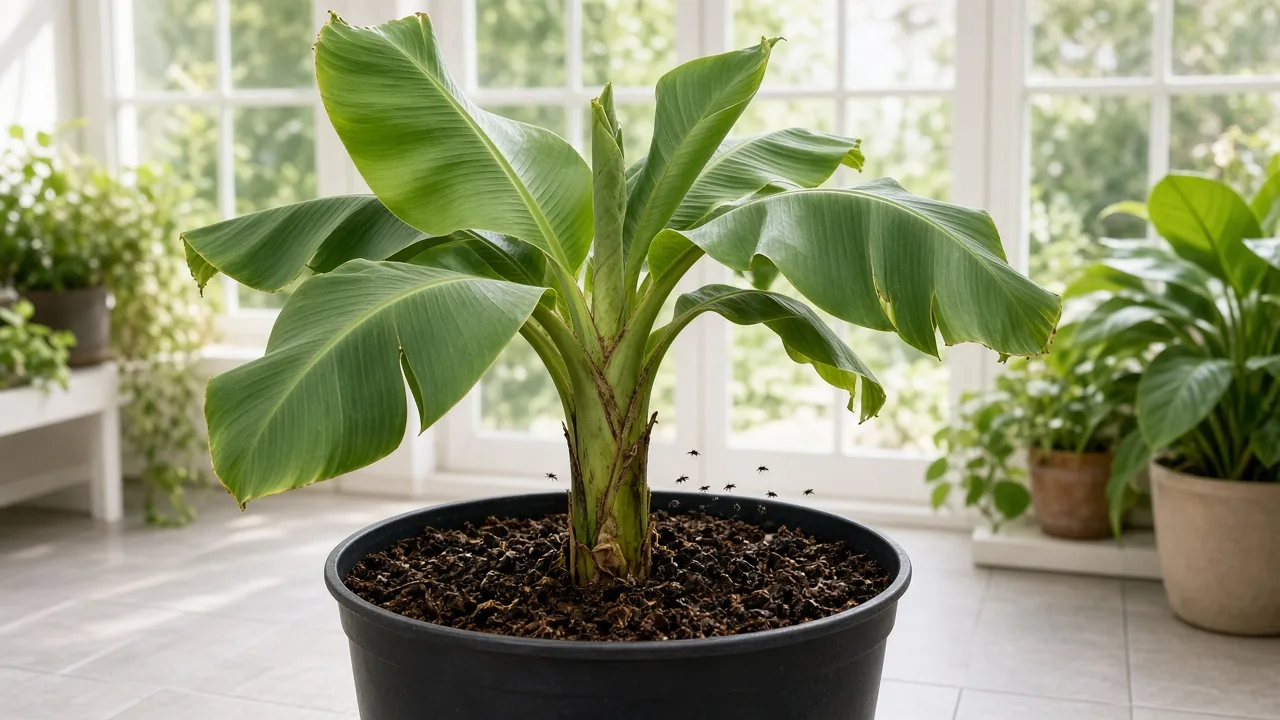
Fungus Gnats on Banana: Causes, Checks & Fixes
This guide covers fungus gnats on Banana. See also the general Fungus Gnats guide, watering, and light pages for this plant.
Fungus Gnats on Banana: Causes, Checks & Fixes
Quick answer
Fungus gnats on Musa acuminata are almost always a surface-moisture and drainage problem in rich potting mix, not a pest that targets banana leaves. Banana is a thirsty tropical herb with a fibrous root system on an underground rhizome—but it is extremely susceptible to damage from flooding and continuously wet soils. When the top layer of compost, peat, and mulch stays dark and damp day after day, adult females lay eggs in moist organic debris and larvae feed on fungi, decaying matter, and fine roots.
For how fungus gnats behave in moist potting media in general, see our fungus gnats hub. On Banana, the useful clues are flies at the base of a large container, a mulch ring that never dries, calendar watering after the plant moved to a cooler room, and a firm pseudostem above a sour-smelling wet crown—not chewed paddle leaves.
First step: let only the top 2–3 cm of mix dry while you empty all saucer water, set a yellow sticky trap at soil level, and log how many days that dry-down takes. Make that one correction before repotting, hydrogen-peroxide drenches, or spraying the whole conservatory.
When to use this page vs other Banana guides
This page is the soil-surface and moisture entry when tiny flies appear around the pot.
| Pattern | Read next |
|---|---|
| White or gray fuzz on soil without many flies | Mold on soil |
| Soft pseudostem base, sour smell, yellowing in wet mix | Root rot or overwatering |
| Folded leaves, light pot, no flies | Underwatering |
| Webbing or stippling on leaf undersides | Spider mites or aphids |
| Mix stays wet despite careful watering | Soil guide — drainage, pot size, and perlite ratio |
What fungus gnats look like on Banana
On banana you usually notice adults at the pot rim, mulch line, and windows before any leaf damage. The huge paddle leaves and upright pseudostem often look fine while the soil story is wrong.
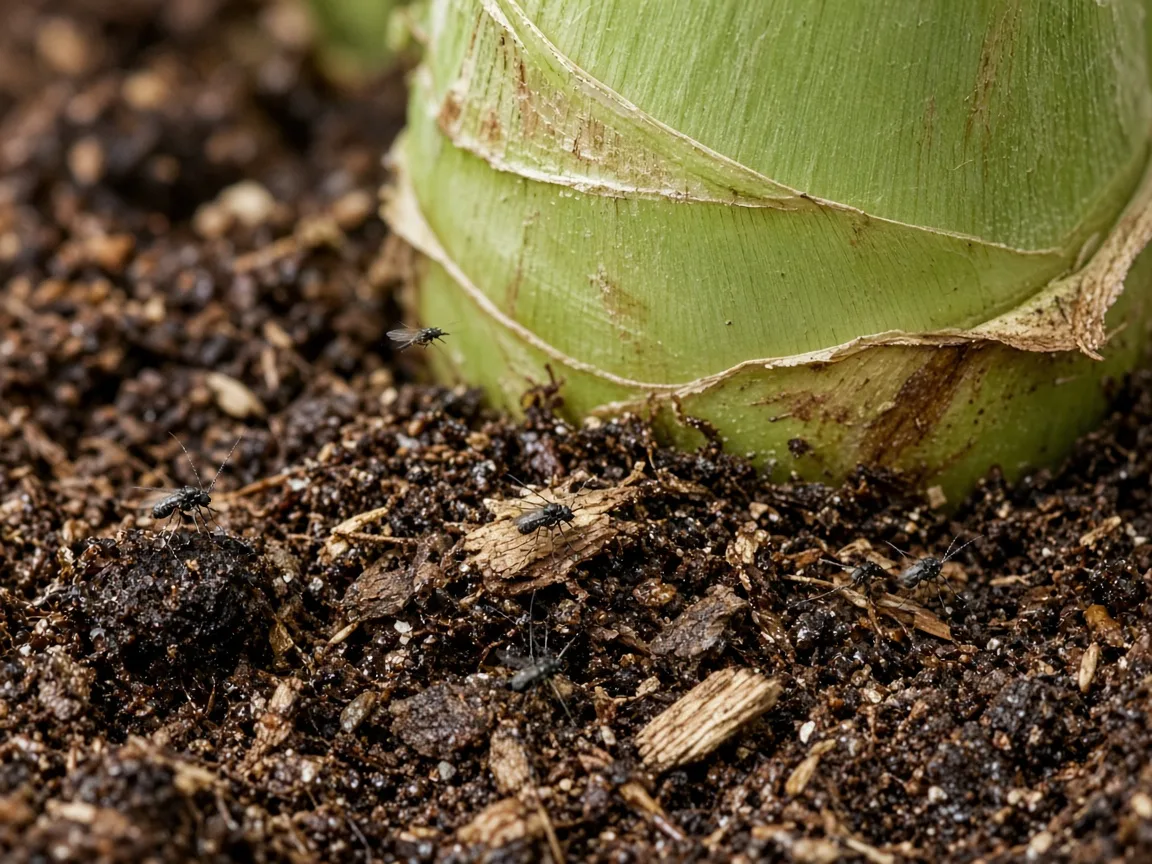
Tiny dark flies on moist organic mulch at the Musa acuminata crown—larvae need this persistently damp surface layer; the pseudostem above can stay firm while gnats breed below.
Typical signs:
- Small dark, mosquito-like flies about 1/16 to 1/8 inch long with long segmented antennae
- Flies that rise in a cloud when you water, slide the pot, or pull back mulch at the base
- Adults resting on windows, pot walls, or the outside of a cachepot—not crawling on leaf blades
- Slender translucent larvae with black head capsules under a potato slice on the mix
- Optional shiny slime trails on the soil surface when larvae are abundant, as UC IPM describes on container media
What the banana plant looks like when gnats are only part of the story:
- Pseudostem still firm and green above the soil line
- New cigar leaf continuing to emerge from the crown in warm, bright conditions
- No stippling, webbing, or sticky residue on leaf undersides (those point to spider mites or aphids)
- Older lower leaves yellowing only if the root zone has stayed saturated—not from gnat feeding alone
Gnats are the alarm. On banana, the overlapping risk is the same wet, oxygen-poor conditions that cause root rot at the rhizome.
Why Banana pots breed fungus gnats
Fungus gnat larvae need moist, organic-rich topsoil to survive. Adults lay eggs in cracks on the surface; larvae feed on fungi, algae, and decaying peat before pupating. Fungus gnats thrive in moist conditions, so overwatered plants are especially vulnerable—but banana creates a specific mismatch because it genuinely needs steady moisture while the surface must still cycle dry.
Banana-specific triggers:
- Calendar watering in cool weather. Banana growth slows below about 16°C (60°F), yet many owners keep the same twice-weekly soak they used in summer. Slower uptake leaves the top layer wet for days.
- Heavy compost-rich mix in an oversized decorative pot. Banana wants organically rich, well-drained loam, but an enormous tub with a small root ball holds a wide band of unused wet soil that never dries.
- Thick mulch pressed against the pseudostem. UF/IFAS recommends 2–6 inches of mulch from the base outward outdoors; indoors, a wet mulch collar keeps the crown dark and damp—ideal egg-laying habitat.
- Cachepots and full saucers. Runoff that sits beneath the nursery pot wicks back upward and keeps the whole profile saturated, even though you intended a single deep drink.
- New sword suckers in peat nursery mix. Small plants imported in moisture-retentive media often carry eggs; placing them beside a mature banana mat spreads adults to every consistently wet container on the terrace.
- Lawn sprinklers or drip timers hitting a patio banana. Over-irrigation can cause root rot on landscape mats; container plants on automatic schedules get the same saturated profile that breeds gnats indoors.
The irony is that banana owners are told “keep it moist” and gnat advice often says “let it dry out.” The workable middle path is moist deep, dry on top—exactly what the Banana watering guide finger-test is designed to catch.
The moist-but-not-soggy test at the pseudostem base
Banana is not a succulent you can bone-dry for weeks. Recovery depends on reading depth, not abandoning water.
- Surface finger test — Press into the top 2–3 cm. If it clings to your skin and feels cool, wait before the next top watering.
- Skewer to mid-pot — A dry wooden skewer pulled from the lower half should feel barely cool, not dripping. Banana roots want moisture there even when the surface has lightened.
- Pseudostem squeeze — Grip the lowest green sheath above the mulch. Firm tissue with a dry surface means you are in range. Soft, waterlogged tissue at the crown means fix drainage now—not just traps.
- Cigar leaf speed — In warm bright conditions, a healthy mat pushes a new rolled leaf regularly. Stalled emergence plus wet mix points to root stress overlapping with gnat habitat.
- Pot weight — Learn the heft after a proper soak and after the top has dried. A banana in a large ceramic tub that stays heavy for ten days is holding too much water for current growth.
This five-point check is banana-only logic. It would be wrong on a ZZ plant rhizome or a desert cactus, where the entire pot must dry.
How to confirm fungus gnats (and rule out lookalikes)
Work through these checks before buying treatments:
- Flight trigger — Disturb the mulch or water the pot. Fungus gnats emerge from soil; fruit flies hover near kitchens and ripening produce, not potting mix.
- Sticky trap test — Place a yellow sticky card at soil level for 48 hours. Dozens of tiny flies on the trap confirm active adults laying eggs in that pot.
- Potato slice — Raw potato chunks placed cut-side down attract larvae to the surface. Check after three to four days for maggots; replace with fresh slices weekly during treatment.
- Wing vein — Under magnification, fungus gnat wings show a distinct Y-shaped vein near the tips, unlike fruit flies.
- Rhizome sniff test — Slide the plant partway out if gnat numbers are high. Firm white roots and no sour odor mean you caught a watering habit early. Mushy dark tissue at the base means shift to overwatering response immediately.
- Nearby pots — Gnats spread to any consistently wet container. Check newly purchased suckers and moisture-loving neighbors on the same bench.
If traps stay empty and flies only appear near the fruit bowl, you do not have a houseplant gnat problem.
First fix for Banana
Let the top 2–3 cm of mix dry, empty all standing saucer water, and set one yellow sticky trap at soil level—then wait one full dry-down cycle before the next soak.
This single step does two jobs: it eliminates favorable egg-laying sites on the surface while keeping deeper roots in the moist-but-draining range banana expects. Insert a dry finger or skewer to the recommended depth in the watering guide. When the surface passes the test, water deeply until a little exits the drainage holes, then discard saucer water within the hour.
While the surface dries:
- Pull mulch back 2–3 inches from the pseudostem so the crown airs out
- Move to brighter light if the plant sits in deep winter shade—faster dry-down shortens the infestation without starving active growth
- Log dry-down days so you can see whether cool weather or an oversized pot is the real driver
Do not shower the foliage, repot on day one, or drench with hydrogen peroxide before fixing the wet-surface habit. Those steps treat symptoms while leaving the breeding habitat intact.
Step-by-step recovery if gnats persist
After the first full surface dry-down cycle, add controls in this order if adults still appear:
1. Adjust watering to growth phase
Match drinks to how fast the mat is actually using water. In hot active growth, banana may need checking every two to three days; in a cool conservatory, the same pot may need ten days between soaks. Bananas require large amounts of water during dry weather but are extremely susceptible to damage from continuously wet soils—the goal is steady deep moisture with a surface that lightens between sessions.
2. Keep using sticky traps
Replace traps when coated with flies. Traps reduce adult egg-laying; they do not reach larvae in soil. Use them as a progress gauge, not the sole treatment.
3. Apply BTI for stubborn larvae
Bacillus thuringiensis subspecies israelensis (BTI)—found in products like Mosquito Bits—targets fungus gnat larvae in moist soil. Mix according to label directions and apply as a soil drench. BTI does not kill eggs or adults, so repeat every five to seven days until trap counts drop. It is safe for people and pets when used as directed on houseplants.
4. Bottom-water selectively
Setting the nursery pot in a tray of water for 15–30 minutes lets roots drink while keeping the top layer drier. This suits established container bananas when the surface will not dry despite sparse top watering. Discard all excess and confirm the top still lightens between sessions.
5. Improve mix or pot only if dry-down stays slow
If the surface stays damp more than a week after one thorough watering in normal indoor heat, the mix or container is too water-retentive for current root mass. Repot into the Banana soil blend with adequate perlite, confirm drainage holes are open, and avoid jumping several pot sizes for dramatic foliage. See the repotting guide as a secondary fix—not day-one surgery—for gnat control alone.
Recovery timeline and what improvement looks like
Expect three to six weeks for full suppression because eggs, larvae, pupae, and adults overlap in the same pot. Modified watering and surface management may take three to four weeks to bring populations down. You are succeeding when:
- Fewer flies appear when you water or pull back mulch
- Sticky traps catch declining numbers each week
- The top 2–3 cm lightens within your expected interval
- The pseudostem stays firm and the cigar leaf keeps emerging in warm conditions
- No sour smell develops at the crown
Signs the underlying problem is worsening:
- Gnat numbers rise weekly despite traps
- Lower leaves yellow while soil stays wet at depth
- Pseudostem softens or smells at the base
- New leaf emergence stalls in warm bright weather
Gnats alone on a firm pseudostem are a nuisance. Gnats plus a soft crown are a root-health emergency—shift focus to rot prevention immediately.
Lookalike symptoms and causes to rule out
| What you see | Likely cause | Quick check |
|---|---|---|
| Flies around kitchen fruit | Fruit flies | Not tied to soil moisture; clean counters and cover produce |
| Flies only on one new nursery sucker | Imported eggs in peat | Isolate new plant; dry surface and use BTI |
| White mold on soil surface | Harmless surface fungus from damp mix | Often appears with gnats; see mold on soil |
| Yellow lower leaves + wet mix + gnats | Overwatering / early rhizome stress | Squeeze pseudostem base—not just trap counts |
| Webbing on leaf undersides | Spider mites in heated dry rooms | Mites prefer dry foliage; gnats prefer wet soil |
Mistakes to avoid on Banana
- Drying the entire root ball to kill gnats—banana wilts, folds leaves, and stalls growth long before larvae die off in the cool core
- Spraying adults only with neem or soap while the mulch ring stays wet—new generations hatch every week
- Adding more mulch to “protect” the crown when the surface is already dark and damp
- Watering on the same summer schedule after moving the plant to a 16°C conservatory
- Assuming gnats mean the banana is “unhealthy”—they mean the pot surface is too wet for too long relative to current growth
- Stopping treatment after one dry week—repeat BTI and trap monitoring until counts stay low through a full growth phase shift
Banana care cross-check
Fungus gnats should prompt a full moisture audit:
- Does the top 2–3 cm dry before each planned soak?
- Does mix drain within minutes and stay oxygenated at the rhizome?
- Are drainage holes open and saucers emptied after every drink?
- Is mulch pulled back from the pseudostem base?
- Did winter arrive without reducing water frequency?
- Is the pot appropriately sized for the root and sucker mass?
Banana in full sun on a warm terrace uses water faster than one in a cool sunroom—but both should still pass the surface dry-down test. Treat it like the fast-growing tropical herb it is, not a fern that wants the surface permanently dark and wet.
How to prevent fungus gnats next time
- Depth-based watering—top 2–3 cm dry, deeper mix evenly moist per the watering guide
- Mulch discipline—beneficial outdoors, but indoors keep organic material away from the crown
- Quarantine new suckers two to three weeks with sticky traps before placing near established mats
- Monitor with traps in fall when outdoor plants move inside with imported peat
- Remove fallen leaf sheaths from the soil surface so they do not add decaying organic matter for larvae
- Skip cachepots without drainage or empty them within the hour after every soak
When gnats stay gone and the cigar leaf keeps unfurling, you have aligned banana culture with how Musa acuminata actually grows—not just eliminated flies.
When to worry
Low urgency: A few gnats, firm pseudostem, steady new growth, and a surface that you can dry within one to two weeks with a watering adjustment.
Higher urgency: Swarms increasing weekly, young sword suckers in the same wet mix (larvae can damage tender roots when numbers are high), or any softening at the crown.
Act today: Soft pseudostem base, sour soil smell, or collapsing lower leaves alongside gnats—treat as overwatering and possible rot, not a standalone pest issue. Inspect the rhizome, trim mushy tissue, and repot into fresh, airy mix if needed.
Conclusion
Fungus gnats on Banana are a practical signal that rich potting mix has stayed wet at the surface too long for current growth—not proof that your plant is the wrong species for indoors. The fix starts with one clear action—dry the top 2–3 cm, empty saucer water, and trap adults at soil level—not a stack of sprays or a drought spell. Sticky traps and BTI help stubborn infestations, but permanent prevention is watering rhythm, mulch placement, and pot choice that let the surface breathe while roots stay fed. When you see gnats, fix the wet crown first; your banana will forgive a drier surface far better than it forgives a swamp at the rhizome.
When to use this page vs other Banana guides
- Banana watering guide — Use for routine moisture checks before assuming fungus gnats is the main issue.
- Banana problems hub — Browse all common issues on this species.
- Overwatering on Banana — Different entry point when symptoms overlap with fungus gnats.
- Mold on soil on Banana — Different entry point when symptoms overlap with fungus gnats.
- Root rot on Banana — Different entry point when symptoms overlap with fungus gnats.
Related Banana guides
- Banana overview
- Banana watering
- Banana light
- Banana soil
- Overwatering on Banana
- Mold on soil on Banana
- Root rot on Banana
- Banana repotting
- Banana problems
Related tool
Use the Plant Problem Diagnosis Tool to narrow causes for fungus gnats on this plant before changing multiple variables at once.