Black Spots on Banana: Sigatoka & Leaf Spot Checks
Quick answer
Black spots on Banana are usually sigatoka leaf spot, anthracnose, or sooty mold on broad paddle leaves—or fixed dry marks from wind tears and cold drafts on Musa acuminata. First step: photograph the newest cigar leaf and lower blades, then stop overhead watering and improve airflow before applying fungicide.
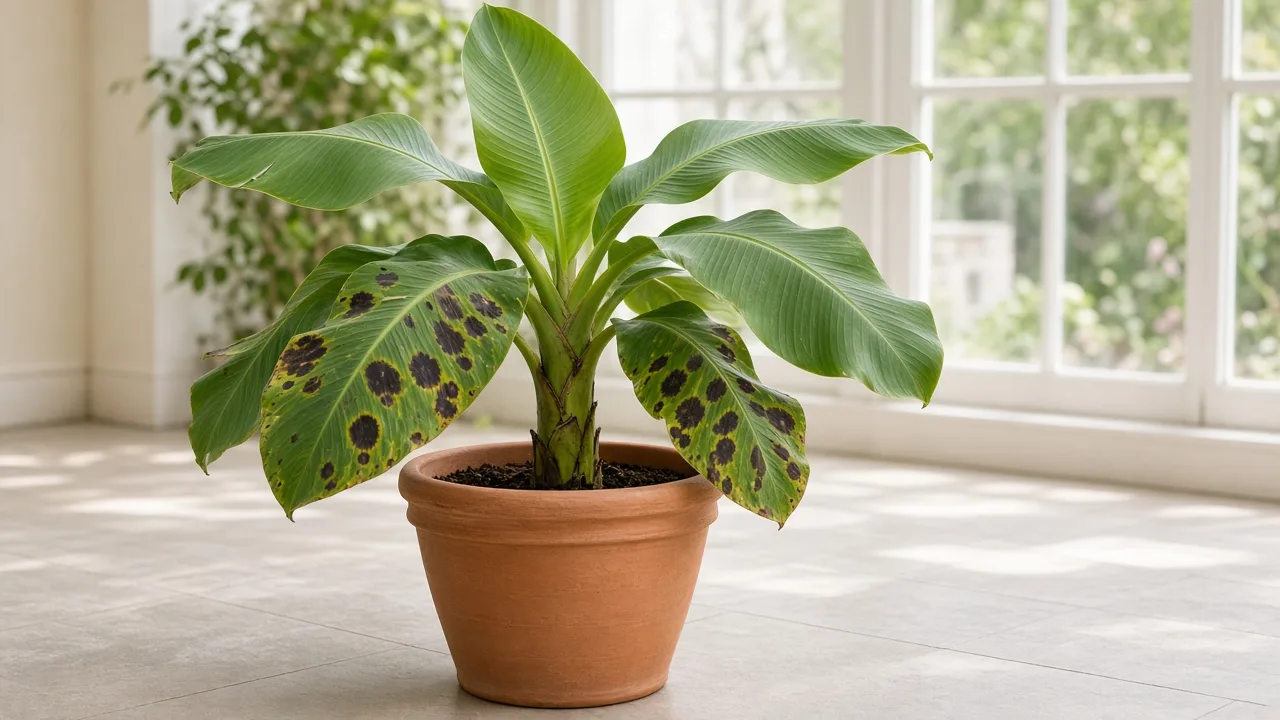
Black Spots on Banana: Causes, Checks & Fixes
This guide covers black spots on Banana. See also the general Black Spots guide, watering, and light pages for this plant.
Black Spots on Banana: Causes, Checks & Fixes
Quick answer
Black spots on Banana (Musa acuminata) are localized tissue death or surface mold on huge paddle-shaped leaves carried on a trunk-like pseudostem. On this fast-growing tropical herb, the pattern usually splits four ways: minute reddish-brown flecks that enlarge with yellow halos point to sigatoka leaf spot after wet foliage in warm humid air; black coating that wipes off is sooty mold on honeydew from aphids, scale insects, or whiteflies; dry black marks along torn or shredded margins often trace wind damage on broad blades—not infection; and fixed dark patches on lowers while soil stays saturated overlap overwatering and advancing root rot. For general spot-disease mechanics, see our black spots guide. On Banana, the lowest paddle blades catch overhead splash and stay wet longer than the upright cigar leaf at the pseudostem crown—sigatoka often starts there before you notice it from across the room.
First step: stop wetting paddle foliage and photograph spots on the newest cigar leaf and two lowest mature blades. Water at soil level only, improve airflow, and compare spot texture before reaching for fungicide.
When to use this page vs other Banana guides
| Your question | Best page |
|---|---|
| Dark spots or flecks on paddle leaves | This page |
| Whole leaves yellowing on wet soil | Yellow leaves or overwatering |
| Brown dry margins only, no mid-blade circles | Brown tips |
| Mushy pseudostem base, sour smell | Root rot |
| Fine stipple with webbing on broad blades | Spider mites |
| Distorted or streaked new growth | Thrips or distorted leaves |
What black spots look like on Banana
Healthy Banana leaves are enormous, paddle-shaped blades on long petioles that spiral up the pseudostem. Black spotting breaks that pattern in recognizable ways:
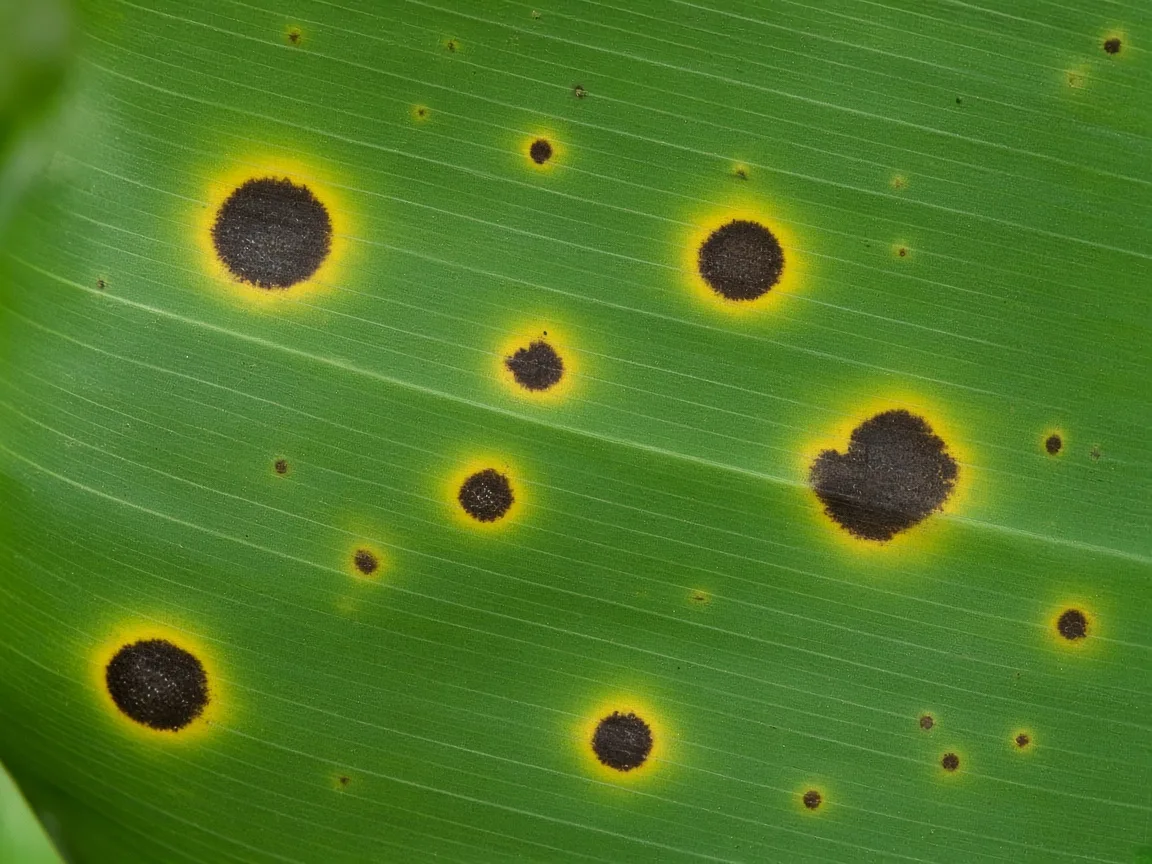
Sigatoka-style leaf spot on Banana—compare water-soaked margins and yellow halos with intact green tissue on the same paddle blade.
- Minute reddish-brown flecks enlarging with yellow halos — Classic yellow sigatoka (Mycosphaerella musicola) or black sigatoka (M. fijiensis) on Cavendish-type plants. Flecks often appear on lower leaf undersides first, then show on the upper surface as infection advances.
- Dark sunken lesions with pinkish spore masses — Anthracnose (Colletotrichum musae) on leaves, pseudostem sheaths, or fruit scars—not always circular.
- Black smear that wipes off with a damp cloth — Sooty mold growing on sticky honeydew from sap feeders. Check leaf undersides and the cigar-leaf axil.
- Dry black or brown linear marks along shredded margins — Wind tears on broad banana blades are common indoors near fans, doors, or balconies. No yellow halo, no spread inward from a water-soaked center.
- Water-soaked dark patches on lowers with wet heavy soil — Overwatering stress and poor drainage weaken tissue; spots may coincide with yellowing lowers and a soft pseudostem base.
- Fixed dry black patches on the oldest outer blade only — Normal senescence as the mat sheds spent paddles. New cigar-leaf growth stays clean.
Spots on the emerging cigar leaf or several active paddles at once are more urgent than one dry tear on the lowest spent blade.
Why the lowest paddle blades spot before the cigar leaf
Banana is a giant herb whose pseudostem is built from tightly packed leaf sheaths, not wood. Each new leaf emerges as a rolled cigar leaf from the crown while older paddles arch outward and downward. That architecture matters for diagnosis:
Lower paddles hang into the splash zone. When you pour water over the canopy or the plant sits in a saucer that overflows, the lowest mature blades hold droplets in their natural cup shape longer than upright crown tissue. Warm temperatures, high humidity, and frequent wetting favor sigatoka development—exactly what happens when a container banana shares a humid corner with other tropicals.
Cavendish cultivars are highly susceptible. UF/IFAS notes the Cavendish group (AAA), including Dwarf Cavendish, is highly susceptible to sigatoka while some other banana groups show intermediate or low susceptibility. Indoor growers with nursery Dwarf Cavendish labels should assume leaf-spot fungi are on the watch list, not a rare greenhouse curiosity.
Wind shredding is not sigatoka. Banana leaves shred easily in wind above 25 mph on tall types; even balcony drafts can leave clean-edged tears that later dry black along the margin. If the mark follows a torn edge and does not enlarge inward with a yellow halo, culture change for fungi is unnecessary.
Reading the unfurling cigar leaf
The cigar leaf is Banana’s best early-warning screen. It sits upright at the pseudostem center and unfurls into the next huge paddle over days to weeks in warm bright conditions.
Clean cigar leaf + spotted lowers only — Infection is probably confined to older blades you can remove after fixing wet-foliage habits. This is the ideal recovery scenario.
Speckled or water-soaked cigar leaf — Active spread. Stop overhead water immediately, increase airflow, and inspect whether soil moisture has been alternating between drought and saturation—stress can compound fungal entry.
Distorted or streaked cigar leaf without classic round spots — Route to thrips or virus suspicion if streaking is silver-gray and new growth stays narrow. True sigatoka on Cavendish usually shows discrete flecks before gross distortion.
Never apply fungicide to a stressed banana before confirming spot type and fixing the wet-leaf trigger.
Lookalike symptoms
| What you see | Often confused with | How to tell them apart |
|---|---|---|
| Dry black line along torn margin | Sigatoka | Follows physical tear; no yellow halo; stable for weeks |
| Wet flecks with yellow halos on multiple blades | Wind damage | Circular lesions enlarge; often on undersides first |
| Black coating wipes off | Leaf spot | Sooty mold only; check for scale bumps |
| Dark patches on lowest blade only | Epidemic | Single senescing leaf; cigar leaf and mid-canopy clean |
| Brown-black mush at pseudostem base | Surface spot | Soft tissue, sour smell—root rot |
How to confirm the cause
- Texture — Water-soaked enlarging center with yellow halo vs dry fixed mark?
- Location — Lower arching paddles, mid-blade, or cigar leaf?
- Underside — Reddish-brown flecks visible before upper-surface spots?
- Culture — Recent misting, overhead watering, grouping with humid tropicals, or wet saucer?
- Soil — Top 2–3 cm dry per watering guide before the next soak?
- Progress — Photograph the same lesion in three days; enlargement confirms active leaf spot.
First fix for Banana
Stop wetting paddle foliage and remove the two worst spotted lower leaves with sterile shears.
Pour water at soil level only until spots stop enlarging. Improve airflow around the pseudostem—Banana needs full sun or very bright light for fast drying, not a dim bathroom with daily misting. Empty saucers within 30 minutes.
If spots match sigatoka (enlarging flecks with halos on multiple blades), a labeled fungicide for ornamental foliage may help after culture correction—RHS recommends approved fungicides for fungal leaf spot once wetting stops. Do not fertilize a spotted stressed banana. Do not repot on day one unless the pseudostem base is mushy on wet mix.
If black smear wipes off, treat the sap feeder (aphids, scale, whiteflies) rather than spraying fungicide on soot alone.
Mistakes to avoid
- Misting paddle blades for “tropical humidity” while sigatoka is active
- Overhead shower rinses that leave the cigar leaf wet overnight
- Removing every spotted leaf at once—weakens photosynthesis on a fast-growing herb
- Fungicide before fixing wet foliage and drainage
- Ignoring a heavy wet pot in a cool room—overwatering and spot fungi compound each other
- Treating wind-torn dry edges with disease sprays
Recovery timeline
Dry culture and lower-leaf removal should show clean new cigar-leaf tissue in two to four weeks during warm active growth. Cool indoor conditions below about 16°C (60°F) slow both unfurling and healing—judge progress across a full growth cycle, not a single weekend.
Spotted paddle tissue does not green up again. Success means halted spread and unstained emerging blades.
When to worry on Banana
Treat as urgent when:
- Spots reach the cigar leaf within a week of first noticing lowers—active epidemic.
- More than half of active paddles show enlarging halos after humid wet weather indoors.
- Pseudostem base softens while soil smells sour—beyond leaf spot alone; see root rot.
- Black soot returns within days after wiping—untreated scale or aphids still feeding.
A single dry tear on one lowest spent blade with a firm pseudostem and clean cigar leaf is usually not urgent.
Prevention
- Water when the top 2–3 cm of mix dries—see watering and soil guides for moisture-retentive but draining blends.
- Grow in the brightest position available; weak light slows drying without reducing leaf size.
- Never mist paddle foliage; humidity from a pebble tray is safer than wet blades.
- Space container bananas for airflow; avoid crowding three pseudostems against a wall.
- Remove spotted lower paddles promptly and bag them—do not compost active sigatoka tissue indoors.
- Quarantine new bananas before placing them beside existing mats.
- Shelter from strong wind that shreds blades and creates entry points for pathogens.
Related Banana guides
Conclusion
Black spots on Banana are wet-paddle and airflow problems first on Cavendish types, with wind tears and pest soot as frequent lookalikes. Dry the culture, read the cigar leaf, and let the next unfurling blade tell you whether you fixed it.