Brahma Kamal Fertilizer Guide for Healthy Growth
Brahma Kamal Fertilizer Guide for Healthy Growth
Brahma Kamal Fertilizer Guide for Healthy Growth
True Brahma Kamal is a small Himalayan alpine perennial, not a hungry tropical houseplant. Saussurea obvallata grows in alpine meadows, rocky slopes, and stream margins at roughly 3,000–4,500 metres, according to the Plants For A Future habitat record. That origin does not prove an exact feeding formula, but it does explain why strong, frequent fertilizer is a poor default: the plant is adapted to a short cool growing season and modest growth, not continuous warmth and rapid leaf production.
No controlled species-specific fertilizer trial or authoritative dose schedule for cultivated S. obvallata was found. The safest practical approach is therefore light feeding only while healthy new growth is visible, followed by a complete stop as growth slows. Fertilizer can replace nutrients lost from a container, but it cannot compensate for warm nights, unsuitable light, saturated roots, or the absence of winter dormancy.
First confirm which Brahma Kamal you own
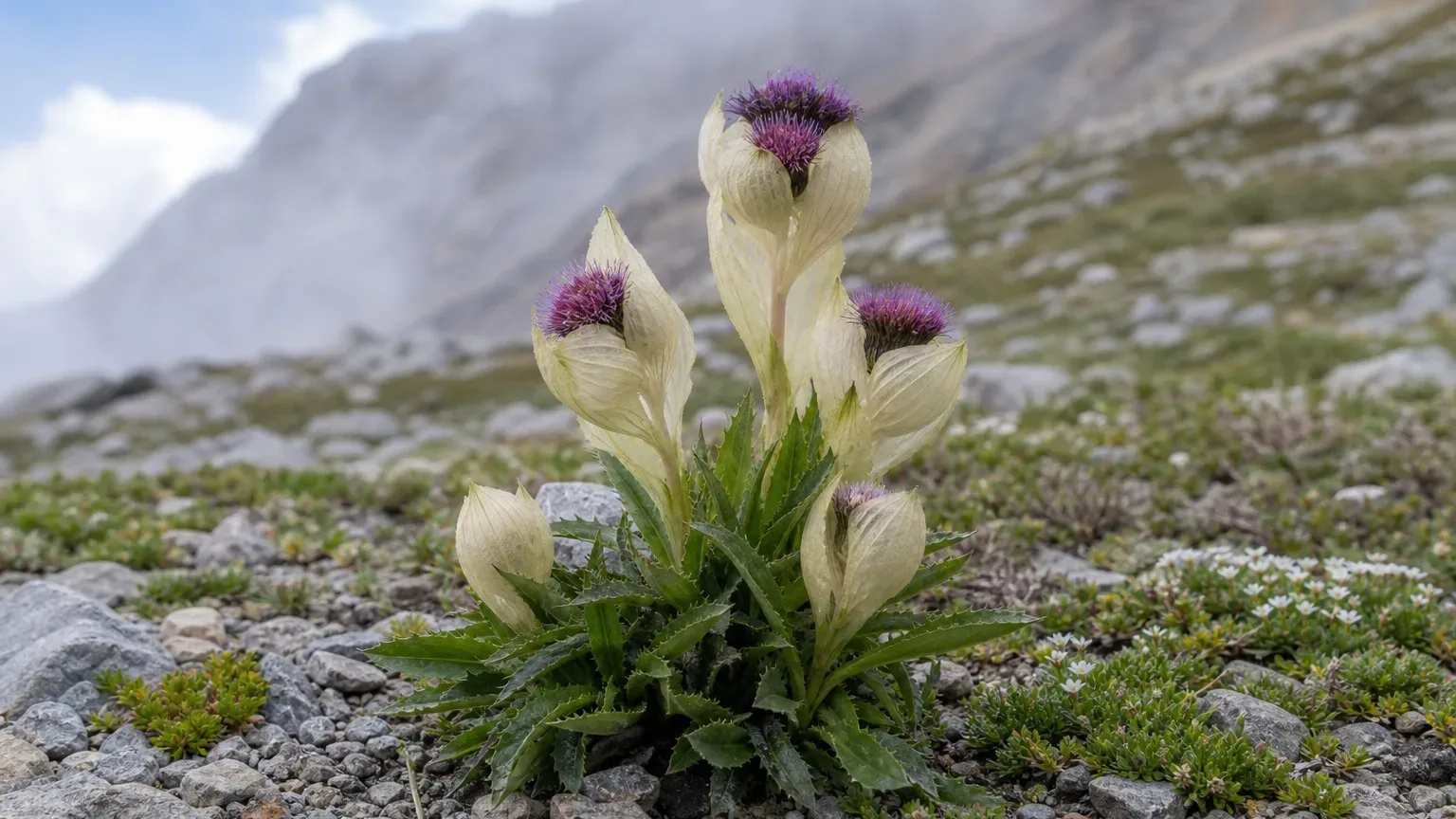
This page covers Brahma Kamal, Saussurea obvallata. Kew’s taxonomic record places the accepted species in the Asteraceae family, and the Indian Institute of Science’s India Flora resource documents it as a Himalayan herb in its species herbarium record. The plant forms a leafy basal clump and short flowering stems surrounded by pale, translucent bracts.
Do not apply this schedule to Epiphyllum oxypetalum, the flat-stemmed tropical cactus also sold as “Brahma Kamal” in India. Orchid cactus fertilizer advice assumes a warm-growing epiphyte and can be far too generous for a slow alpine Saussurea. If the botanical label is missing, use the Brahma Kamal overview to confirm the plant before feeding it.
Why true Brahma Kamal needs restrained feeding
Saussurea obvallata comes from a high-altitude environment and grows slowly in cultivation. A published account describes Brahma Kamal as an herb of the alpine Himalayan range, while the species record places it on meadows, rocky slopes, and river or stream sides. In a pot, that biology points toward a lean, sharply drained root zone and short feeding window rather than a rich mix repeatedly topped up with fertilizer.
Fertilizer is not plant food in the everyday sense; it supplies mineral nutrients that a plant can use only when roots are functioning. Penn State’s explanation of soil fertility and nutrient balance emphasizes that nutrient availability is tied to the root environment, organic matter, and soil chemistry. Feeding a heat-stressed or waterlogged Brahma Kamal adds salts around impaired roots without fixing the actual limitation.
The best fertilizer for Saussurea obvallata
Choose a complete, balanced liquid fertilizer with micronutrients, then use it much weaker than the label’s normal container-plant rate. An approximately even N-P-K ratio is suitable; the precise numbers matter less than conservative concentration and infrequent application. For a plant already growing in a mix that contains compost or controlled-release feed, extra liquid fertilizer may not be needed in its first active season.
Avoid high-nitrogen lawn feeds, concentrated manure products, and “bloom booster” formulas marketed mainly on a very high phosphorus number. University of Minnesota guidance recommends selecting fertilizer from actual plant and soil needs rather than assuming more nutrient is beneficial; its quick fertilizer guide also explains the roles of nitrogen, phosphorus, and potassium. A balanced product reduces the temptation to chase one symptom with an extreme dose.
How to read the label
The three prominent numbers are percentages of nitrogen, phosphate, and potash. A product labelled 10-10-10 is more concentrated than 3-3-3 even though both have the same ratio, so “one capful” is not a transferable dose. Start at one-quarter of the manufacturer’s stated strength for container plants; if the plant is small, newly established, or growing slowly, use less or skip feeding.
Check whether micronutrients are included and whether the potting mix already contains fertilizer. Illinois Extension notes that container management depends on the chosen medium and the limited root volume of the pot in its container gardening guidance. Combining a pre-charged mix, slow-release granules, and liquid feed makes accidental excess much more likely.
A cautious fertilizer schedule
Begin only after the crown produces healthy new leaves in spring. Apply one-quarter-strength liquid fertilizer to moist mix, then wait about four weeks and reassess. For many container-grown plants, two or three light applications across active spring and early-summer growth are a safer starting point than feeding every week.
Do not treat that interval as an obligation. Skip the next dose if growth has paused, leaf tips have browned, the mix drains slowly, temperatures are persistently high, or the plant was recently repotted into enriched soil. If growth remains compact and green, no correction is needed simply because a calendar reminder appeared.
How to apply fertilizer safely
Water plain water first if the upper root zone is dry, allow the mix to become evenly moist, and then apply the diluted solution. Never pour concentrated fertilizer onto a dry crown or let fertilized runoff stand in a saucer. Moist roots are less exposed to a sudden local salt concentration, while free drainage removes surplus solution.
Measure the product rather than estimating a splash. Use the same watering can and note the dilution, date, plant response, and weather. Feed in the cool morning, keep solution off the leaves and crown, and empty runoff promptly; then return to the normal moisture checks in the Brahma Kamal watering guide.
When to stop feeding
Stop when summer heat checks growth, after flowering as foliage begins to decline, and throughout winter dormancy. A dormant crown does not need routine fertilizer. Resume only when fresh spring growth confirms that the plant, rather than the calendar, has restarted.
Also pause after repotting, division, root damage, or any episode of prolonged wetness. Fresh commercial mix may already contain nutrients, and disturbed roots need cool, airy conditions before they need feeding. The Brahma Kamal repotting guide covers when the crown is ready for a new container.
Fertilizer will not force flowers
Flowers depend on a mature, healthy crown, strong light, suitable cool temperatures, seasonal cues, and functioning roots. Extra phosphorus cannot replace those conditions. If a Brahma Kamal makes leaves but no buds, first review species identity, summer heat, light exposure, winter rest, pot drainage, and plant maturity.
Excess nitrogen can encourage soft leafy growth that is poorly matched to a compact alpine habit. Rather than switching immediately to a stronger bloom product, correct the growing environment and hold fertilizer steady or stop it. The Brahma Kamal light guide is the better next check when growth is stretched or flowering fails despite a mature crown.
Read the plant: excess versus deficiency
Possible excess-fertilizer signs include a white crust on the mix or pot rim, brown leaf tips appearing soon after feeding, sudden wilt in moist soil, and stalled growth. Soluble salts can make water harder for roots to take up; Penn State’s review of saline soils and plant growth describes reduced water uptake and plant injury as salt levels rise. In a small alpine pot, salts can concentrate quickly when evaporation is high and drainage is poor.
True nutrient deficiency is harder to diagnose by sight. Uniform paling of older leaves during active growth may suggest low nitrogen, while interveinal chlorosis can involve micronutrients, root damage, or unsuitable pH. Do not diagnose natural autumn dieback as deficiency, and do not feed a pale plant while its mix is cold, wet, compacted, or sour; inspect the Brahma Kamal soil guide first.
What to do after overfertilizing
Stop feeding immediately and remove any visible granules from the surface. If the pot drains freely and the crown is not rotting, pass room-temperature water through the mix several times and let it drain completely. Natural precipitation commonly flushes soluble salts from open soil, as the Penn State salinity guide explains; deliberate leaching serves the same purpose in a draining container.
Do not flush a waterlogged, compacted pot repeatedly. Unpot it, inspect for damaged roots, and replace the failing medium if necessary. Keep the recovering plant cool and bright without harsh afternoon heat, and wait for healthy new growth before considering any further fertilizer.
Compost, manure, and organic feeds
A small proportion of mature leaf mould or fine, finished compost can contribute organic matter to an alpine-style mix, but Brahma Kamal does not need a pot full of rich compost. Penn State notes that organic matter can improve soil structure and water-holding behavior, yet the correct amount depends on the planting system. For this species, retain a large mineral and bark component so surplus water still exits rapidly.
Avoid fresh manure, heavy vermicompost top-dressings, and unmeasured homemade liquid feeds. Their nutrient strength and salt content are difficult to predict in a small pot. A measured dilute complete fertilizer is easier to reduce, repeat, or stop when the plant responds poorly.
Adjusting the plan for Indian growing conditions
In a cool Himalayan garden or high-altitude balcony, active growth may continue through a longer part of spring and summer. In a warm plain, S. obvallata may slow because of heat even while the calendar says “growing season.” Do not feed through that heat pause: move the plant to a bright, ventilated, cool position and protect it from hot afternoon sun and monsoon saturation.
Heavy rain also leaches nutrients, but it does not automatically justify immediate replacement feeding. First confirm that roots are healthy and the medium has not remained saturated. Where irrigation water or fertilizer leaves a persistent mineral crust, use low-mineral water for occasional flushing and reduce fertilizer concentration.
When to use this page vs other Brahma Kamal guides
- Use the Brahma Kamal overview to confirm Saussurea obvallata and understand its alpine growth cycle.
- Use the watering guide when leaves wilt, the crown softens, or the mix stays wet.
- Use the soil guide when drainage, compaction, pH, or salt accumulation may be limiting nutrient uptake.
- Use the light guide for stretched growth or failure to flower in an otherwise mature plant.
- Use the repotting guide when roots crowd the pot or the mix no longer drains cleanly.
Related Brahma Kamal guides
- Brahma Kamal care overview — identity, habitat, growth cycle, and whole-plant priorities.
- Brahma Kamal watering — moisture checks during growth and the dry-down needed in dormancy.
- Brahma Kamal soil — a moisture-retentive but sharply drained alpine mix.
- Brahma Kamal light — cool bright placement and protection from intense low-altitude sun.
- Brahma Kamal propagation — seed, division, and aftercare for young plants.
Conclusion
The safest Brahma Kamal fertilizer plan is deliberately modest: verify that the plant is Saussurea obvallata, wait for active spring growth, and apply a complete balanced liquid feed at about one-quarter label strength. Reassess after four weeks instead of feeding automatically, and stop during heat stress, root trouble, post-flowering decline, and winter dormancy.
Fertilizer should support a healthy alpine growing system, not try to overpower a poor one. Cool conditions, bright light, sharp drainage, steady but not stagnant moisture, and a real seasonal rest matter more than the N-P-K number. When those basics are right, a few measured feeds are enough; when they are wrong, more fertilizer usually adds another problem.