Brahma Kamal Soil: Alpine Mix & Drainage Guide
Brahma Kamal Soil: An Alpine Mix for Saussurea
Brahma Kamal Soil: An Alpine Mix for Saussurea
The correct Brahma Kamal soil is not ordinary houseplant compost and not a desert-cactus blend. This guide is for Saussurea obvallata, the compact Himalayan alpine species. Kew recognizes it as a perennial or rhizomatous geophyte of the subalpine or subarctic biome, so its roots are adapted to cool, aerated ground rather than a warm, stagnant pot.
Aim for a mix that seems contradictory at first: moisture-retentive but sharply drained. Water should spread through the root ball instead of racing down one channel, yet surplus must leave immediately. That balance matters more than copying a rigid recipe, because bark grade, loam texture, pot depth, rainfall, and summer heat all change how the same percentages behave.
Confirm you have the Himalayan Brahma Kamal
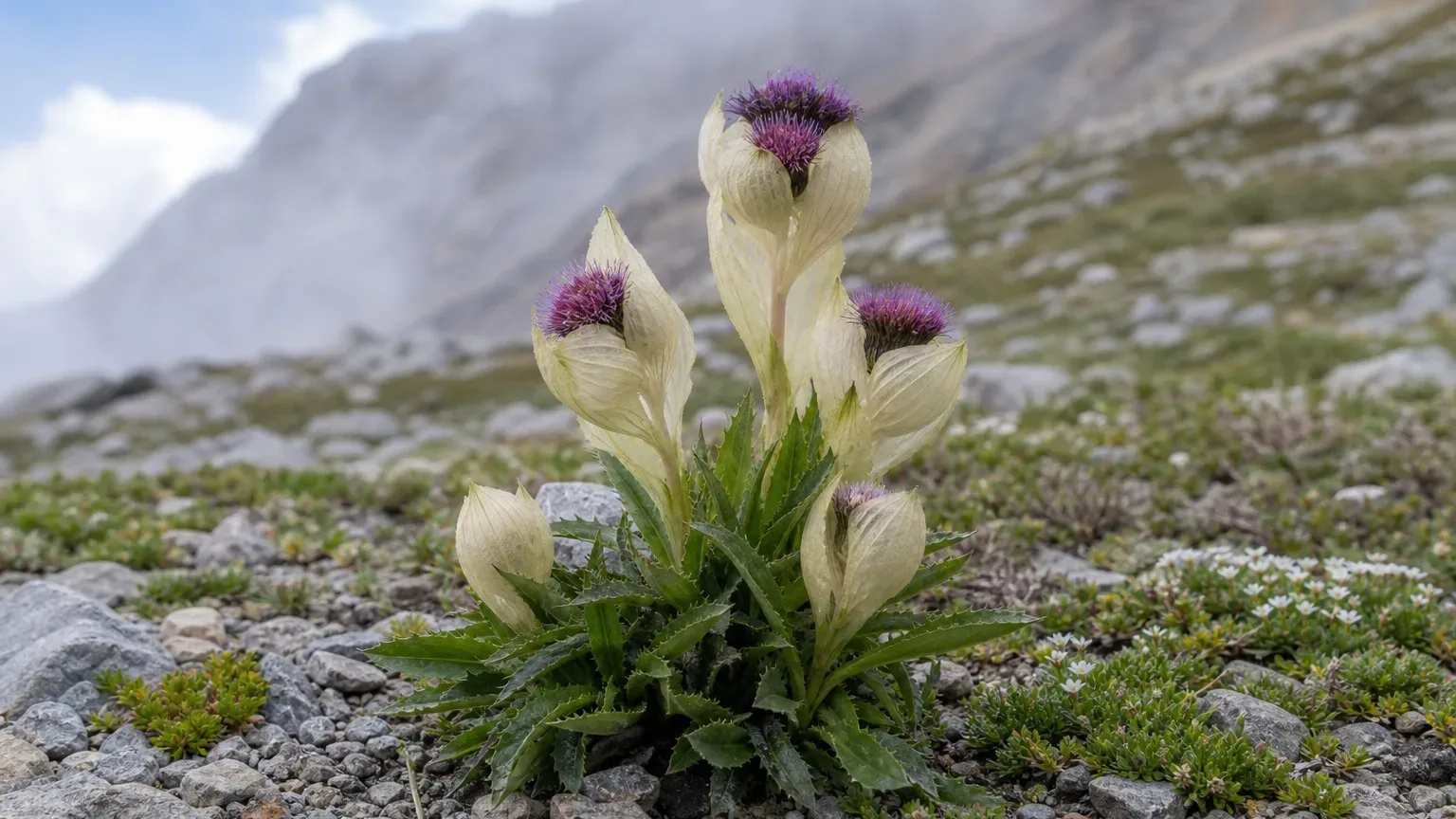
Check the botanical label before changing the soil. The Indian name “Brahma Kamal” is also widely applied to Epiphyllum oxypetalum, a flat-stemmed tropical cactus, but the plant covered here is the accepted Indian alpine species recorded by India Flora Online. Saussurea obvallata forms a low leafy rosette and short flowering stems enclosed by pale bracts; it does not make long, flat cactus stems.
This distinction changes the entire root environment. An orchid-cactus mix is built around coarse epiphytic bark in warm conditions, while Saussurea needs a mineral-rich alpine-style medium that can remain evenly cool without becoming saturated. If the label says Epiphyllum, do not use this page.
What Saussurea obvallata roots experience in habitat
Species records place S. obvallata in alpine meadows, rocky slopes, and stream margins at roughly 3,000–4,500 metres, with a preference for moist soil and a sunny, well-drained position. The species-specific account also admits that cultivation evidence is limited and some advice is inferred from the genus, an important caution when translating habitat into a pot (Plants For A Future).
Rocky habitat does not mean the roots stay dry like a desert succulent. Meltwater, rain, and cool air can supply moisture while stones, slope, and shallow mineral soil prevent prolonged stagnation. In a container, the closest practical equivalent is a connected pore structure: some fine and organic material to hold a thin film of water, plus enough durable mineral particles to preserve air spaces after repeated watering.
The best Brahma Kamal soil mix
A useful starting recipe by volume is:
- 40% fine pine bark or mature leaf mould, screened so there are no large woody chunks
- 30% loam-based potting mix, which supplies body and moderate moisture retention
- 30% pumice, perlite, or fine horticultural grit, using particles large enough to resist compaction
This is a starting formulation, not a species trial result. The Royal Horticultural Society gives a more mineral 50:50 soil-based compost and horticultural grit or sharp sand blend for alpine containers generally (RHS alpine guidance). The slightly more moisture-buffered recipe above reflects S. obvallata records from moist alpine sites, but growers in a very rainy climate should shift closer to the RHS ratio.
What each ingredient does
Fine bark or leaf mould creates irregular pores and slows abrupt drying without turning the mix into mud. Loam-based potting mix distributes water and gives the small rhizomatous crown a stable anchor. Pumice, perlite, or grit interrupts fine particles so the root zone keeps air after watering.
The mineral amendment is not interchangeable in every respect. Oklahoma State University Extension notes that perlite has high oxygen retention, coarse sand increases root-zone air pockets, and pumice can improve aeration and drainage when blended with other media (growing-medium properties). Pumice is usually the most stable choice for a windy balcony; perlite is lighter and may rise during watering; grit adds weight but little water storage.
Adjust the recipe to your climate
In a cool, breezy Himalayan or temperate garden, the 40:30:30 blend may drain fast enough while protecting fine roots from sudden drought. If a test pot stays glossy-wet for more than a day in active weather, increase the mineral portion and reduce the finest organic component. If it becomes dusty and pulls from the pot within a day, add a little screened bark or loam rather than using moisture-holding gel.
For a monsoon-exposed balcony, start near 30% bark or leaf mould, 25% loam mix, and 45% pumice or grit and keep the container under a transparent rain shelter with open sides. For dry, high-altitude air, retain the original recipe and monitor more often. In hot lowland India, soil adjustment cannot solve the larger problem of warm nights and hot roots; this alpine is a specialist plant, not a reliable tropical houseplant.
Drainage matters more than the bag label
“Well-draining” on a commercial bag is not proof that the mix suits this species. Container media need both water-holding pores and air-filled pores, and their behavior changes as particles break down; the NC State Extension container handbook explains why container roots depend on a deliberately structured medium rather than unmodified garden soil.
Test a small batch before disturbing the plant. Fill the intended pot, water slowly until the mix is evenly wet, and watch the base. Water should begin leaving promptly, the surface should not remain ponded, and the squeezed mix should crumble apart rather than form a slick ball. A simple field drainage test is also more useful than guessing from soil colour (Iowa State University Extension).
Choose a pot that protects the air spaces
Use a container with several unobstructed holes, not one tiny opening hidden by a flat saucer. A pot only slightly wider than the crown is safer than an oversized tub because uncolonized mix remains wet longer. Terracotta can help in a damp climate, while plastic slows drying in cold, windy, high-altitude conditions.
Do not create a “drainage layer” of stones beneath fine compost. The useful drainage must run through the whole root zone. Cover large holes with mesh so mix stays in place, fill with one consistent blend, and stand the pot on feet where runoff can escape.
Keep the crown dry without drying the roots
Set the rhizomatous crown at the same level it grew previously; burying it under fine wet compost invites decay. After planting, add a thin top-dressing of washed horticultural grit around, but not piled against, the crown. RHS guidance recommends grit because it keeps low alpine leaves and the plant neck away from damp compost and splash.
Top-dressing is not a substitute for internal drainage. A dry-looking gravel surface can conceal saturated compost beneath it. Check the mix itself with a wooden skewer or by lifting the pot, then follow the Brahma Kamal watering guide rather than watering from surface appearance.
Soil pH and fertility
There is not enough controlled cultivation evidence to justify a narrow, exact pH for S. obvallata. Published database guidance describes tolerance from mildly acid through neutral to mildly alkaline soils, so a practical container target around pH 6–8 is reasonable. Treat that as a broad working range, not a precision requirement.
Avoid strongly acidic, peat-dominated mixes and do not add lime without a test. A low-cost pH strip test on the drainage water can identify a major mismatch, but drainage, root temperature, and watering discipline usually deserve attention first. For nutrient timing and dilution, use the Brahma Kamal fertilizer guide; rich compost or manure should not be used to turn this slow alpine into a fast-growing bedding plant.
Store-bought mixes: what can work
No common retail bag exactly recreates cool Himalayan scree. A loam-based container compost can form the base if you add at least one-third durable mineral amendment. A quality cactus mix may also work as a base, but inspect it: some products are mostly fine peat with a token amount of sand, while others dry so rapidly that Saussurea roots cannot maintain steady moisture.
Avoid straight garden soil in pots because it compacts and drains differently inside a container. Also avoid pure coco coir, pure peat, vermiculite-heavy seed mix, and compost-rich vegetable mix. Each can hold too much water or collapse around the crown unless balanced with structurally stable mineral particles.
Warning signs the mix is wrong
Yellowing while the mix stays wet, wilting in damp soil, a sour smell, or a soft dark crown point toward oxygen-starved roots or rot rather than thirst. Saturated soil displaces air and damages roots, which is why adding more water to a wilted plant can make the decline faster (Missouri Botanical Garden).
At the other extreme, crisp margins, a mix that shrinks from the pot wall, and stalled growth during cool active weather suggest the medium is too coarse or the pot is drying too rapidly. First correct exposure and watering; do not automatically repot a stressed plant. Use the Brahma Kamal repotting guide when the mix has collapsed, drains unevenly, or the crown has genuinely outgrown the container.
What to do when soil stays wet
Move the pot out of rain, empty the saucer, clear every drainage hole, and increase airflow without exposing a weakened plant to hot wind. If the crown remains firm and the mix begins to dry normally, avoid unnecessary root disturbance. If the medium smells sour, remains saturated, or the crown softens, unpot carefully, remove collapsed mix, trim only dead roots with clean tools, and repot into a fresh airy blend.
Do not compensate by placing the root ball in strong sun. Warm, wet roots are the main danger, but abruptly heating damaged roots adds stress. Keep recovery conditions bright and cool as described in the Brahma Kamal light guide.
Seasonal soil management
During spring and summer growth, the medium should hold light, even moisture while draining after every watering. Monsoon protection is essential where repeated warm rain can keep the pot saturated. A roof that blocks rain but leaves the sides open is more useful than enclosing the plant in a humid plastic cover.
After foliage dies back, keep the dormant crown much drier without letting the root ball remain bone-dry for months. RHS notes that alpines are especially vulnerable to winter waterlogging because cold-season water is normally less available in their native conditions. Keep holes clear, shelter the pot from prolonged rain, and delay major soil work until early spring growth is about to resume.
When to use this page vs other Brahma Kamal guides
Use this page to choose ingredients, diagnose compaction, and decide whether the root zone drains correctly. Start with the Brahma Kamal overview if you still need to confirm the species or assess whether your climate is cool enough.
Use the watering guide when the mix is structurally sound but you are unsure when to irrigate. Use the repotting guide for timing and root-handling steps, and the propagation guide for seed or division media rather than applying the mature-plant recipe unchanged.
Related Brahma Kamal guides
- Brahma Kamal overview — identity, habitat, and whole-plant care
- Brahma Kamal watering — moisture checks through growth and dormancy
- Brahma Kamal light — bright exposure without hot-root stress
- Brahma Kamal fertilizer — restrained feeding for an alpine perennial
- Brahma Kamal repotting — when and how to replace exhausted mix
- Brahma Kamal propagation — media for seed and divided crowns
Conclusion
The best soil for true Brahma Kamal is a cool, lightly moisture-retentive alpine mix with permanent air spaces. Start with 40% fine bark or leaf mould, 30% loam-based potting mix, and 30% pumice, perlite, or grit, then change the mineral fraction according to rainfall and drying speed. Use a close-fitting pot with open drainage holes, top-dress the crown with grit, and protect it from prolonged monsoon saturation.
Most importantly, keep the identity straight: this is Saussurea obvallata, not Epiphyllum oxypetalum. No soil recipe can turn a high-Himalayan alpine into a heat-loving lowland houseplant. Where summers are cool, however, a mix that holds a little moisture while releasing every excess drop gives the crown the balance it needs.