Brahma Kamal Care Guide for Saussurea obvallata
Saussurea obvallata
Learn true Brahma Kamal care: cool alpine conditions, bright light, moist well-drained soil, winter dormancy, and how to distinguish it from the orchid cactus.
Brahma Kamal Care Guide for Saussurea obvallata
Start with wateringThe most common care mistake for Brahma KamalWatering guide →Brahma Kamal care essentials
Light
Water
Keep the root zone evenly moist but never waterlogged during active spring and summer growth. Water when the surface just begins to dry, then let excess drain completely.
Soil
Moisture-retentive but sharply drained alpine-style mix with mineral grit and modest organic matter; never use dense, warm, waterlogged potting soil
Humidity
Temperature
Fertilizer
About Brahma Kamal
Brahma Kamal is native to Alpine Himalayas from northern Pakistan and Kashmir east through Nepal, Bhutan, northern India, Tibet, and southwestern China, typically at 3,000–4,500 m elevation, typically reaches 15–30 cm tall and about 20–30 cm wide indoors, with slow growth. Brahma Kamal has a herbaceous perennial growth habit and part of the Asteraceae family. It is also known as Himalayan Snow Lotus, Snow Lotus, King of Himalayan Flowers, and Brahma Flower.
| Detail | Information |
|---|---|
| Also known as | Himalayan Snow Lotus, Snow Lotus, King of Himalayan Flowers, Brahma Flower |
| Native region | Alpine Himalayas from northern Pakistan and Kashmir east through Nepal, Bhutan, northern India, Tibet, and southwestern China, typically at 3,000–4,500 m elevation |
| Mature size | 15–30 cm tall and about 20–30 cm wide |
| Growth rate | Slow |
| Growth habit | Herbaceous Perennial |
| Scientific name | Saussurea obvallata |
| Family | Asteraceae |
Brahma Kamal Care Guide for Saussurea obvallata
True Brahma Kamal, Saussurea obvallata, is a compact Himalayan alpine perennial built for bright, cold, exposed places. It is not the tropical, flat-stemmed night-blooming cactus sold under the same common name. That distinction controls every part of care: the Himalayan plant wants cool air, cool roots, steady but freely drained moisture, and a genuine cold-season rest.
For most growers, temperature is the limiting factor—not finding a magic fertilizer or watering schedule. A high-altitude balcony, cool temperate garden, ventilated alpine house, or cold frame offers a plausible home. A warm living room or humid lowland terrace may keep the plant alive briefly, but sustained hot nights make compact growth and dependable flowering difficult.
First confirm you have the Himalayan Brahma Kamal
Check the botanical label for Saussurea obvallata. Kew accepts it as a species in the Asteraceae family and describes it as a perennial or rhizomatous geophyte of subalpine to subarctic habitat. This is the Brahma Kamal covered here.
The commonly confused plant, Epiphyllum oxypetalum, has long, flattened, leaf-like green stems and large white flowers that open at night. It is an epiphytic tropical cactus, not a Himalayan herb. If your plant has flat succulent stems, do not apply this guide; identify it correctly before changing its care.
What true Saussurea obvallata looks like
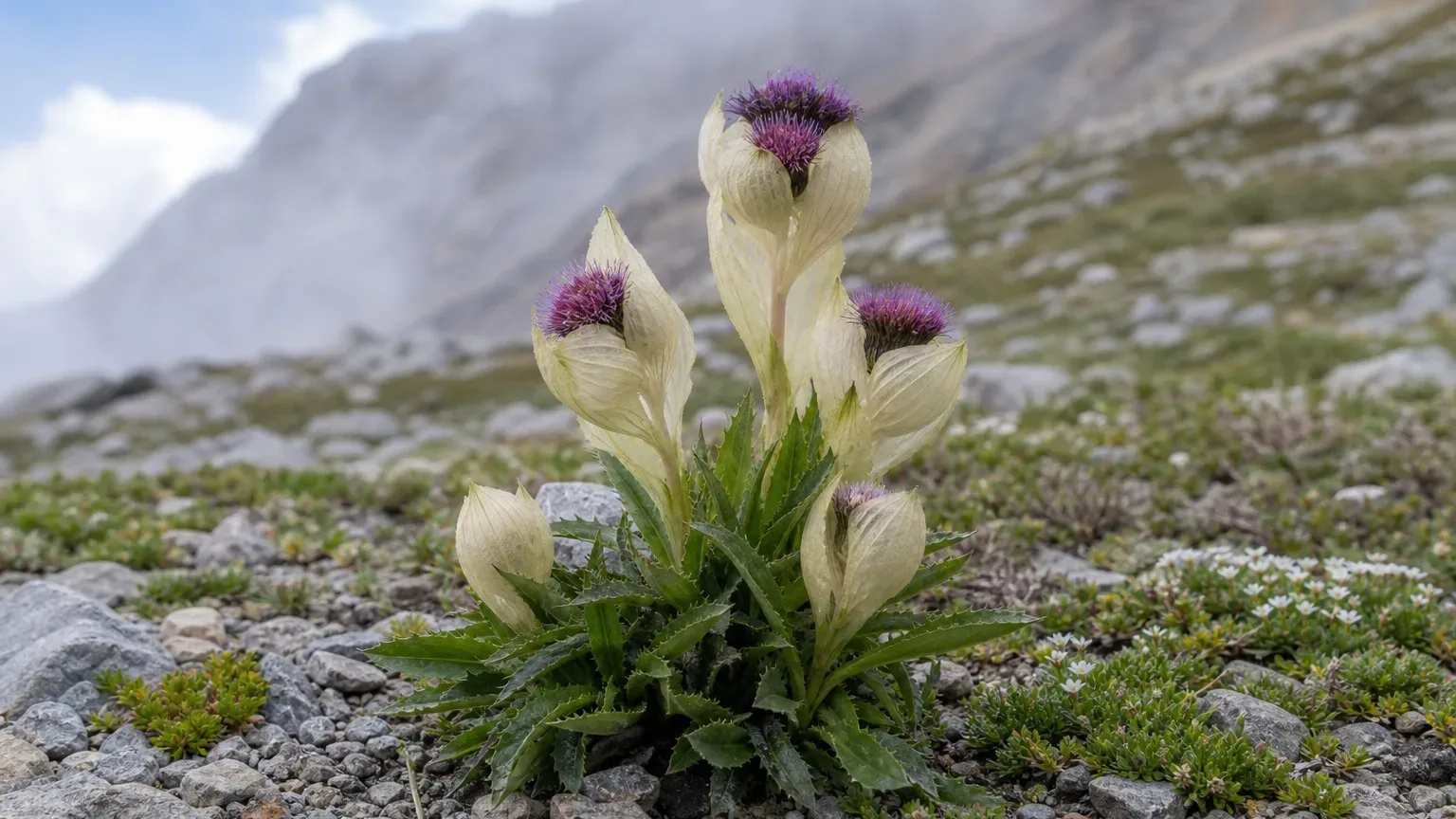
True Brahma Kamal forms a low clump or basal group of toothed leaves, then sends up short, sturdy flowering stems. Flora of China records a perennial herb with a stout caudex, erect stem, and broad lower leaves rather than cactus pads.
Its famous “flower” is a cluster of small purple flower heads enclosed by pale cream to yellow-green, translucent papery bracts. The enclosure can resemble a closed lotus from a distance, but botanically it is an Asteraceae inflorescence. A compact leafy crown and bracted flower head—not a climbing or trailing cactus stem—is the quickest visual check.
What its alpine habitat tells you about care
India Flora Online places the species in grasslands, rocky slopes, scree, and streamside sites at roughly 3,200–5,200 metres. The Nepal flora checklist also records S. obvallata in the Himalayan flora. These are bright environments with short growing seasons, cold nights, snow cover or dormancy, and water that can move through broken mineral ground.
Translate that habitat into five container priorities: bright light, cool air, cool roots, moisture during growth, and fast drainage. “Alpine” does not mean treating the plant like a dry desert succulent. Sites near streams and moist slopes can supply regular water, while rock and scree prevent stagnant, oxygen-poor soil.
Its pale enclosing bracts are also part of a high-mountain strategy. Himalayan Voices describes a plant up to about 30 cm with papery bracts surrounding dense flower heads. In cultivation, expect a small seasonal herb, not a large permanent houseplant.
Where Brahma Kamal can realistically succeed
The easiest regions are cool Himalayan and temperate locations where summer nights drop sharply and winter provides natural dormancy. Outdoors, give it an east-facing position, bright open shade, or morning sun with protection from intense low-altitude afternoon heat. Good air movement matters during monsoon weather because warm, saturated crowns are vulnerable.
In the Indian plains, the difficulty rises as summer night temperatures and humidity remain high. Shade alone does not reproduce alpine conditions; deep shade can weaken growth while the root zone stays warm. An air-conditioned room is usually not a complete solution either, because indoor light and air movement are often inadequate and abrupt transfers create stress.
A practical climate test for Indian growers
Ask whether you can keep the plant outdoors in bright light while protecting the pot from both hot afternoon sun and prolonged warm rain. If summer nights remain warm for weeks and the pot never cools, regard the plant as an experiment rather than a dependable perennial. A shaded stone trough, ventilated north- or east-facing high-altitude balcony, or alpine house is more suitable than a plastic pot on heat-radiating concrete.
Use a probe thermometer in the mix during the hottest month if you are unsure. Persistent warm, wet soil is a stronger warning than one hot afternoon. The goal is not to chase an exact temperature number unsupported by cultivation trials; it is to prevent the combination of heat, stagnant humidity, and saturated roots.
Light: bright exposure without hot lowland scorch
Give Saussurea obvallata several hours of gentle morning sun or very bright open shade. High-elevation plants receive intense light, but a nursery-grown specimen moved directly into lowland afternoon sun can scorch because heat load and root temperature rise together. Acclimate over one to two weeks, beginning with bright shade.
Compact leaves and sturdy stems indicate useful light. Long soft stems, wide gaps between leaves, or a crown leaning strongly toward one side suggest insufficient light or excessive warmth. For placement details and acclimation steps, use the Brahma Kamal light guide.
Water: steady moisture with immediate drainage
During active spring and summer growth, water when the top 1–2 cm of mix has just begun to dry while the layer below still feels cool. Apply enough water to wet the root ball, then let every excess drop leave the pot. Do not leave the container standing in a saucer, and do not wait until the entire crown becomes limp before watering.
This is a narrower balance than cactus care: neither bone-dry for long periods nor continuously saturated. Check frequently in bright, windy weather and less often during cool cloudy spells. After foliage dies back, reduce water sharply and keep the dormant crown only lightly moist; the Brahma Kamal watering guide covers seasonal checks and recovery signs in detail.
Soil and containers for cool, oxygenated roots
Use an alpine-style medium that holds a little moisture but releases surplus water immediately. A practical starting blend is 40% fine pine bark or leaf mould, 30% loam-based potting mix, and 30% pumice, perlite, or fine horticultural grit. Adjust toward more mineral material if your monsoon climate keeps the mix wet for days.
A relatively shallow terracotta or breathable container with generous drainage holes is safer than an oversized decorative pot. Penn State Extension’s account of crevice gardens for alpine plants explains how narrow, mineral spaces emulate free-draining rock formations; the container equivalent is a stable crown with moisture below and rapid air return after watering.
Do not place a layer of stones beneath dense peat and assume it fixes drainage. Drainage comes from the whole mix, open holes, and a sensible pot-to-root ratio. See the Brahma Kamal soil guide for mix adjustments and the repotting guide before disturbing an established crown.
Seasonal growth and winter dormancy
New leaves normally emerge as conditions brighten and warm modestly, followed by short flowering stems in the summer growing season. After flowering, foliage can decline as the plant prepares for dormancy. Allow that cycle instead of trying to keep it evergreen with extra fertilizer and water.
During winter rest, protect the crown from alternating saturation and hard freeze in a container. Cold itself is part of the species’ rhythm, but a small pot is more exposed than a rhizome insulated by mountain soil and snow. Keep dormant material cool, ventilated, and barely moist, then resume regular checks only when new growth appears.
Flowering expectations and why buds fail
A mature, established plant flowers only when its seasonal cues and root health align. The species is documented as a compact perennial; Plants For A Future lists a mature height around 0.3 metres, so waiting for a large bush before expecting flowers is the wrong benchmark. Look instead for a firm, expanding crown and sturdy seasonal shoots.
When flowers do not appear, investigate climate first. Warm nights, weak winter rest, insufficient light, recent division, an immature crown, or roots stressed by stale wet mix are more plausible causes than a simple lack of feed. Heavy nitrogen can create soft foliage without solving any of those limits; use the Brahma Kamal fertilizer guide for conservative feeding.
Common Brahma Kamal care mistakes
The most consequential mistake is applying Epiphyllum advice to Saussurea. Warm indoor placement, orchid-cactus mix, tropical humidity, and a mild winter may suit the night-blooming cactus but work against the alpine species. Confirm identity before acting.
Other failures come from moving a newly bought plant into harsh sun, using a large pot full of water-retentive compost, leaving it exposed to warm monsoon downpours, or feeding during root stress. Treating natural autumn dieback as a crisis often leads to winter overwatering. Let the plant’s season determine care rather than forcing year-round foliage.
Read the plant: healthy growth and warning signs
Healthy growth is compact, firm, and proportionate: toothed leaves gather around a stable crown, stems remain upright, and the mix smells fresh. Yellow leaves while the pot remains wet, soft dark crown tissue, or wilting in damp soil suggest oxygen-starved or decaying roots. Stop watering, move the pot under cover, and inspect only if decline continues.
Crisp edges, limp leaves in a light pot, and mix pulling from the container indicate excessive dryness. Weak stretched growth points toward shade or heat. Do not diagnose from one leaf alone; combine the symptom with pot weight, soil feel, recent weather, and the firmness of the crown.
Pet safety remains unverified
No major veterinary poison-control authority provides a species-specific safety classification for Saussurea obvallata. PFAF reports “none known” under hazards, but absence of a recorded hazard is not proof that the plant is safe for cats, dogs, birds, or grazing pets. Prevent chewing and contact a veterinarian if ingestion is followed by symptoms.
Do not offer any part as food based on traditional medicinal use. A peer-reviewed paper confirms that the species has been investigated for phytochemical and antibacterial activity, but laboratory research does not establish a safe dose for people or companion animals.
Buy propagated plants, never wild-collected material
Brahma Kamal has deep cultural importance in Himalayan communities, but that does not justify removing plants, crowns, or seeds from habitat. Wild alpine populations grow slowly under a short seasonal window and can be damaged by collection and trampling. Purchase only clearly labelled, nursery-propagated stock with legal provenance.
A reputable seller should provide the botanical name and a plant that matches the species’ morphology. Reject listings that show flat cactus stems while claiming Saussurea obvallata. If provenance is vague, leave the plant rather than creating demand for wild collection.
When to use this page vs other Brahma Kamal guides
- Start here when you need to confirm identity, climate suitability, and the complete seasonal care framework.
- Use the light guide to choose exposure or correct stretched growth.
- Use the watering guide when the mix stays wet, foliage wilts, or dormancy changes demand.
- Use the soil guide before changing an unsuitable peat-heavy medium.
- Use the propagation guide for seed or careful crown division rather than wild collection.
Related Brahma Kamal guides
- Brahma Kamal light — exposure, acclimation, and heat-safe placement
- Brahma Kamal watering — moisture checks through growth and dormancy
- Brahma Kamal soil — alpine-style mixes and drainage
- Brahma Kamal fertilizer — restrained feeding for a slow alpine
- Brahma Kamal repotting — container timing and crown handling
- Brahma Kamal propagation — nursery-scale seed and division guidance
- Brahma Kamal pruning — seasonal cleanup without damaging the crown
Conclusion
Successful Brahma Kamal care starts with two honest checks: the plant must be Saussurea obvallata, and the growing site must provide a credible alpine rhythm. Give the true Himalayan species bright gentle sun, cool moving air, evenly moist but sharply drained roots during growth, and a restrained winter dormancy. Its accepted range from the Himalaya into western China and northern Myanmar confirms that this is a cold-region rhizomatous perennial, not a tropical flowering cactus.
If warm nights and monsoon saturation cannot be controlled, no feeding trick will make the plant easy. Grow it where the pot can stay cool, watch the crown rather than the calendar, and accept dormancy as part of health. Most importantly, buy propagated material and keep this culturally treasured alpine in the mountains unless it was legally raised for cultivation.
How to care for Brahma Kamal?
When should you water Brahma Kamal?
Keep the root zone evenly moist but never waterlogged during active spring and summer growth. Water when the surface just begins to dry, then let excess drain completely.
- Feel the top 1–2 cm of mix and lift the pot - Keep the root zone evenly moist but never waterlogged during active spring and summer growth.
- water when the surface is barely dry while the mix below still feels cool - Water when the surface just begins to dry, then let excess drain completely.
- not after the entire root ball has dried - Keep the root zone evenly moist but never waterlogged during active spring and summer growth.
- Drain excess water - Water when the surface just begins to dry, then let excess drain completely.
What soil works best for Brahma Kamal?
Moisture-retentive but sharply drained alpine-style mix with mineral grit and modest organic matter; never use dense, warm, waterlogged potting soil
- 40% fine pine bark or leaf mould - Moisture-retentive but sharply drained alpine-style mix with mineral grit and modest organic matter; never use dense, warm, waterlogged potting soil.
- 30% loam-based potting mix - Moisture-retentive but sharply drained alpine-style mix with mineral grit and modest organic matter; never use dense, warm, waterlogged potting soil.
- 30% pumice, perlite, or fine horticultural grit - Moisture-retentive but sharply drained alpine-style mix with mineral grit and modest organic matter; never use dense, warm, waterlogged potting soil.
Grower notes for Brahma Kamal
What matters most with Brahma Kamal
True Brahma Kamal is a cold-adapted Himalayan alpine perennial, not the tropical night-blooming cactus commonly sold under the same name. Saussurea obvallata needs bright light, cool air, moist but sharply drained roots, and a real winter rest. Heat—especially warm nights combined with wet soil—is a greater challenge than cold. Do not collect plants or seed from the wild; buy only nursery-propagated material.
Best placement in a real home
Place Brahma Kamal outdoors in full morning sun or bright partial shade, with protection from hot afternoon sun and monsoon waterlogging. A cool Himalayan or temperate garden, ventilated alpine house, or north/east-facing high-altitude balcony suits it better than a warm living room. Aim for summer days below about 20°C when possible and distinctly cold nights; sustained tropical heat makes long-term cultivation difficult.
Before you buy this plant
Confirm the botanical label says Saussurea obvallata. Epiphyllum oxypetalum, the flat-stemmed tropical orchid cactus often called Brahma Kamal in Indian nurseries, needs completely different care. True Saussurea forms a compact basal rosette and short flowering stems wrapped in pale, translucent bracts. Choose a legally propagated plant with a firm crown, clean leaves, and no sour-smelling mix.
First month after bringing it home
Keep the plant cool and sheltered while you learn how quickly its pot dries. Do not immediately move a nursery-grown plant into harsh sun or a much larger container. Water when the surface just begins to dry, empty saucers promptly, and protect the crown from prolonged warm rain. Avoid fertilizer until fresh growth shows that the roots have settled.
Pet-aware note for Brahma Kamal
Reliable companion-animal toxicity data for Saussurea obvallata is not available. Plants For A Future reports no known hazards, but that is not proof of safety for cats, dogs, birds, or grazing pets. Treat the plant as unverified, prevent chewing, and do not use its traditional medicinal reputation as a reason to offer any part to an animal.
How to tell Brahma Kamal is settling in
Healthy spring growth appears as a compact rosette of toothed leaves, followed by short upright stems and enclosed flower heads in summer. Stretching, weak growth suggests too much shade or warmth; yellowing in wet mix points to root stress. After flowering, allow natural dieback and reduce water rather than forcing evergreen growth. Seed is surface-sown in spring; established crowns may be divided sparingly.
Is Brahma Kamal safe for pets?
Saussurea obvallata has no well-established companion-animal safety classification. Keep it away from pets that chew plants and contact a veterinarian if any part is eaten.
No species-specific listing from a major veterinary poison-control authority was found for Saussurea obvallata. Plants For A Future records no known hazards, but absence of a reported hazard does not establish pet safety. Treat all parts as unverified for cats, dogs, rabbits, birds, horses, and reptiles; prevent ingestion and seek veterinary advice if exposure causes symptoms.
Watering Brahma Kamal
For Brahma Kamal, feel the top 1–2 cm of mix and lift the pot; water when the surface is barely dry while the mix below still feels cool, not after the entire root ball has dried and water check every 2–3 days in cool active growth; water less often during winter dormancy, according to how quickly the pot dries. Maintain steady moisture as shoots and flower heads develop in spring and monsoon-season summer; reduce sharply after foliage dies back, keeping the dormant crown only lightly moist.
| Detail | Information |
|---|---|
| How often | Check every 2–3 days in cool active growth; water less often during winter dormancy, according to how quickly the pot dries |
| How to check | Feel the top 1–2 cm of mix and lift the pot; water when the surface is barely dry while the mix below still feels cool, not after the entire root ball has dried |
| Seasonal changes | Maintain steady moisture as shoots and flower heads develop in spring and monsoon-season summer; reduce sharply after foliage dies back, keeping the dormant crown only lightly moist |
Signs of overwatering
- yellowing leaves while the mix remains wet
- soft or darkened crown tissue
- wilting despite damp soil
- root or crown rot
Signs of underwatering
- limp foliage in cool conditions
- crisp brown leaf edges
- stalled flower-head development
- mix pulling away from the pot
Soil & potting for Brahma Kamal
Use a mix of 40% fine pine bark or leaf mould, 30% loam-based potting mix, 30% pumice, perlite, or fine horticultural grit for Brahma Kamal. Fast drainage with consistent root-zone moisture; the mix should release surplus water immediately without drying bone-dry. Target soil pH around 6.0–8.0. Repot every 2–3 years, or only when the rhizomatous crown crowds the container or the mix loses drainage, ideally in early spring, just before new growth starts.
| Detail | Information |
|---|---|
| Recommended mix | 40% fine pine bark or leaf mould, 30% loam-based potting mix, 30% pumice, perlite, or fine horticultural grit |
| Drainage | Fast drainage with consistent root-zone moisture; the mix should release surplus water immediately without drying bone-dry |
| Soil pH | 6.0–8.0 |
| Repotting frequency | Every 2–3 years, or only when the rhizomatous crown crowds the container or the mix loses drainage |
| Best season to repot | Early spring, just before new growth starts |
Signs it needs repotting
- rhizomes or roots crowding the pot edge
- water no longer draining freely
- mix collapsing or remaining sour and wet
- growth weakening despite suitable cool light
Humidity & temperature for Brahma Kamal
Fertilizer & pruning for Brahma Kamal
Common problems on Brahma Kamal
Yellow Leaves
MediumLikely cause: Common on this plant type; confirm with recent watering, light, and root checks.
Quick fix: Inspect the plant and correct the most likely care stressor before stacking treatments.
Full fix guide →Brown Tips
MediumLikely cause: Common on this plant type; confirm with recent watering, light, and root checks.
Quick fix: Inspect the plant and correct the most likely care stressor before stacking treatments.
Full fix guide →Root Rot
MediumLikely cause: Common on this plant type; confirm with recent watering, light, and root checks.
Quick fix: Inspect the plant and correct the most likely care stressor before stacking treatments.
Full fix guide →Overwatering
MediumLikely cause: Common on this plant type; confirm with recent watering, light, and root checks.
Quick fix: Inspect the plant and correct the most likely care stressor before stacking treatments.
Full fix guide →Underwatering
MediumLikely cause: Common on this plant type; confirm with recent watering, light, and root checks.
Quick fix: Inspect the plant and correct the most likely care stressor before stacking treatments.
Full fix guide →Spider Mites
MediumLikely cause: Common on this plant type; confirm with recent watering, light, and root checks.
Quick fix: Inspect the plant and correct the most likely care stressor before stacking treatments.
Full fix guide →Mealybugs
MediumLikely cause: Common on this plant type; confirm with recent watering, light, and root checks.
Quick fix: Inspect the plant and correct the most likely care stressor before stacking treatments.
Full fix guide →Aphids
MediumLikely cause: Common on this plant type; confirm with recent watering, light, and root checks.
Quick fix: Inspect the plant and correct the most likely care stressor before stacking treatments.
Full fix guide →Leggy Growth
MediumLikely cause: Common on this plant type; confirm with recent watering, light, and root checks.
Quick fix: Inspect the plant and correct the most likely care stressor before stacking treatments.
Full fix guide →Slow Growth
MediumLikely cause: Common on this plant type; confirm with recent watering, light, and root checks.
Quick fix: Inspect the plant and correct the most likely care stressor before stacking treatments.
Full fix guide →Wilting
MediumLikely cause: Common on this plant type; confirm with recent watering, light, and root checks.
Quick fix: Inspect the plant and correct the most likely care stressor before stacking treatments.
Full fix guide →Drooping Leaves
MediumLikely cause: Common on this plant type; confirm with recent watering, light, and root checks.
Quick fix: Inspect the plant and correct the most likely care stressor before stacking treatments.
Full fix guide →Low Humidity
MediumLikely cause: Common on this plant type; confirm with recent watering, light, and root checks.
Quick fix: Inspect the plant and correct the most likely care stressor before stacking treatments.
Full fix guide →Not Enough Light
MediumLikely cause: Common on this plant type; confirm with recent watering, light, and root checks.
Quick fix: Inspect the plant and correct the most likely care stressor before stacking treatments.
Full fix guide →Fungus Gnats
MediumLikely cause: Common on this plant type; confirm with recent watering, light, and root checks.
Quick fix: Inspect the plant and correct the most likely care stressor before stacking treatments.
Full fix guide →Mold on Soil
MediumLikely cause: Common on this plant type; confirm with recent watering, light, and root checks.
Quick fix: Inspect the plant and correct the most likely care stressor before stacking treatments.
Full fix guide →