Brahma Kamal Propagation From Seed and Division
Brahma Kamal Propagation From Seed and Division
Brahma Kamal Propagation From Seed and Division
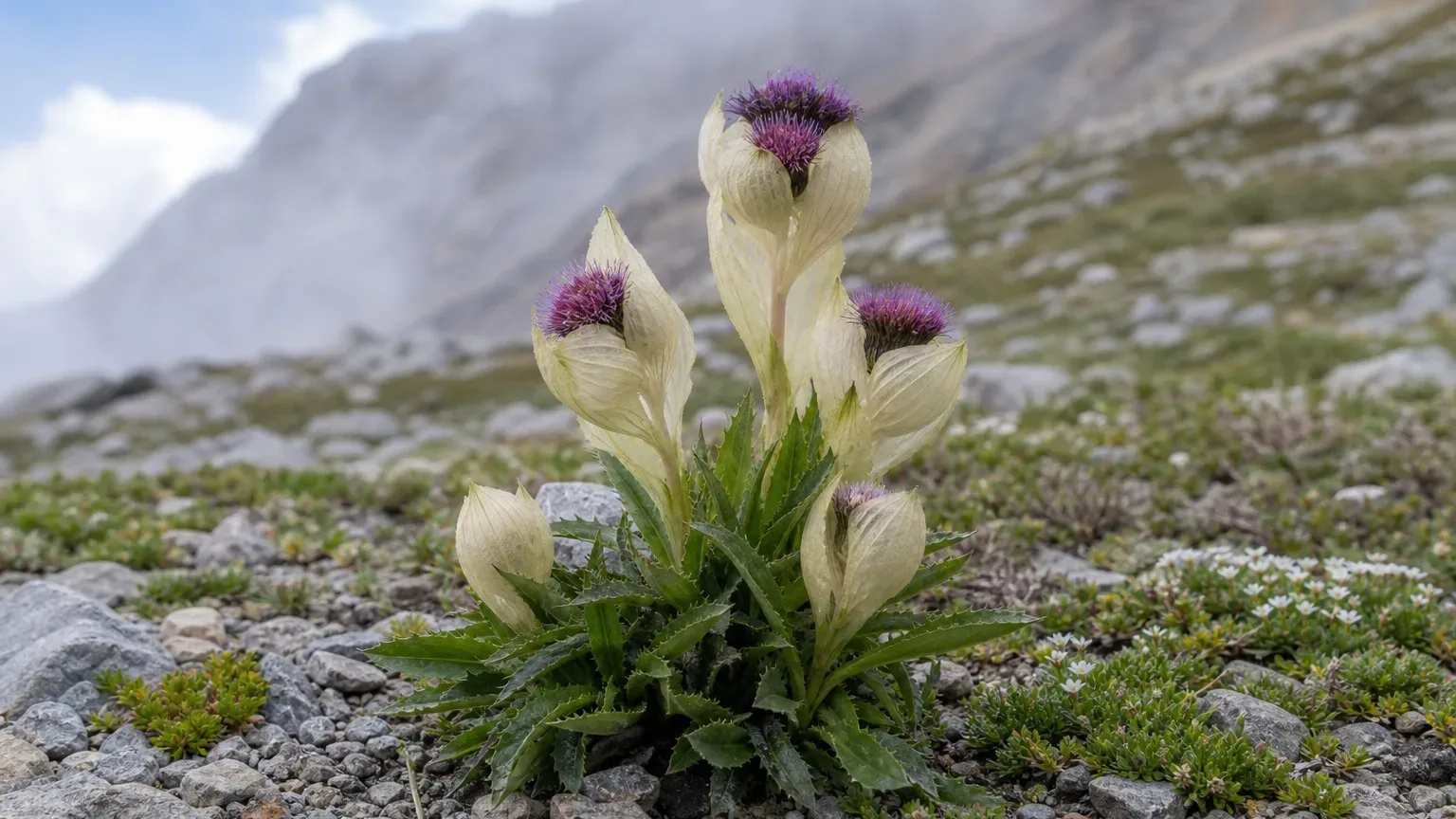
True Brahma Kamal, Saussurea obvallata, is a compact Himalayan alpine perennial. The practical home methods are seed from a documented cultivated source and, much later, careful division of a large nursery-grown crown. Stem and leaf cuttings are not established home methods for this species, while published micropropagation belongs in a sterile laboratory.
That distinction matters because “Brahma Kamal” is also widely used for Epiphyllum oxypetalum, a tropical orchid cactus that roots from flat stem pieces. This guide is only for Saussurea obvallata. If your plant has long, flat, leaf-like cactus stems, stop here: you have the Epiphyllum, and the alpine sowing instructions below will not apply.
Confirm you have Saussurea obvallata
Check the botanical label before buying seed or disturbing a parent plant. Kew accepts Saussurea obvallata (DC.) Sch.Bip. as a perennial or rhizomatous geophyte native from the Himalaya into parts of China and northern Myanmar, growing primarily in a subalpine or subarctic biome (Kew Plants of the World Online). GBIF likewise places the accepted taxon in Saussurea, within the daisy family, rather than among cacti (GBIF Backbone Taxonomy).
A true plant forms a low leafy rosette and short flower stems enclosed by pale translucent bracts. It does not make succulent, flattened, hanging stems. Start with the Brahma Kamal overview if the identity is uncertain; propagating a mislabeled Epiphyllum with alpine methods wastes seed trays and spreads the naming error.
Start with conservation and legal sourcing
Do not collect plants, rhizomes, flower heads, or seed from wild Himalayan populations. A peer-reviewed propagation paper describes S. obvallata as a rare, threatened, near-endemic medicinal herb of the Indian Himalayan region and developed tissue culture partly to reduce pressure on natural populations (Plant Cell Reports). Even taking a few ripe heads removes seed that could recruit in a short, difficult alpine growing season.
Buy only material represented as nursery propagated, with the full botanical name and a traceable seller. Ask whether seed came from cultivated parent plants, retain the invoice and packet, and avoid listings that advertise “wild Himalayan collected” material. Rules differ by land category and jurisdiction; protected-area access or possession of a plant does not by itself grant permission to remove biological material. Check the current law through the official India Code portal and ask the relevant forest, wildlife, or park authority before any collection.
Legal sourcing is also a quality check. A species-specific seed study found that source, seed mass, and pretreatment affected germination and seedling survival, with heavier seed from one Uttarakhand population performing better than seed from the other (Ecology, Environment and Conservation study). That does not justify wild collection; it means a reputable cultivated-seed producer who handles mature, filled seed is more valuable than an anonymous marketplace packet.
Choose the propagation method that fits your plant
For most growers, the decision is simple: use seed if you are starting from scratch; divide only if you already maintain a vigorous multi-point cultivated crown. Seed preserves the parent plant and can produce several genetically distinct plants. Division is faster but creates fewer plants and places both sections at risk.
Do not substitute stem cuttings because a seller calls both species Brahma Kamal. S. obvallata is not the flat-stemmed orchid cactus. A detached leaf or flowering stalk is not a documented shortcut to a rooted alpine crown.
Seed is the best starting method
Seed is the least destructive method and the only realistic home option when no established cultivated parent is available. Choose a packet labeled Saussurea obvallata, preferably with harvest date, cultivated origin, and storage information. Reject seed mixed under a vague “snow lotus” name because that common name is used for more than one Saussurea species.
Expect variation and avoid promised percentages. Published trials show that seed lot and pretreatment can change performance; they do not establish one guaranteed result for every home tray. Split scarce seed into small batches instead of committing the entire packet to an untested treatment.
Division is only for established cultivated crowns
Division makes sense when a legally obtained plant has developed several obvious growth points and is already due for renewal or repotting. A single small rosette is not ready. Cutting it in half may leave neither piece with enough crown and root to recover.
Wait for early spring, just as growth resumes, and divide only when each natural section can keep at least one firm growth point plus a meaningful root portion. If the crown does not separate along a clear seam, leave it whole and revisit the decision another year.
Pick the right season and climate
Sow in late winter to early spring where you can keep the tray bright, cool, and ventilated. In a Himalayan or cool temperate garden, an outdoor cold frame or sheltered alpine setup can follow the natural seasonal transition. In a warmer Indian city, the useful window may be brief; start during the coolest bright part of the year rather than in pre-monsoon heat.
Division belongs at the same early-growth transition, not while the plant is flowering and not in warm, saturated monsoon weather. Review the Brahma Kamal repotting guide before lifting the crown, because container size, drainage, and post-disturbance care decide whether divisions establish.
Prepare Brahma Kamal seed without guessing
Inspect seed under good light. Keep plump, intact pieces and discard visibly empty, crushed, or moldy material. Label every batch with source, harvest year if known, sowing date, and treatment; without labels, a failed experiment teaches nothing.
Do not apply concentrated acids, agricultural growth regulators, or fungicide cocktails from a research protocol at home. The species study tested controlled pretreatments in a seed germinator and greenhouse. Those conditions and chemicals are not a casual kitchen recipe, and the paper’s useful lesson for a home grower is that seed lot and treatment matter—not that more chemical treatment is automatically better.
Does the seed need cold stratification?
There is not enough species-specific evidence to promise that every S. obvallata seed lot needs a fixed number of refrigerated weeks. Temperate perennial seeds can have different dormancy mechanisms, and University of Illinois Extension recommends using natural winter conditions when a species needs chilling rather than assuming one warm sowing works for all (Illinois Extension).
Use a split-batch test when you have enough legally sourced seed. Sow one batch in late winter under cool bright conditions and expose a second, protected tray to a normal cold period or use controlled moist chilling based on the seed supplier’s tested instructions. Never freeze a waterlogged tray, and do not repeatedly move the same seed between extremes; compare treatments and keep records.
Sow legally sourced seed step by step
- Fill a clean, shallow tray or small cells with a fine, low-nutrient alpine seed mix that holds slight moisture but drains immediately. A practical starting mix is equal parts sifted seed compost, fine horticultural grit, and perlite or pumice.
- Pre-moisten the mix and let surplus water drain. It should feel cool and lightly damp, not glossy or muddy.
- Scatter seed thinly. Press it into contact with the surface and cover with only a very fine dusting of grit; deep burial makes it harder for a small seedling to reach light.
- Place the tray in bright, cool, airy conditions protected from hard rain and hot midday sun. A cold frame with ventilation is more suitable than a sealed warm propagator.
- Water from below or use a fine mist only when the surface approaches dryness. Remove standing water after the mix has wicked up enough moisture.
- Keep the label with the tray and wait. Do not declare failure on an arbitrary seven- or fourteen-day schedule, and do not make the tray wetter to force emergence.
The goal is steady slight moisture with abundant air, matching the logic of the adult Brahma Kamal soil guide. Rich compost, deep pots of warm peat, and sealed humidity domes keep a small seed lot wet for too long.
Care for seedlings after emergence
As soon as green seedlings appear, increase ventilation and keep them close to bright light without sudden scorching. Thin crowded patches with tweezers rather than pulling and disturbing neighboring roots. Continue watering lightly from below, but allow the surface to lose its wet sheen between applications.
Pot seedlings on only after they can be handled without crushing and have formed several true leaves. Lift by a leaf, not the stem, and move each seedling into a small pot of the same sharply drained alpine-style mix. Keep the crown at the original depth, shade from strong sun for a few days, and then restore the bright conditions described in the Brahma Kamal light guide.
Do not feed newly emerged seedlings. Once roots hold the plug and new leaves are developing, a very weak feed may be considered during active growth; the Brahma Kamal fertilizer guide covers the restrained feeding approach for this slow alpine plant.
Divide a cultivated Brahma Kamal crown
Water the parent lightly the day before only if the mix is dry; a dripping root ball is harder to handle and easier to smear with damaged tissue. Prepare small draining pots and fresh alpine mix before you unpot the plant. Clean the knife, labels, and work surface.
Ease out the crown and tease away enough mix to see natural rhizome connections. Pull apart an obvious seam with your fingers, or make one clean cut if necessary. Each division must keep a firm growth point, sound crown tissue, and roots; discard soft, dark, or sour-smelling sections rather than sealing rot into a new pot.
Pot each section at its former depth and firm the mix gently. Water once to settle the root zone, drain fully, and keep the divisions cool, bright, and sheltered from hard sun or heavy rain while roots re-establish. Do not fertilize until firm new growth appears. Follow the Brahma Kamal watering guide closely because a freshly divided crown uses less water but must not desiccate completely.
Know what tissue culture can and cannot do at home
Micropropagation is real for this species, but it is not the same as putting a cutting in a jar. The published protocol produced shoots from epicotyl explants on sterile culture media with measured plant-growth regulators, rooted plantlets in vitro, acclimatized them, and then transferred them to field conditions. The study reported 66.7% field establishment after its specified rooting and acclimatization sequence (Springer protocol abstract).
That work is important for conservation and specialist nurseries because it can multiply clean material without repeatedly harvesting wild plants. At home, contamination control, sterile media, chemical precision, and staged acclimatization make it a laboratory project rather than a practical alternative to seed.
Propagating in warm lowland India
The limiting factor is often not technique but climate. Kew’s subalpine/subarctic biome description explains why a seedling may emerge in a cool winter and then fail as hot nights arrive. A refrigerator can chill seed, but it cannot give a growing plant months of cool air, intense mountain light, and a naturally cold dormancy.
In warm lowland and coastal regions, sow only if you have a credible plan for the first summer: an actively ventilated cool growing space, very bright light without heat buildup, and a root zone that remains moist but oxygenated. Air conditioning in a dark room is not a complete substitute. If you cannot maintain cool bright conditions, buying seed is likely to waste scarce propagated material.
High-altitude balconies and cool Himalayan gardens are better candidates, but monsoon waterlogging remains a risk. Shelter trays from pounding rain and keep them off hot concrete. Choose feasibility over forcing the plant into a climate that suits the unrelated Epiphyllum better.
Diagnose propagation failures
An empty tray can mean nonviable seed, an unsuitable pretreatment, deep burial, temperature stress, or prolonged saturation. Keep the tray cool and stable before abandoning it, then inspect records rather than changing every variable at once. When retrying, use fresh documented seed and alter one factor, such as pretreatment or moisture, so the comparison has meaning.
A division that remains firm but pauses may simply be rebuilding roots. A division that darkens, smells sour, or collapses at the crown is rotting; isolate it, remove dead tissue with a clean tool, and correct the wet, warm conditions. Do not compensate for stalled growth with fertilizer.
Prevent damping-off and crown rot
Damping-off can rot seed before emergence or destroy seedlings at and below the soil line. Penn State lists excess moisture, temperature extremes, and crowded flats among the favoring conditions, and recommends clean containers plus pasteurized or soilless media (Penn State Extension). NC State also emphasizes sanitation, drainage, suitable sowing depth, airflow, and avoiding dense stands (NC State Extension).
Remove collapsed seedlings and nearby contaminated mix rather than misting the whole tray more heavily. Increase air movement, let the surface become less wet, and check whether the tray is sitting in runoff. Fungicides are not a substitute for correcting the propagation environment, and unlabeled chemical use can injure seedlings.
Respond to heat-stalled seedlings
Heat-stalled seedlings often stop extending, become soft, or lose roots while the tray still looks moist. Move them out of radiant afternoon heat, ventilate, and water in the cool part of the day only when the mix needs it. Do not seal them under plastic; trapped heat and condensation compound the problem.
If hot nights are sustained and no genuinely cool bright position exists, preserve any firm plants as carefully as possible and postpone further sowing. The honest fix may be a different season or a cooler location, not another additive.
When to use this page vs other Brahma Kamal guides
Use this page to choose seed or crown division, manage the first seedling stages, and source material responsibly. Use the overview for identification and whole-plant expectations, light for a cool bright placement, and soil for the adult alpine mix.
Once a seedling or division is established, use watering to balance steady moisture with oxygen, fertilizer for restrained feeding, and repotting when the cultivated crown actually fills its container. Propagation should not become an excuse to divide or repot a small stressed plant.
Related Brahma Kamal guides
- Brahma Kamal overview — confirm the Himalayan species and understand its annual cycle
- Brahma Kamal light — bright, cool placement for seedlings and established crowns
- Brahma Kamal watering — maintain moisture without suffocating alpine roots
- Brahma Kamal soil — build a moisture-retentive but sharply drained mix
- Brahma Kamal fertilizer — feed only after active growth is established
- Brahma Kamal repotting — lift a crowded cultivated crown with less disturbance
- Brahma Kamal pruning — remove spent or damaged growth without cutting viable crown tissue
Conclusion
The safest route to more true Brahma Kamal is legally sourced cultivated seed, sown in a clean, cool, bright, sharply drained setup. Divide only a vigorous multi-point nursery-grown crown, and leave stem-cutting advice to the unrelated orchid cactus. Good records, restrained moisture, and realistic climate assessment matter more than a promised germination hack.
Conservation is part of the method, not a footnote. Do not remove seed or plants from Himalayan habitat, verify local rules, and support nurseries that can document propagation. A slower cultivated start is a better success than a wild-collected plant that weakens the population this guide is meant to help readers appreciate.