Brahma Kamal Light Needs: Sun, Shade & Placement
Brahma Kamal Light Needs: Sun, Shade & Placement
Brahma Kamal Light Needs: Sun, Shade & Placement
True Brahma Kamal, Saussurea obvallata, needs bright outdoor light, but “give it full sun” is incomplete advice. This is a cold-adapted Himalayan perennial. Sun that suits it on a cool mountain slope can overheat the same rosette on a lowland terrace, especially when hot paving, walls, and still air raise leaf temperature.
The useful goal is bright light with a cool plant, not shade at any cost and not maximum sun at any cost. In a cool high-altitude garden, that may mean sun for much of the day. In a warm Indian city, it usually means early sun followed by bright open shade, while recognizing that sustained lowland heat may make long-term cultivation unsuccessful even after light is adjusted.
How much light does Brahma Kamal need?
Use full morning sun or very bright partial shade as the practical starting point. Plants For A Future records the species for both sun and semi-shade, while also noting that its detailed cultivation information is limited; its habitat record places the plant in alpine meadows, rocky slopes, and stream margins at 3,000–4,500 m (PFAF species profile). That combination supports an open, bright position rather than a dim indoor corner.
The wild plant experiences strong sky light above or near the treeline, but it also grows among rocks, grasses, slope folds, and streamside terrain that create changing shelter. The Flora of China treatment records it from grasslands, rocky mountain slopes, scree, and stream margins at 3,200–5,200 m. Cultivation should imitate the brightness and air movement of that habitat without pretending a warm balcony has the same thermal environment.
Full sun versus partial shade
Choose between full sun and partial shade by temperature and exposure, not by a rigid hour count. Cool sites with cold nights, moving air, and non-reflective ground can support longer sun. Sites where summer afternoons are hot, walls radiate heat, or pots become warm need protection before the hottest part of the day.
The Royal Horticultural Society describes high-mountain alpines as plants exposed to harsh sun and notes that most prefer plenty of light (RHS alpine guide). That is useful context, not proof that every alpine tolerates a west-facing terrace in Delhi. For Brahma Kamal, open morning exposure plus afternoon protection is the safer cross-climate default.
Confirm you have Himalayan Brahma Kamal
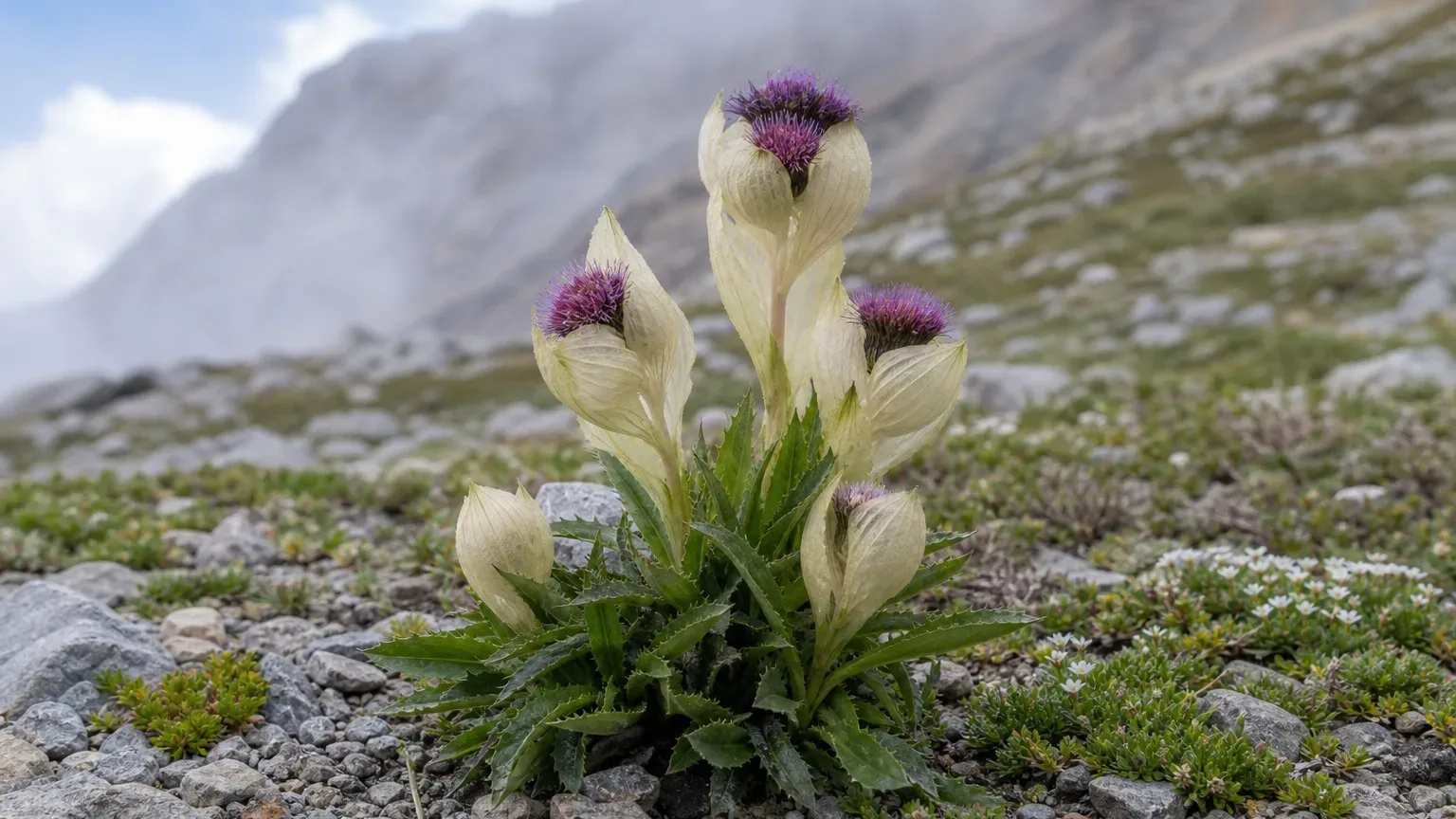
This guide applies only to Saussurea obvallata, an accepted Asteraceae species that Kew describes as a perennial or rhizomatous geophyte of subalpine or subarctic biomes (Kew Plants of the World Online). Its upright flowering stem is enclosed by pale, translucent, leaf-like bracts. The plant is not a flat-stemmed cactus.
Many Indian nurseries also call Epiphyllum oxypetalum “Brahma Kamal.” That tropical orchid cactus needs a different light, temperature, watering, and potting regime. Check the botanical label and compare the plant with authenticated records such as the GBIF taxon profile before using this page; broad, toothed leaves and a compact alpine crown point to Saussurea, while flattened succulent stems point to Epiphyllum.
Best placement for Brahma Kamal
The best position is outdoors in unobstructed light with excellent ventilation. A cool east-facing balcony, an open alpine trough, a bright cold frame with its lid raised, or a rock-garden pocket can work. A room several metres from a window usually cannot provide the combination of high light, cool air, and seasonal change this species evolved under.
Avoid placing the pot against a dark masonry wall that stores afternoon heat. Keep it off hot metal railings and artificial turf. If only one location stays cool, prioritize that site and use the brightest portion of its day rather than moving the plant into a hotter spot simply to add sun.
High-altitude and cool-temperate placement
In Himalayan hill stations and other cool-temperate locations, begin with an open site receiving several hours of morning and midday sun. The RHS advises placing rock gardens in open positions where plants receive sun for much of the day, with perfect drainage (RHS rock-garden guidance). A position where a low rock shades the pot and crown base while the leaves receive open light can buffer root-zone temperature.
Watch the plant during the first clear spell after purchase. A nursery-grown rosette may have been held under shade netting even if the species tolerates stronger wild exposure. Increase direct sun only while new leaves remain compact, normally coloured, and cool enough that the surrounding pot does not become a heat sink.
Warm low-elevation placement
In warm plains climates, use an east or northeast exposure with direct sun soon after sunrise and bright, unobstructed shade later. A high, open balcony is generally better than a ground-level courtyard enclosed by walls. Fifty-percent shade cloth can reduce harsh midday exposure, but it cannot compensate for hot nights or stagnant air.
Treat summer as a heat-management problem. If morning temperatures are already high, reduce the direct-sun window and preserve strong diffuse light. Do not move the plant into deep shade indefinitely: that trades immediate heat relief for weak growth and slower drying. When no outdoor spot stays reasonably cool, this alpine may be unsuitable for the site; the honest fix is not a darker room.
Can Brahma Kamal take direct sun?
Yes, direct sun is appropriate when the air and root zone remain cool. Gentle morning sun is the safest starting exposure because surfaces have not yet accumulated daytime heat. Midday sun can be suitable in a cool mountain climate, while lowland afternoon sun is the highest-risk exposure because radiation and heat load peak together.
Do not interpret pale flower-head bracts as sun bleaching. Flora of China describes the uppermost leaves as pale yellow, membranous, and wrapped around the clustered flower heads (Flora of China). Judge stress on ordinary green leaves and on the timing of damage, especially if patches appear soon after relocation.
Acclimate the rosette gradually
Move a shade-grown plant into direct sun over roughly two to three weeks. Start with 30–60 minutes of early sun, then add exposure every few days while checking the newest leaves. Pause the increase when edges curl persistently, green tissue pales unevenly, or sun-facing areas turn tan or crisp.
Change only light during acclimation. Repotting, feeding, and a major exposure change at the same time make the plant’s response hard to read. If the root ball also needs attention, use the Brahma Kamal repotting guide and stabilize the plant in bright shelter before increasing sun.
How much shade is too much?
Shade is too deep when the plant receives no direct sun and the open sky occupies only a small part of its view. A covered corridor, an interior windowsill behind tinted glass, or a shelf across the room may look bright to human eyes but still be poor alpine light. The plant may remain alive for a while because the crown stores resources, yet fail to build a compact flowering stem.
Use growth form as the practical meter. Healthy active growth should remain comparatively compact for the species. Long, weak petioles, a loose rosette, pronounced leaning toward one opening, and a failure to progress after spring growth begins all justify a brighter position—provided temperature is not already excessive.
Using grow lights for Brahma Kamal
A grow light can supplement a dull winter balcony or a protected alpine house, but it does not turn a warm living room into a Himalayan climate. Artificial light solves photon shortage; it does not supply cold nights, outdoor airflow, or seasonal dormancy. Use it where the temperature regime is already plausible.
University of Minnesota Extension explains that lamp type, intensity, distance, and daily duration all affect indoor plant lighting (UMN Extension lighting guide). No species-specific controlled-light target for Saussurea obvallata was found, so avoid treating a precise lux or PPFD number as established fact.
A practical lamp setup
Choose a white full-spectrum LED panel or bar broad enough to light the whole rosette. Start with the manufacturer’s seedling distance, commonly farther away than for fruiting crops, and run it for about 10–12 hours during active growth. Keep a dark period each night and use a timer; continuous light is unnecessary.
Observe the plant for ten to fourteen days before changing height. A rosette reaching strongly upward or leaning toward one edge needs more even intensity. Local paling or crispness directly under the diodes calls for greater distance, shorter duration, or better airflow. Measure leaf-level light with a meter if available, but let compact new growth and cool leaf temperature decide whether the setting works.
Adjust light through the seasons
In spring, increase exposure as new growth emerges, but do it gradually because foliage developed under winter shelter is easier to scorch. During cool summer weather at altitude, maintain bright open conditions. During lowland heat waves or intense pre-monsoon afternoons, shift to morning sun and ventilated shade.
Cloudy monsoon conditions can reduce useful light while saturated air slows evaporation. Keep the plant in the brightest rain-sheltered position rather than pushing it into heavy shade. Pair that placement with the Brahma Kamal watering guide and Brahma Kamal soil guide so moisture remains steady without trapping warm water around the crown.
After foliage naturally dies back, the dormant crown has little photosynthetic demand, but it still benefits from a naturally cold, seasonally appropriate site. Do not force evergreen growth under long indoor lamp hours. The RHS notes that many alpines are adapted to cold winters and are especially vulnerable to persistent winter wet (RHS alpine care); light management should not override dormancy and drainage.
Warning signs of the wrong light
Read symptoms as patterns, not single clues. Wilting in blazing afternoon light may be heat stress, dry roots, root injury, or all three. Yellowing in shade can reflect excess moisture rather than light alone. Check temperature, recent moves, and pot moisture before changing several variables.
Photograph the rosette from the same angle each week during active growth. This makes gradual stretching and leaning visible and prevents old scars from being mistaken for new damage. The newest fully opened leaves are the best record of current placement.
Signs of too little light
Too little light commonly produces a looser crown, elongated leaf stalks, one-sided leaning, weak pale new growth, and little progress during the expected growing season. Soil may also stay wet longer because the plant is using less water. Move the pot closer to open sky or add a lamp, then reassess watering rather than keeping the old schedule.
Do not try to correct shade with fertilizer. Nutrients cannot replace light, and soft growth produced under poor light is not a successful recovery. Use the Brahma Kamal fertilizer guide only after compact new growth shows that placement is working.
Signs of too much sun or heat
Excess exposure appears as sudden bleaching, tan papery patches, crisp margins concentrated on the sun-facing side, or repeated midday collapse despite moist, draining soil. Damage that follows a move within days strongly implicates exposure shock. Move the plant back to its last safe light level and improve airflow; do not plunge a hot pot into cold water.
Separate heat from light where possible. If the same sun is tolerated on a cool morning but not on a hot afternoon, the problem is the combined thermal load, not proof that the species wants darkness. A ventilated shade cloth, pale outer pot, or rock that shades the container can lower heat while preserving bright ambient light.
When to use this page vs other Brahma Kamal guides
- Start with the Brahma Kamal overview if identity, seasonality, or general suitability is uncertain.
- Use the watering guide when wilting, yellowing, or slow drying may be moisture-related.
- Use the soil guide when the pot remains warm and wet or drainage is poor.
- Use the repotting guide when the mix has collapsed or roots crowd the container.
- Use the propagation guide for seedling and division light aftercare.
Related Brahma Kamal guides
- Brahma Kamal care overview — identity, alpine habit, and whole-plant priorities.
- Brahma Kamal watering — moisture checks as exposure and temperature change.
- Brahma Kamal soil — a cool, moisture-retentive but fast-draining root zone.
- Brahma Kamal fertilizer — feeding only during healthy active growth.
- Brahma Kamal repotting — container and timing choices for the alpine crown.
- Brahma Kamal propagation — light for seeds, divisions, and young plants.
Conclusion
Brahma Kamal needs bright alpine-style exposure, but its cold-adapted biology makes temperature the deciding partner to light. Give Saussurea obvallata open morning sun and excellent airflow as the safest baseline. Extend sun in cool high-altitude conditions; shorten it and provide bright afternoon shade where surfaces and nights run warm.
Confirm the plant is Saussurea, acclimate it in stages, and judge the newest leaves rather than a generic hour count. Compact growth without bleaching shows the balance is close. Stretching calls for more usable light, while one-sided papery damage after a move calls for less direct exposure or lower heat—not permanent darkness.