Brahma Kamal Repotting Guide for Saussurea
Brahma Kamal Repotting Guide for Saussurea
Brahma Kamal Repotting Guide for Saussurea
Repotting true Brahma Kamal means handling a compact Himalayan alpine, not a tropical night-blooming cactus. This guide is only for Saussurea obvallata, the accepted species that Kew describes as a rhizomatous geophyte of subalpine or subarctic habitats. Its crown needs cool air, an open but moisture-balanced root zone, and minimal disturbance.
There is no well-supported, species-specific rule saying that S. obvallata must move to a new pot every year or on an exact schedule. A two- to three-year inspection window is a practical starting point for a slow container plant, not a biological deadline. Repot only when crowding, failing mix, or poor drainage creates more risk than leaving healthy roots alone.
The short answer: disturb it only when needed
The safest Brahma Kamal repotting plan is to work in early spring as the crown begins to wake, use a container only slightly wider than the root mass, and preserve healthy roots. Replace collapsed mix with an airy alpine blend that drains promptly but does not turn dust-dry around fine roots. Keep the crown at its old level, settle the mix with one careful watering, and return the plant to cool bright shelter.
Do not automatically move a newly purchased plant. First read the Brahma Kamal overview and observe whether its current pot drains and whether the crown is firm. A small healthy plant in fresh nursery mix gains nothing from an immediate “upgrade,” especially if it is already adjusting to a new temperature and light pattern.
Confirm you have the Himalayan Brahma Kamal
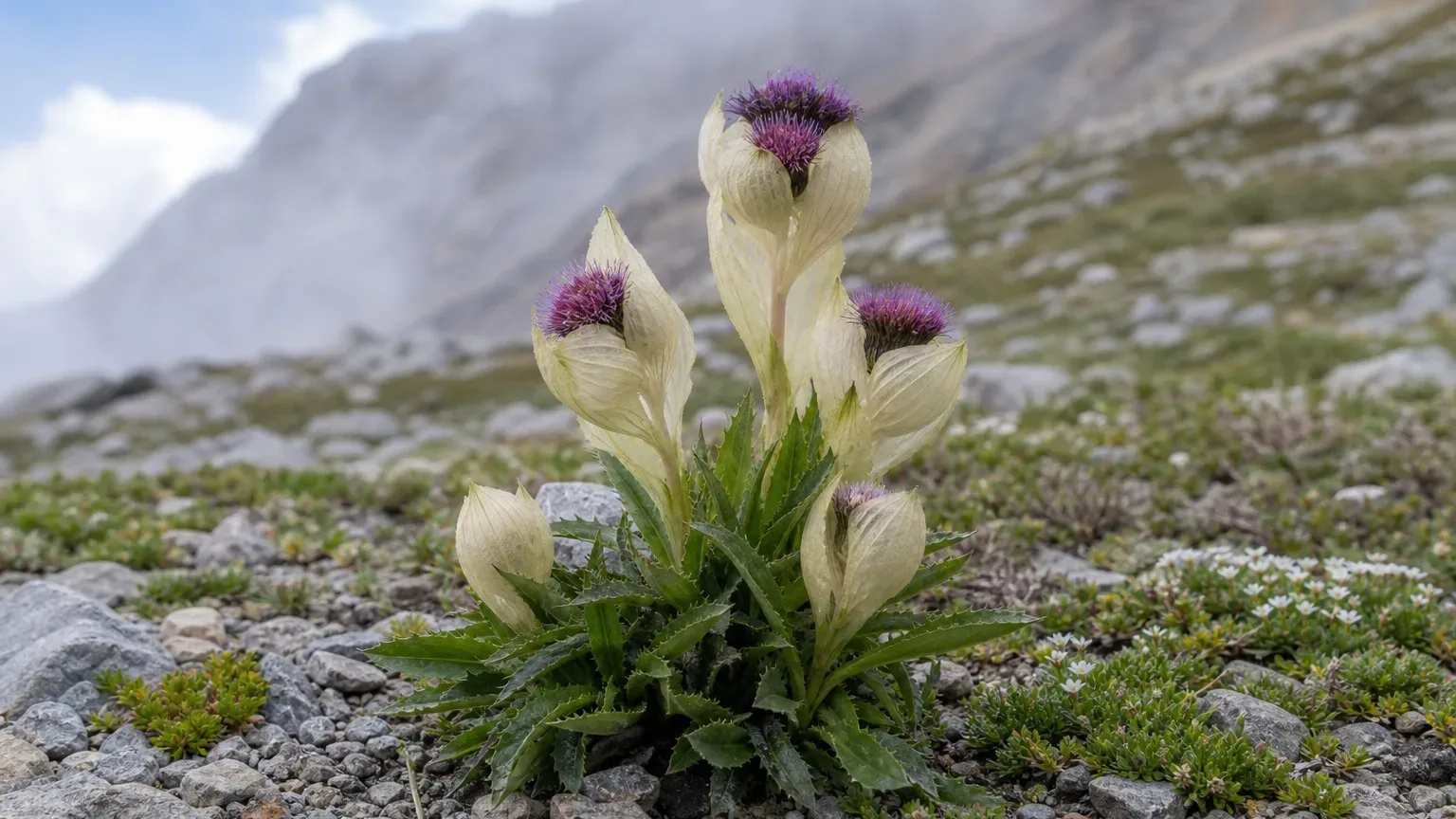
Check the label for Saussurea obvallata before touching the roots. Kew accepts this name in the daisy family and gives its native range from the Himalaya into western China and northern Myanmar; the Indian Institute of Science flora portal also provides a botanical record for the Indian flora. The plant forms a low leafy crown and short flowering stems wrapped in pale translucent bracts.
The flat, segmented cactus sold in India under the same common name is usually Epiphyllum oxypetalum. That tropical epiphyte needs a different mix, temperature range, container shape, and repotting rhythm. If your plant has long flat cactus stems rather than a toothed basal rosette, stop: none of the alpine instructions below apply.
When does Brahma Kamal need repotting?
Let the plant and mix make the decision. Repot when roots or rhizomes press hard against the wall, the root ball has become difficult to wet evenly, water stalls on the surface, or an old organic mix stays sour and wet long after watering. NC State Extension explains that container plants may be transplanted to improve root space and aeration, replenish the medium, or reduce accumulated salts.
Weak growth alone is not enough evidence. Excess heat, unsuitable light, poor seasonal rest, and watering errors can all weaken this high-altitude species. Check the Brahma Kamal light guide and watering guide before assuming that a larger pot will fix stalled growth.
Signs that justify moving the crown
Roots emerging from open drainage holes, a tightly packed root mat visible when the ball slides out, and rhizomes reaching the pot edge are useful physical signs. Penn State Extension likewise identifies roots through drainage holes and a pot-bound root system as common reasons to repot. A collapsing medium is another valid trigger even if the plant does not need more width: return it to the same cleaned pot with fresh mix.
Act sooner if the mix remains waterlogged and the crown has begun to soften. That is a rescue operation, not routine repotting. Remove wet mix, inspect for decay, and keep only firm living tissue; do not hide a small damaged root system inside a large volume of new compost.
When not to repot
Do not repot a firm, actively flowering plant merely because the container looks small. Delay work during peak bloom, severe summer heat, or immediately after a move between climates. Also avoid disturbing a fully dormant crown unless drainage failure or rot demands it, because it is harder to distinguish naturally inactive tissue from declining tissue.
Repotting cannot make S. obvallata into a warm-climate houseplant. Species records place it in alpine meadows and rocky slopes, and Kew classifies its primary biome as subalpine or subarctic. In hot lowland cities, especially where nights stay warm through the monsoon, moving the plant to fresh soil may briefly improve oxygen around the roots but does not remove the underlying heat stress.
Best season for repotting Saussurea obvallata
Choose early spring, when the crown shows the first signs of active growth but before stems elongate strongly. This gives damaged fine roots a cool establishment period. The RHS recommends spring or autumn for many alpines, while also emphasizing that mountain plants need sharply draining compost; for this herbaceous Himalayan species, spring offers the clearer opportunity to see a living crown and then monitor new growth.
Use local plant cues rather than a fixed month. In a high-altitude Himalayan garden, waking may come later than in a protected alpine house. In a refrigerator-cold winter setup or an unusually mild season, wait for crown activity while keeping the plant protected from sudden heat.
Choose a restrained pot size
Select a pot about 2–4 cm wider than the existing root ball, or reuse the same pot if you are only renewing the mix. The aim is room for one stage of growth, not a reservoir of unoccupied wet compost. Oversizing is particularly risky for a slow alpine because roots cannot use the extra water quickly.
The container should be deep enough to hold the existing roots without folding them upward, yet not dramatically deeper than the old pot. A broad, stable alpine pan can suit a shallow spreading crown, but only if it has generous outlets and the root system fits without being compressed.
Drainage matters more than pot material
Use at least one unobstructed drainage hole; several openings are better in a wide pan. The RHS notes that alpines thrive in containers when given sharp drainage, and that principle matters more than whether the pot is terracotta, plastic, or glazed ceramic. Never put the plant directly into a sealed decorative bowl.
Terracotta dries faster and may help in cool humid weather, but it can demand closer moisture checks in dry wind. Plastic buffers moisture but becomes less forgiving in warm rain. Choose material according to your setting, then keep the pot raised so runoff can leave freely and empty any saucer.
Build a cool, moisture-balanced alpine mix
A workable starting blend is 40% fine pine bark or mature leaf mould, 30% loam-based potting mix, and 30% pumice, perlite, or fine horticultural grit. Screen out large chunks that leave hollow pockets around a small root system. The mix should accept water across its surface, release surplus promptly, and remain faintly cool below rather than swinging between swampy and bone-dry.
RHS container guidance gives a very open benchmark of equal parts soil-based peat-free compost and horticultural grit for many alpines. S. obvallata, however, is also recorded from moist alpine situations, so use that 50:50 alpine formula as a drainage reference rather than a command to make this species arid. The Brahma Kamal soil guide covers adjustments for humid monsoons, dry high-altitude air, and different pot materials.
Do not add a thick layer of gravel at the bottom in place of a properly structured mix. Keep the particle balance consistent through the pot so water does not perch above a textural boundary. Avoid dense garden clay, pure peat, fresh uncomposted leaf waste, and rich tropical houseplant blends.
Prepare the plant and workspace
Gather a clean pot, fresh mix, a blunt label or chopstick, and sterilized snips before unpotting. Work in bright shade on a cool morning. Slightly moist—not saturated and not powder-dry—mix usually releases with less tearing of fine roots.
Water the plant according to its normal needs a day before work only if the root ball is dry. If it is already wet, do not add more. Clean reused containers and remove blocked roots or mineral crust from every outlet, following the sanitation and container-selection principles in the NC State container handbook.
How to repot Brahma Kamal step by step
- Support the crown at soil level, tip the pot sideways, and ease out the intact root ball. Never pull on the flowering stem.
- Tease away only loose, exhausted mix from the outside and base. Preserve the central root core unless rot is present.
- Examine crown and roots in good light. Remove dead, hollow, black, or mushy pieces with clean snips, making each cut back to firm tissue.
- Add enough fresh mix to set the old soil line at the correct height. Spread flexible roots naturally; do not force them into a tight coil.
- Fill around the ball in small amounts, tapping the pot and using a label to close large voids. Do not ram the mix hard.
- Water once until a little runoff appears, then drain completely. If substantial root rot was removed, use only enough water to settle the barely moist mix and monitor closely.
This conservative handling differs from aggressive root pruning used on vigorous container shrubs. S. obvallata is a small, slow rhizomatous perennial; the Kew growth-form record supports treating the crown as the plant’s persistent core, not disposable top growth.
Inspect roots and the rhizomatous crown
Healthy roots should feel resilient rather than slippery, while viable crown tissue is firm. Dark color alone does not prove rot; texture, smell, and the surrounding moisture pattern matter. Trim only clearly dead material, because unnecessary root loss increases the establishment burden.
Do not divide the crown simply because it is out of the pot. Divide only a vigorous, multi-point crown when propagation is actually your goal, and keep each section with sound roots and a growth point. The Brahma Kamal propagation guide explains division timing and why legally propagated nursery stock matters for this culturally valued Himalayan plant.
Set the crown at the correct depth
Use the previous soil mark as your guide. The base of the crown should sit at the surface, not disappear under several centimetres of compost. Deep burial keeps the central growing point wet and poorly aerated; planting too high exposes fine roots and lets the small root ball dry unevenly.
Leave a modest watering lip below the rim, but do not create a basin that directs rain into the crown. In a wet monsoon, shelter the pot from prolonged overhead saturation while keeping air moving around it. Top-dress with a thin layer of fine grit only if it helps keep leaves off damp organic material; do not bury the crown in decorative stone.
Aftercare during the first month
Place the repotted plant in bright, cool shelter with gentle morning light and protection from hot afternoon sun, strong wind, and pounding rain. Keep the root zone evenly moist but never continuously saturated. Your next irrigation should be decided by the mix, as detailed in the Brahma Kamal watering guide, not by an automatic daily schedule.
Do not fertilize immediately. Wait until compact new growth shows that roots are functioning, usually several weeks under suitable cool conditions, then resume the conservative approach in the Brahma Kamal fertilizer guide. A newly potted alpine needs oxygen and stable moisture more urgently than extra nutrients.
Minor temporary slowing is possible after root disturbance. Purdue Extension describes transplant shock broadly as stresses associated with a plant failing to establish roots well, often compounded by water imbalance (Purdue University). For Brahma Kamal, prevention means retaining roots, controlling heat, and avoiding both drought and saturation.
Troubleshoot post-repotting stress
If leaves wilt while the mix is wet, do not reflexively water again. Check whether drainage is blocked, the pot is oversized, the crown was buried, or warm conditions are slowing root function. Yellowing with a softening crown or sour smell requires immediate inspection for rot; persistent limpness in a light, barely moist pot points instead toward root loss or under-watering.
If the pot dries within a day, the mix may be too coarse, the root ball may not have been wetted through, or wind and unglazed clay may be pulling water too quickly. If it stays sodden for many days, increase shelter from rain and airflow first, then repot again only when the structure or pot-to-root ratio is clearly wrong. Repeatedly unpotting a stressed crown can cause more damage than one imperfect but usable mix.
No fresh growth after several weeks is not automatically failure. Temperature and dormancy govern this alpine’s pace. Confirm that the crown remains firm, then correct placement through the Brahma Kamal light guide instead of disturbing roots again.
When to use this page vs other Brahma Kamal guides
Use this page when the question is whether, when, or how to move Saussurea obvallata into fresh mix. Use the soil guide to formulate or adjust the root medium without needing a repotting decision, and use the watering guide when symptoms change with wetness but the pot still drains correctly.
For heat, stretching, or placement, use the light guide. For deliberate crown division or seed work, use propagation. The pruning guide covers spent stems and natural dieback; cutting foliage is not a substitute for correcting a wet root zone.
Related Brahma Kamal guides
- Brahma Kamal overview: identity, alpine growth cycle, and whole-plant care.
- Brahma Kamal soil: drainage, moisture retention, and mix adjustments.
- Brahma Kamal watering: moisture checks before and after repotting.
- Brahma Kamal light: cool bright placement and heat protection.
- Brahma Kamal fertilizer: when feeding can safely resume.
- Brahma Kamal propagation: division and seed handling.
Conclusion
Successful Brahma Kamal repotting is deliberately restrained. Confirm that the plant is Saussurea obvallata, wait for a real trigger, and work in early spring as the crown wakes. Move it into the same pot or one only slightly larger, use a moisture-balanced alpine mix with open drainage, preserve healthy roots, and keep the crown at its former depth.
Afterward, cool bright shelter and careful moisture matter more than fertilizer. Watch firmness, drainage, and new growth rather than expecting a fixed recovery date. Most importantly, do not use instructions written for Epiphyllum oxypetalum: true Himalayan Brahma Kamal remains a specialist alpine whose long-term success depends on cool conditions that no repotting technique can replace.