Not Enough Light on Bunny Ear Cactus: Pad Lean & Fixes
Quick answer
Bunny ear cactus without enough light stretches new pad pairs toward the brightest gap, grows thin pale pads, and dries the pot slowly even when the plant looks fine. First step: move the pot within 12 inches of your brightest south or west window and confirm direct sun hits the pad tops for several hours before repotting, feeding, or extra water.
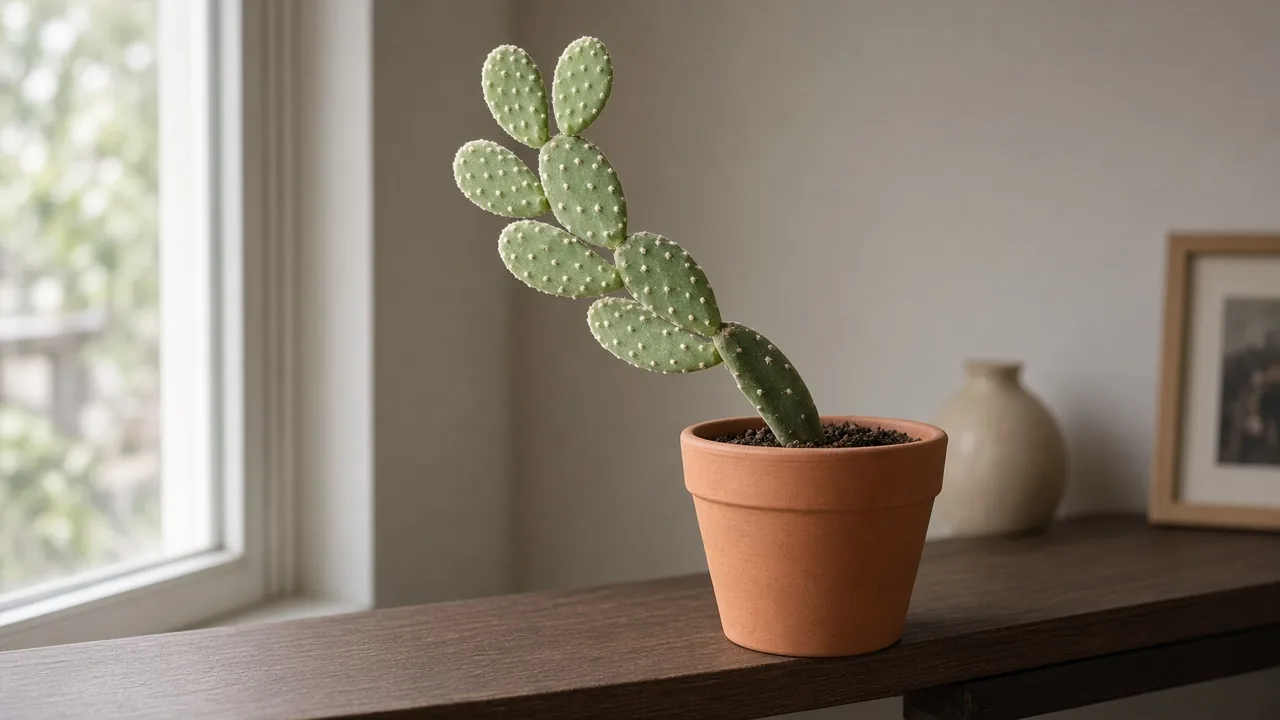
Not Enough Light on Bunny Ear Cactus: Causes, Checks & Fixes
This guide covers not enough light on Bunny Ear Cactus. See also the general Not Enough Light guide, watering, and light pages for this plant.
Not Enough Light on Bunny Ear Cactus: Causes, Checks & Fixes
Quick answer
Opuntia microdasys is a pad-forming desert cactus, not a low-light foliage plant that merely survives a bookshelf. When photons fall short, paired bunny-ear pads lean toward the brightest gap, stretch between new pad joints, and push thin, pale new tissue while older pads still look green enough to hide the problem.
For how chronic low light limits growth in general, see our not enough light hub. On bunny ear cactus, the decisive check is direct sun hours on the pad tops—not whether the room feels bright to your eyes.
First step: move the pot within 12 inches (30 cm) of your brightest south- or west-facing window and confirm direct sunbeams touch the pad surfaces for at least four hours on clear days (or add a close grow light—details below). Do not repot, propagate, or fertilize until you have fixed placement.
When to use this page vs other Bunny Ear Cactus guides
This page is the symptom-first entry for shade-stressed bunny ears—leaning pads, washed-out new growth, and weak pad flushes without pest webbing or base rot.
| Pattern | Read next |
|---|---|
| Extreme bare stem with tiny pads far apart | Leggy growth |
| Growth stalled but pads still compact | Slow growth |
| Lower pads yellow while tips stay green | Yellow leaves |
| Soft pads at soil line after dim-corner watering | Overwatering or root rot |
| Bleached white patches after a sudden move to hot glass | Sunburn |
| Long-term placement and acclimation | Light guide |
| Full problem index | All bunny ear cactus problems |
What not enough light looks like on Bunny Ear Cactus
Healthy bunny ear cactus in strong light builds short gaps between paired pads, firm oval segments, and dense glochid tufts that read as even “polka dots.” Shade stress breaks that silhouette in ways specific to pad-forming Opuntia:
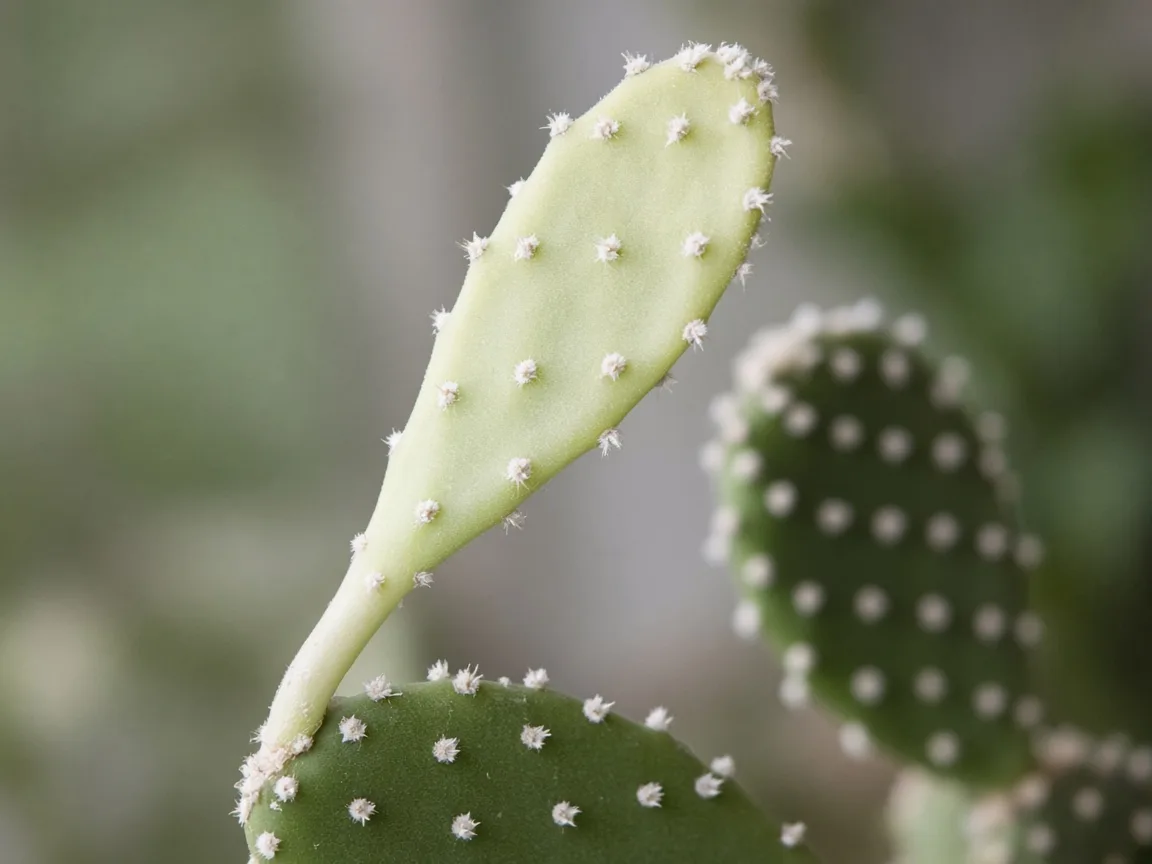
Etiolated pad flush: pale thin new segment with long weak joint—compare with tighter paired pads lower on the same plant.
- Directional lean — the whole pot or the newest pad pair angles toward one window gap, skylight, or hallway opening
- Long weak joints between pad pairs — visible length of thin stem between oval pads that used to sit almost stacked
- Thin, pale new pads — fresh segments feel less firm and look yellow-green rather than rich green
- Sparse or dull glochid tufts — new pads may show fewer obvious glochid clusters until light improves
- Top-heavy wobble — stretched pads gain height without the girth to stay upright in a light plastic pot
- Slow dry-down — mix stays cool and damp longer than it did when the plant lived in direct sun
This differs from leggy growth when stretch is extreme and structural, from slow growth when pads stay compact but new pairs are rare, and from overwatering when pads soften at the base even though you moved the plant recently.
Why Bunny Ear Cactus gets not enough light
Bunny ear cactus evolved in dry, open Mexican scrub where bright light is the default. Related prickly pears in extension references prefer full sun and well-drained, dry, sandy soils—indoor specimens need the brightest spot you can offer, not the “bright indirect” default many tropicals accept.
Pad-cactus-specific triggers:
- Room brightness vs pad brightness — a living room that feels adequate may deliver only soft ambient light at the top pads while lower segments sit in shade. Light intensity drops sharply with distance from glass.
- North windows and interior tables — pots more than a few feet from south or west glass rarely get enough direct sun for compact pad pairs. The plant survives on stored pad water longer than a fern would, which delays obvious collapse.
- Seasonal shade creep — a winter sun path that was strong becomes partially blocked once outdoor trees leaf out, producing mid-season pale flushes and lean.
- Retail-to-dim-shelf shock — nursery stock grown under high light looks compact; stretch often appears two to six weeks after a move to a desk or bathroom shelf.
- Competing sheers, tint, or furniture — objects that block the window strip where the tallest pad reaches.
- Misreading “survival” as “enough light” — green pads can persist for months while slowly etiolating toward the window.
Editorial care guides for O. microdasys consistently place it in bright, direct sunlight near a south-facing window with roughly six or more hours of sun daily—a bar most interior spots without direct beams fail to meet.
Pad-pair lean audit (glochid-safe)
Bunny ear cactus branches by stacking paired oval pads. Low light rarely hits every pad equally, so inspect each pad chain separately—a diagnostic step that does not apply to rosette echeverias or single-stem euphorbs.
- Stand behind the pot and sight along the pad chain toward the window. The segment leaning farthest is your light compass.
- Compare joint length within the same chain—newest pad pair vs growth from last year. Widening gaps confirm etiolation, not normal seasonal rest.
- Check whether only the top pad pair stretches while lower pairs stay compact. That pattern means the upper canopy outgrew the light pool, not that the whole plant is diseased.
- Rotate the pot 90° and watch for correction over two weeks. Pads that keep bending back to the same compass point confirm directional shade.
- Note pot weight when dry. A dim plant uses water slowly; a heavy pot plus stretch often means you are watering for sun that is not there—cross-check watering guidance.
Use tongs or folded paper when handling pads during the audit. NC State notes Opuntia species carry glochids that detach easily and irritate skin—never grip etiolated pads with bare fingers to “straighten” them.
How dim light tightens the overwatering trap
Light is the throttle for water use on pad cacti. A bright bunny ear photosynthesizes actively, dries its mineral mix on a predictable rhythm, and stays firm. A shaded plant grows slowly, holds moisture longer in the root zone, and is more vulnerable to rot if you keep watering on a “sunny windowsill” schedule.
That coupling is especially dangerous on Opuntia: the top pad may look slightly wrinkled while the base sits in wet mix. If you see stretch and the pot stays heavy for weeks after a soak, fix placement first, then lengthen dry intervals per the watering guide—not the reverse.
How to confirm the cause
Work through these checks in order:
- Sun-hour log at pad height — on three clear days, note when direct rays first hit the top pads and when shade takes them. Under four hours strongly points to light stress for indoor bunny ears; the light guide covers window placement details.
- Joint spacing comparison — measure distance between the last three pad pairs on the fastest-growing chain. Increasing spacing versus last season confirms etiolation.
- Lean direction — walk the sight line the plant points toward; identify the blocker (building, tree, curtain, taller furniture).
- Base firmness — press the lowest pad above soil with a tool, not a finger. Firm green pads with stretch above point to light; soft blackening at the soil line points to overwatering and needs a different first fix.
- Grow-light honesty — if you already run a fixture, confirm it sits close enough that pads do not keep leaning and runs long enough each day that new pairs stay compact.
- Dry-down test — a skewer to the pot bottom should come out dry before the next soak; chronic dampness plus lean often means low light, not thirst.
If direct sun at pad height is adequate and pads still stay pale with no stretch, move to pest checks or nutrition—not more shade.
First fix for Bunny Ear Cactus
Move the pot to the brightest available window—within 12 inches (30 cm) of unobstructed south or west glass—and verify direct sun hits the pad tops for at least four hours on clear days.
Practical steps:
- Choose south, then west, then east exposure in the Northern Hemisphere. North glass rarely suffices without supplementation.
- Clear competing objects from the light path at the height of the tallest pad, not the windowsill floor.
- Rotate the pot a quarter turn weekly once new growth begins to straighten—prevents one-sided stretch.
- If no window delivers enough direct sun, add a full-spectrum LED grow light close enough that pads do not keep leaning; run it 12–14 hours daily through dim seasons.
- Acclimate gradually if the plant lived in deep shade: increase exposure over two to three weeks to avoid sun scald on pads moved suddenly to hot south glass. Patch Plants notes that pads pressed against hot glass can scorch—give a small air gap rather than deep shade as the default fix.
Hold repotting, propagation, and fertilizer until you see tighter new pad pairs. Moving a stressed cactus and feeding in the same week makes it harder to read which change helped.
Step-by-step recovery after better light
Once placement is corrected:
- Week 1–2 — Lean may persist; focus on stopping further stretch. Let the mix dry fully between soaks per soil and watering norms.
- Week 3–6 — New pad pairs should sit closer together and feel firmer. Glochid tufts on fresh pads should look normal.
- Month 2–3 — Lower etiolated joints will not refill; optional pruning can remove a weak top pad for balance once growth is clearly compact—use tongs and expect glochids.
- Ongoing — Re-check sun path each spring; stake or weight the pot if height outpaces the new firm base.
Recovery timeline
| Stage | What you should see | If it does not happen |
|---|---|---|
| 2–3 weeks | Lean stops worsening; newest pad pair slightly tighter | Re-measure sun hours; fixture may be too far or blocked |
| 4–6 weeks | Firmer new pads; normal spacing on fresh flush | Rule out chronic overwatering at a soft base |
| 2–3 months | Visible firmness on new pads; better stability | Consider whether pot is too large for root mass |
| 6+ months | Optional reshape via pruning; old etiolated length remains unless removed | Persistent pale tips with good sun may need a pest check |
Old stretched pad tissue does not shorten. Recovery means better architecture on new growth, not a time machine for thin pale joints.
Lookalike symptoms
| What you see | Likely cause | Where to go |
|---|---|---|
| Long thin joints, tiny new pads | Severe chronic shade / etiolation | This page + leggy growth |
| Compact pads, almost no new pairs | Winter rest or chronic shade | Slow growth |
| Yellow lower pads, green tips | Often watering rhythm, not shade alone | Yellow leaves |
| Soft pads, heavy wet pot | Root stress from too much water in low light | Overwatering |
| Crispy bleached patches after a move | Sun scald from too-fast acclimation | Sunburn + light guide |
Mistakes to avoid
- Watering more because a pad looks slightly wrinkled in a dim corner — stretch plus wet mix invites base rot on Opuntia.
- Fertilizing to force pad size — fix light first; feeding a shaded cactus often produces soft etiolated growth.
- Removing the top pad before improving light — new pads will stretch again toward the same gap.
- Assuming survival equals health — firm green lower pads can mask months of slow etiolation.
- Handling pads with bare hands to rotate or prune — glochids are the main injury risk during recovery work.
How to prevent it next time
- Site new purchases within a foot of the brightest glass from day one; acclimate to direct sun over two to three weeks per the overview.
- Rotate weekly and re-measure sun after moving furniture or when outdoor trees leaf out.
- Use grow lights in north rooms or offices before stretch becomes structural.
- Match watering to actual light—dim winter corners need longer dry intervals even if heating runs.
- Keep pads from resting against hot window glass once light is adequate—air gap prevents scorch without returning to deep shade.
Related Bunny Ear Cactus guides
- Light requirements — window choice, direct sun acclimation, and grow-light setup after you confirm shade stress
- Watering — soak-and-dry timing once photosynthesis rate matches your placement
- Soil — mineral mix that dries fast enough for a bright pad cactus
- Pruning — remove etiolated top pads safely after light is fixed (glochid precautions)
- Problems hub — full cluster when symptoms overlap
Related tool
Use the Plant Problem Diagnosis Tool to separate light stress from watering and pest patterns before you change multiple variables at once.