Calathea Musaica Care: Mosaic Leaves, Humidity & Water
Goeppertia kegeljanii
Network calathea care: partial shade, 60%+ humidity, filtered or rainwater, evenly moist well-draining soil, and division at repotting. Pet safe.
Calathea Musaica Care: Mosaic Leaves, Humidity & Water
Start with wateringThe most common care mistake for Calathea MusaicaWatering guide →Calathea Musaica care essentials
Light
Water
Every 5–7 days spring and summer (top 2 cm beginning to dry). 7–10 days winter. Rainwater, distilled, or filtered water preferred.
Soil
Well-draining but moisture-retentive mix. pH 6.0–7.5. Peat or coco coir base with perlite.
Humidity
Temperature
Fertilizer
Fertilize lightly every 4–6 weeks in active growth with balanced liquid at quarter to half strength.
About Calathea Musaica
Calathea Musaica has a upright growth habit. It is also known as Network Calathea, Mosaic Calathea, and Calathea Network.
| Detail | Information |
|---|---|
| Also known as | Network Calathea, Mosaic Calathea, Calathea Network |
| Growth habit | Upright |
| Scientific name | Goeppertia kegeljanii |
Calathea Musaica Care: Mosaic Leaves, Humidity & Water
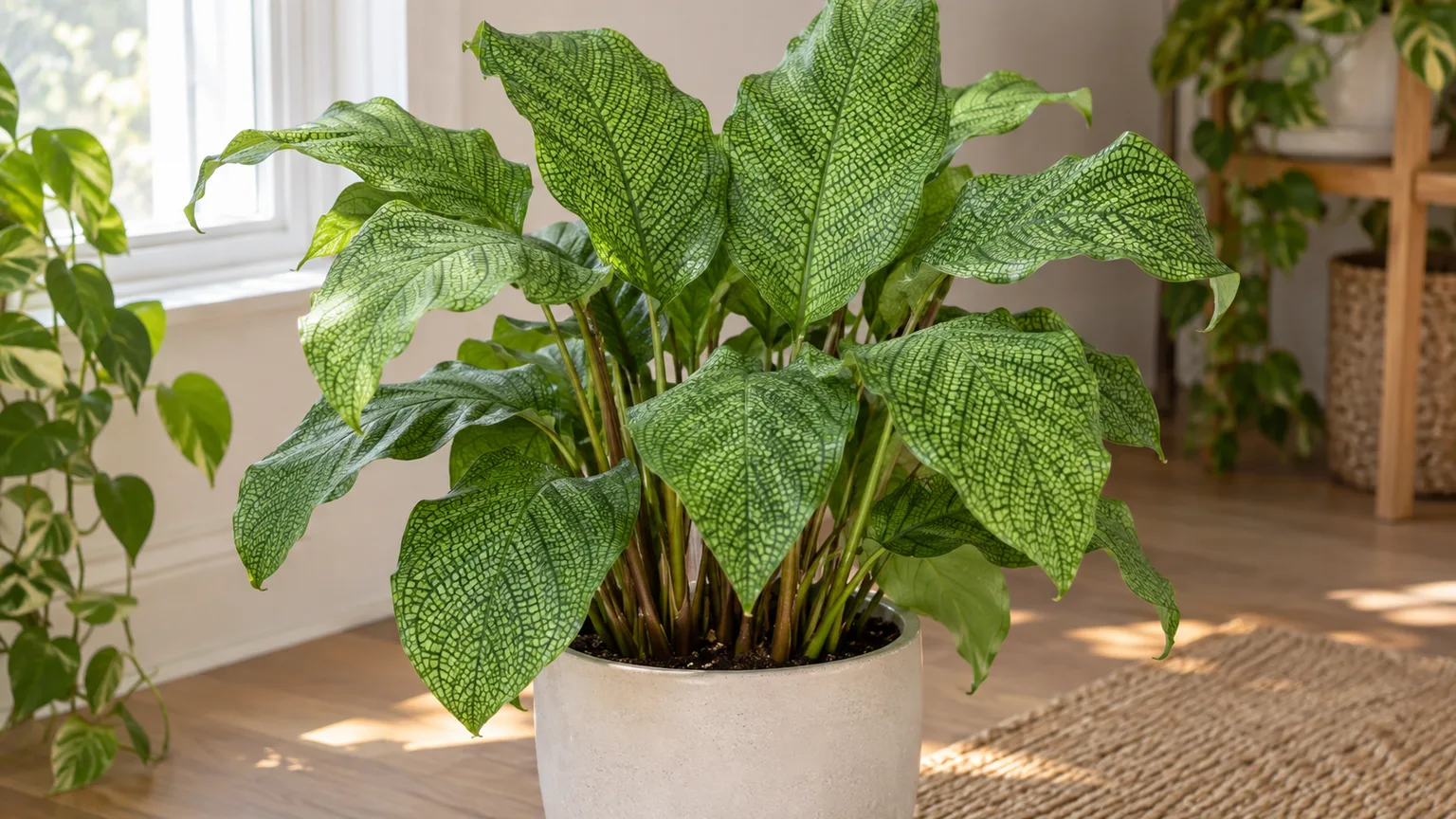
Calathea Musaica — sold widely as the Network plant or Mosaic Calathea — is one of the most recognizable prayer plants in the trade: small, heart-shaped leaves covered in a fine green fishnet grid that looks painted on. Botanically it is Goeppertia kegeljanii, a tropical rhizomatous perennial in the Marantaceae family native to Brazilian rainforest understory. That habitat matters. Musaica did not evolve for dry living rooms, hard tap water, or a windowsill that catches afternoon sun. It evolved for warm, humid, filtered light where new leaves can unfurl without tearing — and every care decision on this page flows from that biology.
This overview covers identity, size, light, water, soil, humidity, feeding, repotting, propagation, pet safety, and the mistakes that show up first on the mosaic pattern. For deep dives on individual topics, use the sibling guides linked at the end.
What Is Calathea Musaica?
Retail tags may read Calathea musaica, Calathea Network, or Network Prayer Plant, but the current accepted name is Goeppertia kegeljanii. NC State Extension lists former names including Calathea musaica, Calathea bella, and Maranta musaica — useful when cross-referencing older articles or forum posts. The plant grows as an upright, clumping evergreen from a rhizomatous root system, producing leaves on upright stalks rather than trailing stems.
Unlike calatheas grown mainly for bold stripes or peacock eyes, Musaica is prized for density and intricacy: a compact pot reads as a living mosaic tile. Flowers are small and insignificant indoors; the foliage is the entire point. The Royal Horticultural Society groups Goeppertia kegeljanii Network among calatheas with intricately patterned leaves, alongside peacock plant (G. makoyana), rattlesnake plant (G. insignis), and orbifolia (G. orbifolia).
The Mosaic Leaf Pattern That Defines This Species
Musaica leaves are thick, waxy, and glossy with wavy margins and a cordate (heart-shaped) outline, per NC State Extension. The upper surface is light green veiled by a lattice of fine dark green lines — the “network” or “fishnet” pattern. Because the markings are so fine, damage shows on every unfurl: brown halos, pale mineral spots, or torn edges on a new leaf are immediately visible in a way they are not on larger, solid-patterned relatives.
That sensitivity is the practical difference between Musaica and a more forgiving rattlesnake or zebra calathea. A stable environment during leaf opening matters as much as weekly watering. If humidity crashes while a spear is expanding, you get stuck or ripped new growth long before older leaves look obviously stressed.
Goeppertia kegeljanii and the Calathea Name Change
If you have researched prayer plants lately, you have seen both Calathea and Goeppertia on the same pot. A 2012 molecular phylogeny in Systematic Botany split the old broad Calathea genus, placing most popular houseplant species — including Musaica — into Goeppertia. Nurseries, the ASPCA, and most care labels still say Calathea because that is what buyers search for.
For growers, three facts are enough. Care does not change when the genus name changes. Search both names when troubleshooting. Musaica’s current botanical name is Goeppertia kegeljanii, with the trade cultivar Network (‘Pp0005’PBR) widely sold under the calathea label on RHS plant profiles.
How Musaica Differs From Other Prayer Plants
Maranta leuconeura, the classic trailing prayer plant, roots easily from stem cuttings and tolerates slightly more watering forgiveness than most Goeppertia types. Calathea Musaica is an upright clumper propagated almost exclusively by division, with smaller, thicker leaves and a finer pattern than pinstripe (G. ornata) or peacock (G. makoyana) calatheas. Compared to orbifolia, Musaica stays more compact — typically 1 to 2 feet tall and wide indoors rather than pushing dinner-plate leaves.
The genus-wide calathea reputation for fussiness applies, but Musaica has a specific weak point: dry air during unfurl. Pinstripe calatheas often brown at old leaf edges from tap water while new growth still opens clean. On Musaica, water quality and humidity failures land on the newest mosaic first, which makes problems feel sudden even when roots are only mildly stressed.
Growth Habit and Mature Size Indoors
NC State Extension describes the network prayer plant as erect and clumping with a rapid growth rate under good conditions. Expect 12 to 24 inches (30 to 60 cm) in height and spread in a typical indoor pot — a manageable size for shelves, plant stands, and grouped tropical displays. The RHS Network profile lists mature dimensions of 0.5 to 1 metre over 5 to 10 years, which is the long-term ceiling in ideal conservatory conditions; most homes see a slower, smaller ceiling.
New leaves emerge rolled and expand over several days. Judge plant health by the newest fully opened leaf, not by cosmetic damage on older blades that cannot heal. A Musaica pushing regular clean mosaics on short petioles is stable even if lower leaves carry old edge burn from a previous winter.
Light Requirements
Musaica wants partial shade — horticultural code for bright indirect or filtered light, not a dark corner and not direct sunbeams. NC State lists light as partial shade (direct sunlight only part of the day, 2 to 6 hours). The RHS calathea growing guide recommends a bright spot out of direct sunlight: near a north- or east-facing window in summer, moving closer to a south-facing sill in lower winter light.
Direct sun bleaches the grid pattern and scorches the waxy leaf surface. Deep shade shrinks new leaves, dulls contrast, and keeps soil wet longer — a common trigger for yellowing and root stress. Place the pot where you can read by daylight without a lamp, but where midday sun does not paint a sharp shadow on the leaves. For window specifics, grow-light distance, and warning signs, see the Calathea Musaica light guide.
Watering and Water Quality
Calathea Musaica needs even moisture without soggy stagnation. A practical trigger: water when the top 2 cm (about an inch) of mix is beginning to dry and the pot feels lighter — often every 5 to 7 days in spring and summer and every 7 to 10 days or longer in winter for a plant in appropriate light. The RHS advises keeping compost evenly moist during the growing season and allowing the surface to dry before rewetting in autumn and winter without letting the mix dry out completely.
Water quality is not optional on Musaica. NC State notes that fluoride in tap water can cause brown leaf edges and recommends distilled water or rainwater. Mineral-heavy tap water leaves pale halos on the mosaic pattern — often the first sign something is wrong while soil moisture still looks acceptable. Rainwater, filtered water, or tap water left overnight (helps chlorine but not fluoride) are safer long-term choices. Always empty the saucer after watering so roots never stand in runoff.
Full soak-and-drain technique, seasonal adjustment, and over/underwatering diagnostics live in the Calathea Musaica watering guide.
Soil Mix and Pot Drainage
Musaica roots need a moist but well-drained medium with good aeration. NC State recommends incorporating perlite or vermiculite into potting mix for drainage, with acidic to neutral pH. The RHS suggests free-draining, moisture-retentive peat-free compost — either a houseplant blend or multi-purpose compost with about ten percent potting grit by volume.
A reliable home recipe:
- 3 parts coco coir or peat-based potting mix
- 1 part perlite
- 1 part orchid bark or coarse charcoal (optional but helpful)
Every pot needs a drainage hole. Oversized pots hold excess wet mix the root ball cannot use quickly — a frequent reason Musaica yellows despite “careful” watering. Upsize only one pot size at repotting. Mix recipes, pH notes, and wrong-soil warning signs are covered in the Calathea Musaica soil guide.
Humidity and Temperature for Stable Unfurling
Prayer plants are humidity-sensitive; Musaica is especially so during leaf unfurl. NC State recommends at least 60% relative humidity and temperatures between 60 and 80°F (16 to 27°C), with no sudden drafts or temperature swings. The RHS places calatheas at 16 to 21°C (61 to 70°F) with high humidity, suggesting bathrooms, pebble trays (pot above water line), or grouping plants to share transpired moisture.
A practical indoor target for Musaica is at least 60% RH with stable levels — spikes from misting followed by dry heating-air crashes are worse than a steady baseline from a small humidifier. Misting alone wets leaf surfaces briefly without raising room humidity enough to protect an expanding spear. Keep plants at least a foot back from cold winter glass and away from HVAC blasts that desiccate leaf margins overnight.
Fertilizing During Active Growth
Musaica is not a heavy feeder. NC State recommends monthly balanced houseplant fertilizer during the growing season. The RHS suggests a general-purpose liquid feed once a month from April to September, avoiding autumn and winter feeding. Use quarter to half label strength on already-moist soil — never on a drought-stressed or newly repotted plant.
Hold off feeding when growth has paused, roots are recovering, or soil stays wet too long from low light. Salt buildup shows as crispy tips on sensitive leaves; flush the pot with plain water before increasing fertilizer. Timing, NPK choices, and overdose signs are detailed in the Calathea Musaica fertilizer guide.
Repotting and Division Propagation
Repot Musaica every one to two years, or when roots circle drainage holes, mix compacts, or watering becomes unpredictable. The RHS recommends repotting every few years in spring or summer into a pot one to two sizes larger with fresh peat-free compost. Spring is the safest window for both repotting and division — the standard propagation method. Each division needs stems, leaves, and a portion of healthy rhizome.
Do not repot on day one after purchase or as a reflex to every brown tip. Most edge damage is environmental. Repot when the root-zone system — drainage, compaction, pot size — is clearly the limiter. Step-by-step repot and division workflows are in the Calathea Musaica repotting and propagation guides.
Nyctinasty: Night Folding vs. Stress Curl
Like other Marantaceae, Musaica folds leaves upward at night and lowers them by day — nyctinasty driven by light and temperature shifts at the leaf base. Many new owners panic at evening lift, assuming wilt. On a stable plant, predictable night folding with firm daytime reopening is normal.
Stress curl looks different: leaves rolled or drooping throughout the day, often with dry soil, cold exposure, or root problems. If movement stops entirely, check for 24-hour grow lights or very dim placement disrupting the rhythm. Restore a consistent day/night light cycle and read new mosaic leaves as the verdict after any change.
Common Mistakes on Calathea Musaica
Using tap water while blaming humidity. Pale halos and edge burn on new mosaics often trace to fluoride and minerals before low humidity is the main issue. Switch water first, then adjust humidity.
Misting instead of humidifying during unfurl. Surface mist does not protect an expanding spear the way a steady 60%+ RH does.
Overpotting after purchase. A huge decorative pot keeps the root zone wet and dulls the grid pattern within weeks.
Chasing brown old leaves with repotting, fertilizer, and relocation in one weekend. Change one variable, wait two weeks, read new growth.
Direct sun “to brighten the pattern.” Musaica bleaches and crisps faster than orbifolia under the same exposure because the leaf tissue is smaller and the pattern has no solid green buffer zone.
Pet Safety and Handling
The ASPCA lists Calathea species as non-toxic to dogs, cats, and horses, which makes Musaica a strong choice for pet-aware homes that still want bold foliage. NC State also classifies the network plant as non-toxic to pets and humans, while noting that sap can cause skin irritation — wear gloves when dividing rhizomes or handling cut tissue.
Non-toxic does not mean edible. Heavy chewers may still vomit from plant fiber. Keep pots out of routine nibbling paths and confirm with the current ASPCA database before placing any plant within pet reach.
Seasonal Care Overview
| Season | Light | Water | Humidity | Feed | Notes |
|---|---|---|---|---|---|
| Spring | Bright indirect; acclimate to stronger sun slowly | Resume 5–7 day checks on dry-down | Target 60%+; humidifier if heating ended | Start monthly quarter-strength feed | Best window for repotting and division |
| Summer | East or filtered bright window; avoid hot glass contact | Most frequent; heat dries pots faster | Maintain 60%+; watch AC dryness | Continue light feeding through August | Rotate pot for even mosaic development |
| Fall | Maximize remaining brightness | Gradually reduce frequency | Monitor dry heating start-up | Taper feed by late fall | Fewer interventions; watch unfurl on new growth |
| Winter | Supplement with grow light if dim | 7–10+ days; surface dry before rewet | Humidifier especially valuable | Pause unless actively growing in warm bright room | Protect from window chill; prioritize water quality |
Conclusion
Calathea Musaica rewards growers who treat it as a compact Brazilian understory plant with a fine mosaic pattern, not as a generic “calathea” that only needs weekly water. Botanically Goeppertia kegeljanii, it shares prayer-plant biology with pinstripe and peacock relatives — filtered light, even moisture, high humidity, rhizomatous division — but adds a sharper constraint: new leaves reveal every mistake on the grid.
Get bright indirect light, rainwater or filtered water, at least 60% stable humidity, and a well-aerated, moisture-retentive mix right, and Musaica becomes one of the most distinctive foliage plants you can grow indoors: small heart-shaped leaves that shift with the clock and hold a pattern like stained glass. Miss those basics and the same plant looks impossible within a month. The gap is almost always setup and consistency — especially during unfurl — not a mysterious black thumb.
When to use this page vs other Calathea Musaica guides
- Calathea Musaica overview — Canonical hub; start here for whole-plant context, then open topic guides below.
- Calathea Musaica watering — Moisture checks, water quality, seasonal rhythm, and soak technique when leaves curl or soil timing is unclear.
- Calathea Musaica light — Window placement, direct-sun limits, grow lights, and bleached-pattern diagnostics.
- Calathea Musaica soil — Mix recipes, drainage, pH, and repotting-linked soil refresh.
- Calathea Musaica propagation — Division timing, step-by-step, and aftercare for new divisions.
Related Calathea Musaica guides
How to care for Calathea Musaica?
When should you water Calathea Musaica?
Every 5–7 days spring and summer (top 2 cm beginning to dry). 7–10 days winter. Rainwater, distilled, or filtered water preferred.
- Check top 2 inches - Every 5–7 days spring and summer (top 2 cm beginning to dry).
- Drain excess water - Rainwater, distilled, or filtered water preferred.
What soil works best for Calathea Musaica?
Well-draining but moisture-retentive mix. pH 6.0–7.5. Peat or coco coir base with perlite.
- Well-draining mix - Well-draining but moisture-retentive mix.
Grower notes for Calathea Musaica
What makes Musaica different
Musaica — sold as Network or mosaic calathea — is Goeppertia kegeljanii, not a generic prayer-plant clone. Small heart-shaped leaves carry a painted fishnet grid; every new unfurl shows humidity and water-quality stress as pale halos or torn edges on the pattern itself. Compact 1–2 ft clumps from rhizomes, not a large striped calathea.
Musaica light and humidity note
Give partial shade or bright indirect light — NC State recommends filtered light, not direct sun that burns the mosaic. Run a humidifier for at least 60% RH; pebble trays help but rarely hold through unfurl. Keep 16–27°C (60–80°F) and away from heating vents. Dry air during unfurl is the main failure mode on this cultivar.
What matters most with Calathea Musaica
Stable humidity, low-mineral water, and check-before-you-water rhythm. Pair moist-but-draining peat-coco-perlite mix with partial shade. Change one variable at a time — do not repot, relocate, and feed in the same week.
Best placement in a real home
North- or east-facing windows, or filtered south/west light 1–2 m from glass. Bathrooms and kitchens work when humidity stays high and drafts are absent. Water when top 2 cm dries. Leaves should fold at night and reopen by morning.
Before you buy this plant
Choose firm new spears with crisp mosaic lines on the newest leaf, clean undersides, and evenly moist — not wet — mix. Avoid widespread brown network lines on fresh growth, collapsed crowns, or pots sitting in stale water. Pattern damage on old leaves is cosmetic; damage on the leading unfurl is a care warning.
Safety note for Calathea Musaica
Musaica is non-toxic to cats and dogs per ASPCA Calathea listings and NC State — one of the few intricate foliage plants that is fully pet-safe. Sap may irritate skin; wear gloves when dividing rhizomes. Chewing can still cause mild stomach upset from plant fiber.
Is it pet safe?
Calathea Musaica is generally considered pet safe per ASPCA Calathea listings.
Non-toxic to cats and dogs; sap may irritate skin when dividing rhizomes.
Watering Calathea Musaica
Every 5–7 days spring and summer (top 2 cm beginning to dry). 7–10 days winter. Rainwater, distilled, or filtered water preferred.
Soil & potting for Calathea Musaica
Well-draining but moisture-retentive mix. pH 6.0–7.5. Peat or coco coir base with perlite.
Humidity & temperature for Calathea Musaica
Fertilizer & pruning for Calathea Musaica
Use fertilize lightly every 4–6 weeks in active growth with balanced liquid at quarter to half strength. for Calathea Musaica.
| Detail | Information |
|---|---|
| Fertilizer type | Fertilize lightly every 4–6 weeks in active growth with balanced liquid at quarter to half strength. |
Common problems on Calathea Musaica
Yellow Leaves
MediumLikely cause: Common on this plant type; confirm with recent watering, light, and root checks.
Quick fix: Inspect the plant and correct the most likely care stressor before stacking treatments.
Full fix guide →Brown Tips
MediumLikely cause: Common on this plant type; confirm with recent watering, light, and root checks.
Quick fix: Inspect the plant and correct the most likely care stressor before stacking treatments.
Full fix guide →Root Rot
MediumLikely cause: Common on this plant type; confirm with recent watering, light, and root checks.
Quick fix: Inspect the plant and correct the most likely care stressor before stacking treatments.
Full fix guide →Overwatering
MediumLikely cause: Common on this plant type; confirm with recent watering, light, and root checks.
Quick fix: Inspect the plant and correct the most likely care stressor before stacking treatments.
Full fix guide →Underwatering
MediumLikely cause: Common on this plant type; confirm with recent watering, light, and root checks.
Quick fix: Inspect the plant and correct the most likely care stressor before stacking treatments.
Full fix guide →Spider Mites
MediumLikely cause: Common on this plant type; confirm with recent watering, light, and root checks.
Quick fix: Inspect the plant and correct the most likely care stressor before stacking treatments.
Full fix guide →Mealybugs
MediumLikely cause: Common on this plant type; confirm with recent watering, light, and root checks.
Quick fix: Inspect the plant and correct the most likely care stressor before stacking treatments.
Full fix guide →Aphids
MediumLikely cause: Common on this plant type; confirm with recent watering, light, and root checks.
Quick fix: Inspect the plant and correct the most likely care stressor before stacking treatments.
Full fix guide →Leggy Growth
MediumLikely cause: Common on this plant type; confirm with recent watering, light, and root checks.
Quick fix: Inspect the plant and correct the most likely care stressor before stacking treatments.
Full fix guide →Slow Growth
MediumLikely cause: Common on this plant type; confirm with recent watering, light, and root checks.
Quick fix: Inspect the plant and correct the most likely care stressor before stacking treatments.
Full fix guide →Wilting
MediumLikely cause: Common on this plant type; confirm with recent watering, light, and root checks.
Quick fix: Inspect the plant and correct the most likely care stressor before stacking treatments.
Full fix guide →Drooping Leaves
MediumLikely cause: Common on this plant type; confirm with recent watering, light, and root checks.
Quick fix: Inspect the plant and correct the most likely care stressor before stacking treatments.
Full fix guide →Low Humidity
MediumLikely cause: Common on this plant type; confirm with recent watering, light, and root checks.
Quick fix: Inspect the plant and correct the most likely care stressor before stacking treatments.
Full fix guide →Not Enough Light
MediumLikely cause: Common on this plant type; confirm with recent watering, light, and root checks.
Quick fix: Inspect the plant and correct the most likely care stressor before stacking treatments.
Full fix guide →Fungus Gnats
MediumLikely cause: Common on this plant type; confirm with recent watering, light, and root checks.
Quick fix: Inspect the plant and correct the most likely care stressor before stacking treatments.
Full fix guide →Mold on Soil
MediumLikely cause: Common on this plant type; confirm with recent watering, light, and root checks.
Quick fix: Inspect the plant and correct the most likely care stressor before stacking treatments.
Full fix guide →