Chinese Fan Palm Care: Light, Water, Size, and Cold
Livistona chinensis
Give Chinese Fan Palm full sun to light shade outdoors or bright light under glass, use moist but well-drained soil, and water a container when the surface begins to dry. It can reach about 30 ft outdoors and has an established landscape cold-hardiness reference near 20°F; pet safety remains unverified.
Chinese Fan Palm Care Guide
Start with wateringThe most common care mistake for Chinese Fan PalmWatering guide →Chinese Fan Palm care essentials
Light
Outdoors, grow in full sun or light shade. In a container under glass, provide full or bright indirect light; a bright sunroom or patio suits its eventual size.
Water
Keep the root zone moist but well drained while a new planting establishes. In a container, water thoroughly when the surface begins to dry, let excess drain, and water more sparingly in winter. Established landscape palms tolerate some drought.
Soil
Use moist but well-drained soil. For containers, a peat-free, loam-based potting compost provides a suitable starting point; amend a mix that stays wet with a coarse, free-draining component.
Humidity
No precise humidity target was verified for this species; keep container plants in a stable, bright room away from hot, dry drafts.
Temperature
Warm subtropical conditions support growth; in cooler climates the RHS recommends growing under glass or summering a container outdoors.
Fertilizer
Apply balanced liquid fertilizer about once a month during the growing period, as recommended by the RHS; reduce or stop feeding in winter.. Balanced liquid fertilizer at the product label rate.
About Chinese Fan Palm
Chinese Fan Palm is native to Southern China to Vietnam and temperate East Asia., typically reaches A slow-growing landscape specimen can reach about 9 m (30 ft) tall with a 3–4 m (10–12 ft) spread; container plants stay smaller for many years but need room for their arching fronds. indoors, with slow; young palms take time to form a trunk, and mature landscape size develops over decades. growth. Chinese Fan Palm has a palm like growth habit and part of the Arecaceae family. It is also known as Chinese Fountain Palm and Fountain Palm.
| Detail | Information |
|---|---|
| Also known as | Chinese Fountain Palm, Fountain Palm |
| Native region | Southern China to Vietnam and temperate East Asia. |
| Mature size | A slow-growing landscape specimen can reach about 9 m (30 ft) tall with a 3–4 m (10–12 ft) spread; container plants stay smaller for many years but need room for their arching fronds. |
| Growth rate | Slow; young palms take time to form a trunk, and mature landscape size develops over decades. |
| Growth habit | Palm Like |
| Scientific name | Livistona chinensis |
| Family | Arecaceae |
How to care for Chinese Fan Palm?
How much light does Chinese Fan Palm need?
Outdoors, grow in full sun or light shade. In a container under glass, provide full or bright indirect light; a bright sunroom or patio suits its eventual size.. Full sun outdoors once established. Light or partial shade outdoors. Bright indirect light under glass. direct sun
- Outdoors - Outdoors, grow in full sun or light shade.
- grow in full sun or light shade. In a container under glass - In a container under glass, provide full or bright indirect light; a bright sunroom or patio suits its eventual size..
- provide full or bright indirect light - In a container under glass, provide full or bright indirect light; a bright sunroom or patio suits its eventual size..
- a bright sunroom or patio suits its eventual size - In a container under glass, provide full or bright indirect light; a bright sunroom or patio suits its eventual size..
- Full sun outdoors once established - Full sun outdoors once established.
- Light or partial shade outdoors - Light or partial shade outdoors.
- Bright indirect light under glass - Bright indirect light under glass.
- direct sun - direct sun.
When should you water Chinese Fan Palm?
Keep the root zone moist but well drained while a new planting establishes. In a container, water thoroughly when the surface begins to dry, let excess drain, and water more sparingly in winter. Established landscape palms tolerate some drought.
- Check the surface layer of potting mix. When it begins to dry - In a container, water thoroughly when the surface begins to dry, let excess drain, and water more sparingly in winter.
- water through the pot and empty any standing water from its saucer - In a container, water thoroughly when the surface begins to dry, let excess drain, and water more sparingly in winter.
- Drain excess water - In a container, water thoroughly when the surface begins to dry, let excess drain, and water more sparingly in winter.
What soil works best for Chinese Fan Palm?
Use moist but well-drained soil. For containers, a peat-free, loam-based potting compost provides a suitable starting point; amend a mix that stays wet with a coarse, free-draining component.
- Peat-free, loam-based potting compost - For containers, a peat-free, loam-based potting compost provides a suitable starting point; amend a mix that stays wet with a coarse, free-draining component.
- Coarse sand, perlite, or fine bark if the mix needs better drainage - For containers, a peat-free, loam-based potting compost provides a suitable starting point; amend a mix that stays wet with a coarse, free-draining component.
How to propagate Chinese Fan Palm?
Sow fresh seed in containers in spring at about 23°C (73°F); seed propagation is slow.
- Seed - Sow fresh seed in containers in spring at about 23°C (73°F); seed propagation is slow.
Grower notes for Chinese Fan Palm
Identify the species before applying care advice
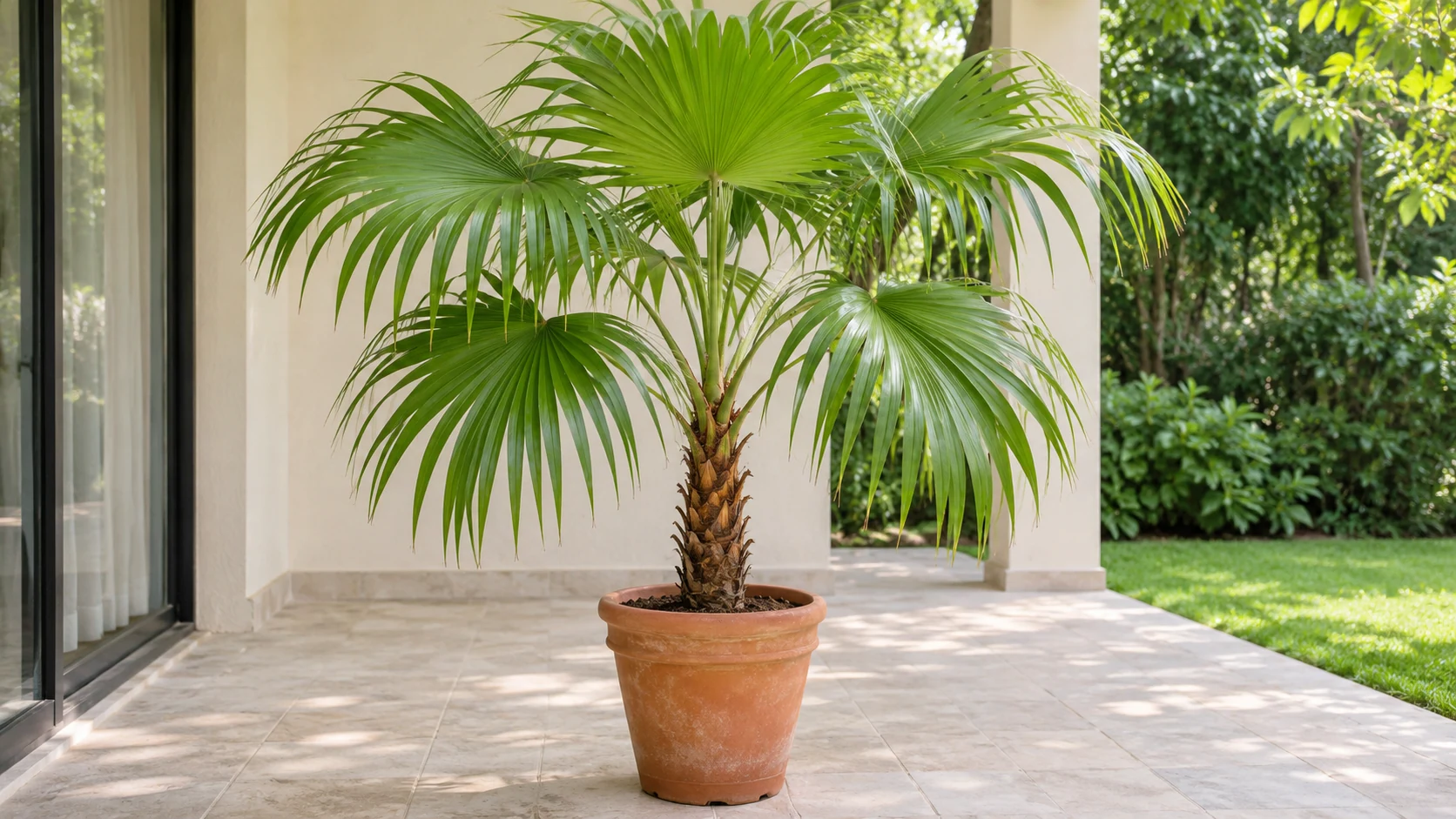
Chinese Fan Palm is Livistona chinensis. Its large, divided fan leaves have drooping outer tips that create a fountain-like outline. “Fan palm” is a broad common name used for different palms, and “Livistona Palm” can refer to the genus rather than this one species.
Use its real sun tolerance
UF/IFAS describes this species growing in full sun or light shade outdoors. For a container under glass, the RHS recommends full or bright indirect light. Acclimate a shade-grown pot gradually before placing it in stronger outdoor sun.
Water by the soil, not a calendar
Keep the mix moist but well drained while the palm establishes. In a pot, water through when the surface starts to dry, then let the excess drain; water more freely during active growth and less in winter. Established landscape palms tolerate some drought.
Leave room for the mature crown
A young Chinese Fan Palm may look compact, but a landscape specimen can eventually reach about 30 feet tall and spread 10–12 feet. Its slow growth gives you time to plan; it does not make the mature palm a small-space plant. Larger patio containers or a bright sunroom are better long-term settings.
Treat cold hardiness as a landscape limit
UF/IFAS lists established in-ground palms as cold hardy to about 20°F and suitable for USDA zones 9A–11. That figure is not a promise for a young plant, a container root ball, or every length of freeze. In colder climates, use a container that can be moved to a bright, frost-free place.
Handle pet safety carefully
The ASPCA listing retrieved for Chinese Fan Palm did not provide a toxic or non-toxic classification, so this profile does not call it pet-safe. Keep pets from chewing the leaves and take care with juvenile leaf stalks, which can be spiny.
Is Chinese Fan Palm safe for pets?
Species-specific pet toxicity was not verified in the ASPCA plant listing retrieved for Chinese Fan Palm, and the ASPCA notes its list is not exhaustive. Do not assume the plant is non-toxic; keep pets from chewing it and contact a veterinarian if a pet eats it or shows symptoms.
No species-specific toxic or non-toxic classification for Livistona chinensis was verified. The ASPCA cautions that its plant list is not all-inclusive and that eating plant material can cause gastrointestinal upset. Juvenile leaf stalks also have spines, so keep cut fronds and the plant itself away from pets that may chew or paw at it.
Watering Chinese Fan Palm
For Chinese Fan Palm, check the surface layer of potting mix. When it begins to dry, water through the pot and empty any standing water from its saucer. and water do not follow a fixed calendar. Check container soil as it dries, especially during warm active growth; reduce watering during cool, slow-growth periods. Water freely during active growth and more sparingly in winter. Outdoor rainfall and the palm's drought tolerance reduce the need for supplemental water once it is established.
| Detail | Information |
|---|---|
| How often | Do not follow a fixed calendar. Check container soil as it dries, especially during warm active growth; reduce watering during cool, slow-growth periods. |
| How to check | Check the surface layer of potting mix. When it begins to dry, water through the pot and empty any standing water from its saucer. |
| Seasonal changes | Water freely during active growth and more sparingly in winter. Outdoor rainfall and the palm's drought tolerance reduce the need for supplemental water once it is established. |
Signs of overwatering
- Potting mix staying saturated between waterings
- Water collecting in the saucer after drainage
Signs of underwatering
- Potting mix drying completely for extended periods
- Potting mix drying through the root zone
Soil & potting for Chinese Fan Palm
Use a mix of Peat-free, loam-based potting compost, Coarse sand, perlite, or fine bark if the mix needs better drainage for Chinese Fan Palm. Moisture-retentive but free draining; avoid leaving container roots in standing water. Target soil pH around No narrow species-specific pH target was verified; prioritize a loam-based medium that drains well. Repot repot when roots fill the container or emerge through its drainage holes; no fixed interval is needed for this slow-growing palm., ideally in spring or early active growth.
| Detail | Information |
|---|---|
| Recommended mix | Peat-free, loam-based potting compost, Coarse sand, perlite, or fine bark if the mix needs better drainage |
| Drainage | Moisture-retentive but free draining; avoid leaving container roots in standing water. |
| Soil pH | No narrow species-specific pH target was verified; prioritize a loam-based medium that drains well. |
| Repotting frequency | Repot when roots fill the container or emerge through its drainage holes; no fixed interval is needed for this slow-growing palm. |
| Best season to repot | Spring or early active growth. |
Signs it needs repotting
- Roots circling the root ball or emerging from drainage holes
- The container drying unusually quickly despite sound watering
- The palm becoming unstable as its crown grows
Humidity & temperature for Chinese Fan Palm
Chinese Fan Palm prefers no precise humidity target was verified for this species; keep container plants in a stable, bright room away from hot, dry drafts., though normal home humidity is usually fine. Keep temperatures around warm subtropical conditions support growth; in cooler climates the RHS recommends growing under glass or summering a container outdoors. Avoid letting Chinese Fan Palm sit below UF/IFAS lists established landscape Chinese Fan Palms as cold hardy to about 20°F (-7°C); young and container-grown palms should be protected from freezing. The roughly 20°F figure is a landscape hardiness reference, not a guarantee for every exposure or for a pot. UF/IFAS places outdoor use in USDA zones 9A–11; move container plants to a frost-free, bright space where freezes are expected.
| Detail | Information |
|---|---|
| Humidity | No precise humidity target was verified for this species; keep container plants in a stable, bright room away from hot, dry drafts. - normal home humidity is fine. |
| Ideal temperature | Warm subtropical conditions support growth; in cooler climates the RHS recommends growing under glass or summering a container outdoors. |
| Minimum temperature | UF/IFAS lists established landscape Chinese Fan Palms as cold hardy to about 20°F (-7°C); young and container-grown palms should be protected from freezing. |
| Temperature notes | The roughly 20°F figure is a landscape hardiness reference, not a guarantee for every exposure or for a pot. UF/IFAS places outdoor use in USDA zones 9A–11; move container plants to a frost-free, bright space where freezes are expected. |
Humidity tips
- Keep the crown away from heater and air-conditioner outlets
- Maintain airflow around the broad fronds
Fertilizer & pruning for Chinese Fan Palm
Feed Chinese Fan Palm apply balanced liquid fertilizer about once a month during the growing period, as recommended by the RHS; reduce or stop feeding in winter. using balanced liquid fertilizer at the product label rate. The best feeding window is spring and summer, while the palm is actively growing. Do not feed a dormant winter plant or use fertilizer to compensate for waterlogged soil or inadequate light.
| Detail | Information |
|---|---|
| Fertilizer schedule | Apply balanced liquid fertilizer about once a month during the growing period, as recommended by the RHS; reduce or stop feeding in winter. |
| Best season | Spring and summer, while the palm is actively growing. |
| Fertilizer type | Balanced liquid fertilizer at the product label rate. |
| What to avoid | Do not feed a dormant winter plant or use fertilizer to compensate for waterlogged soil or inadequate light. |
Pruning (optional)
Remove only completely dead fronds. Juvenile leaf stalks can have spines, so use care when handling or pruning them.