Lalese Stamps’s Plants and Ceramic Planter Style
See how Lalese Stamps pairs bold ceramics with bold houseplants, from a variegated rubber tree to a rescued bird of paradise—and what to copy at home.
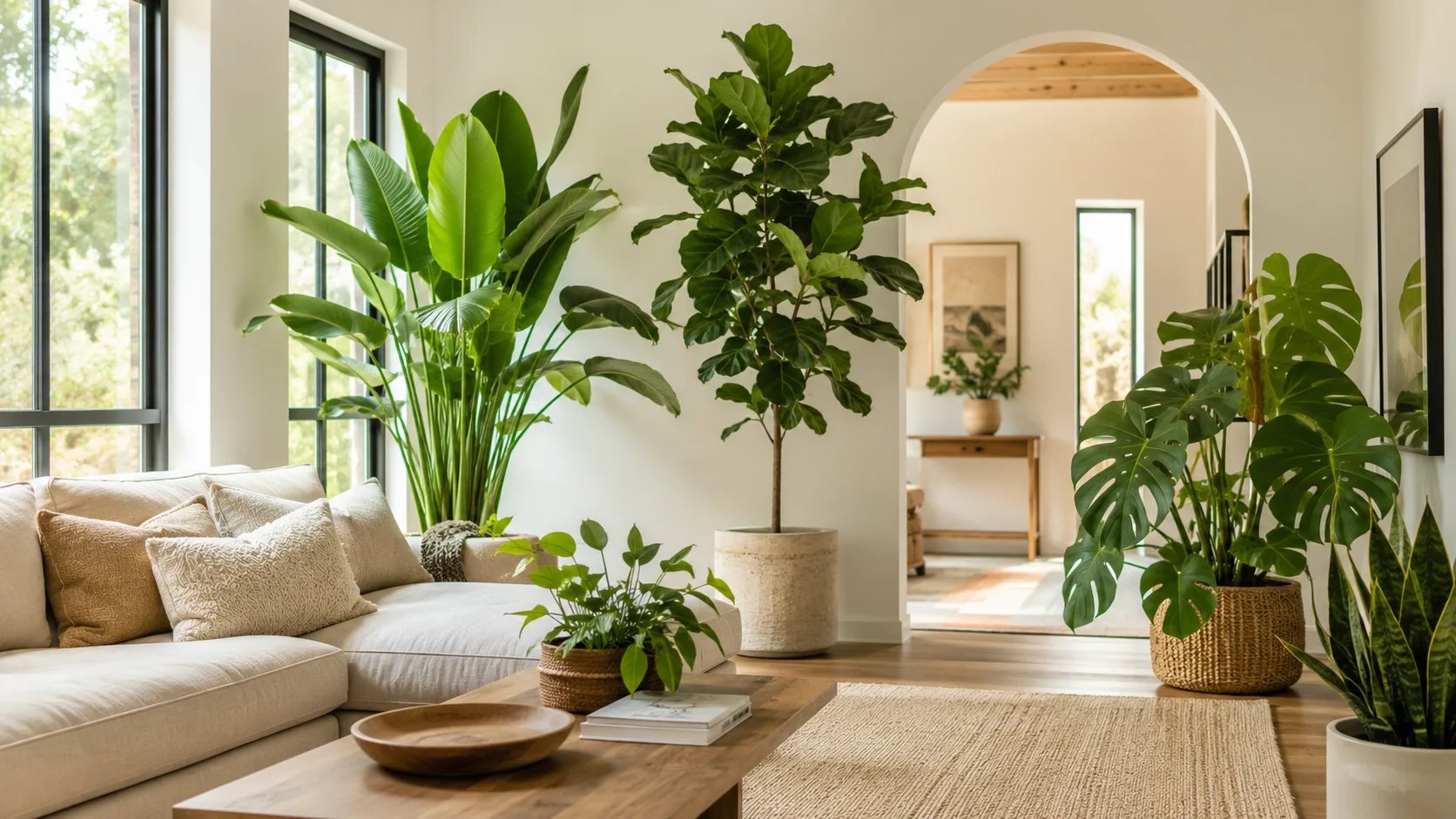
A ceramics studio filled with nearly 100 houseplants is more than a dramatic background. In Lalese Stamps’s world, the plants and the pots speak the same visual language: strong outlines, unusual shapes, bold scale, and enough personality to hold their own beside handmade objects.
The plant tour that inspired this story captures Stamps during her Columbus, Ohio period. It is not a current inventory of her home. Her official Lolly Lolly Ceramics biography now describes her as a New York designer whose work spans ceramics, furniture, lighting, and interiors. That change matters because it lets us read the older studio visit for what it is: a revealing snapshot of how a designer thinks about living things, objects, space, and care.
It also gives plant people something useful to take away. You do not need 100 plants or a pottery wheel to borrow the underlying method. Choose plants for their form, choose containers that support their roots, and build displays around the conditions you can actually maintain.
The earlier Columbus studio, and what changed
When the episode was filmed, Stamps’s Columbus studio held a collection of almost 100 large houseplants, many of them chosen because their shapes felt as assertive as her ceramics. The room was memorable not simply because it was full, but because the plants were treated as active design elements: leaves occupied vertical space, trailing stems created movement, and broad foliage gave the handmade vessels a living scale reference.
Independent profiles fill in the part of the story a quick plant tour cannot. In a 2020 interview with Colossal, Stamps described Columbus as a supportive creative community where connections helped her business grow. The same interview records that she had been working on Lolly Lolly since 2017 while also working as a graphic designer, and that the business expanded from a small side practice into a more structured studio.
Her current biography reflects a broader design practice than the episode’s ceramics-only frame suggests. Recent coverage from Home & Texture describes Stamps’s move into furniture and interior design, while the official studio page places ceramics, furniture, and lighting under the same design identity. The plants are therefore not a random hobby pasted onto a maker profile; they fit a larger interest in how objects occupy a room.
The 100-day project explains the design language
The clearest route into Stamps’s visual style is not a planter. It is the project that made her work widely visible: 100 mugs with different handles made over 100 days. Colossal’s original coverage describes the series as an experiment in wildly varied handles, while a later Livingetc profile recounts how Stamps drew inspiration from ordinary objects and reworked familiar curves into unexpected forms.
That process explains why a delicate, generic plant would not be the obvious partner for her work. A peperomia’s trailing line, an Epiphyllum’s long narrow growth, a rubber tree’s glossy leaves, or a bird of paradise’s architectural fan all give the eye something to investigate. The plant becomes another piece of form-making, but it remains alive and subject to light, water, roots, and time.
There is a useful lesson here for any collector. Instead of asking only whether a plant is trendy, ask what it contributes to the room: a vertical spear, a broad canopy, a dangling line, a patterned leaf, or a bright patch of variegation. Then choose a pot that gives that feature room to read.
Why bold plants make sense beside bold ceramics
Stamps’s collection favors what might be called visual weight. A plant with thick leaves, a branching silhouette, or a strong upward gesture can balance a bulbous or irregular vessel. A fragile, wispy plant can still be beautiful, but it may need a calmer pot or a simpler setting so both the plant and the vessel do not compete for attention.
This is not a rule that plants must match their pots. Contrast can be more interesting than coordination. The practical rule is to create a clear relationship: repeat a color, oppose a shape, echo a curve, or let one texture quiet another. A blue-toned pot can make variegated foliage look sharper; a matte vessel can keep glossy leaves from becoming visually noisy; a narrow, tall pot can emphasize an upright plant while making a trailing plant feel misplaced.
The display still has to function as a growing system. Penn State Extension’s repotting guidance recommends choosing a container only slightly larger than the current one and considering how its size, color, and material relate to the plant’s scale and texture. That is the point where styling becomes plant care: the best-looking pot is the one that fits the root ball, drains well, can be moved safely, and suits the plant’s light and watering rhythm.
The collection’s standout plants
The episode’s plant list is interesting because it is not a catalogue of identical collector specimens. Each plant demonstrates a different kind of visual behavior. Together they show why a large collection can feel designed even when each pot holds a different species.
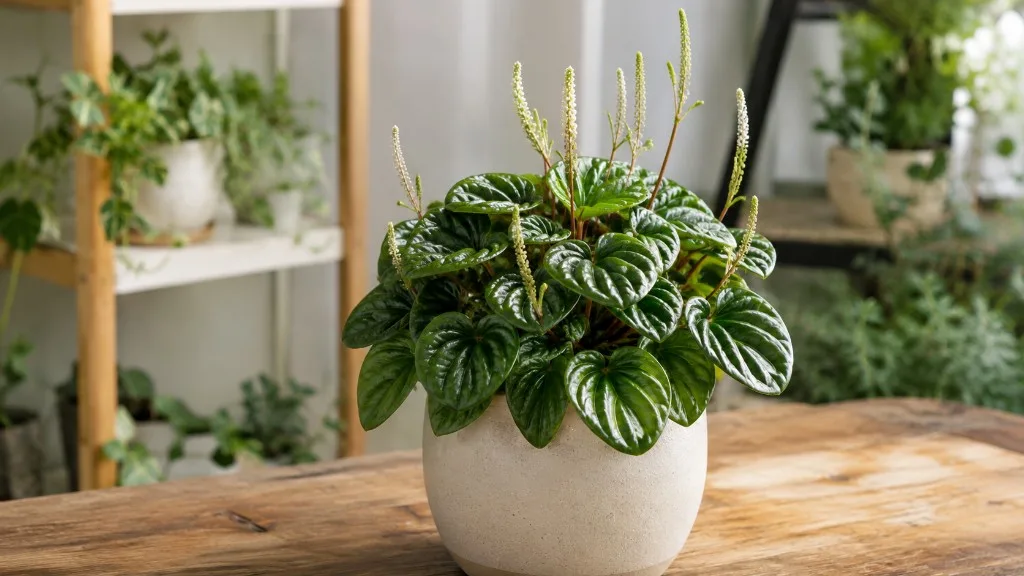
Variegated cupid peperomia
The variegated cupid peperomia supplies the kind of detail that rewards close viewing. Its heart-shaped leaves and trailing habit create a softer line than the massive foliage elsewhere in the studio, while the pale variegation gives a dark or saturated ceramic surface something bright to play against.
Peperomia is also a good example of why a pretty planter should not dictate a watering schedule. The Royal Horticultural Society’s peperomia guide recommends bright, indirect light, letting the top few centimetres of compost dry before watering, and caution around persistently damp conditions because root rot is a risk. A shallow decorative vessel that traps water can make this small plant look styled for a week and stressed for a month.
For a display, place a cupid peperomia where its stems can fall over the rim without being crushed by a neighboring pot. Use a drainage pot inside a ceramic cachepot if the handmade outer vessel has no hole. The plant’s scale makes it a good foreground or shelf-level accent, not a centerpiece that must carry the entire room.
Epiphyllum
The Epiphyllum stands out for its long, narrow growth. That shape has a different effect from a plant that fills space with a round canopy: it introduces a line that can travel across a shelf, drop from a ledge, or soften the edge of a heavy planter.
This is the kind of plant that benefits from being displayed with its growth habit in mind. Do not crowd its stems against a wall or wedge the pot between two large containers. Give the plant a clear edge to move toward, and let the container remain visually simple enough that the growth is the event.
The broader design principle is negative space. A collection of 100 plants does not need every inch filled. Leaving a gap around a trailing or unusually linear plant can make it feel more abundant, not less, because the eye can follow its path.
Variegated rubber tree
The variegated rubber tree is the long-term keeper in the story: a plant Stamps had carried from place to place and watched become large and strong. That history is part of what makes a mature plant valuable. It is not just a decorative object; it records moves, seasons, mistakes, and the care that kept it going.
The plant also earns its place visually. The RHS profile for Ficus elastica describes a large tropical evergreen with broad, glossy leaves and cultivars that can show red or bronze tones. Its growing guidance calls for bright but filtered or indirect light, moderate watering during growth, and a well-drained mix; it also recommends top-dressing annually and repotting every two to three years when needed.
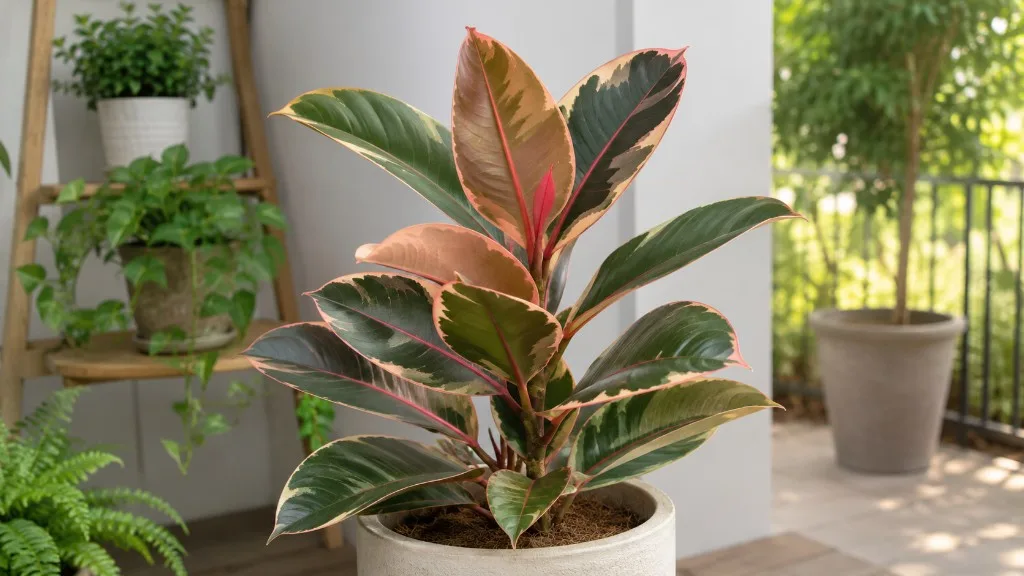
That combination makes a rubber plant a natural anchor for a ceramic display, but it creates a weight problem too. A wet, mature rubber plant in a heavy ceramic pot is difficult to lift and easy to tip if the base is too narrow. Put the plant in its permanent location before filling it, use a saucer that can handle runoff, and do not make a beautiful pot so heavy that routine care becomes a two-person job.
Dracaena palm
The dracaena palm in the episode works as both plant and metaphor. Its leaves emerge in different directions, giving it a branching, multi-tasking silhouette that Stamps associated with the many parts of running a small business.
For styling, dracaena provides height without the broad floor footprint of a rubber tree. It can sit behind shorter peperomias or beside a low, rounded pot to create contrast. Rotate it gradually rather than making dramatic changes to its position, and check the light at leaf height; the brightest point in a room may not be the brightest point where the plant actually sits.
The metaphor is worth keeping because it describes plant collecting honestly. A large collection is not one task repeated 100 times. It is a group of different responsibilities: light, watering, pruning, pest checks, repotting, cleaning, and moving. The collection becomes sustainable only when those jobs are organized by need instead of handled as one giant chore.
Bird of paradise
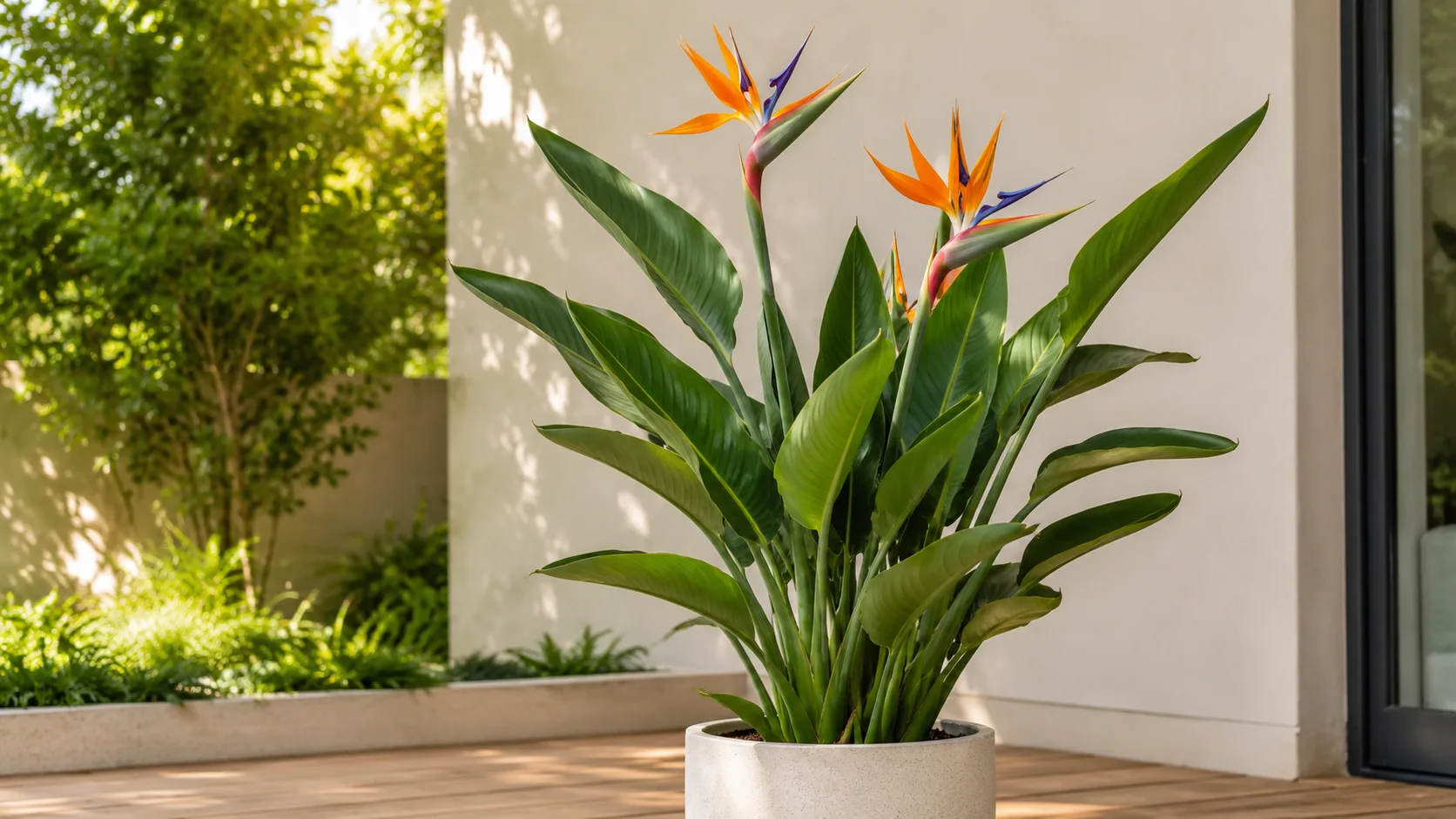
The bird of paradise is the story’s great scale gesture. Stamps drove a two-door car on a four-hour round trip to bring home a large specimen, an extreme example of the lengths a collector will go for a plant that changes the character of a room.
Its appeal is easy to understand. The University of Wisconsin–Madison Extension’s bird of paradise guide describes the plant’s broad, banana-like leaves and notes that some Strelitzia species can become very large. Indoors, it wants as much light as possible, and mature plants may fail to bloom when light is insufficient. The same guidance recommends allowing the pot to dry between indoor waterings and using a well-drained mix.
In a home display, the bird of paradise is not a casual shelf plant. It needs a clear light path, headroom, stable flooring, and enough distance from furniture that its leaves can move without constant damage. It is also a reminder to measure the route before buying: door width, stair turns, elevator clearance, vehicle space, pot weight, and the place where the plant will live all matter more than the bargain price.
Chinese fan palm
The Chinese fan palm is the collection’s trouble spot. The episode describes it as having a fungal problem that Stamps was trying to treat, but it does not establish the pathogen, the cause, or whether the plant recovered. That uncertainty is important. A brown spot or declining palm is not a diagnosis, and a treatment that fits one disease can be useless or harmful for another.
If a plant in your collection begins to struggle, separate it from the display first. Check the roots and pot drainage, inspect both sides of the leaves, look for insects, and record changes in light, watering, temperature, and fertilizer. Remove clearly dead material with clean tools, but avoid stripping a plant or applying a product until you have identified the problem through a reliable extension or plant-health source.
Visually, a struggling plant can still teach you something. A collection should have a recovery zone with easy access, washable surfaces, and enough space to inspect the plant. The most attractive room is not the one where every plant is forced to look perfect; it is the one that makes it easy to notice when a plant needs help.
The ceramic planter rules that protect the roots
The central tension in a handmade planter is simple: the vessel is an object you want to admire, but the plant needs a root environment that can drain, breathe, and be checked. Solve the horticultural problem before you solve the color problem.
Drainage before decoration
For most houseplants, a drainage hole is the cleanest way to let excess water leave the root zone. Penn State Extension explains that a container with drainage holes helps prevent waterlogged potting mix and recommends using a drip tray to protect furniture and other surfaces. It also gives the safest workaround for a decorative container that cannot be drilled: grow the plant in a separate pot with a drainage hole and use the ceramic piece as a cachepot.
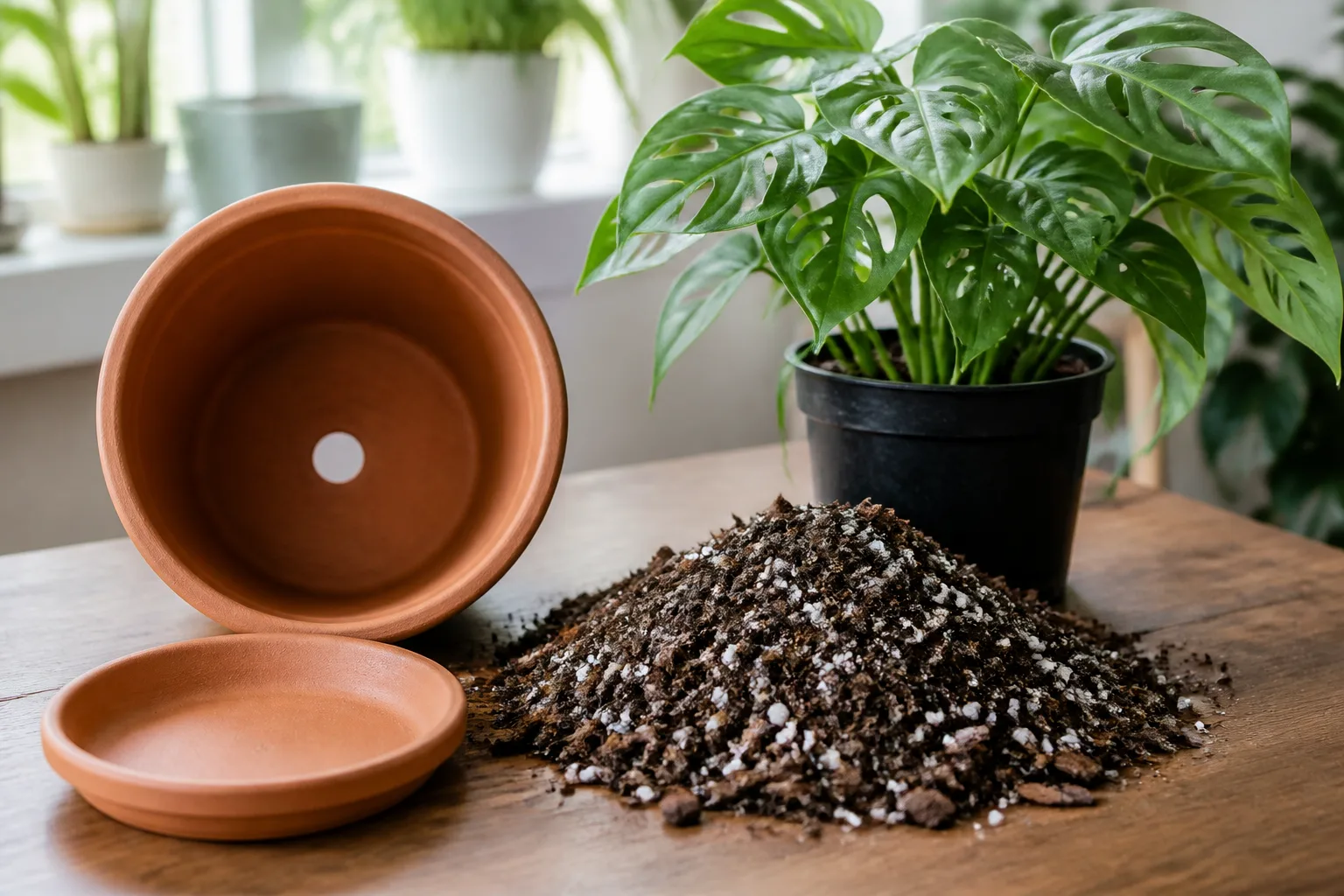
That inner-pot method is not a compromise in style. It is often the best way to use a one-of-a-kind ceramic object, because the plant can be lifted out for watering, root inspection, and repotting without risking the vessel. Leave enough clearance inside the cachepot for water to drain freely, and empty any water that collects at the bottom instead of letting the nursery pot sit in it.
The BBC Gardeners’ World guidance on upcycled containers makes the same practical point for unusual vessels: conceal a removable plastic pot or add drainage holes. A decorative container without drainage is not automatically a bad planter; it is simply an outer vessel unless you can safely modify it.
Do not rely on a layer of rocks at the bottom of a standard sealed pot as a substitute for a drainage hole. It changes where water sits but does not give excess water a way out. If the container is valuable, glazed, thin, or awkward to drill, protect it and use a removable inner pot.
Material and size change the care routine
Ceramic is not one uniform material. Unglazed clay is porous and can dry faster; glazed ceramic is less absorbent and behaves more like a sealed surface. Penn State notes that terracotta can pull water and soluble salts from the potting mix, while ceramic and terracotta are more breakable than plastic. Those differences should change how often you check moisture and how carefully you move the pot.
Size matters just as much. A container that is dramatically larger than the root ball holds more wet mix than the plant can use quickly, which increases the chance of prolonged dampness. A pot that is too small can make the plant unstable, restrict roots, and turn watering into a constant emergency. The default is a modest step up, with exceptions for top-heavy plants that need a wider, heavier base and for species whose care guidance specifically favors being somewhat pot-bound.
The bird of paradise is one of those exceptions: Wisconsin Extension notes that plants may bloom more profusely when pot-bound, so repotting should not be automatic just because the plant is large. That does not mean a cracked container or badly failing root system should be ignored. It means the plant’s biology gets a vote in the design decision.
For a heavy ceramic vessel, use a pot that is stable but still movable when dry. Put felt or a proper plant caddy under it if the floor allows, and avoid dragging a wet pot across delicate surfaces. The right planter is one you can live with on watering day, not only one that looks good in a photograph.
How to style a large collection without creating chaos
The easiest way to make many plants look intentional is to stop treating every pot as an isolated centerpiece. Group plants by a few repeated design decisions, then separate them again when their care needs differ.
Build each grouping around one visual anchor
Start with one plant that owns the silhouette: a broad rubber tree, a tall dracaena, a bird of paradise, or a dramatic trailing form. Add smaller plants that support its shape rather than competing with it. A peperomia can soften the base of a tall plant; a low, textured vessel can ground a broad canopy; a narrow pot can echo a vertical leaf line.
Use a limited palette within each grouping. The palette might be all matte black and green, warm clay with bronze foliage, or pale ceramics with variegated leaves. Repetition creates coherence even when the plants are unrelated. Fine Gardening’s container-design guidance similarly emphasizes bold foliage, varied textures, and a restrained color story when building abundant container displays.
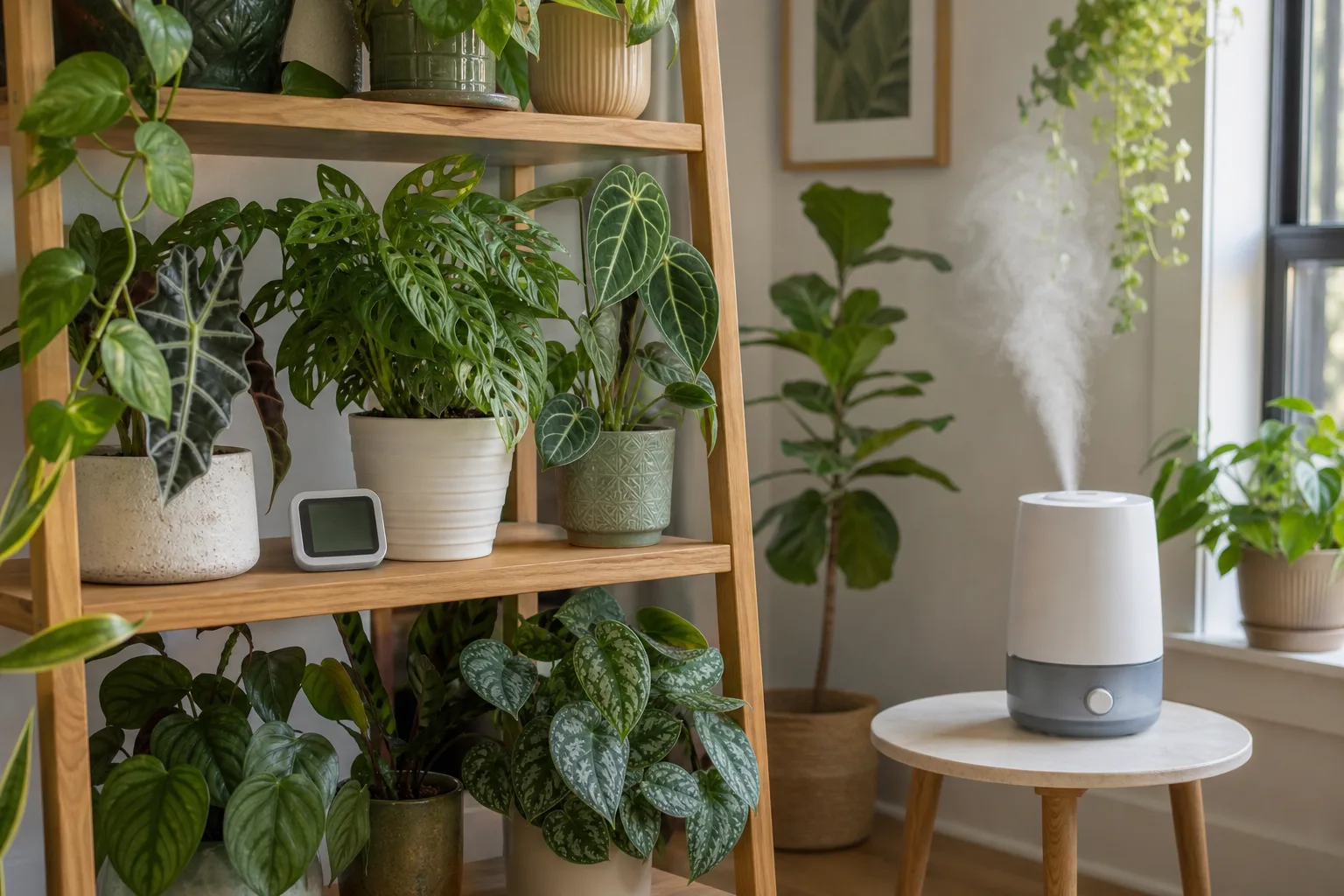
Then edit. Move one pot away if every leaf is touching another leaf, a trailing plant has nowhere to fall, or a colorful glaze is competing with variegation. A collection feels richer when each plant has a readable outline.
Keep light and watering zones honest
Good styling cannot erase incompatible conditions. A bird of paradise that needs a very bright window should not be grouped with a peperomia simply because both look good in a blue pot. Put plants together when their visual relationship is strong, but keep the care zones truthful: brightest light, medium light, lower light, high-humidity support, recovery, and quarantine.
This approach also makes watering more precise. Labeling every plant is optional; labeling a shelf or zone by its drying pattern is more useful. A group of small peperomias may be checked when the top few centimetres dry. A rubber plant may need a different interval in the same room. A bird of paradise in bright light can use water faster than a plant tucked behind it, even if both were watered on the same day last month.
Place the plants so you can reach the soil, rotate the pots, inspect leaf undersides, and remove one plant without dismantling the whole composition. Leave a small working gap between heavy ceramics. The gap is not wasted space; it is what lets you care for a living collection without turning every task into a rearrangement project.
What a 100-plant home teaches about attention
The most useful part of Stamps’s plant story is not the number. It is her explanation of why plants are satisfying: care creates a visible relationship between what you provide and how something grows. That idea feels especially fitting beside ceramics, a medium that also rewards repetition, observation, and patience.
A large collection magnifies both the pleasure and the limits. You see new leaves, changing variegation, leaning stems, and plants that outgrow the spot you chose for them. You also see the consequences of a pot without drainage, a move made too quickly, a missed pest, or a watering routine that became automatic instead of observant.
If you want the same feeling at a smaller scale, begin with three plants that offer different shapes rather than three plants that need identical care. Choose one anchor, one trailing or fine-textured plant, and one plant with a distinctive leaf pattern. Give each a container that is safe for roots and easy for you to handle. Grow the collection until care feels like attention rather than backlog.
That is the bridge between Stamps’s studio and an ordinary home. The goal is not to copy a room, a plant count, or a shopping list. It is to notice form, choose with intention, and let the living material change the design over time.
Conclusion
Lalese Stamps’s plant-filled studio is compelling because the plants are not background greenery. They are bold shapes, long-term companions, and active partners to the handmade ceramics around them. The historical Columbus episode shows a collector drawn to strong foliage, unusual growth, and the satisfaction of keeping demanding plants going.
The practical lesson is more grounded than the spectacle: choose the plant for its form, choose the pot for the roots, and build the display around the care you can sustain. A drainage-first cachepot, a modest pot upgrade, a truthful light zone, and enough room to inspect each plant will take you further than a beautiful sealed vessel or an overcrowded shelf ever will.



