Cucumber Watering Guide: Schedule, Soil Checks & Signs
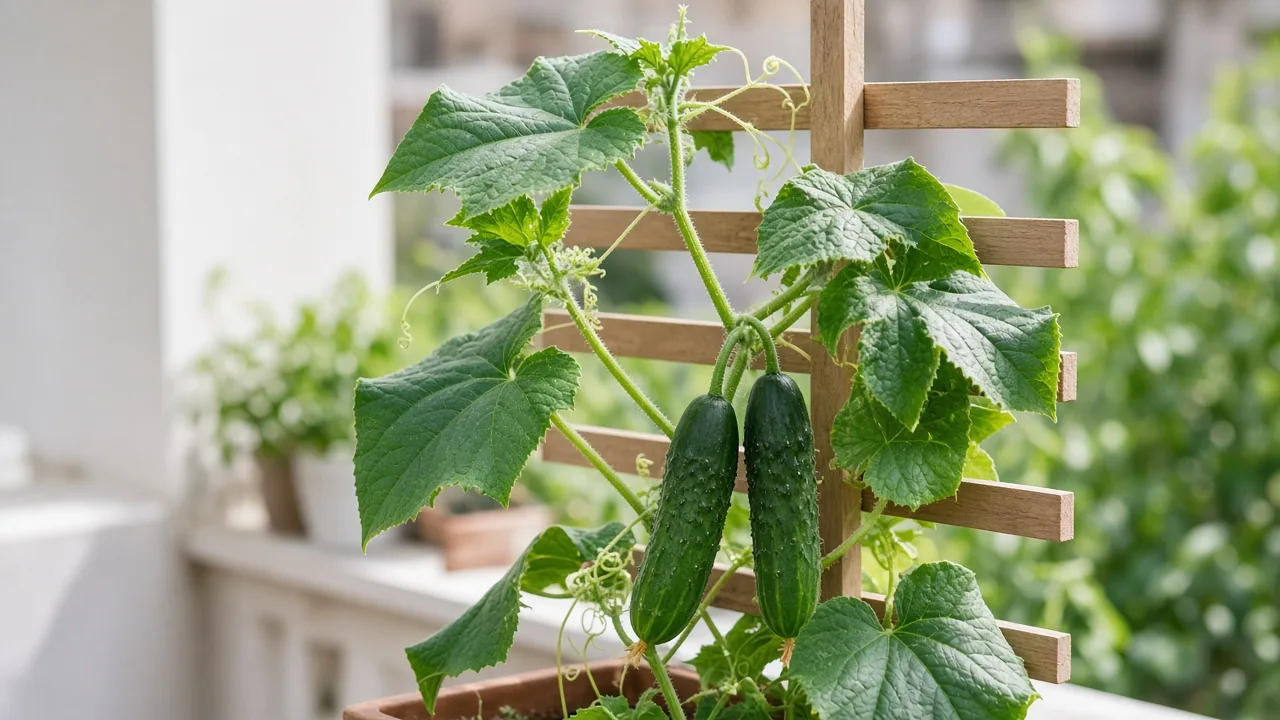
Cucumber Watering Guide: Schedule, Soil Checks & Signs
Cucumber Watering Guide: Schedule, Soil Checks & Signs
A cucumber vine can look thirsty at noon and drowning by evening if you only watch the leaves. Cucumis sativus is a warm-season cucurbit with large, thin foliage and fruit that is mostly water. It grows fast when sun, fertility, and steady root-zone moisture line up—but it hates both bone-dry swings and saturated, airless soil. On Indian terraces and kitchen gardens, that usually means checking the upper 2–3 cm of mix or soil daily in heat, watering deeply at the base when that layer dries, and never assuming wilt always means “add more water.”
The quick answer: even moisture at the roots, dry leaves above
Push a finger 2–3 cm into the soil away from the main stem. If that depth feels dry and the soil below is only lightly cool—not wet—soak the full root zone until water drains freely from the bottom of a pot or penetrates deeply in a bed. If the mix stays dark, cool, and clings to your skin, wait. Cucumbers need consistent moisture, not constant sogginess.
Many vegetable guides translate that into about 1–2 inches (2.5–5 cm) of water per week for in-ground plants, including rainfall—but containers, trellises, wind, and March–June heat on the plains change the math within days. Treat weekly inches as background context; your finger, pot weight, and vine recovery are the real schedule. The Royal Horticultural Society advises keeping greenhouse and container compost evenly moist, especially while fruits form, with container plants sometimes needing daily water in hot spells (RHS — How to grow cucumbers).
Why a calendar fails on a warm-season vine
Cucumber is an annual vine, not a forgiving succulent. NC State Extension notes high water needs with consistent moisture for proper growth, plus good drainage and dry leaves while irrigating (NC State — Cucumis sativus). A fixed “every Tuesday” plan fails the moment pre-monsoon winds hit a trellised pot or a week of cloud breaks reduces evaporation. Check often; water when the root zone is beginning to dry.
What “1–2 inches per week” really means in a pot
In a 20 L or larger container with compost-rich mix—what most full-size slicing vines need on a balcony—that weekly total might arrive as two or three deep soakings in calm weather, or daily light-targeted irrigation when the vine is fruiting on a west-facing railing. UF/IFAS highlights that cucumbers’ large, thin leaves dry out faster than thick-leafed plants, so they need frequent watering, while still being sensitive to flooding (UF/IFAS — Cucumbers). A small nursery pot dries in hours; a mulched raised bed may go longer. Scale checks to the container and training method described in the Cucumber overview and Cucumber light guide.
Why cucumbers need more water than most terrace herbs
Copying snake-plant drought cycles or mint’s “wet feet” tolerance will disappoint you here. Cucumbers evolved as rapid summer vines; their biology punishes both drought stress during fruit fill and oxygen-starved roots in waterlogged clay after heavy rain.
Thin leaves and rapid transpiration
Each leaf surface loses water quickly in full sun. UF/IFAS ties that anatomy directly to irrigation frequency: thin foliage means faster drying, so the plant depends on you (or rain) to refill the root zone before turgor collapses (UF/IFAS — Cucumbers). Trellising improves airflow and fruit quality, but NC State explicitly warns that vertically grown cucumber plants lose moisture more easily than vines sprawled on the ground—so trained terrace vines often need more frequent checks, not fewer (NC State — Cucumis sativus).
Fruit development depends on steady uptake
University of Georgia Extension stresses that quick-growing cucumbers must be well supplied with moisture and nutrients all season, with water especially critical during the fruiting stage (UGA — Growing cucumbers in the home garden). Fruit that starts forming during a dry spell may finish misshapen or harsh-tasting. UGA also notes that plenty of moisture as fruit matures helps avoid bitter taste—a common complaint when growers alternate drought with heavy rescue watering (UGA — Growing cucumbers in the home garden). Steady moisture beats heroic soaking after neglect.
How often should you water cucumbers?
There is no honest universal interval. Pot volume, mix, trellis height, cultivar vigour, wind, humidity, mulch, and whether the vine is flowering or harvesting all change drying speed. Use the frameworks below as starting points, then let soil dryness decide.
In-ground beds and raised kitchen gardens
In a fertile, mulched bed with good drainage, you might deep-water two to three times per week during dry pre-monsoon weeks, and far less when steady rain keeps the root zone moist. Gardening Channel’s practical guidance favours fewer, longer soakings over daily sprinkles so water reaches deep roots and the plant builds a resilient root system (Gardening Channel — How often should I water cucumbers?). After a deep soak, wait a day or two, then test: if soil is dry to your first knuckle, soak again; if not, wait. Pair that habit with the drainage and organic matter advice in the Cucumber soil guide.
Trellised vines and large containers
Trellised terrace vines combine fast transpiration with limited soil volume. Expect to check daily during 35 °C afternoons; many growers water every one to two days in peak fruiting if the upper 2–3 cm dries. RHS notes container cucumbers may need daily irrigation in hot weather while in-ground plants benefit from mulch and need less frequent attention (RHS — How to grow cucumbers). Anchor the trellis at planting—as in the hub grower notes—so you are not shifting roots mid-season when water stress already shows.
Seedlings and newly transplanted vines
For germination, UF/IFAS recommends irrigating the bed and keeping it moist for at least one week after planting to support seed emergence (UF/IFAS — Cucumbers). Small cells and fresh transplants cannot store moisture; wilting here is often genuine thirst. Once several true leaves expand, shift toward the deeper, less frequent soak pattern—without letting the root zone crash dry during the first flowering wave. Seed timing and root handling are covered in the Cucumber propagation guide.
How to check soil moisture before you water
Surface colour lies, especially on cocopeat-heavy mixes that crust on top while staying wet below. Use at least one of these checks every time:
Finger or knuckle test: Press into the mix 2–3 cm beside the stem. Dry at that depth with only faint coolness below means water. Clinging, cold soil means wait.
Pot weight: Lift the container after a good soak to learn “heavy.” A sudden light feel with dry surface soil confirms thirst.
Skewer test: Insert a dry bamboo skewer to the lower third of the pot. Darkening or stuck particles mean moisture remains.
Wilting leaves plus wet soil suggest flooding, poor drainage, or root damage—not a call for more water. Wilting with dry soil calls for a deep soak at the base. Afternoon flagging on a hot terrace with moist soil may be heat stress; recheck in the cooler morning before irrigating again—similar logic to balancing water with sun in the Cucumber light guide.
Deep watering at the soil line
Cucumbers want consistent moisture, delivered at the roots, with foliage kept as dry as practical. Light daily sprinkles that only wet the top inch encourage shallow roots and leave the core dry—exactly the pattern that produces bitter or uneven fruit when heat returns (Gardening Channel — How often should I water cucumbers?).
When you irrigate, apply water slowly at the soil surface until it moves through the full root ball and exits drainage holes on pots. In beds, water until the soil darkens several inches down without creating standing puddles that linger for hours.
Drip lines, soaker hoses, and careful hand watering
Drip or soaker hoses at the soil line match how extension guides think about cucurbits: moisture where roots are, leaves spared. If you use a watering can or hose, direct the stream under the leaf canopy, not over it. RHS recommends watering at the base to reduce fungal diseases such as powdery mildew, and suggests sinking a small pot beside each plant to deliver water straight to roots (RHS — How to grow cucumbers).
Morning vs evening in humid Indian summers
Morning watering is the default: leaves dry through the day, which helps in humid coastal and monsoon-adjacent climates where cucurbit mildews thrive (RHS — How to grow cucumbers). If work schedules force evening irrigation, still keep water on the soil, not the canopy. Avoid late-night overhead sprays that leave leaves wet until dawn.
Mulch, drainage, and monsoon rain
Cucumbers need moisture but not flooding. UF/IFAS lists cucumbers as sensitive to flooding even though they require frequent watering—raised beds, coarse mix, and clear drainage holes are not optional on terraces that see monsoon downpours (UF/IFAS — Cucumbers).
Mulch straw, dried leaves, or compost around in-ground vines slows evaporation and cushions soil from hammering rain (UGA — Growing cucumbers in the home garden). Leave a small gap around the stem to avoid collar rot. After heavy rain, pause irrigation until the upper 2–3 cm actually dries; many grower mistakes are “rain plus reflex watering.” If water pools on saucers, empty them immediately.
If monsoon weeks stay cloudy and cool, vines drink less—reduce frequency without letting containers go bone dry for days, which can abort young fruit.
Seasonal shifts through flowering and harvest
Early vine growth: Steady moisture supports leaf cover; do not alternate flood and drought while tendrils climb the trellis.
Flowering and fruit set: This is the highest-stakes window. UGA’s fruiting-stage emphasis applies here: short dry spells can drop flowers or produce rough fruit (UGA — Growing cucumbers in the home garden). Increase check frequency, not necessarily volume per watering.
Peak harvest: Frequent picking stimulates more fruit, and a loaded vine transpires heavily. Large containers may need daily attention; mulched beds might still need only deep soakings between rains.
Late season: As vines age and powdery mildew pressure rises, keep moisture even but improve airflow via pruning practices in the Cucumber pruning guide. Pull back water only when soil tests show sustained wetness, not because leaves look tired from age.
Fertility changes water uptake too; if you push nitrogen while moisture swings, you may get leaves at the expense of fruit—coordinate with the Cucumber fertilizer guide once the basic wet–dry rhythm is stable.
Overwatering and underwatering warning signs
Underwatering often shows as limp vines, dull leaves, dry pulling soil, blossom drop, and bitter or misshapen fruit after moisture stress during development (Gardening Channel — How often should I water cucumbers?). Recovery after a proper soak within a day supports thirst as the cause.
Overwatering may present as yellowing foliage, wilting despite wet soil, sour-smelling mix, and soft lower stems—especially in dense, poorly aerated media. NC State ties persistently wet conditions to weakened roots and fungal leaf issues when foliage stays damp (NC State — Cucumis sativus). Hold irrigation, verify drainage, and improve airflow before assuming nutrients are lacking.
First steps when vines wilt and you are unsure
Do not reflex-soak. Push your finger 2–3 cm deep, lift the pot, and sniff near drainage holes. Wet and heavy: skip watering, empty saucers, and confirm mix porosity per the Cucumber soil guide. Dry and light: one deep base watering, then recheck the next morning.
Remove damaged yellow leaves only after you fix moisture—stripping foliage does not dry out saturated roots. If a plant was root-bound or recently moved, gentle handling matters; see the Cucumber repotting guide. If problems persist two weeks after a corrected rhythm, revisit light exposure and feeding rather than escalating water alone.
When to use this page vs other Cucumber guides
Use this page when the core question is how much water, how often, and how to test dryness for cucumber vines in beds, raised planters, or large pots. Start with the Cucumber overview for cultivar choice, trellis setup, harvest timing, and whole-plant context.
If mix dries in hours or stays soggy for days, move to the Cucumber soil guide. For sun stress versus water stress, read the Cucumber light guide. Feeding and fruit quality after moisture is stable belong in the Cucumber fertilizer guide. Transplant timing and final container size are in the Cucumber repotting guide; seed sowing and seedling moisture in the Cucumber propagation guide; canopy thinning in the Cucumber pruning guide.
Related Cucumber guides
- Cucumber overview — vine habit, trellis planning, and harvest basics
- Cucumber light — full sun, heat, and wilting that is not thirst
- Cucumber soil — drainage, compost, and moisture retention
- Cucumber fertilizer — feeding during flowering without lush-only growth
- Cucumber repotting — final pot size and transplant care
- Cucumber propagation — germination moisture and direct sowing
- Cucumber pruning — airflow and canopy management in humid weather
Conclusion
Cucumber watering is a soil-line discipline: keep the root zone evenly moist through flowering and harvest, drain every container completely, and keep leaves as dry as you reasonably can. Check 2–3 cm deep instead of obeying a calendar; trellised and potted vines usually need more frequent attention than sprawled bed plants. Back off when monsoon rain or heavy soil has already saturated the mix, and soak deeply when the upper root zone dries—especially before fruit quality suffers. Match rhythm to your terrace, cultivar, and season, and use the sibling guides when drainage, light, or fertility—not thirst—drive what you see on the vine.