Brown Tips on Java Fern: Causes, Checks & Fixes
Quick answer
Brown tips on submerged Java Fern fronds usually follow excess light, nutrient imbalance, or aging-not dry room air. Trim dead tips only after you fix light level and water quality; new fronds emerge clean once conditions stabilize.
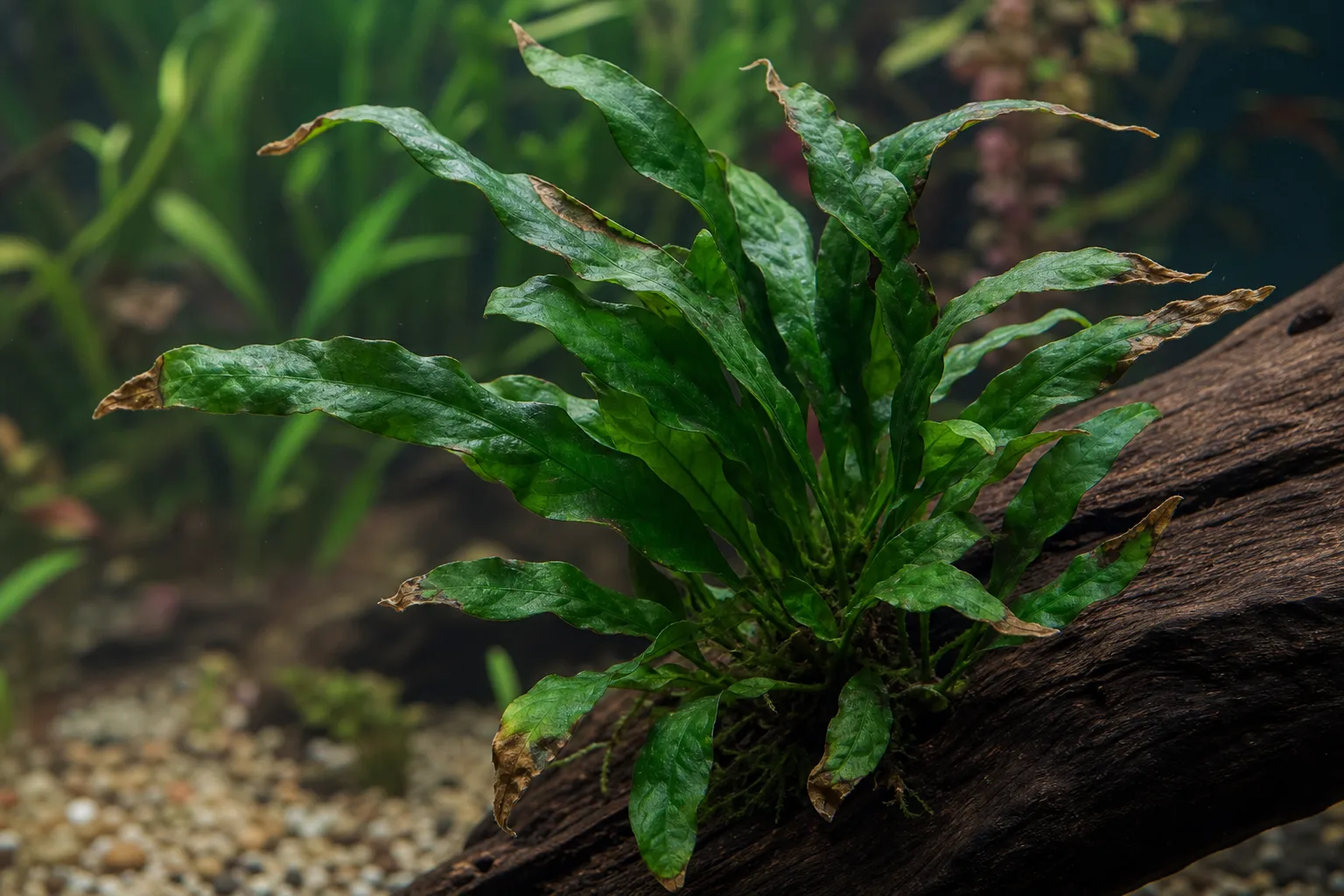
Brown Tips on Java Fern: Causes, Checks & Fixes
This guide covers brown tips on Java Fern. See also the general Brown Tips guide, watering, and light pages for this plant.
Brown Tips on Java Fern: Causes, Checks & Fixes
Quick answer
Brown tips on Java Fern (Microsorum pteropus) are usually environmental stress in the aquarium-not disease and not dry room air. On fully submerged fronds, the most common triggers are too much light for this low-light epiphyte, nutrient deficiency or overdose, physical damage from filter blast, and normal aging on long-lived fronds.
First fix: reduce photoperiod by one to two hours or move the plant out of the brightest PAR zone, then confirm the rhizome is attached to hardscape-not buried. Trim only fully dead margin tissue after conditions stabilize.
For baseline light targets and PAR ranges, see the Java Fern overview. For emersed fronds browning above the waterline, use low-humidity instead-submerged tips are a tank problem, not a humidifier problem.
What brown tips look like on Java Fern
Tan or dark brown patches at frond tips or along margins, while the rhizome stays firm and woody. Patterns differ by cause:
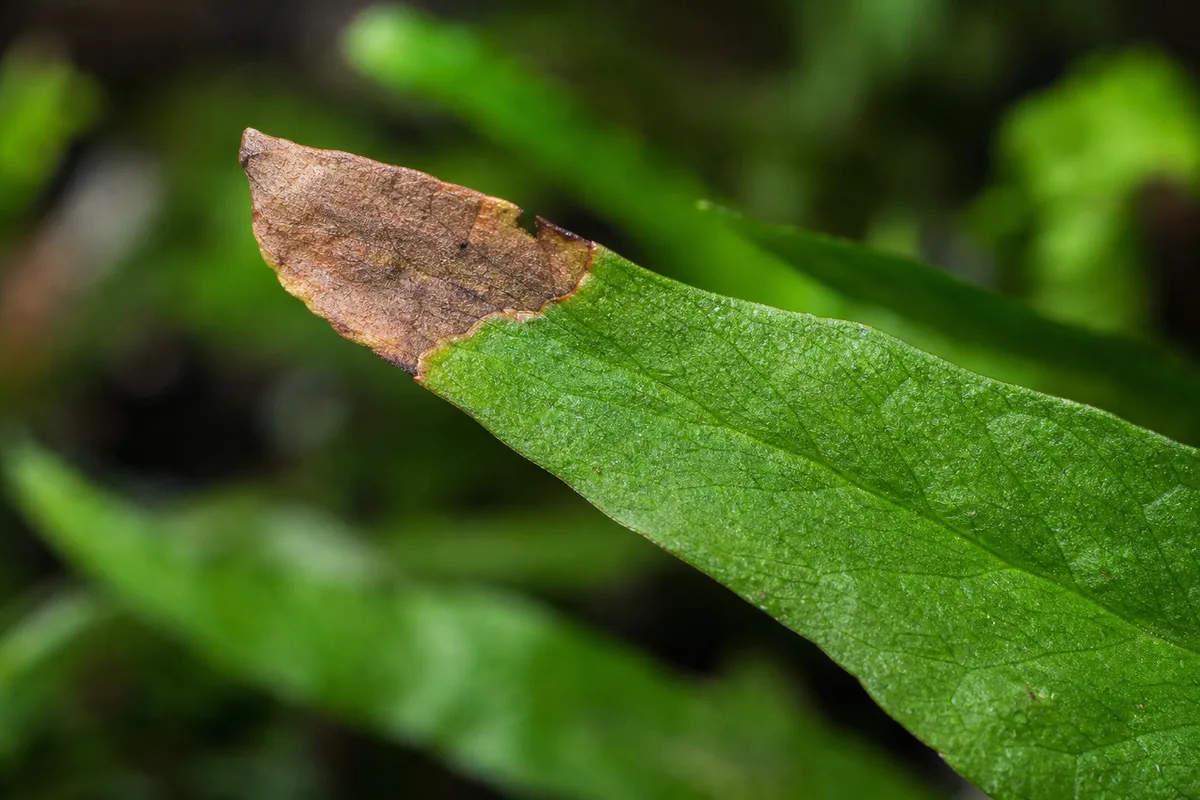
Brown Tips symptoms on Java Fern - compare with healthy tissue on the same plant.
Tip burn vs senescence vs mechanical injury vs rhizome rot
- Light stress: dry tan or brown tips and margins on the tallest fronds directly under the LED fixture; lower shaded fronds often stay green
- Senescence: uniform browning on the oldest frond before it melts-normal turnover on a slow-growing plant, not an emergency
- Mechanical injury: sharp brown spots where a frond bends against heater glass, filter outflow, or hardscape from constant current
- Rhizome rot: black mushy tissue at the rhizome spreading outward-different workflow than cosmetic tip burn; see
root-rot
Sporangia dots vs disease
Symmetrical dark bumps on the underside of firm green leaves are normal sporangia-reproductive structures, not tip disease. Tip burn affects margins and tips on the upper surface; sporangia sit on healthy tissue underneath and do not spread as necrotic patches.
Why Java Fern gets brown tips
Java Fern evolved on shaded stream margins in tropical and subtropical Asia. In aquariums it tolerates dim conditions better than intense unshaded light. Sudden jumps in LED intensity or photoperiod can stress low-light plants and scorch leaf margins even though the species survives dim conditions.
Excess light and photoperiod
Stock aquarium LEDs on default settings often exceed the 0.25–0.5 W/L range Tropica recommends for Easy-category plants. Hobby PAR targets for Java Fern land near 15 PAR at the low end up to about 50 PAR at the medium end, with best long-term appearance toward the lower half of that range-details in the overview PAR table.
Tip burn is often the first signal before algae coats slow-growing fronds. The tallest leaves under the brightest zone receive the highest PAR and brown first. Extending photoperiod beyond six to eight hours without shading compounds the stress.
Cultivar note: Windelov and Trident forms have more finely divided fronds that can look scorched sooner under the same PAR as standard Java Fern-shade them more aggressively in high-light tanks.
Nutrient deficiency or overdose
In heavily planted low-tech tanks, zero nitrate can starve slow epiphytes at leaf margins before whole-frond yellowing appears-healthy Java Fern culture typically targets 10 to 50 mg/l nitrate. Iron or potassium shortfalls can also show as edge necrosis or pinholes on older leaves.
Conversely, a recent liquid fertilizer overdose produces translucent melt rather than dry crispy tips-that branch fits fertilizer-burn better. Chronic heavy dosing with tank-wide algae pressure fits overfertilization. For baseline feeding rules, see java-fern-fertilizer.
Physical damage from filter flow
Java Fern fronds are leathery but not rigid. A filter outflow or powerhead aimed directly at the cluster whips tips against rock or glass, creating localized brown creases. Redirect flow so water passes through the plant gently rather than hammering one frond against hardscape.
Normal aging on long-lived fronds
Individual fronds live many months. The oldest leaf browns uniformly, then melts away as the rhizome produces replacements. If only one aged frond shows even browning and new growth stays green, trim at the rhizome and wait-no culture change needed.
How to confirm the cause
Match timing to your last care change:
- Light timeline: Did tips brown within days of a new LED, higher intensity setting, or longer photoperiod? Check whether only top fronds under the brightest zone are affected.
- Nutrient check: Test nitrate. Zero in a planted tank may explain margin browning on slow growers; a spike after dosing points to
fertilizer-burn. - Rhizome inspection: Press the rhizome-it should feel firm. Confirm it sits on wood or rock, not buried in substrate.
- Flow map: Note whether damaged tips align with filter blast or heater contact points.
- Submerged vs emersed: If brown tips appear only on fronds above the waterline, room humidity is the suspect-read
low-humidity. Fully submerged browning is never a room-humidity problem.
Confirmed light stress: tan tips on tallest fronds after a lighting change, firm rhizome, green new growth at the base. Suspected but unconfirmed: test nitrate and review photoperiod before trimming live tissue.
First fix for Java Fern
Reduce light exposure before you trim. One clear action:
- Shorten photoperiod by one to two hours or dim/raise the fixture so tallest fronds sit in a shadier zone (target the lower half of the 15–50 PAR comfort range from the overview).
- Redirect filter outflow away from whipping fronds.
- Wait seven to ten days for new growth to show whether margins stay clean.
Secondary steps only after light is addressed:
- Trim fully dead margin tissue with sharp scissors-do not cut into live green tissue.
- If nitrate reads zero in a planted tank, add a light all-in-one aquarium fertilizer at labeled low-tech rates dosed into the water column-never poured on emersed leaves. Check shrimp sensitivity on product labels before dosing in invert tanks.
- If the rhizome is buried, remount on hardscape-that fix belongs on
root-rotif tissue is already soft.
Do not crank light hoping green returns. Java Fern is a slow epiphyte, not a high-light carpet plant. Pale leggy growth with long gaps between fronds may mean too little light-see not-enough-light instead of adding intensity.
Recovery timeline
Dead tip tissue will not re-green. Success is a firm rhizome and at least one new frond without brown margins after you stabilize light and nutrients.
- Days 1–7: Stop further scorch by reducing light; old brown tips remain cosmetic.
- Weeks 2–4: First clean new leaf may emerge at the rhizome if conditions are correct.
- Weeks 4–6: Plant looks fuller as slow new growth replaces trimmed old fronds.
Optimum temperatures around 22–28°C/27914) support steady leaf formation; cold water below 20°C slows recovery. Residual brown on old fronds can persist for weeks-that is old damage, not ongoing burn.
Lookalike symptoms
| Pattern | Location | Rhizome | Key clue |
|---|---|---|---|
| Light tip burn | Tips/margins on tallest fronds | Firm | Follows LED upgrade or long photoperiod |
| Nutrient deficiency | Margins or pinholes on older leaves | Firm | Zero nitrate or gradual weeks-long change |
| Fertilizer burn | Translucent melt at edges | Firm | 24–72 h after dose; see fertilizer-burn |
| Senescence | Whole oldest frond evenly brown | Firm | No recent care change; one frond only |
| Mechanical injury | Crease point on one frond | Firm | Aligns with filter blast or hardscape rub |
| Algae coating | Fuzzy surface on firm tissue | Firm | Wipes off; reduce light, do not trim live leaf |
| Emersed dry air | Tips on fronds above waterline | Firm | Open paludarium or propagation cup; see low-humidity |
| Rhizome rot | Black mush from base outward | Soft, foul | Buried rhizome; see root-rot |
What not to do
Do not mist submerged fronds or raise room humidity-irrelevant underwater. Do not confuse sporangia on leaf undersides with tip disease. Do not trim into live green tissue hoping it regrows. Do not double fertilizer when margins brown-confirm whether the issue is light or deficiency first. Do not bury the rhizome to “anchor” the plant during a tip-burn episode.
How to prevent brown tips
Acclimate new plants to your lighting over two weeks-lower intensity first, then gradually increase if needed. Keep photoperiod in the six-to-eight-hour range for low-tech tanks. Place Java Fern in shade behind driftwood, under floaters, or off-center from the brightest LED zone.
Remove aging fronds at the rhizome before they decay in flow and feed algae. Dose one aquarium fertilizer lightly in planted tanks rather than letting nitrate hit zero for months. When upgrading lights, move the fern to a shadier position before running the new fixture at full power.
For full light placement and PAR context, continue with the Java Fern light guide.
When to worry
Cosmetic brown tips on a firm rhizome are not urgent. Escalate if:
- Browning spreads from the rhizome outward with soft black tissue-treat as rot on
root-rot - Every frond browns or melts within days of a massive fertilizer pour-pause dosing, test ammonia and nitrite, and read
fertilizer-burn - New growth stays pale and stunted for six or more weeks after you reduced light-consider
not-enough-lightornitrogen-deficiency
When to use this page vs other Java Fern guides
- Java Fern watering guide - Use for routine moisture checks before assuming brown tips is the main issue.
- Java Fern problems hub - Browse all 28 common issues on this species.
- Low Humidity on Java Fern - Different entry point when symptoms overlap with brown tips.
- Yellow Leaves on Java Fern - Different entry point when symptoms overlap with brown tips.
Related Java Fern guides
- Java Fern overview
- Java Fern watering
- Java Fern light
- Java Fern soil
- Low Humidity on Java Fern
- Yellow Leaves on Java Fern
- Java Fern problems
- Black Spots on Java Fern
Related tool
Use the Plant Problem Diagnosis Tool to narrow causes for brown tips on this plant before changing multiple variables at once.