Spider Mites on Kalanchoe: Causes, Checks & Fixes
Quick answer
Spider mites on Kalanchoe show as pale speckling and dull, dusty leaves, often with fine webbing at leaf axils and flower clusters. First step: isolate the plant and rinse all leaf surfaces thoroughly, especially the undersides, before applying any spray.
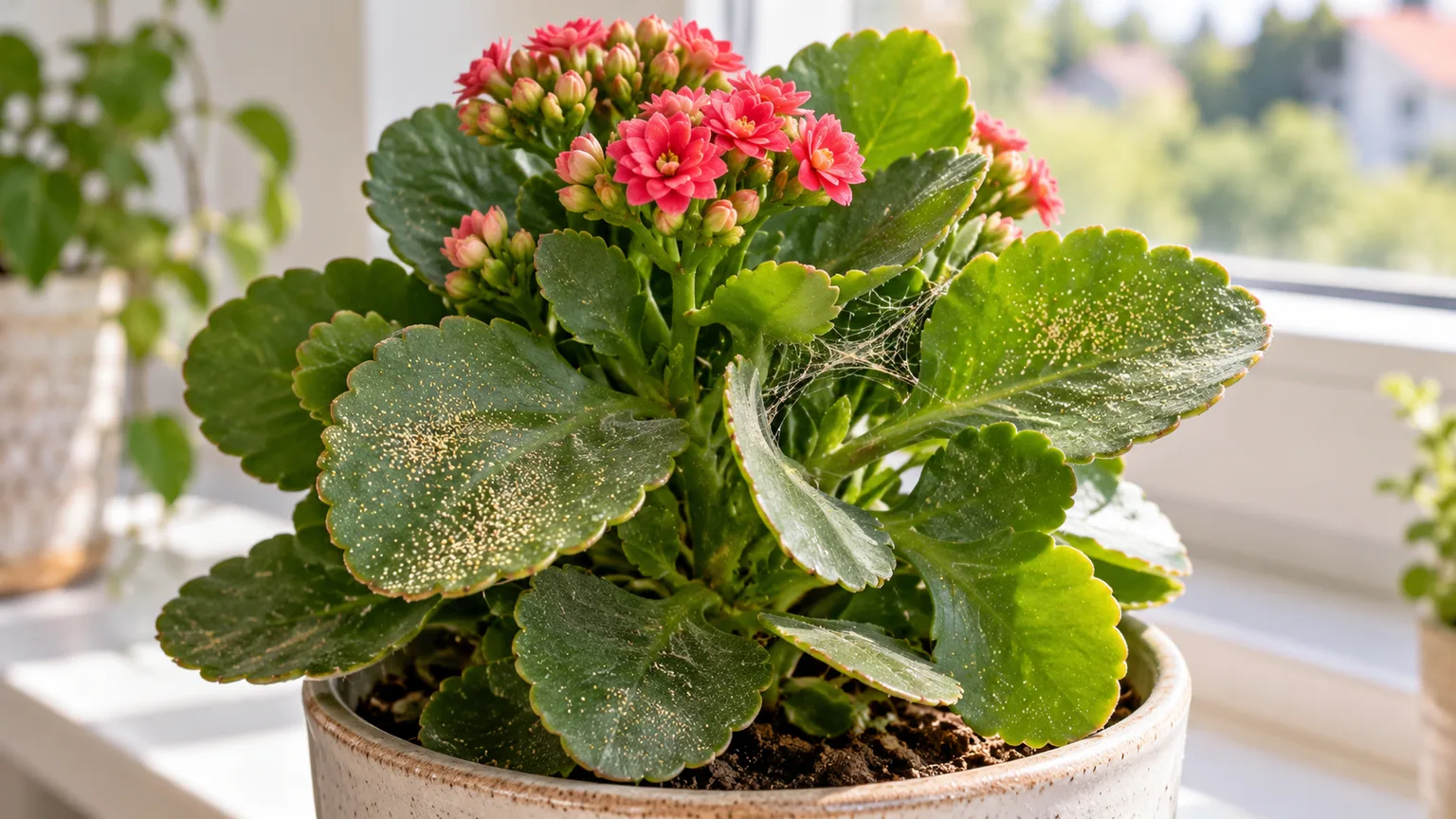
Spider Mites on Kalanchoe: Causes, Checks & Fixes
This guide covers spider mites on Kalanchoe. See also the general Spider Mites guide, watering, and light pages for this plant.
Spider Mites on Kalanchoe: Causes, Checks & Fixes
Quick answer
Pale, dusty speckling on your Kalanchoe plus fine silk at the leaf joints usually means spider mites, not a watering problem. These tiny sap-feeders are listed among the most common insect pests of florist kalanchoe, and they build fastest in the hot, dry air kalanchoes often sit in through winter.
First step: isolate the plant and rinse the whole plant thoroughly. Take it to a sink or shower, spray all leaf surfaces with a firm stream of water, and spend extra time on leaf undersides and the tight axils where scalloped leaves meet the stem. For how spider mites feed and spread in general, see our spider mites guide. On Kalanchoe, the pattern usually shows up as fine pale stippling on thick leaves that never wipes off, plus webbing caught in the leaf scallops and flower clusters.
When to use this page vs other Kalanchoe guides
This page is the pest-first entry for confirmed or strongly suspected spider mites on Kalanchoe. Use it when you see stippling plus webbing or moving specks.
- Mealybugs on Kalanchoe - use when you see white cottony clusters in leaf axils rather than fine webbing and speckling.
- Aphids on Kalanchoe - use when soft-bodied insects cluster visibly on buds and new growth with sticky honeydew.
- Yellow leaves on Kalanchoe - use when whole leaves yellow without stippling, which points to watering or light causes.
- Overwatering on Kalanchoe - use when leaves turn soft and translucent in wet soil rather than dry and stippled.
- Kalanchoe problems hub - browse all 16 issues on this species when the pattern is unclear.
What spider mites look like on Kalanchoe
Kalanchoe’s thick, waxy leaves change the classic mite picture. Instead of rapid wilt, you get a slow fade: leaves lose their glossy green first, then develop thousands of pinprick pale dots that do not rinse off.
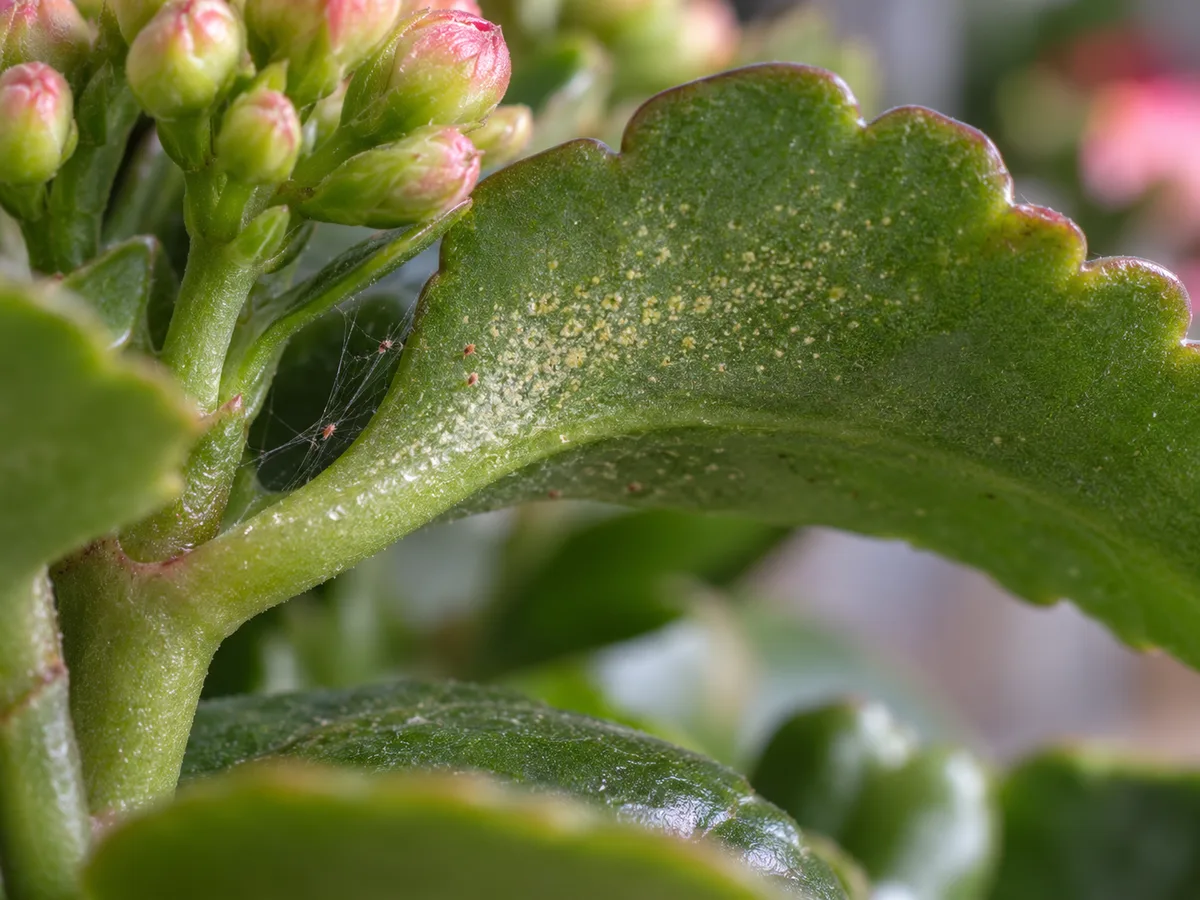
Pale stippling and fine webbing on Kalanchoe leaves - compare with healthy glossy tissue on the same plant.
Typical Kalanchoe mite damage:
- Fine yellow-white speckling on the upper surface of leaves that looks like dust but does not wipe away
- Leaves turning dull, dusty, then bronzed or grayish as feeding continues
- Fine silk threads at leaf axils, along scalloped leaf edges, and inside the dense flower cluster
- Buds that stall, deform, or drop before opening on a plant that previously bloomed well
- Tiny pale, tan, or reddish specks moving on leaf undersides under a 10x lens
Because the leaves store water, a Kalanchoe can look plump while mites drain individual cells. Do not wait for wilting. By the time leaves bronze and drop, the population has usually been feeding for weeks.
Why Kalanchoe gets spider mites
Three traits of this plant stack the odds toward mites.
1. Thick succulent leaves hide early stippling
On thin-leaved plants, mite stippling shows fast. On Kalanchoe’s fleshy scalloped leaves, the first pale dots blend into the waxy surface and owners mistake them for dust or hard-water spots. Colonies feed undisturbed on the undersides for another generation before anyone looks closely. Wipe a suspected leaf with a damp white cloth: dust transfers, mite stippling does not.
2. Crowded leaf axils and flower heads shelter mites
Florist kalanchoes are bred as dense mounds of overlapping leaves topped with tight bloom clusters. Those junctions trap still, dry air and catch the fine webbing mites use to travel leaf to leaf. Check where each leaf meets the stem and deep inside spent flower heads first. A plant in active bloom is harder to spray thoroughly, which is one reason infestations found during flowering need repeat treatments rather than a single wash.
3. Hot, dry indoor air plus strict dry-down watering
Kalanchoe wants bright light and a pot that dries fully. The standard guidance is to allow the soil to dry out between waterings and then water deeply, which is correct for rot prevention but means the foliage zone stays dry for long stretches. Add winter heating or a sunny south windowsill above a radiator and you get exactly the hot, dry microclimate mites exploit. Plants pushed into full sun without a gradual transition also carry mild heat stress that makes mite damage look worse.
How to confirm the cause
Work through these checks before spraying anything:
- White-paper test - Hold white paper under several leaves, tap the foliage sharply, and watch for 30 seconds. Mites appear as slow-moving dust specks; still dust is just dust (Epic Gardening describes this shake-and-watch step as the standard home confirmation).
- Underside inspection - Flip the most stippled leaves and examine the undersides with a magnifier or phone macro lens. Look for oval-bodied specks, shed skins, and pinpoint eggs along the veins.
- Webbing check - Look for silky webbing with heavier infestations strung between leaf edges, at stem forks, and inside the bloom cluster. Webbing plus stippling is diagnostic; webbing alone with no stippling can be a true spider.
- Pattern check - Mite damage starts on older outer leaves and the driest side of the plant, then moves inward. Uniform yellowing of the lowest leaves in wet soil points to the overwatering guide instead.
- Neighbor check - Inspect plants touching the Kalanchoe. Mites travel across touching leaves, so a second plant with fresh stippling confirms an active spreader.
If taps produce moving specks and stippled leaves carry webbing at the axils, treat as spider mites. If leaves are soft and translucent with a heavy pot, check roots first per the watering guide before treating for pests.
Lookalike comparison
| What you see | Likely cause | How to tell apart |
|---|---|---|
| Pale pinprick dots plus fine webbing at axils | Spider mites | Paper test shows moving specks; leaves develop an overall faded look |
| White cottony tufts in axils, no webbing | Mealybugs | Tufts wipe off with alcohol revealing soft insects clustered, not specks |
| Visible clustered insects plus sticky film on buds | Aphids | Insects visible without a lens; honeydew feels tacky |
| Whole leaves yellow and soft in wet mix | Overwatering | Pot heavy, soil damp at depth; see overwatering |
| White powder on leaves in still, humid air | Powdery mildew | Powder wipes off; NC State notes good air circulation prevents it on kalanchoe |
First fix for Kalanchoe
Isolate the plant and wash every leaf surface now. Clemson Extension advises isolating infested kalanchoes and notes that spraying sturdy plants with water removes many pests when all surfaces are covered (Clemson Extension).
Move the Kalanchoe away from other plants. In a sink, angle the pot so the mix does not flood, then spray foliage with a firm stream for several minutes: tops, undersides, stem forks, and around (not directly into) open blooms. Let the plant drip-dry in bright indirect light with airflow. This single wash knocks the population down enough to see what remains, and it avoids chemical stress on bloom-covered plants on day one.
Step-by-step recovery
After the first wash, work in this order based on severity.
If stippling is light and webbing is limited to one or two axils:
- Repeat the firm-water rinse every 4 to 5 days for two weeks to catch hatching eggs.
- Prune only the worst bronzed leaves and any finished flower stalks blocking spray coverage. Do not strip the plant bare; Kalanchoe needs its leaves for recovery.
- Dust remaining leaves gently so future stippling is easy to spot.
If mites persist after two rinses or webbing spans multiple stems:
- Apply insecticidal soap, which targets spider mites among other soft-bodied pests. Coat leaf undersides fully in the evening, never in harsh midday sun.
- Test one leaf first: Kalanchoe’s succulent surface is generally soap-tolerant, but blooms scorch easily, so shield open flowers from direct spray.
- Reapply at 5- to 7-day intervals for at least three rounds, since eggs survive each contact spray. Repeated treatments are needed because the mite life cycle runs fast in warm rooms.
- As a rotation option, neem oil extract is listed for spider mites on houseplants (Clemson Extension); use it the same way, in the evening, with the same underside coverage.
For the pot and placement during treatment:
- Keep the normal soak-and-dry rhythm from the Kalanchoe watering guide — do not keep the mix constantly damp to “raise humidity.” Wet cold mix invites the root rot Kalanchoe is famous for.
- Improve airflow instead: space the plant from neighbors, open the cachepot, and keep leaves out of still corners. The soil guide covers the gritty fast-draining mix that lets you rinse foliage without waterlogging roots.
- Hold fertilizer until new growth looks clean. A mite-stressed Kalanchoe in the wrong light needs diagnosis first; the light guide helps you confirm the window is bright enough for recovery.
Recovery vignette: florist kalanchoe on a heated windowsill
A grocery-store Kalanchoe in full bloom sat above a winter radiator in gritty mix. Lower leaves dulled and stippled; fine silk appeared inside the bloom cluster. The paper test showed moving specks. The owner isolated the plant, rinsed all foliage twice in the first week (shielding blooms from the hardest jet), then applied insecticidal soap to leaf undersides three times at weekly intervals in the evening. No repot, no fertilizer change. Stippling stopped spreading by week two; new leaves emerging beside the bloom head were glossy and clean by week four. Old speckled leaves stayed marked but the plant kept the remaining buds.
Mistakes to avoid
- Fogging the plant daily with mist - Surface wetness without airflow encourages mildew and does not drown mites hiding on undersides.
- Spraying once and stopping - One contact spray never catches the egg hatch; schedule the follow-up rounds before you start.
- Repotting on day one - Mites live on leaves, not in soil. Unpotting a blooming Kalanchoe adds root stress while mites keep feeding.
- Blasting blooms with oil or soap at noon - Wet petals plus sun and oils spot and abort buds. Treat in the evening and shield open flowers.
- Fertilizing a mite-stressed plant - Extra nitrogen pushes soft growth mites prefer. Resume feeding only after clean new growth appears.
- Keeping the mix soggy to fight dry air - Kalanchoe roots rot fast in wet mix; fix air dryness with spacing and airflow, not overwatering.
Recovery timeline
- Days 1 to 7: moving specks drop sharply after the wash; no new webbing should appear if coverage was complete.
- Weeks 2 to 3: stippling stops spreading; existing dots remain but leaf color stabilizes instead of bronzing further.
- Weeks 4 to 6: new leaves and buds emerge glossy and clean. That is the recovery signal on Kalanchoe, not the repair of old speckled tissue.
If webbing returns within days of soap rounds, coverage missed the axils, the neighboring plant is reinfesting, or the room is extremely hot and dry. Tighten spray angles, treat the neighbor, and move the plant off the heat source before adding stronger products.
How to prevent spider mites next time
Build mite checks into normal Kalanchoe care:
- Keep the plant in bright indirect light to some direct sun per the light guide — vigorous Kalanchoes outgrow light mite pressure better than etiolated ones.
- Water deeply only when the pot is dry at depth, using the gritty blend in the soil guide, and empty saucers so roots never sit wet.
- Wipe or rinse thick leaves monthly in dusty homes so early stippling stays visible.
- Quarantine every new plant for two weeks and tap-test before placing it beside the Kalanchoe.
- After bloom ends, deadhead spent clusters (see the overview) to remove the dense webbing harbors mites reuse.
- Browse the problems hub seasonally so winter heating-season inspections become routine.
When to worry
Treat as urgent when:
- Webbing spans multiple leaves and the bloom head in the same week
- New leaves emerge already stippled or buds abort despite treatment
- Leaves bronze rapidly and drop while the pot is correctly dry
- Two full soap rounds plus rinses show no slowdown in spread
In those cases the population is outpacing contact control. Prune the worst webbed growth, treat the plant and its immediate neighbors together, and consider discarding a heavily webbed spent bloom head rather than losing the whole plant. Mild stippling on a few outer leaves with firm stems is low urgency and usually resolves with rinses plus one soap series.
FAQs
How do I know these are spider mites and not dust on my Kalanchoe?
Dust wipes off with a damp cloth and looks random. Mite stippling is pinprick pale dots embedded in the leaf that never wipe away, usually paired with fine silk at the axils. Tap the leaf over white paper: moving specks confirm living mites, while still debris confirms dust.
Should I throw away a blooming Kalanchoe with spider mites?
Rarely. Blooms make spraying awkward but the plant itself is salvageable when stems stay firm. Rinse foliage, shield open flowers from direct soap spray, and treat leaf undersides in repeat rounds. Only discard when stems soften at the base or the whole crown bronzes despite two full treatment rounds.
Can I just raise humidity instead of spraying?
No. Kalanchoe prefers average indoor air and needs the mix to dry fully; constantly wet air and mix invite rot and mildew faster than they deter mites. Use spacing and airflow for prevention, and rely on rinsing plus soap rounds for active mites. Follow the watering and soil guides rather than humidifying the corner.
Why did mites appear right after my Kalanchoe finished blooming?
Post-bloom plants often sit in the same dry heated spot for months with dense spent heads nobody inspects. Mites colonize those undisturbed clusters while the owner focuses on flowers. Deadhead finished blooms, rinse the foliage, and resume monthly underside checks once the display ends.
How do I keep mites from coming back every winter?
Winter heating creates the dry still air mites prefer, exactly when Kalanchoe growth slows. Move the plant off heat vents into bright light with space around it, tap-test monthly from November onward, and quarantine holiday gift plants before they join the windowsill.
Related Kalanchoe guides
- Kalanchoe overview - bright light, soak-and-dry watering, and rebloom basics
- Watering - full-pot dry-down rhythm that protects roots during mite treatment
- Light - window placement for compact growth and faster recovery
- Soil - gritty fast-draining mix that tolerates foliage rinsing
- Mealybugs on Kalanchoe - cottony axil clusters vs mite webbing
- Aphids on Kalanchoe - visible bud insects with honeydew vs mite stippling
- Yellow leaves on Kalanchoe - watering and light yellowing vs pest speckling
- All Kalanchoe problems