Root Rot on Kalanchoe: Causes, Checks & Fixes
Quick answer
Root rot on Kalanchoe shows as soft translucent leaves, black or brown stem bases, and soil that stays wet for days. First step: stop watering and unpot to inspect the roots — firm white roots stay, brown mushy ones get trimmed with sterile tools.
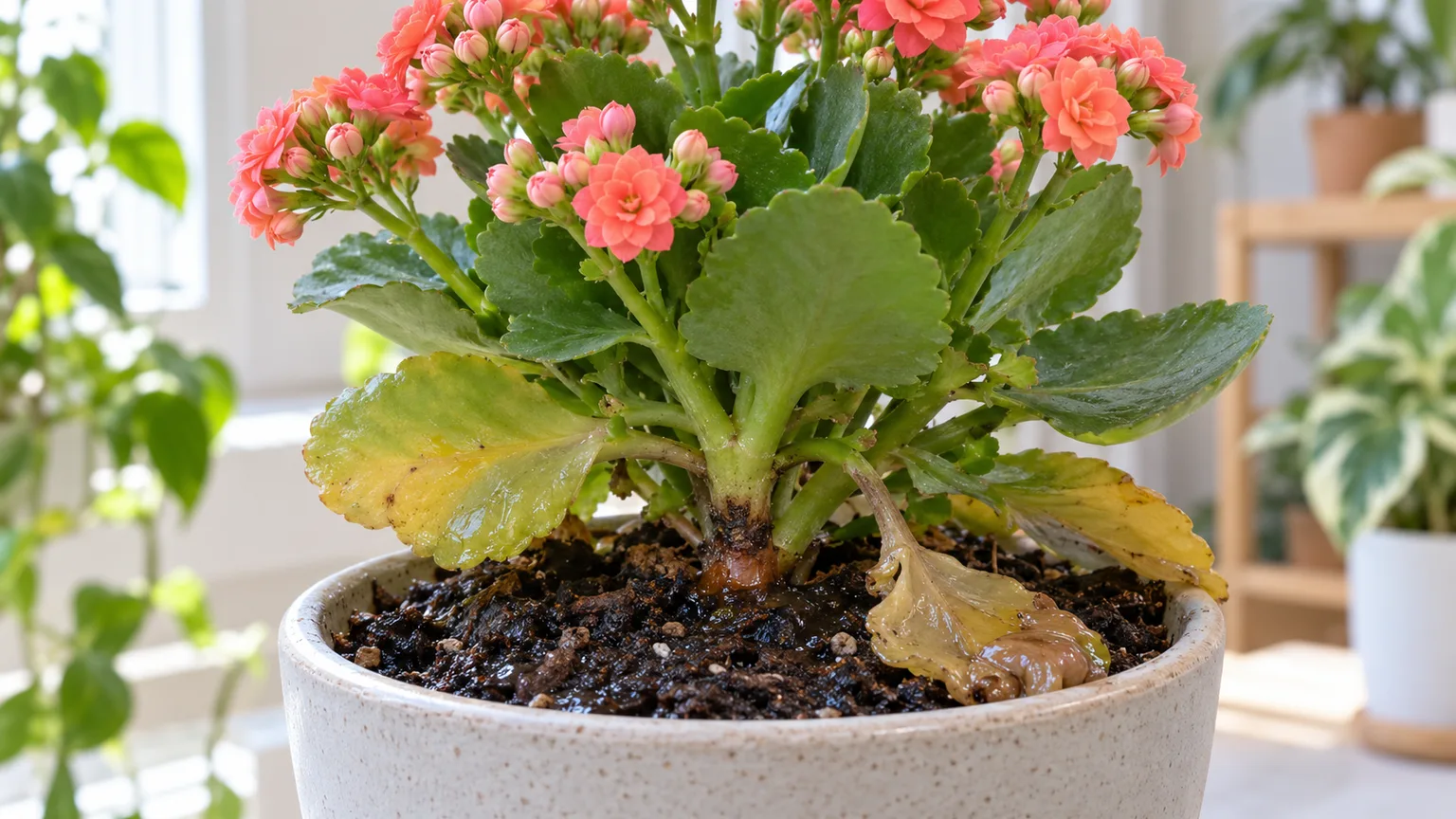
Root Rot on Kalanchoe: Causes, Checks & Fixes
This guide covers root rot on Kalanchoe. See also the general Root Rot guide, watering, and light pages for this plant.
Root Rot on Kalanchoe: Causes, Checks & Fixes
Quick answer
Your Kalanchoe (Kalanchoe blossfeldiana) has soft, translucent leaves or blackening stem bases, and the pot stays heavy days after watering. This is the classic Kalanchoe emergency: a succulent that stores water in its leaves is sitting in a root zone with no oxygen, and water-mold pathogens are already at work.
First step: stop watering and unpot the plant to inspect the roots. Firm white or tan roots stay; brown, black, mushy, or sour-smelling roots get trimmed with sterilized tools. Everything else — fresh gritty mix, a terracotta pot, the drying wait — follows from what you find underground. For the general mechanics of how chronic wet mix destroys roots, see our root rot guide. On Kalanchoe, the pattern usually shows up as a black ring at the stem base plus leaves that feel waterlogged rather than dry.
What root rot looks like on Kalanchoe
Kalanchoe does not wilt and crisp the way a fern does. Because its thick scalloped leaves hold stored water, a rotting Kalanchoe looks swollen and waterlogged: lower leaves turn yellow, translucent, and jelly-soft, then detach at a touch. The most diagnostic sign is at the soil line — stems turn brown to black at the base, sometimes with a visible pinched or sunken ring where the tissue has collapsed.
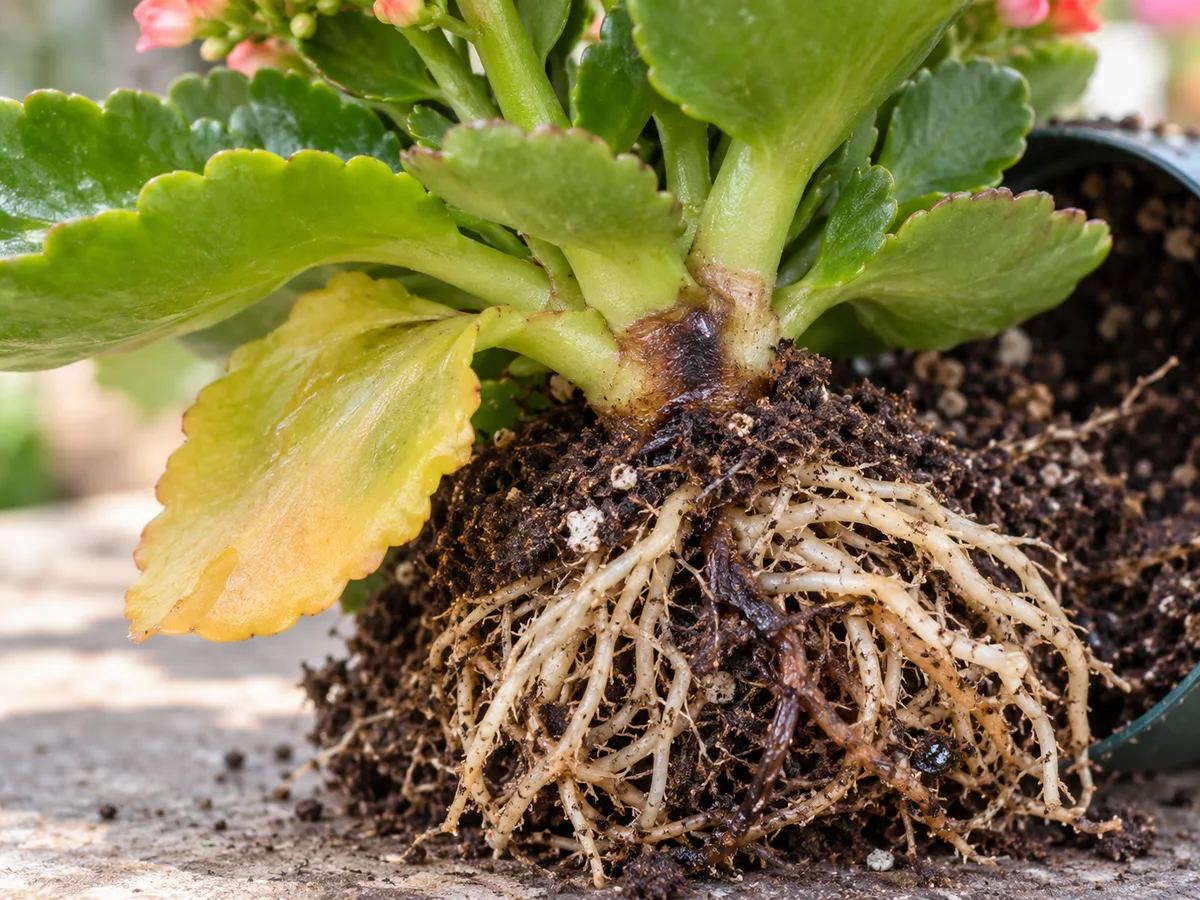
Root rot on Kalanchoe: translucent mushy leaves and dark stem bases at the soil line, with firm white roots for comparison.
Typical Kalanchoe rot pattern:
- Lower leaves go soft, yellow, and translucent instead of dry and papery
- Stem bases darken to brown or black right at the soil line
- The whole plant feels loose or wobbly as anchor roots decay
- Soil stays heavy and cool days after watering, sometimes with a sour or mildew smell
- New buds and upper growth stall even though the mix is wet
That last point is what fools people: the plant looks thirsty because roots can no longer move water, so owners water again. On Kalanchoe, wilting in wet soil is almost never a cue for more water — rule out rot at the roots before treating it as thirst.
Why Kalanchoe rots faster than leafy houseplants
Everything about this plant is built around roots that must dry out between drinks. It comes from seasonally dry northeast Madagascar and stores water in fleshy leaves, so its fine root system evolved for fast drainage and long dry spells — not for peat that stays damp for a week. Clemson HGIC notes Kalanchoe can be damaged by over watering and warns that root rot usually results from a soil mix that does not drain quickly or from watering too often.
Three Kalanchoe-specific traps make this worse than on a pothos or fern:
Florist pots ship in water-holding peat. Grocery and gift Kalanchoes are forced into bloom in dense peat that stays wet far longer than a succulent tolerates. The plant looks perfect for weeks, then collapses once the stored leaf water runs out and the roots have been wet the entire time.
Oversize decorative pots hold a reservoir the roots never reach. A small Kalanchoe in a large cachepot sits in a volume of mix it cannot drink dry. Excess soil volume holding more water than the plant can absorb is one of the most common rot setups for small succulents (Gardens Whisper).
Weak winter light stalls drying. Clemson HGIC notes Kalanchoe grows best in full sun and gets spindly in low light. A plant in a dim winter window uses almost no water, so a summer watering rhythm becomes a slow drowning. If your plant is also stretching, read the not-enough-light guide alongside this one — but fix the wet roots first.
The pathogens themselves are opportunists waiting for exactly these conditions: water molds such as Pythium and Phytophthora plus fungi like Rhizoctonia attack roots once wet, airless soil weakens them (Missouri Botanical Garden).
How to confirm: the skewer, lift, and unpot check
Work in this order so you only disturb the roots when the evidence justifies it:
- Lift the pot. A Kalanchoe pot that still feels heavy 5–7 days after watering is holding water the plant cannot use. Compare against a freshly watered versus fully dry pot to calibrate your hand.
- Skewer to the bottom. Push a wooden skewer to the drainage holes and leave it a minute. If it comes out damp or dark below the top inch, the root zone never dried — the core requirement NC State Extension states as allowing the soil to dry out between waterings is being violated.
- Squeeze the stem base. Gently press stems right at the soil line. Firm and green means you may have caught this at the overwatering stage. Soft, dark, or sunken means rot has reached the crown — proceed to unpot the same day.
- Sniff the drainage hole. A sour, swampy, or mildew smell from the pot base is near-certain rot, even if leaves still look passable.
- Unpot and inspect. Slide the root ball out and shake off wet mix. Healthy roots are firm and white or tan; rotted roots are brown or black, mushy or slimy, and smell foul. Crown rot shows as brown-to-black discoloration migrating around the stem at the soil line.
If the roots are firm and white but the mix was soggy, you caught overwatering before it became rot — dry the plant out without surgery. If any roots are mushy, continue to the rescue below.
The first fix to try
Stop all watering and get the root ball out of the wet mix today. This single action matters more than any product: no fungicide, fertilizer, or repotting trick compensates for roots sitting in airless soil, and every extra day wet lets decay travel further up the stem. If the stem base is still firm, unpotting plus a full dry-down may be the entire cure. If you find mushy roots, trim them now with tools sterilized in rubbing alcohol — sterile, sharp instruments are the difference between rescue and spreading infection from cut to cut.
Do not fertilize, mist, or move the plant into deep shade at this stage. A stressed Kalanchoe with damaged roots cannot use feed, and dark corners slow the drying you desperately need.
Step-by-step rescue: trim and dry repot
Once you have confirmed mushy roots, follow this sequence — it mirrors the standard succulent-rot rescue of trimming with sterile tools, a sterilized container, fresh soil, and a real drying period (Gardening Know How):
- Unpot and clear the roots. Shake and rinse off all old saturated mix under lukewarm water so you can see every root. Old mix carries the pathogens that started this.
- Cut away all decay. With scissors sterilized in rubbing alcohol (re-sterilize between cuts), remove every brown, black, mushy, or foul-smelling root back to firm white tissue. Also remove any translucent leaves and stem sections that collapse under gentle pressure.
- Disinfect the home. Scrub the old pot with hot soapy water or switch to a clean terracotta pot one size down — never larger. Terracotta wicks moisture out of the mix, and Kalanchoe-specific guidance favors it for recovery because it promotes air circulation and evaporation (Biology Insights). Confirm drainage holes are open.
- Repot in dry, gritty mix. Use fresh cactus/succulent mix — roughly cactus blend with perlite and coarse grit — never garden soil or reused peat. NC State Extension specifies a well-drained potting mix suited to cactus or succulents for this species. Details are in the soil guide.
- Wait before watering. Hold water for 3–7 days so cut root ends callus and heal rather than rotting again in damp mix (Biology Insights). Some growers hold up to two weeks for severe trims (Gardening Know How) — match the wait to how much you cut.
- Restart in bright indirect light. Place in bright, indirect light — no harsh midday sun on freshly trimmed tissue — and resume only when new firm growth appears. Full watering rhythm details apply once the plant is drinking again.
Expect no visible improvement for the first week or two. Success looks like damage stopping: no new translucent leaves, stem bases staying firm, and eventually tiny firm leaves at the crown.
When only cuttings can save it: stem-cutting rescue
Kalanchoe has one advantage over many rotted houseplants: healthy stem tissue roots easily. If the stem base is black and mushy all the way through, or no firm roots remain, stop trying to save the root system and propagate instead:
- Cut above the rot. With a sterilized blade, take 2–3 inch stem tips with completely firm, green tissue — Clemson HGIC recommends two- to three-inch stem cuttings with lower leaves removed for this plant.
- Callus the cuttings. Lay them in bright indirect light for 3–5 days until the cut end dries and seals. Skipping this step invites the same rot into the new plant.
- Root in barely damp gritty mix. Set callused cuttings in dry-ish succulent mix, water lightly only after a week, and keep humid domes and misting away — Kalanchoe cuttings rot under exactly the humidity that helps tropical cuttings.
This is also the moment to be honest: if every stem is translucent and the crown collapses like wet paper, the plant is finished. Compost it, sterilize the pot, and start from a firm cutting or a new plant in proper mix. Our propagation guide covers healthy-cutting technique for next time.
Lookalike symptoms: rule these out
| What you see | More likely | How to tell | Go here |
|---|---|---|---|
| Wrinkled, thin, papery leaves; bone-dry light pot | Underwatering | Leaves deflate without translucency; stem base stays firm and green | Water deeply after full dry-down |
| Soft leaves + heavy wet pot, but roots still white | Overwatering | No black stem bases, no sour smell, roots firm | Dry-down only, no surgery |
| Fuzzy mold on soil surface, plant still firm | Mold on soil | Growth sits on the mix surface; stems upright | Scrape, dry, fix airflow |
| Tiny flies rising when you water | Fungus gnats | Damp mix breeding flies that nibble fine roots | Dry top inches, trap adults |
| Uniform yellowing of oldest leaves only | Yellow leaves or natural aging | One or two bottom leaves, rest firm | Normal if new growth is clean |
| Drooping but firm stems in dry pot | Drooping leaves from thirst or light | Pot is light, mix shrunken from pot edge | Soak, then resume rhythm |
The decisive test stays underground: firm white roots mean a care imbalance, while mushy brown roots mean rot regardless of what the leaves suggest.
Mistakes to avoid on Kalanchoe
- Watering a wilted plant without checking the soil. On Kalanchoe, wilt in wet mix is a root failure signal, not a thirst signal. Watering again is how mild cases become fatal.
- Repotting into a bigger pot “for recovery.” Extra mix holds extra water the damaged roots cannot drink. Size down, never up.
- Fertilizing a stressed plant. Feed cannot rebuild rotted roots and burns damaged tissue. Resume feeding only when new growth is clearly healthy — see the fertilizer guide for the spring-only rhythm.
- Sealing cuttings in plastic or misting them. Kalanchoe tissue calluses in dry air; humidity domes rot fresh cuts.
- Stacking surgery, fungicide, repot, and relocation on the same day. One intervention at a time lets you read whether the plant is stabilizing.
How to prevent it next time
Prevention for Kalanchoe is almost entirely about dry-down speed:
- Water by skewer, not calendar. Water only when a probe to the pot bottom comes out fully dry — roughly every 10–14 days in summer, every 3–4 weeks in winter. Full seasonal detail lives in the watering guide.
- Keep the gritty mix gritty. Refresh compacted peat into a fast-draining succulent blend. If water does not exit the drainage holes within a minute, the mix is wrong no matter how careful your schedule is.
- Stay in terracotta with open holes. Never leave the nursery pot sitting in a water-filled cachepot. Empty saucers after every watering.
- Give it real light. Bright indirect light to some direct sun keeps the plant drinking and the mix drying. Compare placement notes in the light guide if growth is also leggy.
- Repot on schedule. Every 2–3 years in spring into fresh mix, before compaction turns a good pot airless. See repotting for timing.
When to worry
Treat it as urgent — same-day unpotting — when stems soften at the soil line, several leaves turn translucent within days, or the mix smells sour. These mean decay is moving through the crown, and crowns do not regenerate once fully girdled.
You can monitor for a few days instead when a single lower leaf softens but stems stay firm, the pot is drying normally, and roots (if you peek) are white. In that case, hold one watering cycle and reassess — many scares resolve into simple overwatering caught early.
Related Kalanchoe guides
- Kalanchoe overview — baseline care: light, watering rhythm, and growth habit this page assumes.
- Problems hub — all Kalanchoe issues in one place when you are unsure which symptom fits.
- Watering guide — long-term soak-and-dry rhythm to adopt after rescue.
- Soil guide — gritty mix ratios that keep succulent roots aerated.
- Overwatering — use when roots are still firm and you caught the wet spell before decay.
- Mold on soil — use when the issue is surface fuzz on damp mix without soft stems.
- Fungus gnats — use when small flies signal chronically damp mix alongside leaf softening.
- Wilting — use when the plant droops but stems are firm and you need thirst-versus-rot triage.
- Yellow leaves — use when yellowing is the main symptom and rot signs are absent.
Related tool
Use the Root Rot Risk Checker to score drainage, pot size, and watering rhythm for root rot on this plant before changing multiple variables at once.