Drooping Leaves on Kalanchoe: Causes, Checks & Fixes
Quick answer
Drooping leaves on Kalanchoe most often mean the roots are either suffocating in wet peat or the plant has gone too long without a deep drink. Push a wooden skewer to the bottom of the pot and lift the pot for weight before you water, move, or feed anything.
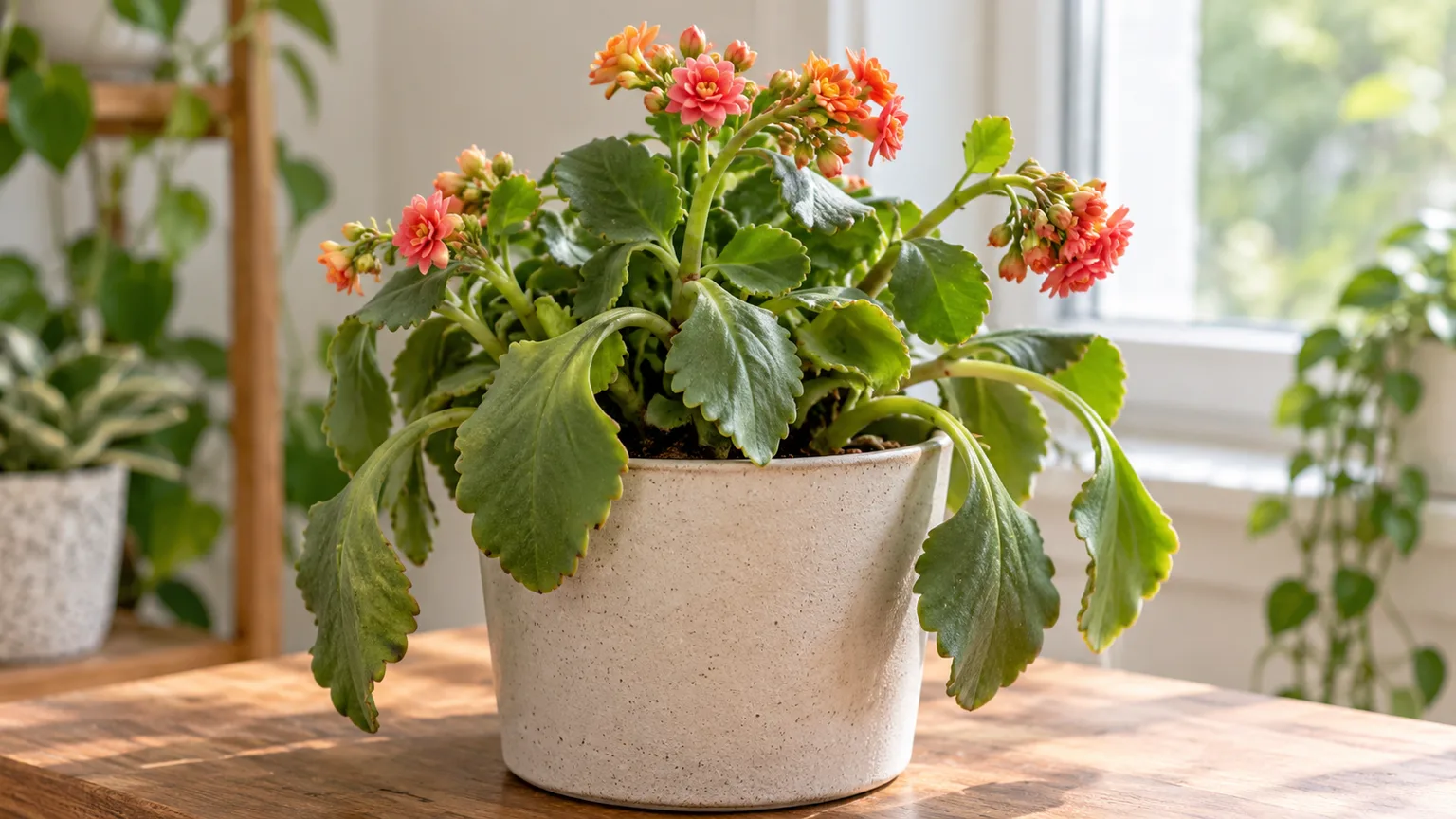
Drooping Leaves on Kalanchoe: Causes, Checks & Fixes
This guide covers drooping leaves on Kalanchoe. See also the general Drooping Leaves guide, watering, and light pages for this plant.
Drooping Leaves on Kalanchoe: Causes, Checks & Fixes
Quick answer
Push a wooden skewer all the way to the bottom of the pot, then lift the pot for weight. Take one watering action based on what you find, and change nothing else that day.
Kalanchoe (Kalanchoe blossfeldiana) stores water in thick scalloped leaves, so drooping foliage is a root-zone signal, not a request for fertilizer or a bigger pot. A damp skewer plus a heavy pot means roots are suffocating and you should stop watering until the mix dries. A clean dry skewer plus a feather-light pot means the plant is genuinely thirsty and needs one deep soak until water runs freely from the drainage hole.
For how limp foliage works in general across houseplants, see our drooping leaves guide. On Kalanchoe, the pattern usually shows up as either mushy translucent leaves on wet mix or wrinkled papery leaves on bone-dry mix, often with weak flopping stems when light has also been too dim.
What drooping looks like on Kalanchoe
A healthy Kalanchoe holds stiff, plump, scalloped leaves on short upright stems, often topped with flower clusters. Drooping breaks that architecture: leaf blades tilt downward, stems lean or flop outward, and the whole plant looks deflated rather than just leaning toward a window.
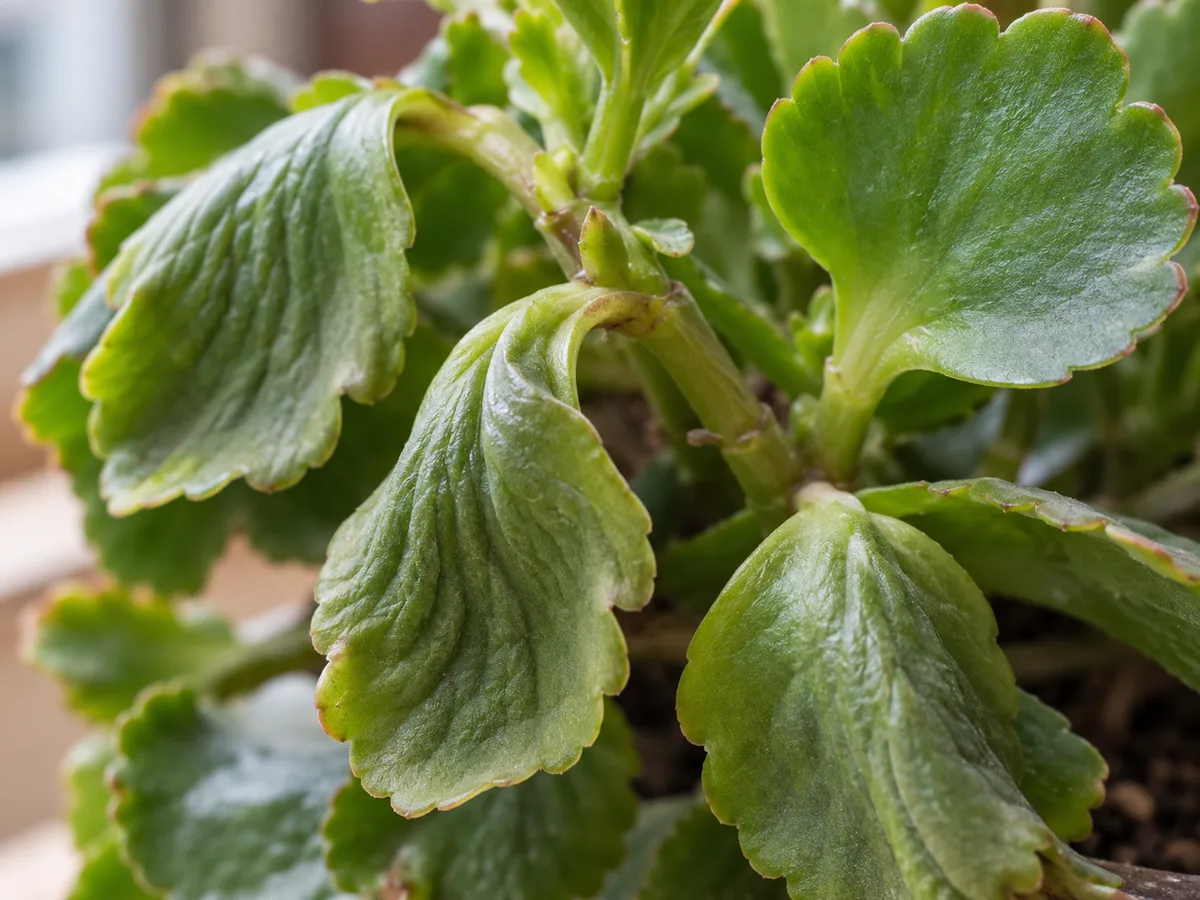
Drooping Kalanchoe foliage up close: compare soft or wrinkled blades against firm plump leaves on the same plant.
Read the scalloped leaves: plump versus mushy versus wrinkled
Kalanchoe leaves are water tanks, and their texture tells you which failure you are dealing with. Learn this three-way read before you touch the watering can:
- Mushy and translucent lower leaves that feel soft like wet tissue point to too much water around the roots. These leaves often yellow first, then detach with barely a touch.
- Wrinkled and thin leaves that feel papery or deflated point to drought stress. The leaf surface puckers between the veins and the blade folds downward.
- Soft stems at the soil line, sometimes with black or brown bases, point past simple watering stress into stem rot. The foliage above may still look green while the base collapses.
This leaf read is Kalanchoe-specific because fleshy succulent blades telegraph water status directly. On thin-leaved houseplants every stress looks like a crisp edge, but on Kalanchoe the mushy-versus-wrinkled distinction separates overwatering from underwatering in seconds.
Why Kalanchoe gets drooping leaves
Wet roots in dense mix. Kalanchoe needs full sun and a well-drained potting media, and soggy soil around its fine roots cuts off oxygen so uptake stops. Leaves droop while the mix is still wet, which tricks owners into watering more. Clemson Extension warns that Kalanchoe can be damaged by over watering and advises letting the soil dry slightly between drinks.
The florist-peat root ball problem. Most Kalanchoes arrive from the nursery forced into bloom on heavy peat that stays wet in dim shops. That peat compacts, holds water against the stem base, and later turns hydrophobic when it finally dries, so water sheets down the pot sides without reaching roots. Drought droop on a plant that was overwatered a month ago is a classic Kalanchoe trap. Baseline context for this habit is on the Kalanchoe overview.
Genuine underwatering. These plants are drought tolerant, and it is best to allow the soil to dry out between waterings and then water deeply. Skipped drinks, tiny pots, or light surface sprinkles that never reach the root ball all produce wrinkled drooping foliage. Underwatered Kalanchoe usually perks up fast once soaked properly.
Too little light, then flop. Kalanchoe grows best in full sun and turns spindly in weak light. Stems stretch tall and thin searching for brightness, then cannot hold the leaf canopy upright and flop over. If your plant is both leggy and droopy, light is at least half the story; compare notes with leggy growth on Kalanchoe and not enough light on Kalanchoe.
Post-bloom exhaustion. Florist Kalanchoes pour energy into weeks of flowers, then slump when blooms fade and owners keep up display-table watering while growth stalls. Spent flower heads plus soft stems after the show ends usually mean the plant needs deadheading and a drier rest, not rescue feeding.
Cold and drafts. Kalanchoe prefers nights around 60°F and days near 70°F, and should be brought indoors before temperatures drop to 45 degrees Fahrenheit. A plant parked against cold winter glass or under an AC blast can droop within days even with correct watering.
Pests on stressed plants. Weak Kalanchoes attract aphids, mealybugs, and spider mites, and heavy sap-sucking on new growth can add droop to an already stressed plant. Check leaf axils for white cottony mealybug clusters before assuming water is the only issue; the mealybugs on Kalanchoe guide covers that pattern.
How to confirm the cause
Work through these checks in order before changing anything:
- Skewer test at full depth - Push a wooden skewer to the bottom and leave it a minute. Damp soil clinging to the wood means wet; a clean dry skewer means dry. Surface appearance lies on peat mixes.
- Pot weight - Lift the pot. Heavy days after watering confirms slow dry-down; feather-light confirms drought.
- Leaf texture squeeze - Gently press a lower leaf. Mushy-translucent fits overwatering; wrinkled-papery fits underwatering.
- Stem base inspection - Part the lower leaves and look at the soil line. Firm green bases fit water stress; black or brown soft bases fit stem rot.
- Drainage audit - Check for a drainage hole, a saucer full of standing water, or a sealed cachepot. Roots sitting in runoff stay wet regardless of your schedule; the first-fix section below covers this trap.
- Light history - Note whether the plant stretched tall with sparse leaves before flopping. Recent moves to dim corners plus flop point to light as a co-cause.
- Temperature exposure - Recall cold windows, AC vents, or nights near 45°F. Cold droop arrives fast and affects the whole plant evenly.
- Pest scan - Inspect leaf axils, undersides, and flower buds for cottony masses, sticky residue, or fine webbing.
First fix to try
Do the skewer-and-lift test, then take exactly one watering action.
If the skewer comes out damp or the pot feels heavy, stop watering entirely. Move the plant to bright light with airflow, empty the saucer and cachepot, and let the mix dry before the next drink. Follow the dry-down ladder on the overwatering guide if the pot stays heavy for more than a week.
If the skewer comes out clean and dry and the pot is light, water deeply once until excess flows from the drainage hole, wait 30 minutes, then empty the saucer. Severely dry peat may need a 10-minute bottom soak so the root ball actually absorbs moisture instead of shedding it down the pot sides. Then wait until the skewer reads dry again before watering, using the rhythm in the Kalanchoe watering guide.
Do not unpot, prune, fertilize, or spray on day one unless stems are black and soft at the base. One correction lets you read the plant’s response; a bundle of fixes hides which one worked.
Step-by-step recovery
For overwatering droop: Hold all water until the skewer reads dry at depth. Keep the plant in bright indirect light to full sun with airflow so the mix dries from both ends. Remove only fully mushy detached leaves; leave partly firm foliage that still photosynthesizes. If stems stay firm, new growth should stiffen within one to two weeks.
For underwatering droop: After the deep soak, expect visibly perkier leaves within hours. Keep the soak-and-dry rhythm rather than switching to daily sips, which keeps only the top inch moist while roots stay thirsty.
For hydrophobic peat: Bottom-soak the whole root ball for about 10 minutes so moisture penetrates instead of running off. Plan a spring repot into gritty cactus mix with perlite, since rewetting tricks only buy time.
For leggy light flop: After fixing water, move the plant gradually into stronger light over a week to avoid scorch. Prune back the weakest flopping stems above a leaf node in spring; Kalanchoe backbuds readily from firm stems. Do not stake a light-starved plant and call it fixed.
For post-bloom slump: Snip spent flower clusters back to the first set of healthy leaves, ease off watering while the plant rests, and give short winter nights if you want rebloom. This is normal cycle care, covered alongside sibling patterns on the Kalanchoe problems hub.
For pest-related droop: Isolate the plant, dab mealybugs with alcohol or rinse aphids off, and confirm live pests before any spray. Treat pests as the second fix after water is corrected, not the opening move.
Root and stem inspection when droop persists
If drooping continues more than a week after the watering fix, or stems darken at the base, inspect before the next drink. Kalanchoe stems rot from the soil line upward, and catching it early decides whether you save the plant or only cuttings.
- Slide the plant out - Tip the pot and ease the root ball free so you can see roots and the stem base together.
- Smell and squeeze - Sour odor, brown or black mushy roots, and soft stem tissue at the soil line confirm rot rather than simple thirst.
- Trim to firm tissue - With sterilized scissors, cut away mushy roots and any soft stem base back to firm green-white tissue.
- Judge the crown - If upper stems and the crown stay firm, repotting can save the plant. If the whole base is mush, take firm stem cuttings as backup instead.
- Repot small and gritty - Use fresh cactus mix with perlite in a terracotta pot just big enough for the trimmed roots. Oversized pots stay wet and restart the cycle.
- Wait before watering - Let the plant settle a few days, then water lightly and resume soak-and-dry only when new firm growth appears. The full rescue protocol continues on the root rot on Kalanchoe guide.
Missouri Botanical Garden notes Kalanchoe is susceptible to stem rot, if over-watered, which is why this inspection matters more here than on plants that merely wilt.
Recovery timeline and signs of improvement
Simple thirst droop on firm stems often visibly improves within hours of a deep soak. Overwatering droop is slower: expect the decline to stop within a week of dry-down, then firmer new leaves at the crown over the following two to four weeks.
Signs you are winning:
- Leaves regaining stiffness from the crown outward
- New small scalloped leaves emerging firm rather than soft
- Pot weight cycling predictably between heavy and light
- No new yellowing or detaching lower leaves
Signs it is worsening:
- Stem bases darkening or softening at the soil line
- Green leaves detaching with a light touch while mix stays wet
- Sour smell from the drainage hole
- Droop spreading upward to previously firm crown leaves
Mushy or blackened leaves will not refl ate. Recovery is measured by new firm growth, not old foliage returning to perfect.
Lookalike symptoms
Separate true drooping from neighboring Kalanchoe problems before stacking fixes.
| Pattern | Leaf look | Pot and stems | Likely cause | Next step |
|---|---|---|---|---|
| Mushy droop, heavy pot | Soft translucent lower leaves | Damp skewer, firm-or-softening base | Overwatering | Stop water, dry out fully |
| Wrinkled droop, light pot | Thin papery puckered blades | Bone-dry skewer, firm stems | Underwatering | Deep soak via underwatering |
| Whole-plant wilt, wet soil | Limp but not yet mushy | Soggy mix, petioles limp | Root damage | Inspect roots, trim rot |
| General wilt after disruption | Floppy within days of event | Variable moisture | Transplant or cold shock | Stabilize; compare wilting |
| Yellow but still attached | Discolored, upright | Often wet in dim room | Early water or light stress | Yellow leaves |
| Tall stretch then flop | Sparse small leaves on long stems | Any moisture | Low light | Brighten; see leggy growth |
| White cotton in axils plus droop | Sticky, stunted new growth | Variable | Mealybugs | Mealybugs guide |
Growers often confuse drought droop with a persistent whole-plant wilt pattern. Use the skewer test to split them: true underwatering droop rebounds within hours of soaking, while wilt with damaged roots stays limp in wet mix.
Mistakes to avoid
Do not water on sight just because leaves hang; wet droop plus more water is how stem rot starts. Do not fertilize a drooping Kalanchoe to push recovery while roots are stressed. Do not repot, prune hard, relocate, and spray in the same week during acute droop. Do not leave the nursery pot sitting in a full cachepot after watering. Do not park a recovering plant in a dim corner where the mix stays wet for weeks. And do not assume misting fixes anything; it wets foliage while the root zone stays wrong.
How to prevent it next time
Repot florist purchases into gritty fast-draining mix in a terracotta pot with a drainage hole, ideally in spring after bloom. Water only when a skewer comes out dry, roughly every 10 to 14 days in summer and every 3 to 4 weeks in winter, following a soak-and-dry seasonal rhythm. Give full sun to bright indirect light so stems stay compact enough to hold their leaves; the Missouri Botanical Garden recommends watering thoroughly but letting dry between watering. Empty saucers within 30 minutes of every drink. Keep winter nights above 45°F and away from cold glass. Deadhead spent blooms so energy returns to leaves and roots.
When to worry
Move to root inspection now if stems blacken at the soil line, several leaves detach with a touch, or sour odor rises from the mix; the trim-and-repot ladder in the inspection section above carries the full protocol. A Kalanchoe with firm stem bases, slowing leaf loss, and one stiff new leaf at the crown is recovering even if older foliage still looks tired. Kalanchoe is toxic to cats and dogs, so keep fallen leaves cleared and the plant out of reach while you handle it during inspection.
Related Kalanchoe guides
- Kalanchoe overview - species baseline, florist-peat habit, and bloom cycle
- Kalanchoe problems hub - all Kalanchoe problem patterns in one index
- Kalanchoe watering - soak-and-dry rhythm, skewer checks, and winter slowdown
- Overwatering on Kalanchoe - heavy pot, wet mix, and full dry-down ladder
- Underwatering on Kalanchoe - wrinkled leaves and deep-soak recovery
- Root rot on Kalanchoe - mushy roots and trim-and-repot rescue
- Wilting on Kalanchoe - persistent wilt versus simple droop
- Yellow leaves on Kalanchoe - discoloration without mass flop
Drooping on Kalanchoe almost always traces to water timing in a succulent that stores its own reserves: too much water in dense peat suffocates roots, too little leaves the tanks empty, and dim light stretches stems past what they can hold. To close the loop, run the skewer test, apply one matched fix, and judge recovery by firm new crown growth. If wet mix and soft stem bases align, work through the dry-down and inspection steps above before changing light or fertilizer.
How we wrote and verified this guide: Recommendations were checked against Clemson Cooperative Extension, NC State Extension, Missouri Botanical Garden, ASPCA, and experienced-grower references cited inline. Author: sai-ananth. Reviewer: LeafyPixels Review Board. Methodology: plant problem guidance is reviewed against botanical references, extension resources, and LeafyPixels plant-care data before publication. Last reviewed: 2026-09-05.