Not Enough Light on Kalanchoe: Causes, Checks & Fixes
Quick answer
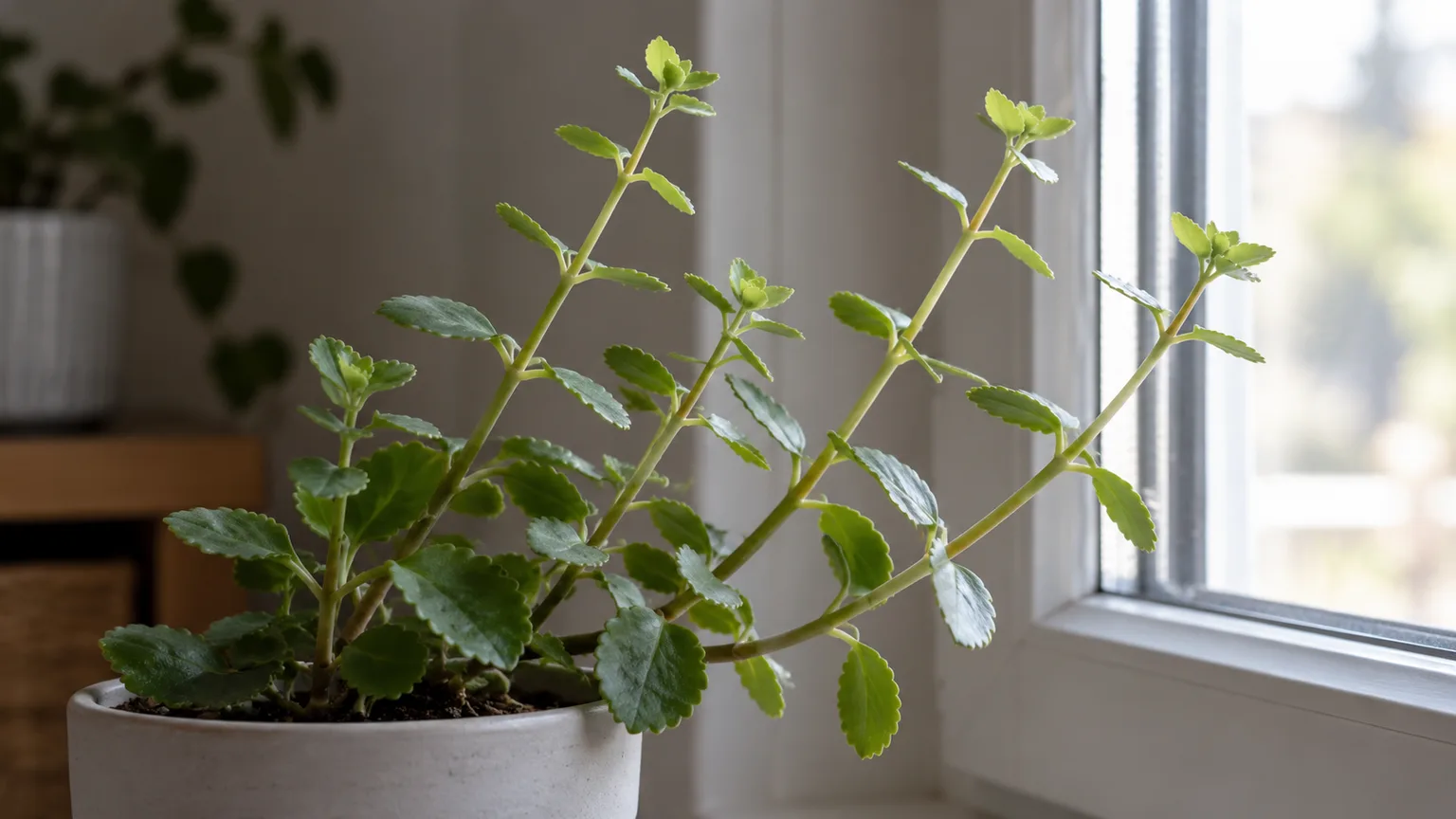
Pale small leaves, widening gaps between leaf pairs, and stems leaning toward the window mean your Kalanchoe needs more light. First step: move it to your brightest east- or south-facing window over 7 to 10 days so tender leaves acclimate without scorching.
Not Enough Light on Kalanchoe: Causes, Checks & Fixes
This guide covers not enough light on Kalanchoe. See also the general Not Enough Light guide, watering, and light pages for this plant.
Not Enough Light on Kalanchoe: Causes, Checks & Fixes
Quick answer
If your florist kalanchoe is going pale, stretching upward with wide gaps between leaf pairs, and refusing to bloom, low light is the most likely cause — not hunger or thirst. First step: move it to your brightest east- or south-facing window over 7 to 10 days, shifting it closer every couple of days so the thick leaves acclimate without scorching.
For the general mechanics of how dim indoor light weakens houseplants, see our not enough light guide. On Kalanchoe specifically, the pattern shows up as loose rosettes, soft leaning stems, and buds that never form — a very different look from the compact, free-flowering mound you brought home.
What not enough light looks like on Kalanchoe
A light-starved Kalanchoe loses the tight rosette habit that defines the species. New scalloped leaves emerge smaller and paler than older foliage, internodes (the stem gaps between leaf pairs) visibly widen, and stems grow soft, thin, and inclined toward the window. Lower leaves may yellow and drop while the crown keeps reaching, and the plant stops setting buds entirely — or opens a few weak flowers that fade fast.
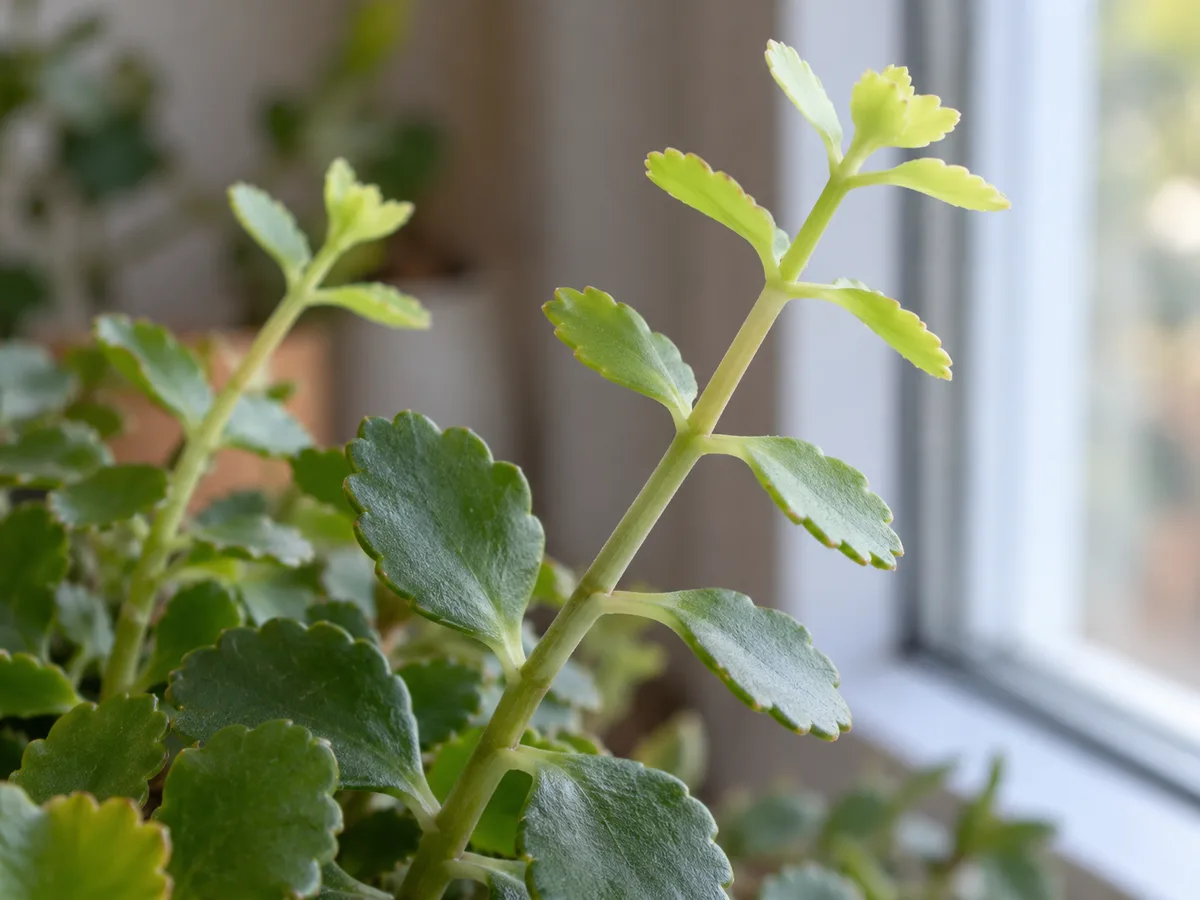
Low-light Kalanchoe detail: small pale leaves with wide internode gaps — compare with firm, tightly stacked growth on the same plant.
The bloom failure is diagnostic. Kalanchoe needs 6 to 8 hours of bright light every day to fuel flowering, so a plant that grows but never reblooms is telling you its light budget is short. Weak stems that flop under their own weight, plus soil that stays damp for three weeks or more, round out the picture of a succulent idling in light too dim to use water.
Why Kalanchoe stretches in dim rooms
Kalanchoe blossfeldiana evolved in the open, seasonally dry habitats of northeast Madagascar, and it is built for strong light — Clemson Extension notes it grows best in full sun and that plants tend to get spindly in low light conditions. Indoors it tolerates bright windows well, but a spot several feet from the glass delivers a fraction of what its thick CAM-photosynthesis leaves are designed to process.
That mismatch drives etiolation: the shade-avoidance response in which stems invest in vertical extension at the expense of leaf size and strength, with visibly stretched internodes and smaller, paler leaves. It also explains the rebloom problem — Kalanchoe is a short-day plant that needs about six weeks of 14 to 16-hour nights to set buds, and dim days plus lamp-lit nights deliver neither half of the equation.
Dim light creates a second trap unique to florist plants. Grocery-store kalanchoes usually arrive in moisture-holding peat, and a plant in low light barely drinks — so the mix stays wet, feeder roots suffocate, and the grower misreads the stall as thirst and waters again. Root rot usually results from a soil mix that does not drain quickly or from overly frequent watering, which is exactly the spiral a dark, peat-potted kalanchoe falls into.
How to confirm light is the real problem
Work through these checks before moving or pruning anything:
- New-growth pattern — Compare the newest leaf pairs with older ones. Smaller, paler leaves with widening gaps that all lean one direction point to light; uniform yellowing of old leaves first points more toward overwatering on Kalanchoe.
- Shadow test — Hold your hand a foot above the leaves at midday. A faint blurry shadow means low light; a defined shadow with soft edges is the bright indirect range Kalanchoe wants. No readable shadow means the spot is too dark for this species.
- Dry-down speed — A healthy kalanchoe in good light empties its pot in roughly 10 to 14 days in summer. If the mix is still damp after three weeks with no rot smell, the plant is not photosynthesizing enough to drink — a light problem disguised as a watering one. Confirm with the Kalanchoe watering guide.
- Bloom history — No buds since the grocery-store flush, despite months of care, strongly implicates light (and night length). Buds that form then blast may instead indicate temperature swings or pests — check the Kalanchoe slow growth guide if growth has stalled without stretching.
- Rot rule-out — Squeeze a lower stem base and sniff the soil surface. Firm tissue with dry-leaning mix confirms a pure light issue; soft translucent bases or sour mix mean root rot on Kalanchoe has joined in and must be handled first.
The first fix to try
Move the plant toward brighter light gradually — that single relocation is the whole first fix. Start with bright indirect exposure a few feet from an east- or south-facing window, then ease it into a couple of hours of gentle morning or late-afternoon sun over 7 to 10 days. NC State Extension warns that prolonged direct sun can scorch the leaves so afternoon shade is recommended, so a nursery-grown plant thrown straight into harsh midday rays will burn before it benefits.
Do not fertilize, repot, or prune on the same day as the move. One variable at a time lets you read the response: within two to three weeks the newest leaf pair should emerge deeper green and more tightly stacked.
Step-by-step recovery
Once the plant sits in its brighter spot, work through recovery in this order:
- Settle and observe (weeks 1–2). Leave the plant alone in the new position, rotating the pot a quarter turn every week or two for even growth. Water only when the top inch is completely dry — brighter light will gradually speed dry-down, so recheck with a finger or skewer rather than a calendar.
- Correct the watering rhythm (weeks 2–4). As photosynthesis resumes, the 10-to-14-day summer dry-down from the Kalanchoe watering guide should reassert itself. If the mix still stays soggy, the peat-heavy nursery soil is the bottleneck — plan a spring repot into gritty succulent mix per the Kalanchoe soil guide, but do not repot a stressed plant mid-recovery.
- Add supplemental light if windows fall short (any time). North-facing rooms or dark winters may never deliver enough. A full-spectrum LED grow light run 12 to 14 hours a day above the rosette mimics the bright days Kalanchoe expects — this practical timing is widely recommended by specialty houseplant growers for winter succulent care.
- Prune leggy stems (after stabilization). Stretched internodes never contract, so once compact new growth appears, cut lanky stems back to just above a leaf node with clean scissors. Spring cuttings of two to three inches with two pairs of leaves root readily after a few days of callusing — see the Kalanchoe pruning guide for shaping cuts.
- Reset the bloom cycle (October–March). After vegetative growth compacts, give the plant roughly 14 hours of total darkness daily for at least 6 weeks — a room where lamps stay off at night, or a closet routine each evening. Keep daytime light bright throughout; buds should show roughly 12 weeks after the long nights begin.
Recovery timeline
Expect new compact leaf pairs within 4 to 6 weeks of the move. Pale older leaves will not re-green — judge progress only by the color and spacing of the newest growth and by stems that stop leaning. Full rosette density returns over one growing season, and rebloom follows the next proper short-day cycle, not the week after the move. If stretching continues despite a bright window, the light is still insufficient and a grow light is the honest next step, not more fertilizer.
Lookalikes: what else mimics low light on Kalanchoe
| What you see | More likely cause | How to tell | Where to go |
|---|---|---|---|
| Soft translucent leaves, black stem bases, sour wet mix | Overwatering / root rot | Tissue is mushy, not just pale; soil never dries | Overwatering on Kalanchoe |
| Wrinkled, thin, papery leaves that perk after watering | Underwatering | Leaves shrivel rather than stretch; mix is bone dry | Underwatering on Kalanchoe |
| Stretched stems right after the bloom flush ends | Natural post-bloom legginess | Stretch follows flowering, not a dark spot; spent flower stems present | Leggy growth on Kalanchoe |
| White cottony clusters in leaf axils plus stunting | Mealybugs | Visible insects and sticky honeydew; Clemson lists mealybugs, aphids and brown scale as the most common kalanchoe pests | Mealybugs on Kalanchoe |
| Uniform yellow lower leaves, no lean, wet mix | Nutrient/water stall | Whole leaves yellow evenly rather than new growth emerging small and pale | Yellow leaves on Kalanchoe |
| Fine webbing with mottled yellow flecks | Powdery mildew in still damp air | Mottling and spot patterns rather than clean stretch; stagnant humid corner | Mold on soil on Kalanchoe |
Mistakes to avoid
- Feeding a dim plant. Fertilizer cannot substitute for photons, and salts accumulate when the plant is not growing. Clemson advises feeding actively growing plants once a month — a stalled, pale kalanchoe is not actively growing, so hold all feed until compact growth resumes.
- Sun-shocking it. Moving from a dark shelf straight into full midday sun scorches the same tender leaves you are trying to save. Acclimate over 7 to 10 days and keep harsh afternoon rays filtered.
- Watering on schedule in a dark spot. A plant that cannot photosynthesize cannot use water. Keep the allow the soil to dry out between waterings rule strict while light is low, or rot follows dimness.
- Pruning first. Cutting leggy stems before the light improves just produces a second flush of weak stretched regrowth. Light first, prune second.
- Chasing rebloom with lamps on at night. Ambient evening light during the dark period inhibits bud set — temperatures above 80°F during the long night period can further delay flowering, so keep nights dark and reasonably cool.
Kalanchoe care cross-check
Light, water, and mix form one system on this succulent. Confirm the bright spot against the Kalanchoe light guide, keep the soak-and-dry rhythm from the Kalanchoe watering guide, and make sure drainage matches the Kalanchoe soil guide — peat that stays wet for weeks will undo the benefit of any window. Feed only in active spring and summer growth per the Kalanchoe fertilizer guide, and browse the Kalanchoe problems hub if more than one symptom is present.
How to prevent it next time
Keep the plant within 2 to 3 feet of your brightest window year-round and shift it closer as winter days shorten — a spot that worked in June can be functionally dark by December. Rotate the pot regularly so one side never etiolates, and pair every seasonal move with a watering recheck since brighter positions dry faster. If you want the signature winter flower show, protect the October-to-March dark nights from room lamps and hold the plant in the 60°F night and 70°F day range NC State Extension recommends. Grouping it with other succulents under one winter grow light is the simplest insurance for small, dim apartments.
When to worry
Escalate when stems turn soft and translucent at the base, damage spreads across several leaf pairs within days, or the crown collapses — that is rot, not mere dimness, and needs the root rot path immediately. Total leaf drop after a sudden move into harsh sun is scorch shock: pull back to bright indirect light and wait. A plant that stays firm but stretched for a full season is not dying, just waiting — prune and relight it in spring rather than discarding a recoverable succulent.
Related Kalanchoe guides
- Kalanchoe overview — full care profile: light, water, soil, and rebloom basics.
- Kalanchoe light — long-term placement and seasonal window guidance.
- Kalanchoe watering — soak-and-dry rhythm to pair with brighter placement.
- Kalanchoe soil — gritty mixes that forgive brighter, thirstier positions.
- Kalanchoe fertilizer — when feeding resumes after compact growth returns.
- Leggy growth on Kalanchoe — go here when stretch persists after flowering rather than from a dark spot.
- Slow growth on Kalanchoe — go here when growth stalls without the pale leaning pattern.
- Yellow leaves on Kalanchoe — go here when yellowing dominates over stretching.
- Overwatering on Kalanchoe — go here when wet mix and soft tissue suggest water damage alongside dim light.
- Root rot on Kalanchoe — go here when stem bases blacken or smell sour.
- Mealybugs on Kalanchoe — go here when cottony clusters appear in leaf axils.
- Drooping leaves on Kalanchoe — go here when leaves flop without the one-sided lean toward light.
- Kalanchoe problems — browse all 16 documented issues on this species.