Slow Growth on Lithops (Living Stones): Why It Stalls &
Quick answer
A Lithops that sits unchanged for months is usually resting, not failing — this plant renews one leaf pair per year and can live decades in the same pot. First step: check the season and the fissure, move the pot into 4-5 hours of direct morning sun, and hold all water until the gritty mix is dry at depth and the cycle calls for a soak.
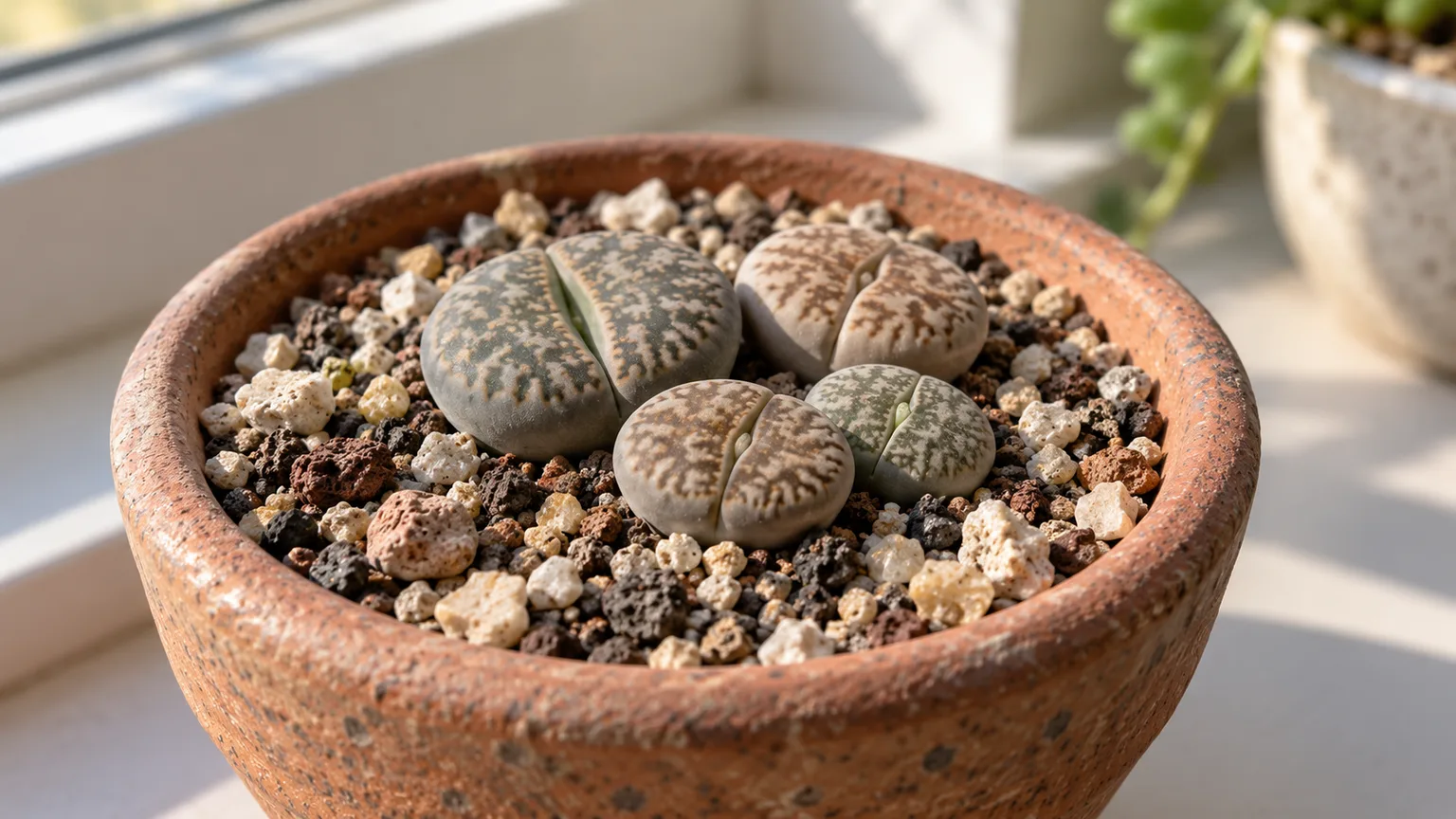
Slow Growth on Lithops: Causes, Checks & Fixes
This guide covers slow growth on Lithops. See also the general Slow Growth guide, watering, and light pages for this plant.
Slow Growth on Lithops: Causes, Checks & Fixes
Quick answer
A Lithops that has not changed size for months is usually doing exactly what it evolved to do. Each plant is only two succulent leaves fused into an inverted cone with no stem, and the whole visible body is water storage that can survive for months without rain. Real growth happens almost invisibly: one new leaf pair per year, built inside the old body.
First step: check the season and the fissure, move the pot into 4–5 hours of direct morning sun, and hold all water until the gritty mix is dry at depth. Do not water, fertilize, or repot to “wake it up.” Forcing growth on a resting stone plant is what stalls — or kills — it.
For how stalled growth works on houseplants in general, see our slow growth guide. On Lithops, the pattern usually shows up as a firm, flat, well-camouflaged body that simply sits through the season — versus a pale, rising cone (light starvation) or a soft, wrinkled body with damp mix (root trouble).
When to use this page vs other Lithops guides
- Firm stone sitting unchanged, no split yet — stay on this page to separate normal dormancy from a true stall.
- Body rising tall, pale, leaning toward glass — read leggy growth on Lithops; that is etiolation, a light problem with its own correction.
- Dull pattern and no direct sun but body still flat — start with not enough light on Lithops for placement diagnosis before structure changes.
- Soft, translucent, or splitting bodies with damp mix — read overwatering on Lithops and root rot on Lithops first; a stalled plant with wet roots is rotting, not resting.
- Deep wrinkling that ignores a correct seasonal soak — see underwatering on Lithops; thirst looks different from rest.
- Sun hours, acclimation, and grow-light setup — see Lithops light.
What slow growth looks like on Lithops
A healthy-but-quiet Lithops sits nearly flush with its gravel topdressing, roughly half an inch to an inch high, with a flat patterned crown split by a central fissure. It can hold that exact pose for months. That stillness is the camouflage strategy working: in its southern African habitat the plant hides as a pebble, and the genus is recorded there in Aizoaceae as a dry-adapted specialist, not a fast foliage producer.
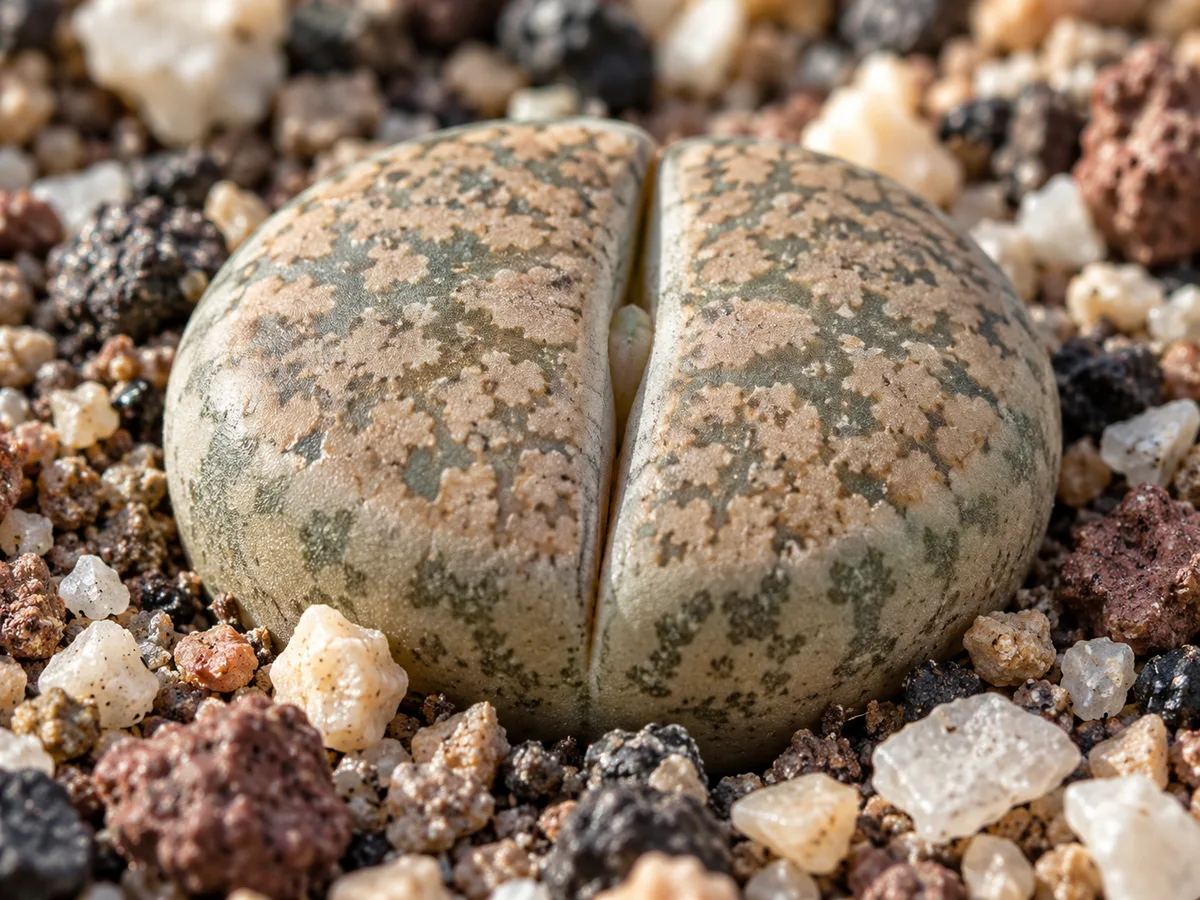
Firm, flat leaf pair with sharp windows and a closed fissure — a resting stone, not a failing plant. Compare with stretched or softened tissue described below.
The benchmark for growth on this plant is one renewal per year, not new leaves per month. RHS describes them as very small succulent perennials with paired, stone-like leaves, and a mature head may never visibly enlarge — instead the old pair dries to a papery sheath while the new pair takes its place. These plants can persist for 40 to 50 years, and it is quite possible to keep a plant in the same pot for 10 to 20 years, so a pot that looks “stuck” for a season is often simply long-lived.
A true stall looks different from rest. Suspect a real problem when a full growing season passes with no fissure activity at all, the body slowly rises into a paler cone, the windows wash out, or firmness fades toward soft or leathery. Stillness plus stretch means light starvation; stillness plus softness means water or root trouble — both covered in the checks below.
Why stillness is usually the cycle, not failure
Lithops runs on a strict yearly handoff: flower in autumn, rest, then grow a new leaf pair inside the old one through winter and spring while the old pair dries away. The new body pushes up through the fissure — the old fissure’s replacement forms at roughly 90 degrees to it — and consumes the old leaves as it expands. During that transfer the plant can look frozen for weeks while all the action happens underground and inside the body.
Watering discipline defines whether the cycle completes. The rule is to water only during certain stages and keep the soil dry at other stages: soak in active growth, then let plants go totally dry through winter and spring while the old pair is reabsorbed. Watering while the old leaves should be drying keeps them plump, blocks the handoff, and reads as “not growing” for a full season — the plant is stuck mid-renewal, not dormant.
Summer dormancy adds a second quiet window. In peak heat the plant rests again and wants drought, not encouragement. A Lithops that sits unchanged through summer in strong light with firm tissue is behaving correctly; soaking it to force activity risks splitting and rot instead of growth.
Real stall causes on Lithops
When a Lithops genuinely fails to renew, the causes are almost always cultural and specific to its stone-plant architecture.
Chronic low light. The crown needs about 4 or 5 hours of direct sunlight during the early part of the day. Below that, the plant first idles — no split, no flowers — then reaches: it will begin to grow slender and elongated, lean to one side to receive more light, lose coloration and turn greenish. A stall that slowly turns into a rising cone is light starvation graduating to etiolation, which is pale and drawn-out growth due to lack of light. Confirm placement math on Lithops light.
Wrong-season water. Soaking during the dry rest or mid-renewal keeps old leaves fat so the new pair cannot emerge, and the plant sits in suspended animation. Peat-heavy mix does the same thing passively by holding moisture for weeks around the taproot. The structural fix is mineral mesemb mix that dries fast, in 3 to 5 inch deep pots with drain holes that fit the extensive root system, as detailed on Lithops soil and the seasonal calendar on Lithops watering.
Root loss from past excess water. A plant whose fine roots rotted in a previous wet spell cannot take up the moisture that triggers the renewal cycle, so it sits — firm at first, then progressively more wrinkled — even when the current mix is dry. If the body fails to plump after a correct seasonal soak, suspect dead roots rather than thirst, and compare against root rot on Lithops.
Oversized pots, annual repotting, and feeding at the wrong time. A big pot of damp mix around a tiny taproot never dries on schedule; yearly repotting breaks the fine roots the plant needs for its one annual push; and nitrogen during dim months grows soft tissue instead of compact stone. Fertilize Lithops sparingly with a low-nitrogen, high-potassium formulation and only in active growth — or skip feeding entirely until a firm new pair proves the plant is moving. Cross-check timing on Lithops repotting and Lithops fertilizer.
Hidden root pests. Root mealybugs feed underground and can stall a plant for a season before any above-ground symptom appears. If light, water timing, and mix all check out but the plant ignores two consecutive active windows, unpot and inspect the roots and the taproot junction for white waxy clusters, then treat per mealybugs on Lithops.
How to confirm the cause
Work through these checks in order before changing anything:
- Season and cycle state — note the month. Late autumn through spring is renewal and rest; high summer is heat dormancy. A firm, unchanging body in those windows is usually normal. Only a missed full active window counts as a stall.
- Fissure activity — look into the central split with a magnifier. A widening fissure, a glimpse of new tissue inside, or old leaves thinning evenly to paper means renewal is underway — leave it alone and keep it dry. A tight, inactive fissure for a whole season means something is blocking the cycle.
- Direct sun on the crown — count hours of actual sun striking the top of the body. Under two hours of direct sun with no renewal confirms light as the driver. A southern window or unobstructed eastern exposure is the baseline; verify against Lithops light.
- Firmness and mix moisture — squeeze gently and push a wooden skewer to the bottom of the pot. Firm plus dry means rest or light-limited idle; soft, translucent, or leathery-plus-damp means water or root involvement — stop and read overwatering first.
- Mix and pot audit — peat-heavy, compacted, or sour-smelling mix, no drainage hole, or a pot far larger than the taproot all explain a stall even in good light. Compare with Lithops soil.
- Root inspection (last resort) — only if the plant ignored a full active season in good light with correct dry-downs. Unpot during an active window, shake off mix, and check for white firm roots versus brown mushy ones, plus waxy pest clusters. Repot immediately into dry mineral mix per Lithops repotting.
If the body is firm, the fissure shows slow activity, and sun hours are low, you have confirmed a light-limited idle — not disease. If tissue is soft or the mix smells sour, treat as rot first.
The first fix to try
Give the plant real morning sun and keep it completely dry.
Move the pot to a southern sill or bright eastern exposure where direct sun lands on the crown for the early hours, with partial afternoon shade in hot climates. If the plant has lived in deep shade, acclimate over 7–14 days — a sheer curtain pulled back a little more each day — because moving abruptly to brighter light can sunburn and fatally injure the plant. Hold all water until a skewer comes out completely dry and the pot feels light; the stored water in the fused leaves covers weeks of drought safely.
Do not fertilize, repot, topdress, or soak “to wake it up” this week — one variable at a time. When no window delivers useful direct sun, add a full-spectrum grow light 15–30 cm above the crown for 12–14 hours daily rather than extending a weak desk lamp into the evening.
Step-by-step recovery
After light is corrected and the mix is dry:
- Stabilize for two to three weeks in the brighter spot with no water. The crown color should hold and any lean should stop progressing.
- Resume strict seasonal watering only — a deep morning soak, then a full dry-out, and only during active growth windows per Lithops watering. Keep the plant totally dry while the old pair is being reabsorbed; if water is given too soon, the old leaves will try to continue to grow and the plant will not develop properly.
- Leave the old body alone. Do not peel the papery sheath “to help” — the new pair feeds on the old leaves as they dry, and interrupting the transfer stalls the reset by a full season.
- Fix drainage failure only if proven — peat-heavy mix that stays damp for more than a few days, no drainage hole, or a circling taproot. Move to mineral mesemb mix per Lithops soil, ideally in early active growth.
- Feed minimally or not at all until a firm new pair proves the plant is moving. One weak low-nitrogen feed in active growth is plenty; heavy feeding in shade rebuilds the same stalled, soft tissue.
Recovery timeline
Lithops measures recovery in seasons, not weeks. Plants grown from seed can be expected to flower in 3 to 4 years under optimal conditions — that is the natural pace of this genus.
| Milestone | What to expect |
|---|---|
| 2–3 weeks | Crown holds color; lean stops worsening; mix dries normally in the brighter spot. |
| 6–10 weeks | Fissure activity normalizes in the active window; no new upward push. |
| Next renewal (winter–spring) | New pair emerges firm with sharper pattern; old pair thins to paper. |
| One full year | One complete old-pair-to-new-pair handoff proves the stall is over; autumn flowering may resume under strong light. |
Judge recovery by the new pair emerging cleanly through the fissure, not by the old body enlarging. Note that stretched growth is permanent and the affected section never shrinks back — if the stall included etiolation, only the next generation comes in compact. If the plant ignores a second consecutive active window in good light with dry mix, recheck roots and pests rather than adding more water.
Lookalike symptoms
- Early low light without structural change — duller pattern and no flowers but body still flush with soil; see not enough light on Lithops.
- Light stretch with a rising cone — pale taller body leaning toward glass; that is leggy growth on Lithops, not simple stillness.
- Overwatering with weak light — translucent, splitting, or mushy base with damp mix; prioritize overwatering and root rot.
- Normal renewal wrinkling — old pair shriveling evenly to paper in winter–spring while the center stays firm is the cycle working, not thirst; do not soak.
- Underwatering outside the rest — deep wrinkling plus failure to plump after a correct seasonal soak points to underwatering or dead roots.
- Wrinkled new pair with firm old leaves — wrong-season water kept the old pair fat; hold drought until the sheath dries fully.
What not to do
Do not soak a resting Lithops to force growth — excess water during the dry rest or mid-renewal is the fastest way to convert a healthy idle into splitting or rot. Do not fertilize a stalled plant in dim light; feed cannot replace the direct sun the crown needs and only builds softer tissue. Do not repot on day one unless the mix is failing or roots are proven dead — Lithops resents root disturbance and a dry rest in the current pot is safer than a fresh pot at the wrong season. And do not peel, pick at, or water the papery sheath to “free” the new leaves; the old pair is food, not packaging.
How to prevent slow growth next time
Build the setup so strong light and fast drying are the default. Keep the plant on the sunniest sill year-round, topdress with gravel so the crown sits just above fast-draining mineral mix, and house it in a deep-enough breathable pot with drainage holes rather than a wide shallow bowl. Follow the seasonal calendar on Lithops watering — soak in active growth, drought through dormancy and renewal — and match every other choice to brightness using Lithops light and Lithops soil.
Repot on a 3–5 year rhythm instead of annually, feed sparingly if at all, and start from the whole-plant baseline on the Lithops overview whenever two or more conditions change at once. Compare against the full Lithops problems hub before assuming stillness means failure — on this plant, patience is a care technique.
When to worry
Stillness alone is a care correction, not an emergency. Escalate if the body turns soft or translucent, the base darkens, the plant smells sour, or several heads collapse at once — that is rot or cold damage riding on the stall, not simple rest. A plant that also fails to plump after a correct seasonal soak needs a root-zone inspection before the next scheduled watering. Otherwise, hold light steady, keep the dry rest dry, and give the renewal cycle time to do the growing you cannot force.
Related Lithops guides
- Lithops overview — whole-plant baseline for seasonal rhythm and dry-adapted anatomy
- Lithops light — window direction, acclimation schedule, and grow-light distance
- Lithops watering — seasonal soak calendar and dry-rest rules
- Lithops soil — mineral mesemb mix and drainage that keeps the cycle on schedule
- Not enough light on Lithops — placement diagnosis before structural stretch
- Leggy growth on Lithops — separating etiolation from a healthy idle
- Overwatering on Lithops — translucent and splitting bodies in damp mix
- Root rot on Lithops — soft base with wet soil and dead roots
- Lithops problems — hub for comparing every documented issue
FAQs
How do I know my Lithops is resting and not dying?
A firm, flat, well-patterned body with a slowly thinning old pair and dry gritty mix is resting or renewing — healthy behavior for a plant that replaces one leaf pair per year. A soft, translucent, or darkening body with damp or sour mix is in trouble and needs a root-zone inspection, not patience.
Should I water a Lithops that has not grown for months?
Only if the season and the fissure agree: soak during an active growth window when the mix is dry at depth and the old pair has finished drying. Never soak during the dry rest or mid-renewal to force activity — water at the wrong stage blocks the handoff and risks rot.
Can I fertilize my Lithops to make it grow faster?
No — fertilizer cannot speed up a plant whose pace is set by light and season, and feeding in dim light or dormancy builds soft, vulnerable tissue. Use a weak low-nitrogen feed only during active growth under strong light, once a firm new pair shows the plant is moving.
How long until a stalled Lithops shows new growth?
Plan on one full renewal cycle, typically through winter into spring, before a clean new pair proves recovery. The old body never enlarges; success is a sharp-patterned new pair emerging through the fissure, which can take a full year on this very slow genus.
What setup keeps Lithops growing on schedule?
About 4–5 hours of direct early-day sun, mineral mesemb mix in a 3–5 inch deep pot with drainage holes, soaks only in active windows with total drought during renewal, and repotting every 3–5 years. Match every change to the season rather than the calendar.
Conclusion
Slow growth on Lithops is usually a misread calendar, not a sick plant: a firm stone sitting through its dry rest or mid-renewal is behaving exactly as its southern African origins programmed it. Confirm the season and fissure state, correct light to real morning sun, hold the drought the cycle demands, and let one full renewal prove the fix. You cannot hurry a plant that lives for decades and renews once a year — but one correct cycle under bright, gritty, restrained conditions restarts the rhythm better than any rescue soak could.
Related tool
Use the Plant Problem Diagnosis Tool to narrow causes for slow growth on this plant before changing multiple variables at once.