Mealybugs on Lithops: Causes, Checks & Fixes
Quick answer
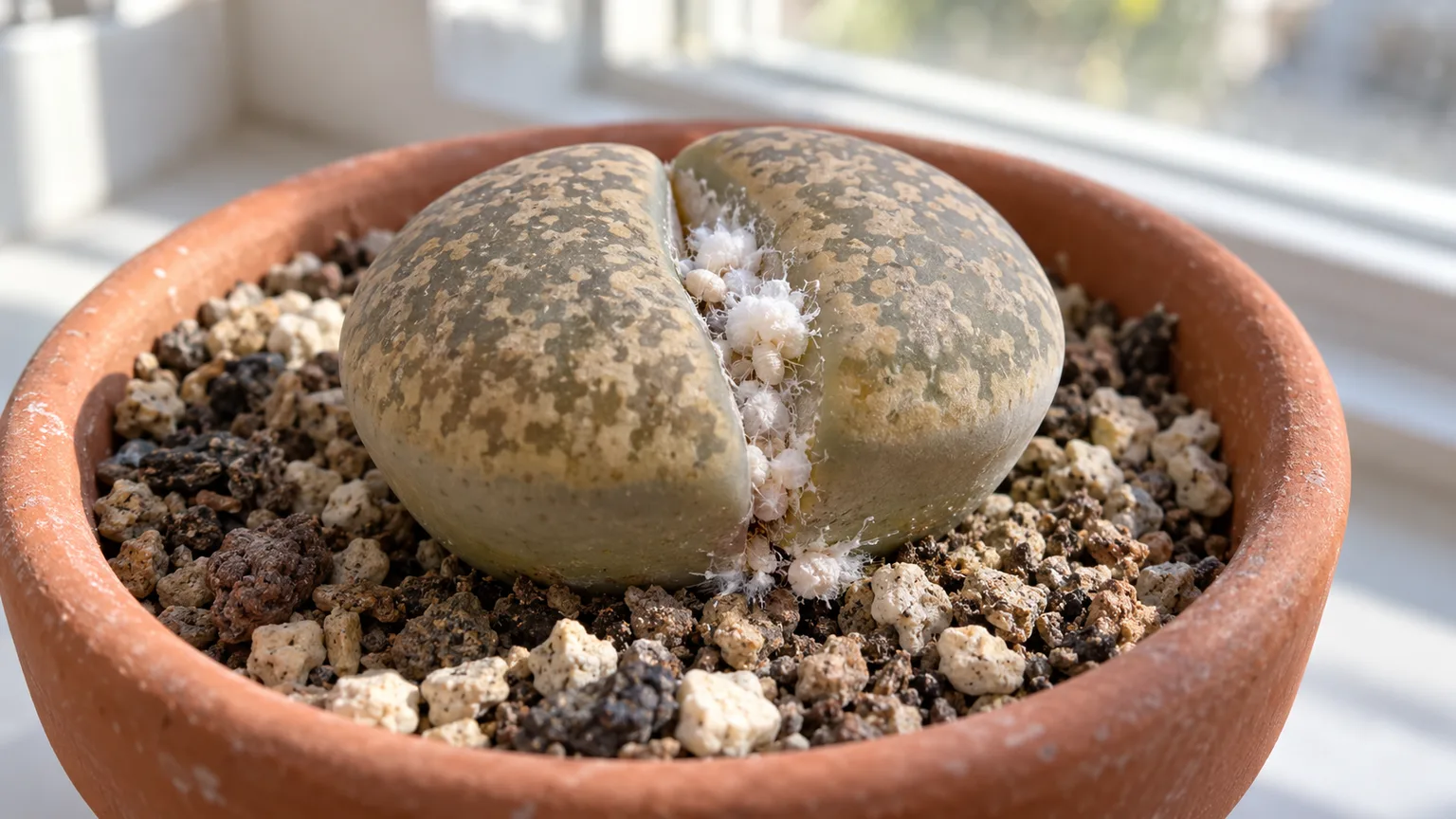
Mealybugs on Lithops hide in the top fissure, around the sides at soil level, and under dry old-leaf husks. First step: isolate the pot and dab every visible cottony cluster with an alcohol-dipped cotton swab, then re-check in 7 days before reaching for any spray.
Mealybugs on Lithops: Causes, Checks & Fixes
This guide covers mealybugs on Lithops. See also the general Mealybugs guide, watering, and light pages for this plant.
Mealybugs on Lithops: Causes, Checks & Fixes
Quick answer
Your living stone has white cottony fluff tucked somewhere it should not be, and you need to know whether it is a pest or just mineral crust. On Lithops the answer matters more than on a leafy plant: there are only two leaves to work with, no spare foliage, and a wrong drench during splitting season can finish what the bugs started. NC State lists mealybugs among the monitored pests for this genus, so treat any true cottony cluster as a real infestation, not cosmetic dust.
First step: isolate the pot and dab every visible white cluster with a cotton swab dipped in isopropyl alcohol (no more than 70%). That kills on contact without soaking the plant. For general mealybug biology and life stages, see our mealybugs guide. On Lithops, the pattern usually shows up as fluff packed into the top fissure or a white ring around the body exactly at soil level — places a routine glance from above never checks.
What mealybugs look like on Lithops
Forget the picture of mealybugs spread across big leaves. A Lithops is a single paired body sitting at soil level, so the insects work the few sheltered seams available: the central fissure across the top, the vertical sides where the body meets the gritty top dressing, and underneath papery husks of old leaves that cling to the base. The RHS notes that glasshouse mealybugs cluster in exactly these kinds of inaccessible spots — leaf axils, sheaths, and crevices — and cacti and succulents are among their favorite hosts.
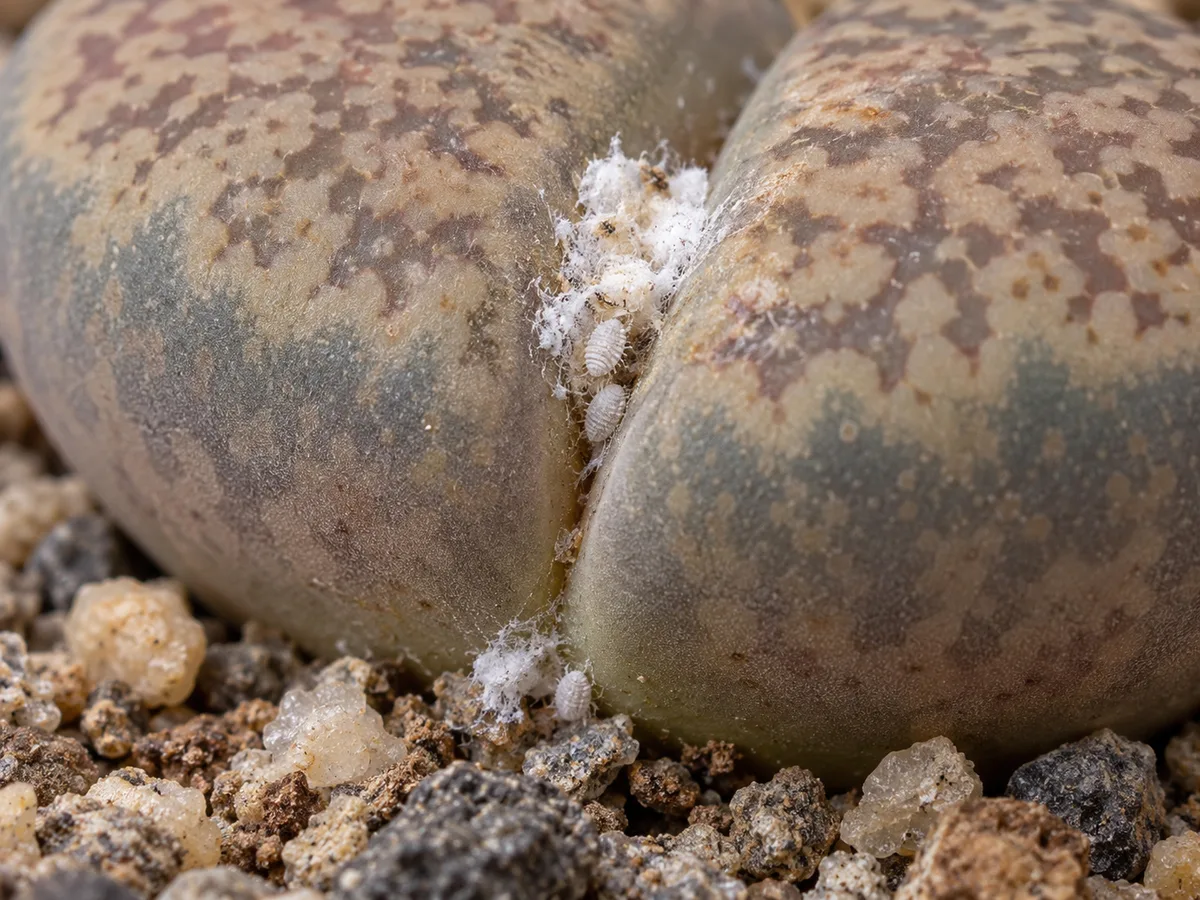
Macro view: cottony wax masses lodged in the fissure and soil-line crevices, the two places mealybugs hide first on Lithops.
An adult female is tiny — about 1/16 to 1/8 inch long with a white, waxy, oval body — and she sits under a fluffy white wax coating with her orange-pink eggs hidden beneath it. On Lithops that means you see cotton first and the insect second: poke the fluff gently with a toothpick or hand lens and look for soft oval bodies rather than dry crumbs. Heavy feeding drains sap from a plant that stores almost all its water in those two leaves, so an infested body looks dull, slightly deflated, or stalls instead of plumping after its correct seasonal soak. Sticky honeydew and black sooty mold are less obvious on Lithops than on leafy plants, but check neighboring pots and the shelf — honeydew on the surface below the plant is a giveaway that sap-feeders are overhead.
Why Lithops gets mealybugs
Mealybugs do not fly or crawl far on their own; the RHS confirms they usually arrive on an affected plant, which makes new acquisitions and crowded windowsills the main route onto Lithops. A starter collection packed pot-to-pot lets crawlers walk from an infested succulent to a clean living stone in days, and ants will actively farm and transport them. Because Lithops sits half-buried with its sides touching top dressing, it offers more undisturbed contact shelter than an upright plant — grit, husks, and the pot rim form a protected ring the insects never have to leave.
Greenhouse-warm indoor conditions let populations build year-round, and a Lithops that is watered off-schedule is a softer target: excess water keeps bodies turgid and sappy rather than hard and dormant, exactly the tissue sap-feeders prefer. Read the Lithops watering rhythm before treating, because a plant watered during leaf renewal or winter rest is stressed in ways that slow its response to any pest cleanup. Overpotted plants in organic-rich mix stay damp longer and give root mealybugs — waxy species that feed underground on roots — a comfortable home the surface inspection never sees.
How to confirm the cause
Work in this order so you do not mistake mineral deposits for insects:
- Fissure check. With a hand lens or phone macro, look straight into the top fissure. Mealybug wax is fluffy and three-dimensional, often with visible oval bodies or eggs underneath; mineral crust is flat, crystalline, and dry.
- Soil-line ring. Brush back the top dressing and inspect the full circumference where the body meets the mix. White waxy clusters tucked against the sides are classic mealybugs. Perlite dust and fertilizer salts wipe away as dry powder with no bodies.
- Husk lift. Gently lift any papery old-leaf husks clinging to the base. Mealybugs shelter under them; if the husk is clean and dry, that is one hiding spot cleared.
- Ant patrol. Watch the pot for a few minutes. Ants going in and out of the pot are scouting honeydew, and ant traffic is near-proof that sap-feeders are present even if you have only found one cluster.
- Root check for dull, stalling plants. If the body looks deflated outside splitting season and surface clusters keep returning, unpot and look for white waxy masses on the roots and lower taproot. The RHS notes some Rhizoecus species feed on plant roots under glass — on Lithops this is the infestation most growers miss.
Confirm before spraying anything. One cottony cluster in the fissure is a dab-and-watch job; waxy masses on the roots are an unpot-and-repot job, and the two need different fixes.
The first fix to try
Isolate the pot away from every other succulent, then dab — do not spray, do not drench. Soak a cotton swab in isopropyl rubbing alcohol at no more than 70% strength, touch each white cluster directly, and lift the dead wax away. Test on one small spot of the body first and wait a day;The Spruce’s leaf-test advice matters doubly on Lithops because alcohol sitting in the fissure can mark the windowed leaf tops. Work with the pot tilted so excess alcohol runs off rather than pooling in the crease.
This single action — physical removal with alcohol — is the whole first fix. It kills on contact, removes the egg masses hidden under the wax, and adds zero moisture to a plant that may not want water this month. Mark the date and re-inspect in 7 days; mealybug nymphs complete development in roughly a month in warm conditions, so one pass never ends it.
Step-by-step recovery
Follow the severity. Most Lithops cases resolve at step 1 or 2.
Light case (a few clusters, firm body): Dab with alcohol, remove the wax with tweezers, and re-check weekly for a month. Wipe the pot rim and wash the top dressing surface. Keep the plant in its normal bright spot — see the Lithops light guide — since strong light keeps growth compact and easy to inspect.
Returning clusters (new fluff within 1–2 weeks): Step up to insecticidal soap or superior horticultural oil, applied exactly per label, aimed into the fissure and soil-line crevices where crawlers hide. The Missouri Botanical Garden advises thorough coverage of hiding spots with soap or oil sprays and repeats per label instructions. Epic Gardening suggests reapplying soap in 7 to 10 days while insects persist. Apply in the evening out of direct sun, keep liquid out of a splitting fissure, and never stack soap, oil, and alcohol on the same day.
Heavy or root infestation (masses on roots, ants farming, body collapsing): Unpot, shake off all old mix, wash roots gently, dab remaining clusters with alcohol, and repot into completely fresh gritty mix as described in the Lithops soil guide and repotting walkthrough. The RHS is blunt that it can be simpler to dispose of heavily affected plants than to eliminate mealybugs — with a very slow species like Lithops, a badly weakened single head costs less to replace than to rescue over two seasons.
Do not fertilize during recovery. A stressed Lithops needs no feed, and soft nitrogen-pushed growth is more attractive to the next crawler wave. Resume the normal seasonal watering only — the overwatering page shows how extra drinks during treatment bloat bodies and invite rot on top of the pest damage.
The root-mealybug check, step by step
Root mealybugs deserve their own section because they defeat every surface treatment and they love exactly the conditions Lithops dislikes least: a pot that stays faintly damp. If surface clusters return after two careful dabbing rounds, or the body stays dull and wrinkled despite correct seasonal watering, unpot on a dry day:
- Tip the plant out and shake the gritty mix free. White waxy clumps on fine roots or the upper taproot — not uniform root hairs, but cottony masses — confirm root mealybugs.
- Rinse roots under lukewarm water, dab survivors with an alcohol swab, and let the plant air-dry for a day in bright shade.
- Repot into fresh, fully mineral mix in a clean pot; discard the old mix and scrub the pot before reuse. The shallow-breathing-pot logic on the Lithops soil page applies double here: fast dry-down is hostile to root pests.
- Hold water for at least a week after repotting, longer if the plant is mid-split, then resume only the correct seasonal soak.
One unpot done cleanly beats months of surface dabbing against an underground population.
Recovery: what to expect on a plant this slow
Set expectations by the Lithops calendar, not the houseplant one. Current leaf-pair scars, sucked-dry patches, and dull windowed tops never heal back to perfect — judge progress by the next replacement pair, not the damaged one. A firm body that holds its shape through the dry rest, followed by a clean new pair emerging on schedule, is success. Because Lithops develops one new leaf pair per year and grows very slowly, full visual recovery can take a full seasonal cycle; that is normal, not failure.
Signs of improvement: no fresh wax for 3–4 weeks, firm body, normal splitting or flowering on schedule. Signs of trouble: returning fluff, spreading softness at the base, sour-smelling mix, or a body that wrinkles and fails to plump after its correct soak — that combination points to root mealybugs plus rot, and means unpot immediately following the root rot checks.
Mistakes to avoid
- Blasting water into the fissure. A shower dislodges mealybugs on leafy plants but on Lithops it parks moisture in the central crease, the fastest route to splitting-body rot. Dab, do not hose.
- Drenching with neem or oil during leaf renewal. Oils plus a splitting plant plus sun equals burned new leaves. If the old pair is feeding the new pair, postpone anything wetter than a swab.
- Stacking repot, spray, and feed in one day. Each is a stress event; combined on a mesemb they compound. One intervention, then observe.
- Tossing the top dressing and calling it done. Fresh grit over surviving root mealybugs just hides them. If roots are infested, the mix must be replaced, not topped.
- Skipping quarantine after cleanup. The Missouri Botanical Garden recommends examining and quarantining new plants for 2 or 3 weeks; the RHS suggests at least a month of isolation for new acquisitions. Keep the treated Lithops separated until a full month passes with no fresh wax.
Lookalike symptoms on Lithops
| What you see | More likely | How to tell apart |
|---|---|---|
| Flat white crystalline crust on body or pot rim | Mineral deposits from hard water | Crust is flat and gritty, wipes to dry powder, no oval bodies under lens — see mold on soil for soil-surface confusion |
| Fine webbing plus stippled dull skin, no cotton | Spider mites | Mites make silk and tiny speckles; mealybugs make 3D cotton with bodies inside |
| Shiny sticky small insects clustered in fissure | Aphids | Aphids are glossy individual insects, often green or black, not wrapped in white wax |
| Body splitting open after watering | Overwatering split, not pests | Clean rupture from turgor pressure with no wax or insects present |
| Wrinkled soft body, no wax anywhere | Underwatering or root loss — compare underwatering and root rot | Wrinkling without any cotton, often with sour mix (rot) or bone-dry pot (thirst) |
When the lookalike table points away from insects, follow the linked page instead — each covers its own confirmation checks.
Lithops care cross-check
Mealybugs establish faster on stressed plants, so run this quick audit after cleanup: is the pot on the correct seasonal schedule in the watering guide? Is it getting the 4–5 hours of morning sun and afternoon shade of the light guide? Is the mix genuinely mineral and fast-draining per the soil guide? And is the plant in active growth versus splitting or resting — the Lithops overview lays out the annual rhythm that decides whether watering or feeding is even appropriate this month. Fix the cultural miss behind the outbreak or the crawlers will be back.
How to prevent it next time
Quarantine every newcomer for at least a month before it joins the windowsill — mealybug females do not travel far, so isolation of new plants breaks almost every introduction chain. Space pots so bodies do not touch, brush spent husks off promptly since they are ready-made shelters, and inspect the fissure and soil line with a lens whenever you handle the plant. Keep the mix very gritty and the pot shallow so dry-down is fast; a Lithops that dries correctly between seasonal soaks is simply a harder host. Finally, control ants around indoor pots — where ants patrol, mealybugs usually follow.
When to use this page vs other Lithops guides
Use this page when you see fluffy white wax with bodies or eggs underneath, in the fissure, at the soil line, under husks, or on washed roots. Use aphids for glossy unwaxed insects, spider mites for webbing and stippling, mold on soil for fuzz confined to the mix surface, and overwatering or root rot when the body softens or splits with no insects present. If new growth is simply slow with no pests at all, slow growth is the right page. Browse the full set from the Lithops problems hub.
Related Lithops guides
- Lithops overview — annual splitting rhythm and seasonal calendar; start here if you are unsure whether your plant should be watered at all right now.
- Lithops problems hub — full index of Lithops diagnoses; use when the lookalike table above leaves you torn between two causes.
- Lithops watering — seasonal soak timing; read before and after any pest treatment so you do not water a plant that should be dry.
- Lithops light — bright-position requirements; weak light stretches bodies and makes inspection harder.
- Lithops soil — mineral gritty mix recipe; essential reading when root mealybugs force a full repot.
- Root rot on Lithops — soft base and sour mix with or without pests; use when unpotting reveals mush rather than just wax.
- Overwatering on Lithops — splitting and translucency from excess water; use when bodies burst without any insects present.
- Aphids on Lithops — glossy sap-feeders in buds and fissures; use when the insects lack white wax coating.
- Spider mites on Lithops — webbing and stippled skin; use when damage is speckled rather than cottony.
Related tool
Use the Pest Identifier Tool to narrow causes for mealybugs on this plant before changing multiple variables at once.