Aphids on Lithops: Causes, Checks & Fixes
Quick answer
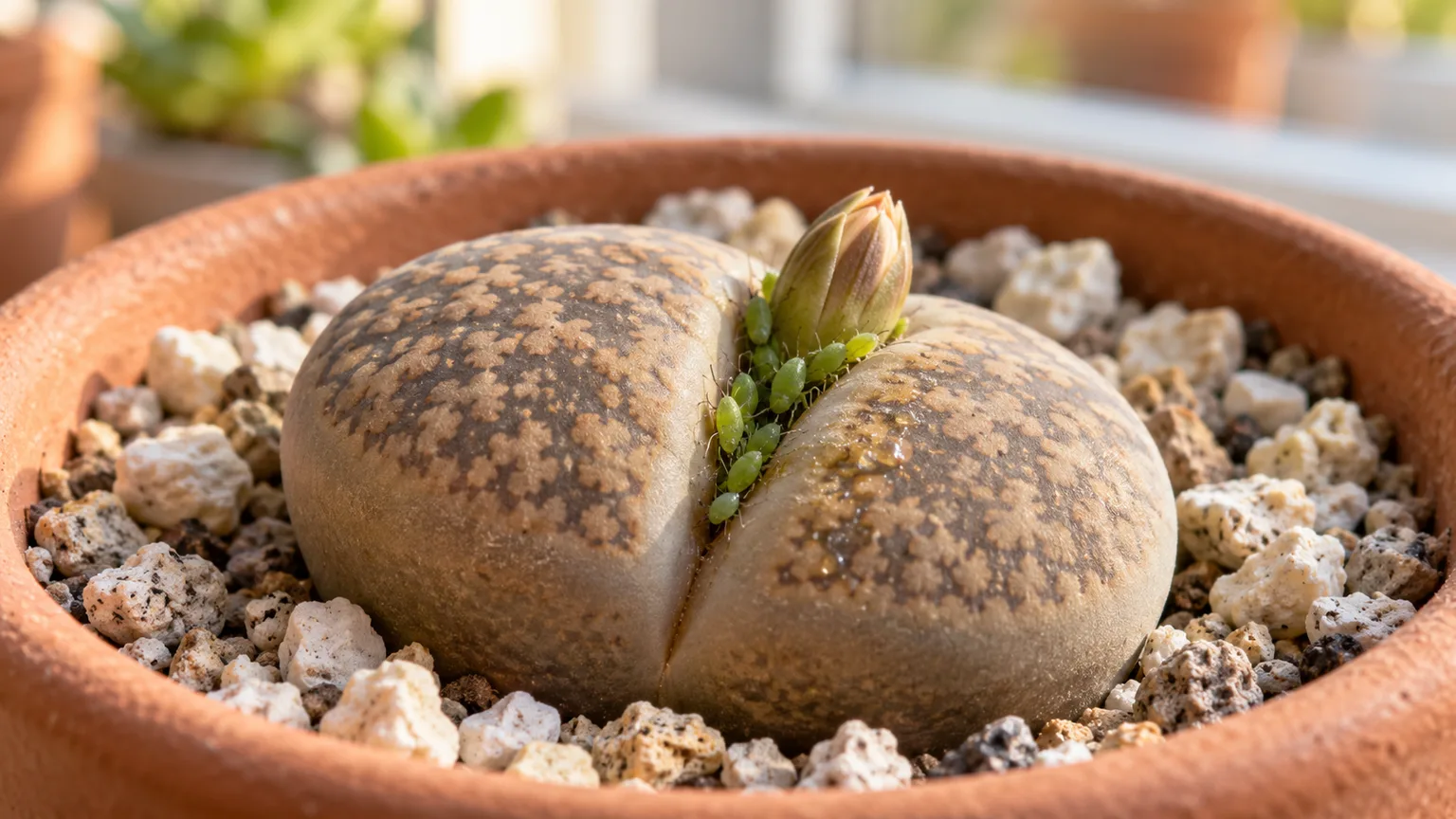
Sticky residue or tiny clustered insects in the cleft between the leaves usually mean aphids feeding on fresh fissure growth or flower buds. First step: isolate the plant and dab colonies off with a damp cotton swab, keeping the leaf bodies and gritty mix dry.
Aphids on Lithops: Causes, Checks & Fixes
This guide covers aphids on Lithops. See also the general Aphids guide, watering, and light pages for this plant.
Aphids on Lithops: Causes, Checks & Fixes
Quick answer
If your living stones show tiny clustered insects or sticky film deep in the cleft between the two leaves, aphids are the likely cause, not ordinary thirst. A Lithops body is just one fused leaf pair sitting at soil level, so there are almost no stems or leaf undersides for pests to hide on. The fissure and any emerging flower bud are the only soft tissue worth eating, and that is exactly where aphids settle.
First step: isolate the pot and dab every visible colony off with a damp cotton swab, working gently inside the fissure and around buds. Keep the leaf bodies and the mineral mix as dry as possible while you work. Do not reach for a hose or a full-canopy spray on day one. Soaked living stones split, and wet grit around a stressed taproot invites the root rot Lithops are famous for.
Aphids are slow-moving and visible once numbers build, and indoor colonies stay active all year round. Catching a fissure colony before honeydew coats the leaf windows is far easier than rescuing a bloom already drained of sap.
Why Lithops gets aphids in the fissure and on buds
There is only one place to feed. Living stones are stemless plants, usually with only two thick leaves and much of the body underground, growing rarely more than an inch above the soil surface (Gardening Know How). Mature leaf faces are tough, waxy, and low in nitrogen. Fresh tissue appears in exactly two spots: the narrow band of new growth inside the fissure and the daisy-like bud that pushes up through the cleft in bloom season. Aphids are sap-sucking true bugs that feed on foliage, stems, and flowers, so on Lithops they pack into those two soft spots and ignore the hardened leaf faces.
Blooms are the peak-risk window. A flowering Lithops holds its bud and open flower above the bodies for days, pumping sugary sap into tissue with none of the plant’s normal armor. Winged aphids drifting from nearby houseplants or an open window find that bud by scent and settle first on sepals and petals, then spill down into the fissure. If your plant only ever gets aphids while a bud is up, that is the normal pattern, not a coincidence.
Nearby plants are the usual source. Living stones kept on a windowsill beside herbs, hibiscus, or a new nursery succulent inherit their neighbors’ pests. Ants commuting across the grit to the fissure are a classic giveaway, since honeydew attracts ants that then protect the colony. A plant that spent summer outdoors and came back inside without inspection is another common entry route.
Soft growth invites heavier attack. Lithops on rich organic mix with frequent water push puffier, nitrogen-loaded tissue that aphids prefer over hard-grown bodies. Gritty culture is protective: plants grown in a cactus mix with sand that dries fully between waterings in the brightest available spot grow dense, slow tissue that supports smaller colonies. For the general mechanics of how sap feeding weakens plants, see our aphid guide. On Lithops, the pattern above is what that feeding looks like in miniature.
What aphids look like on Lithops
- Clusters of small pear-shaped insects about 1 to 7 mm long, green, black, yellow, or pink, packed into the fissure or on bud surfaces
- Colonies tucked where the bud meets the leaf cleft, sometimes half-hidden until the flower opens further
- Sticky, shiny honeydew filmed across the leaf tops and windowpanes near the cleft
- Ants traveling across the grit and up the bodies toward the fissure
- Buds that stall, deform, or fail to open, with petals chewed or glued by honeydew
- A gray-black sooty mould film growing on untreated honeydew, dulling the leaf windows
- White cast skins shed by molting aphids lodged in the cleft

Tiny pear-shaped insects clustered in the cleft and on bud tissue, with sticky honeydew on the leaf tops nearby.
Because a Lithops has almost no leaf underside to check, the fingertip test matters more here than on leafy plants. Touch a leaf top near the cleft. Tacky residue that returns within a day means sap feeders are still active above, even if the fissure looks empty at a glance.
Confirm aphids vs. overwatering, mealybugs, mites, and normal splitting
Work in this order so you never spray a rotting plant for bugs it does not have:
- Body firmness - Gently squeeze the leaf pair. Firm bodies with insects only in the cleft point to aphids. Soft, translucent, or splitting bodies on damp mix mean excess water comes first; read the overwatering guide for Lithops before any pest treatment.
- Fissure scan - Use a magnifier and good side light to look straight down into the cleft and around any bud base, where colonies hide.
- Honeydew test - Wipe a leaf top clean and recheck in 24 hours. Returning stickiness confirms active sap feeders.
- Ant trail follow - Ants crossing dry grit toward one plant usually lead to honeydew in its fissure, not to soil pests below.
- Mix moisture - Confirm the grit is dry all the way down per the Lithops watering guide. Treating pests on a wet pot traps moisture against the bodies.
Symptom lookalike comparison
| What you see | Likely cause | Key check |
|---|---|---|
| Soft pear-shaped insects clustered in the cleft or on buds | Aphids | Colonies move when touched; honeydew returns after wiping |
| White cottony tufts in the cleft or at the soil line | Mealybugs | Stationary waxy masses; dabbed alcohol turns them orange-gray |
| Fine stippling with no visible insects and no stickiness | Spider mites | Mites favor dry air; damage without honeydew or ants |
| Bodies splitting with clear fluid, no insects | Overwatering | Wet mix history; see overwatering and root rot |
| Old leaf pair thinning while a firm new pair emerges inside | Normal leaf renewal, not pests | No insects, no honeydew; keep dry per the Lithops soil and watering rhythm |
| Pale stretched growth with wide gaps and no insects | Not enough light | Elongation without colonies; compare with yellow leaves from light hunger |
Confirmed diagnosis - Visible pear-shaped insects plus honeydew or ants at the fissure with firm bodies. Suspected - Stickiness without visible insects means recheck the cleft with magnification at different times of day before treating, since small colonies hide deep in the fold.
First fix: isolate, swab, and spot-treat without soaking
Isolate the pot away from other houseplants until you see no new aphids for at least two weeks after treatment. Winged adults wander, and one infested bud can seed a windowsill collection.
Dab colonies off by hand first. Moisten a cotton swab, wrap it to a fine point, and lift aphids out of the fissure and off bud surfaces. Support the bud stem with a fingertip so it does not snap. This is the lowest-risk first fix for living stones: no residue on the leaf windows and no water driven into the cleft or the mix. Extension guidance notes that dislodged aphids rarely climb back onto the host (Colorado State Extension), and a swab achieves the same removal without the drenching a hose would cause.
When swabbing is not enough
If colonies refill the fissure within two to three days, spot-treat with insecticidal soap labeled for ornamentals. Rules that keep living stones safe:
- Treat only while the mix is dry and the plant is in active growth, never during leaf renewal when no water should be given at all.
- Apply with a swab or a fine dropper directly onto the colony, not as a whole-plant drench. Contact sprays only kill insects they touch.
- Work in the morning so any dampness in the cleft evaporates in bright air the same day; never leave the fissure wet overnight.
- Patch-test one spot and wait 24 hours before treating a second head in a clump.
- As an alternative, neem oil works by suffocating aphids and disrupting feeding and reproduction on contact, with repeat applications about a week apart until colonies stop returning.
What not to do the same day
Do not hose the plant down, do not soak the pot to “flush pests out,” and do not repot to check roots the same day you start treatment. Repotting a Lithops outside its early-growth window sets it back for months, and wet handling of the bodies is exactly how a small aphid problem becomes fatal rot. Do not fertilize either; extra nitrogen pushes the soft growth aphids prefer.
Recovery timeline and bloom expectations
Visible aphids should clear within one to two weeks of consistent swabbing or spot treatment. Because growth is extremely slow, judge success by absence: no returning stickiness, no ants, and a bud that opens cleanly. Leaf faces that were pitted or scarred will stay marked until the old pair is shed and replaced, which can take a full season. A bud that aborted from heavy feeding will not reopen; the next bloom is the real report card.
Firm bodies throughout treatment are the good sign. Softening at the base, spreading translucency, or a sour smell from the mix means moisture damage, not aphids, and needs the rot response immediately.
How to prevent aphids on Lithops
Quarantine every new plant for two weeks before it joins the windowsill, and inspect the fissure weekly from late summer through bloom season when buds are up. Keep culture hard and dry: the brightest window you have, a shallow breathable pot of mostly mineral grit per the Lithops soil guide, and water only in active growth windows per the Lithops watering guide. Strong light and dry-down cycles grow the dense tissue aphids like least, and good airflow around widely spaced pots makes it harder for winged adults to settle. Check the full Lithops care hub each season so watering restraint, light, and mix stay aligned; the problems hub collects every issue page for this species in one place.
When to escalate
Escalate if colonies refill the fissure after three full rounds of swabbing plus spot treatment, if sooty mould spreads across the leaf windows and blocks light, or if ants defend the colony so aggressively you cannot work the cleft. A second pest at the same time, such as mealybugs at the soil line alongside fissure aphids, also warrants a fresh identification pass rather than stronger sprays. For heavy recurring infestations, a local extension office can confirm the pest; avoid soil-applied systemics on a plant this small and slow unless an expert directs it, since the Lithops fertilizer and chemistry margin is narrow and bloom buds are sensitive.
Living stones are southern African mesembs in the genus Lithops built to survive neglect, not chemistry. Aphids alone rarely kill a firm plant, but the wrong treatment, too much water too fast, surely can.
When to use this page vs other Lithops guides
- Lithops watering guide - Use for routine moisture checks before assuming insects are the main issue.
- Lithops problems hub - Browse all 16 common issues on this species.
- Overwatering on Lithops - Different path when bodies are soft or splitting on damp mix.
- Root Rot on Lithops - Different emergency when the base softens or smells sour.
- Mealybugs on Lithops - Different entry point when white waxy masses, not soft pear-shaped insects, fill the cleft.