Overwatering on Lithops: Causes, Checks & Fixes
Quick answer
Stop watering immediately and let the gritty mix dry completely. On Lithops, translucent, splitting, or mushy leaf bodies mean the plant took up water it could not use — most often during leaf replacement or dormancy. Firm bodies usually recover with drought; soft, glassy, or sour-smelling bases need unpotting and rot triage.
Overwatering on Lithops: Causes, Checks & Fixes
This guide covers overwatering on Lithops. See also the general Overwatering guide, watering, and light pages for this plant.
Overwatering on Lithops: Causes, Checks & Fixes
Quick answer
Stop watering immediately and let the pot dry out completely. On Lithops, swollen, glassy, or splitting leaf bodies mean the plant absorbed water it had nowhere to put — most often because it was watered during leaf replacement or dormancy. For how standing water damages roots on any houseplant, see our overwatering guide. On Lithops, the pattern shows up as translucent sides, burst skin, or a soft base instead of ordinary yellow leaves.
First fix: move the pot to your brightest warm spot with good airflow and withhold all water until the mix is dry all the way down and the bodies feel firm again. Unpot only if tissue turns mushy, glassy, or sour-smelling — that signals rot, and drying in place is no longer enough.
What overwatering looks like on Lithops
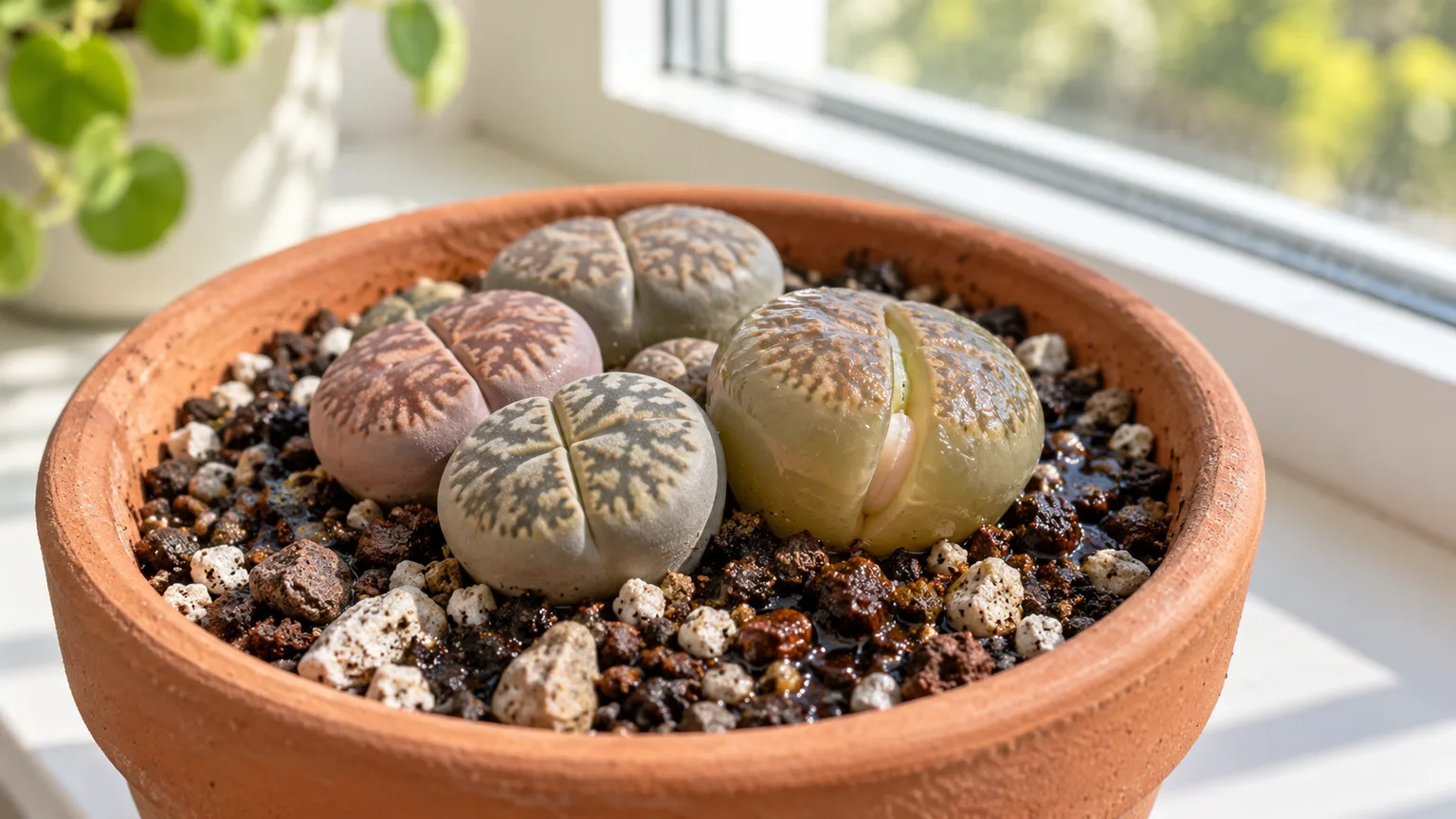
Healthy Lithops bodies feel firm and look opaque, with crisp window patterns on top. Overwatered plants lose that stone-like density. Sides turn yellowish-green and slightly translucent, as if lit from inside, and the skin may split open along the flank where expanding inner tissue bursts through. These burst leaves are the signature sign — ordinary houseplants wilt, but Lithops rupture.
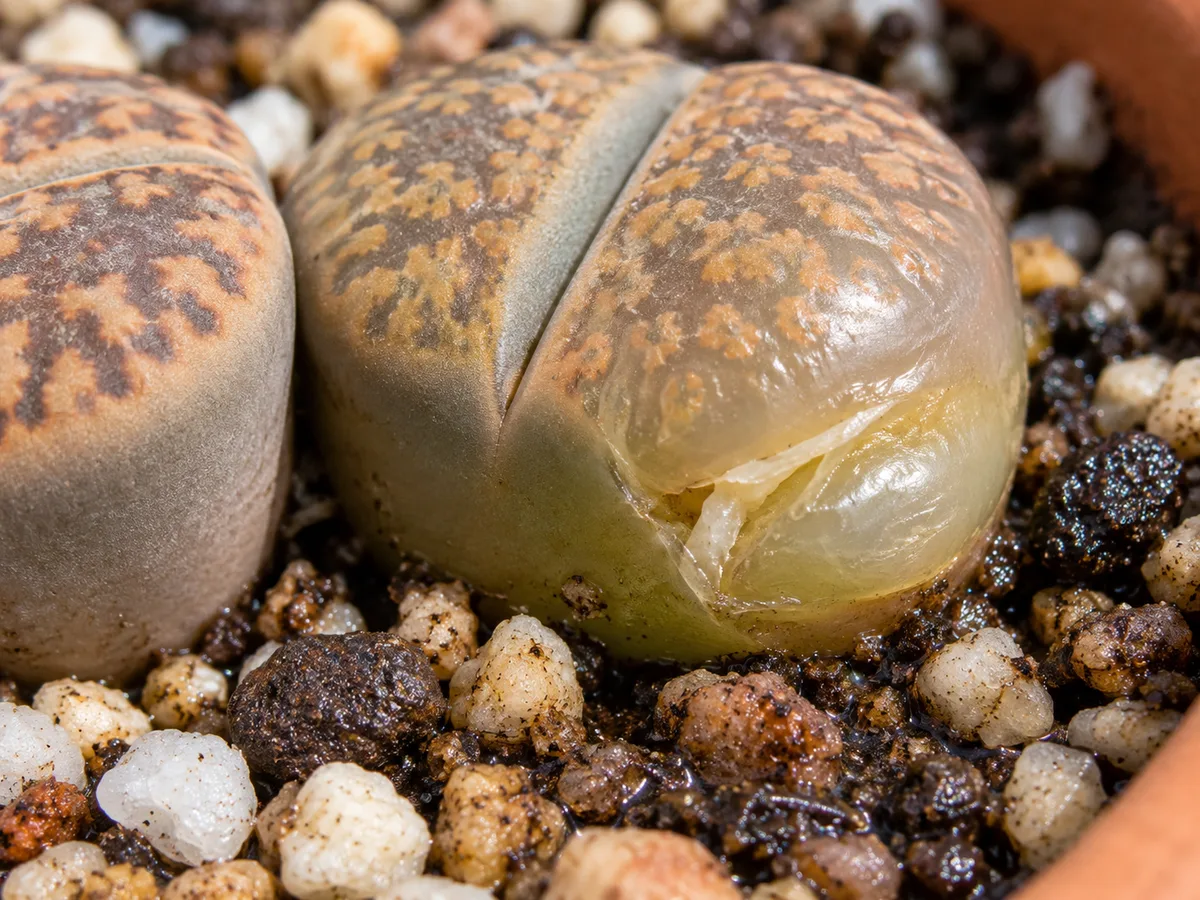
Translucent, swollen leaf bodies with a side split — classic excess-water damage on Lithops; compare firmness and opacity with healthy tissue.
As damage advances, the base softens where the bodies meet the soil, and the plant may lean or sink slightly. Brown blotches from edema — cells that took up more water than they could hold — can speckle the sides. In the worst stage the whole head turns to mush with a sour soil smell, which means internal rot rather than simple swelling.
The splitting-season trap: why watering during leaf replacement kills
Lithops grows one leaf pair at a time. Each year the new pair emerges through the top fissure while the old pair transfers its stored water inward and dries to papery husks. NC State Extension describes this cycle directly: no water at all during winter and early spring while old leaves die and new leaves form in spring.
Watering during this window is the most common fatal mistake. The old leaves stay fat instead of drying, stacking three or four leaves where there should be two, and moisture sits inside tissue that was meant to empty. New growth arrives soft and bloated rather than compact, and the crowded, wet fissure invites rot exactly where you cannot see it. If your plant holds plump outer leaves beside an emerging inner pair, the schedule — not the amount of any single drink — is the cause.
Reading the fissure and the leaf-pair stack
Count the leaf pairs before you decide anything. Two bodies with a clean central fissure is normal. Three or more stacked pairs, or a fissure gaping with pale soft tissue pushing up, means water arrived while the plant was recycling leaves. Gently squeeze the outer pair: papery and dry is correct during replacement, while thick and juicy beside new growth confirms the trap.
Also check the fissure for stuck husks. Old leaf skins that stay leathery instead of crisping often trace to humidity plus watering during the changeover. Do not tear them off — pulling damages the new pair underneath. Let them dry fully, then they lift away on their own once watering resumes correctly.
Seasonal rhythm: when Lithops wants water and when it does not
Lithops runs on seasons, not weeks. NC State Extension gives the practical calendar: water from late spring into early summer, stop during summer dormancy heat, water about every two weeks in late summer during active growth and bloom, and withhold water entirely through winter and early spring.
Most indoor overwatering happens in two places: sympathetic winter drinks while the plant looks wrinkled (normal — the old leaves are supposed to wrinkle as they feed the new pair), and summer drinks during heat dormancy when the roots are idle. Confirm by recalling the last month, not the last drink. One splash rarely kills; repeated out-of-season watering does. Match future watering to the Lithops watering guide rather than to how the surface looks.
Gritty mesemb mix and shallow-pot dry-down
Lithops evolved in southern African rocky ground with under 20 inches of annual rain, so ordinary potting soil holds water far longer than its roots tolerate. NC State Extension calls for a cactus mix or fast-draining gritty potting mix, and the Lithops genus placement in the ice plant family Aizoaceae explains why: these are dry-habitat specialists, not tropical foliage. RHS describes Lithops as very small succulent perennials that demand sharp drainage.
In practice that means roughly 80 percent mineral grit — pumice, coarse sand, fine gravel — with only a little cactus mix, in a shallow terracotta pot with a drainage hole. Deep plastic pots and cachepots without drainage keep the taproot zone damp for weeks. Lift the pot after watering: it should feel noticeably lighter within days. If it stays heavy, the container or mix — not your discipline — is the problem, and the fix belongs in the Lithops soil guide before the next watering ever happens.
How to confirm overwatering in order
Work through these checks before you unpot or treat anything:
- Squeeze test — Firm and opaque is healthy. Swollen-translucent is early excess; soft, glassy, or weeping is advanced.
- Split and stack check — Side splits, edema blotches, or more than two leaf pairs point to water during the wrong season.
- Pot-weight test — A pot that still feels heavy several days after watering confirms the root zone never dried.
- Base and smell check — A firm base can dry in place. A mushy base or sour smell means rot is underway.
- Calendar check — Water given during leaf replacement or winter rest confirms the cause even if the mix surface looks dry now.
If the bodies are firm and only slightly swollen, drying in place is enough. If tissue is mushy or smells off, move to rot triage — the root rot on Lithops guide covers that path, since mushy stems and rotting roots mark the stage where simple drying no longer works.
The first fix to try
Withhold all water and maximize drying conditions. Move the plant to the brightest warm position you have with airflow around the pot — a sunny windowsill with a cracked window nearby is ideal. Do not mist, do not feed, and do not repot a merely swollen plant; disturbance adds stress while the bodies are already full. Most early cases stabilize within two to four weeks as the mix dries and the bodies firm up.
Unpot only when the base is soft, glassy, or sour. In that case, ease the plant out, shake off wet mix, and trim only black or mushy roots with a clean blade, keeping every firm white root. The standard rescue sequence is unpot, remove damaged roots, dry the roots, disinfect, and repot into fresh dry mix — then wait at least a week before even thinking about water. Dusting cut surfaces and letting them callus in air for a day or two reduces reinfection.
Step-by-step recovery
For firm-but-swollen plants, recovery is passive: dry air, bright light, and time. Do not “help” with fertilizer — a stressed Lithops cannot use nutrients, and salts in damp mix worsen root damage. Resume watering only when bodies feel firm, the mix is dry deep down, and the season is an active-growth window per the Lithops watering guide.
For unpotted rot cases, repot into completely dry gritty mix in a clean shallow pot, settle the plant at the same soil level, and wait. The key is timing water around the growth cycle and letting old leaves dry rather than nursing the plant with sips. Expect no visible change for weeks; Lithops is extremely slow, and patience is the treatment.
Recovery timeline
Burst or translucent patches never heal — they scar or dry as the leaf pair ages out. Judge recovery by arrest, not repair: swelling stops spreading, no new splits appear, and the base stays firm. The real confirmation arrives with the next leaf cycle, when a new pair emerges compact and opaque through a clean fissure. That can take a full season, sometimes six months or more.
Improvement signs: bodies firm up, translucency fades, pot dries on a normal rhythm. Worsening signs: spreading glassiness, new splits, leaning, base collapse, or sour smell — escalate to the root rot on Lithops guide promptly, since internal rot moves faster than it looks from outside.
Lookalike symptoms: thirst, light hunger, and pests
Overwatering is over-diagnosed in reverse too — wrinkled Lithops in winter is usually normal leaf recycling, not thirst. Use this table before adding water:
| What you see | Likely cause | Key check |
|---|---|---|
| Translucent, splitting, or mushy bodies on damp mix | Overwatering (this page) | Pot heavy, glassy tissue, out-of-season watering |
| Soft spreading decay with sour smell | Root rot on Lithops | Mushy base and black roots after unpotting |
| Deep wrinkling that plumps after a correct seasonal soak | Underwatering on Lithops | Wrinkles outside the normal dry rest; mix bone-dry deep down |
| Tall stretched bodies with pale tops | Leggy growth on Lithops | Weak light history; see also not enough light |
| Yellowing without translucency during leaf change | Yellow leaves on Lithops | Old pair yellowing while new pair emerges is normal recycling |
| Speckled tops with fine webbing | Spider mites on Lithops | Pests on tops; bodies stay firm, not glassy |
| White cotton in the fissure | Mealybugs on Lithops | Waxy insects, not watery tissue |
| Fuzzy soil surface with tiny flies | Mold on soil and fungus gnats | Surface problem from damp mix; bodies may still be firm |
When in doubt, thirst wrinkles feel papery and the pot feels light, while overwatering feels swollen and the pot feels heavy. That single contrast prevents most wrong-direction waterings.
Mistakes to avoid
Do not water on a calendar — Lithops needs seasonal soakings weeks to months apart, never weekly drinks. Do not mist the bodies; surface moisture in the fissure rots the crown. Do not repot a swollen-but-firm plant “to check roots,” since breaking fine roots on a waterlogged mesemb invites the very rot you fear. Do not fertilize until the plant has produced one clean growth cycle on plain water. And never water a plant sitting in a decorative cachepot without drainage — tip out any collected water immediately or, better, remove the cachepot until recovery is complete.
How to prevent it next time
Prevention is a system, not willpower. Keep the plant in maximum indoor light — weak light slows drying and stretches bodies so they hold water longer. Use the gritty mineral mix and shallow breathable pot from the Lithops soil guide. Water only inside active-growth windows and never while old leaves are visibly feeding the new pair. After each watering, confirm the pot lightens within days; if it does not, downsize the pot or add grit before blaming yourself. Review the Lithops overview each season so the annual rhythm — grow, bloom, replace, rest — stays ahead of the watering can.
When to use this page vs other Lithops guides
- Lithops watering guide — Use for the routine seasonal schedule once this incident is over.
- Lithops problems hub — Browse all 16 documented issues when more than one symptom is present.
- Root rot on Lithops — Switch here when the base is mushy or roots are black after unpotting.
- Underwatering on Lithops — Use when deep wrinkling recovers after a correct seasonal soak.
- Wilting on Lithops — Different entry point when softness overlaps with other causes.
Related Lithops guides
- Lithops overview
- Lithops watering
- Lithops light
- Lithops soil
- Lithops repotting
- Root rot on Lithops
- Underwatering on Lithops
- Yellow leaves on Lithops
- Leggy growth on Lithops
- Mold on soil on Lithops
- Lithops problems
Related tool
Use the Root Rot Risk Checker to narrow causes for overwatering on this plant before changing multiple variables at once.