Brown Tips on Lithops: Window-Edge Checks
Quick answer
Brown tips on Lithops show as dry brown edges on the shoulders of the paired leaf bodies around the fissure and window—not true leaf tips. First step: check whether the plant is splitting (old leaves feeding the new pair) and weigh the pot before adding any water.
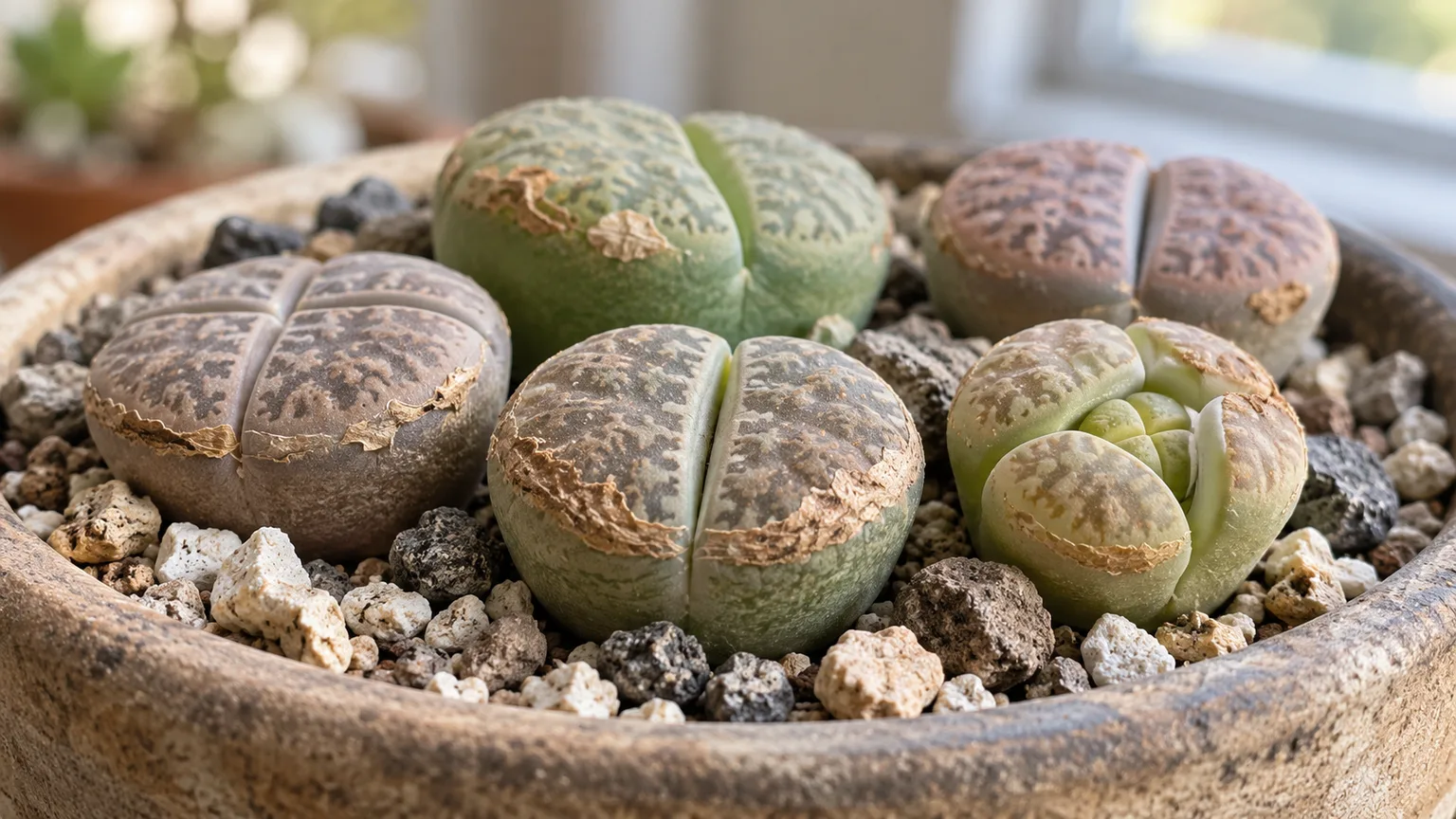
Brown Tips on Lithops: Causes, Checks & Fixes
This guide covers brown tips on Lithops. See also the general Brown Tips guide, watering, and light pages for this plant.
Brown Tips on Lithops: Causes, Checks & Fixes
Quick answer
Lithops has no true leaves with tips — it grows as paired fleshy bodies with a flat window on top split by a central fissure, a form described by RHS as two very fleshy leaves with translucent markings. What owners call “brown tips” is browning or crisping on the shoulders and window edges of those bodies. For how tip burn works on leafy houseplants in general, see our brown tips hub. On Lithops, dry brown shoulders almost always trace to the seasonal calendar, sun scorch on the window, thirst in gritty mix, or salt buildup — not low humidity the way it hits ferns.
First step: check whether the plant is splitting before you touch water. If papery old leaves are shrinking around a new pair pushing through the fissure, stop watering and change nothing else — watering during replacement is the usual failure point. Only if no split is active should you weigh the pot and read thirst versus wet-root stress.
When to use this page vs other Lithops guides
| Pattern | Read next |
|---|---|
| Whole body translucent, mushy, or sour-smelling | Overwatering |
| Soft base on wet mix, spreading collapse | Root rot |
| Deep wrinkling that ignores the season | Underwatering |
| Stretched tall bodies, faded windows | Not enough light |
| Yellowing before browning on wet soil | Yellow leaves |
| Fine webbing or stippling on bodies | Spider mites |
| Whole plant stalled with no new pair | Slow growth |
What brown tips look like on Lithops
Because there are no leaf blades, edge damage sits on the body itself: dry tan-to-brown papery margins on the shoulders, a browned rim around the window, or a scorched patch on the sun-facing side while the base stays hard and the fissure stays clean.
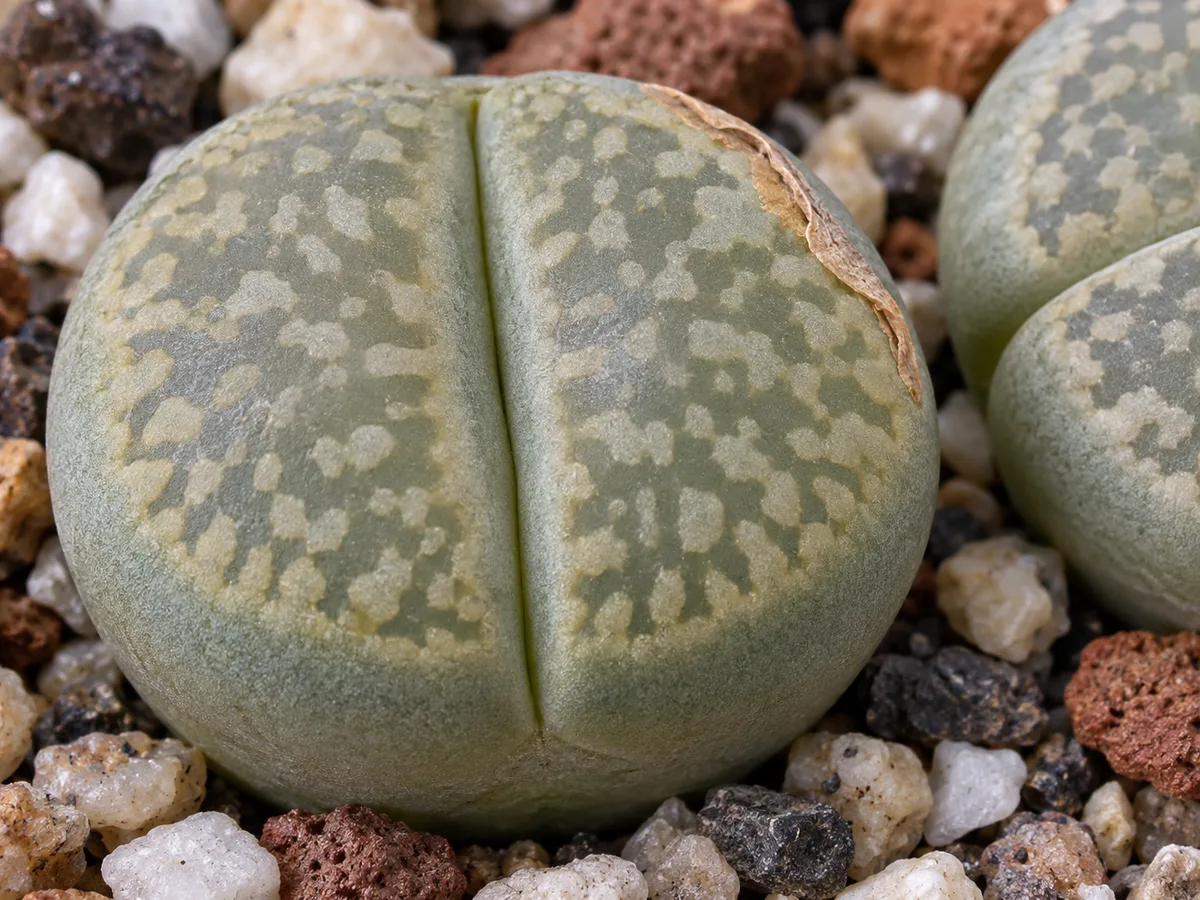
Dry brown shoulders on a firm paired body — the dead rim will not re-green; watch the fissure and window of the next growth for clean tissue.
- Dry brown shoulder rims, firm body, clean fissure — Thirst, sun scorch, or normal aging on an older leaf pair.
- Brown window top after a move to harsh afternoon glass — Sunburn on the crown, the classic succulent top-browning pattern.
- Brown edges plus white crust on the mix surface — Salt or fertilizer residue; see the fertilizer guide.
- Brown spreading into translucent or jelly-like tissue — Wet injury and possible edema or rot, not tip burn; see overwatering.
- Brown papery husks clinging around an emerging new pair — Normal splitting-phase shrivel, not damage on the new growth.
A firm body with browned shoulders and a clean new pair emerging is common and not automatically a crisis — the old pair is disposable tissue feeding the replacement.
Fissure-and-window anatomy: why edges brown first
This section is Lithops-specific and does not apply to broad-leaf tropicals.
- Each head is a pair of fused fleshy leaves with a flat windowed top — the window and shoulders take the most light and lose moisture first.
- The fissure is the growth gate: flowers and the replacement leaf pair emerge there, so damage radiating from the fissure matters more than a browned outer shoulder.
- Lithops are southern African plants built for full sun, rocky soil, and drought, storing water in the bodies — the rim desiccates before the core when uptake lags.
- Old leaf pairs are designed to shrivel into husks while the new pair draws them down, a cycle described in Lithops care references — brown papery husks during a split are the plant working, not failing.
Always compare the oldest outer pair to the tissue at the fissure. Browning confined to husks around clean new growth is seasonal; browning on the new pair itself is urgent.
The splitting-phase check: never water a replacement
Most Lithops deaths come from watering while old leaves feed the new pair. Before any other diagnosis:
- Look into the fissure. A new pair swelling up through the center, with outer leaves thinning into papery husks, means an active split — withhold all water.
- Feel the husks, not just the color. Thin, dry, papery husks around a firm center are normal replacement. Thick, soft, translucent outer leaves on damp mix are wet injury — see overwatering.
- Count heads separately. In a cluster, one head may split while neighbors drink — water only the non-splitting side or wait until all heads finish.
- Check the calendar. Splitting and winter rest are dry phases; watering follows the growth cycle, with dry summers and rest periods. If you cannot name the current phase, default to dry.
Do not soak, mist, or fertilize a splitting plant to “help” the new pair — the new growth is already drinking the old leaves.
The gritty-pot and taproot check
Lithops sits on a taproot in nearly soil-free mix, so pot weight tells the truth that the surface hides:
- Lift the pot. Learn your dry weight — mineral mix in a shallow breathable pot should feel feather-light between correct soakings.
- Probe all the way down with a wooden skewer. Surface grit dries in hours while the taproot zone can stay damp; water only when the probe comes out fully dry outside rest and split phases, per the watering guide.
- Confirm the container. No drainage hole, a deep moisture-holding pot, or organic-rich mix keeps the taproot wet and turns edge browning into whole-body rot — compare with the soil guide.
- Smell the drainage. Sour mix plus browning beyond the shoulders means root-zone failure; move to root rot instead of treating tips.
Never repot a stressed Lithops just to check roots unless you find soft translucent tissue or sour mix — disturbance during a split or rest sets recovery back months.
Why Lithops gets brown tips
Sun scorch on the window. Lithops wants about 4 to 5 hours of morning sun with afternoon shade; a sudden move to harsh afternoon glass burns the window top brown. The pattern matches sunburn browning on succulent crowns — damage faces the glass while shaded sides stay clean.
Thirst in gritty mix. Underwatered succulents show crispy margins first, and on Lithops that means browned shoulders on a feather-light pot with wrinkled skin. One correct seasonal soak per the watering guide resolves it; repeated sips do not.
Salt and fertilizer buildup. Lithops is a near-zero feeder in mineral mix, so even modest feeding leaves minerals behind. Excess salts scorch margins and crust the surface, the same salt-buildup browning seen on other succulents. Flush rarely and lightly, then hold fertilizer — detail in the fertilizer guide.
Wet-root browning mistaken for tips. Overwatered living stones brown through edema and rot — translucent patches that darken from the base up. If browning spreads past the shoulders into soft tissue, treat as overwatering, not tip burn.
Cold damage. Lithops must be protected from freezing and dislikes cold below about 40°F; a cold windowsill can brown shoulders overnight even in dry mix. Move the pot back from cold glass before adjusting water.
Normal husk aging. Outer pairs naturally tan, thin, and peel during replacement. This is not progressive tip burn — no fix needed while the fissure tissue stays firm and clean.
How to confirm the cause
- Splitting status — Active split with papery husks means seasonal, not disease.
- Shoulder versus whole body — Dry rims only versus translucent or soft bodies (see overwatering).
- Sun side — Browning only on the glass-facing window points to scorch; check the light guide.
- Pot weight and probe — Feather-light plus wrinkles means thirst; heavy plus browning means wet roots.
- Surface crust — White mineral ring at the rim points to salt stress.
- New growth at the fissure — Clean emerging tissue means stable; browning on the new pair means escalate.
First fix for Lithops
Confirm no active split — then either keep the plant dry or give one deep seasonal soak, never both.
- Splitting or resting, any browning on old husks — Do nothing. Keep dry until husks are papery and the new pair stands alone.
- No split + feather-light pot + firm wrinkled shoulders — Soak deeply until runoff once, then wait per the watering guide.
- No split + heavy wet pot + browning beyond shoulders — Stop water; follow overwatering.
- Window-top browning right after a sunny move — Pull back to bright morning light per the light guide; do not compensate with extra water.
- White crust + brown rims — Leach once with plain water, then hold all fertilizer.
Do not trim browned shoulders for cosmetics — cutting into the water-storing body invites infection. Do not fertilize to “heal” dead rims. Do not mist the windows.
Recovery timeline
Browned rim tissue does not re-green. Judge recovery by a firm body, a stable dry-down rhythm, and clean tissue at the fissure. Mild thirst or scorch browning usually stabilizes within one to two correct watering cycles, and the next leaf pair — or the exposed new growth after a split finishes — should emerge without brown edges. Window-scorched crowns may look marked until that pair is replaced in the next annual cycle, which is normal for this very slow plant. If browning keeps spreading into soft translucent tissue, re-route to root rot promptly.
Mistakes to avoid
- Watering a splitting plant because the husks “look thirsty”
- Soaking on a schedule while the pot still feels heavy
- Leaving a fresh plant in harsh afternoon glass because “desert plants love sun”
- Fertilizing brown-rimmed stressed bodies to push new growth
- Cutting browned shoulders off the water-storing body
- Repotting during a split or rest just to inspect firm roots
How to prevent brown tips next time
Match watering to the growth cycle — soak only in active windows and stay dry through splits and rest. Keep the very mineral mix and shallow drained pot from the soil guide, hold the bright-but-acclimated position from the light guide, and feed almost never per the fertilizer guide. See the Lithops overview and problems hub for the full seasonal calendar.
Related Lithops guides
Conclusion
Brown tips on Lithops are edge stress on water-storing bodies, not a leaf-tip disease — fissure first, pot weight second, water last. Respect the split, soak only in season, and let clean new growth be your success marker. Dead brown rims will not recover; the next firm pair with clear windows will.