Mold on Soil on Lithops: Causes, Checks & Fixes
Quick answer
White fuzz on Lithops soil is usually harmless saprophytic fungus feeding on damp organic mix — but on a plant that sits at soil level and expects months of dryness, it means the pot is far too wet. Stop watering entirely, scrape off the moldy top layer, and let the gritty mix dry all the way down before even thinking about the next drink.
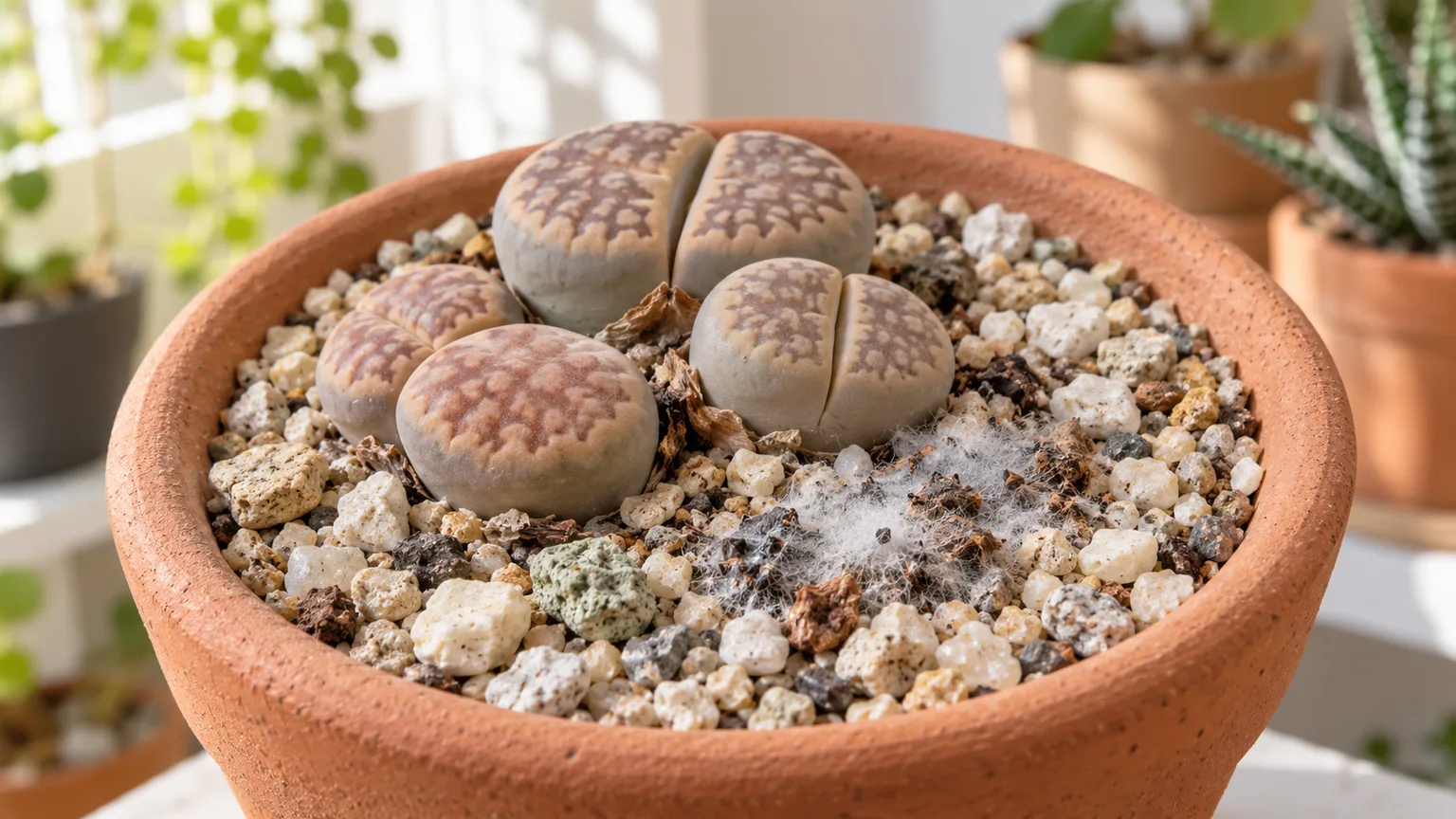
Mold on Soil on Lithops: Causes, Checks & Fixes
This guide covers mold on soil on Lithops. See also the general Mold on Soil guide, watering, and light pages for this plant.
Mold on Soil on Lithops: Causes, Checks & Fixes
Quick answer
Your living stones sit directly on the potting mix, so white fuzz on that surface is touching the plant itself. The good news: the fuzz is usually harmless saprophytic fungus feeding on damp organic matter, not a disease eating living tissue.
First step: stop all watering and scrape off the moldy top layer. Lift it away with a spoon, trash it, and leave the pot alone in bright light with moving air. On Lithops, mold is never just cosmetic — it proves the pot has stayed damp far longer than a desert mesemb tolerates, and the same wetness rots taproots fast.
When to use this page vs other Lithops guides
This page is the symptom-first entry for fuzzy growth on the soil surface. Use it to decide what the mold means and what to do today.
- Overwatering — go here for the full growth-cycle watering calendar and translucent or splitting bodies
- Root rot — go here when leaf bodies feel soft at the base or smell sour
- Fungus gnats — go here when small flies rise from the pot alongside the mold
- Watering guide — go here for the seasonal soak schedule once mold clears
- Soil guide — go here for mineral gritty mixes that stay dry at the surface
- Underwatering — go here when bodies wrinkle during a legitimate watering window, not a wet one
- Wilting — go here when softness spreads and you cannot tell thirst from rot
What mold on soil looks like on Lithops
A healthy Lithops pot looks dusty dry on top most of the year — pale grit, no film, no smell. Mold breaks that pattern:
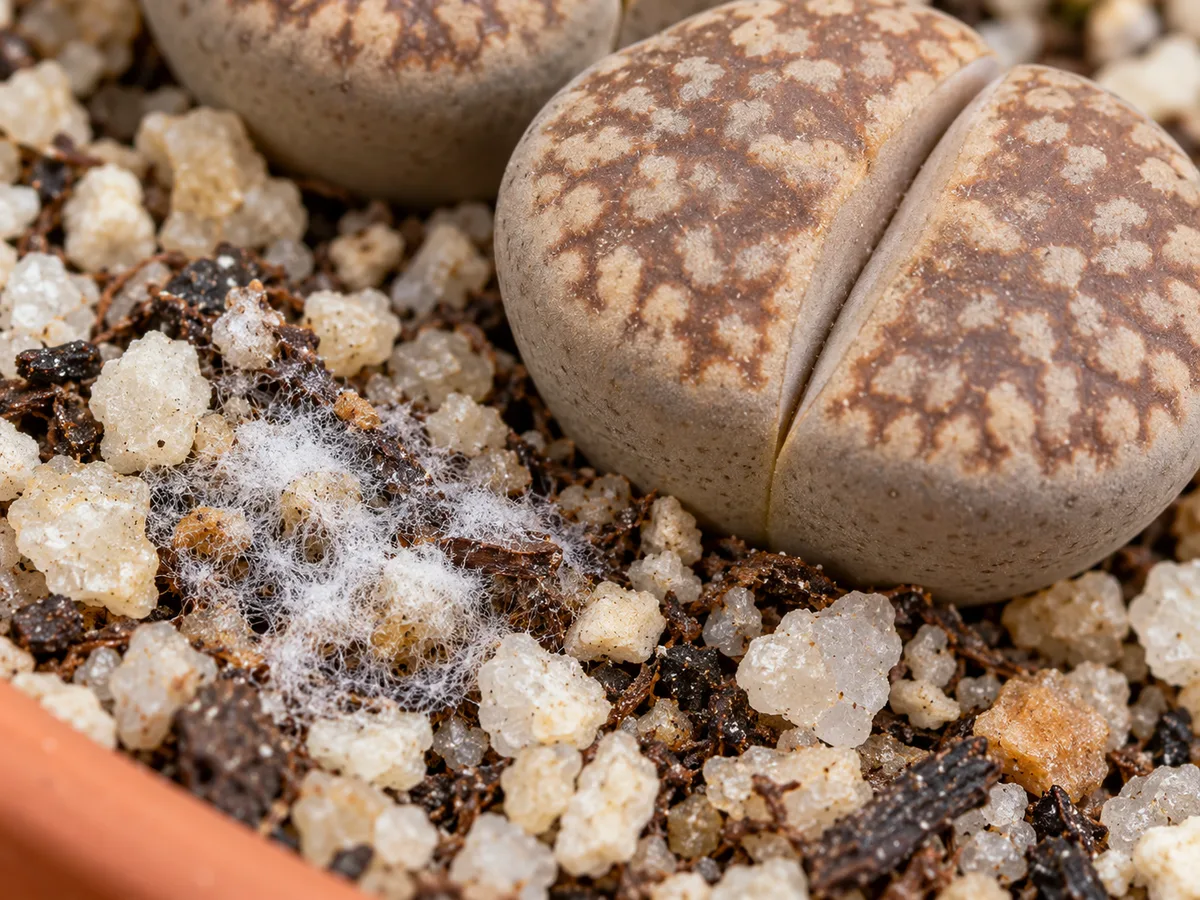
White surface mold creeping across the top grit around firm Lithops leaf bodies — compare the fuzzy film with clean, dry mineral grains.
Typical harmless surface mold:
- White or pale gray fuzzy threads spread across the top grit or soil
- Growth clusters where organic bits collect — peat fines, fallen leaf flakes, old flower stalks
- Surface feels cool and damp days after the last watering
- Leaf bodies still firm and opaque where they meet the mix
Signs the wetness behind the mold is hurting the plant:
- Mold returns within days of scraping
- Leaf bodies look translucent, glassy, or swollen at the soil line
- Base of the plant feels soft when nudged gently with a fingertip
- Sour or swampy smell rises from the pot
- Small dark flies hover after watering — fungus gnats sharing the same damp layer
Because Lithops bodies rest on the mix rather than above it on stems, surface dampness sits in constant contact with living tissue. A cactus can outgrow a wet surface; a living stone cannot lift itself away from it.
Why Lithops gets mold on soil
Lithops are stemless mesembs in the ice plant family (Aizoaceae), native to southern Africa, where they grow among rocks in grit with almost no organic matter. RHS describes them as very small succulent perennials with paired, stone-like leaves — each plant is essentially two water tanks with a fissure between them, sitting at soil level. For how chronic wet mix grows surface mold in general, see our soil mold guide. On Lithops, the pattern almost always traces to one of these plant-specific failures.
Watering during a no-water window. Lithops watering follows its growth cycle: soak sparingly in active growth, nothing while old leaves are being absorbed, nothing in deep dormancy. Mold appearing while the plant is splitting or dormant means water went in when the plant wanted months of drought — stop entirely and review the overwatering guide.
Too much organic matter in the mix. Peat-heavy indoor soil feeds saprophytic fungus on decaying organic matter and holds surface dampness for days. Lithops needs a mostly mineral mix — pumice, coarse sand, fine gravel — with a dry grit top dressing (see the soil guide below). If the surface looks like dark garden soil instead of pale grit, the mix itself is the mold farm.
Oversized or deep pots. A tiny plant in a big pot means a reservoir of wet mix the roots never drink. Shallow, snug clay pots dry fastest; deep plastic pots stay damp at the surface for a week or more.
Low light and still air. Dim corners slow evaporation, and overwatering plus poor drainage encourages saprophytic fungus on succulent soil even faster when air never moves. A Lithops on a dark shelf with no airflow can grow mold from a single ill-timed drink — see not enough light if the plant also stretches or fades.
How to confirm the cause
Work through these checks in order before repotting or spraying anything:
- Surface touch test — Press a fingertip to the top layer. Cool, clinging dampness days after watering confirms the surface never dries. A correct Lithops surface feels gritty and room-temperature dry.
- Skewer to the bottom — Push a plain wooden skewer to the pot base and leave it a minute. Any dampness or darkening on the wood means the whole pot is wet, not just the surface.
- Pot weight — Lift the pot. Noticeable heaviness long after watering confirms deep saturation in a plant that should feel feather-light most of the time.
- Base firmness — Nudge the leaf bodies gently at the soil line. Firm and opaque means mold is still just a moisture warning. Soft, translucent, or splitting tissue means rot may be underway — switch to root-rot diagnosis rather than surface fixes.
- Smell check — Clean grit smells like nothing. A sour or musty odor points to anaerobic decay under the mold.
- Calendar check — Is the plant splitting, flowering, or dormant? Mold during a should-be-dry phase is proof of wrong-season watering. Confirm against the seasonal watering guide.
Lookalike comparison
| What you see | Likely cause | How to tell apart |
|---|---|---|
| Fuzzy white-gray threads on damp surface | Saprophytic surface mold | Threads wipe away; grit beneath is dark and wet |
| Hard white or tan crust, no fuzz | Mineral salt buildup | Crust is gritty, not threadlike; soil beneath may be dry |
| Smooth green film on mix and pot rim | Algae from constant wet plus low light | Same drying fix as mold; needs brighter placement |
| White cotton tufts on the plant, not the soil | Mealybugs | Tufts sit in the fissure and leaf crevices and smear when touched — soil mold never grows on living tissue |
| Brief white threads after repotting into fresh mix | Normal mycelium before first dry-down | Fades once the pot dries; no damp smell, bodies firm |
First fix for Lithops
Stop all watering and scrape off the moldy top half-inch with a spoon.
Bag the scraped material and trash it. Do not water the plant “to help it recover” — a firm Lithops holds months of water in its leaf bodies, and the single most dangerous response to mold on this plant is another drink. Set the pot in your brightest spot with gentle airflow and leave it completely alone until a skewer to the bottom reads bone dry.
Step-by-step recovery
After the scrape and full stop on water, branch by what you find:
If bodies are firm and the skewer dries within a week:
- Replace the scraped layer with dry mineral grit — coarse sand or fine gravel, no peat.
- Wait until the skewer reads completely dry, then check the calendar: water only if the plant is in an active growth window.
- When you do water, soak lightly from the edge and confirm the surface dries within a day or two.
If mold returns within days of scraping:
- The mix is too organic or the pot too large. Unpot and check: dark, soggy mix around the taproot means a full repot into mineral mix (see the soil guide below).
- Downsize to a shallow pot barely wider than the plant with a drainage hole.
- Top-dress with a half-inch of coarse dry grit to keep organic fines buried and the surface hostile to spores.
If fungus gnats swarm with the mold:
- Keep the surface bone dry — larvae die without damp organic matter.
- Remove every fallen leaf flake and flower stalk from the pot.
- Use yellow sticky traps for adults while the pot dries, then follow the dedicated fungus gnats guide if flies persist.
If leaf bodies soften or smell sour:
Stop surface fixes. Unpot, inspect the taproot, trim any mush with a sterile blade, dust cuts, and let the plant air-dry before repotting into dry grit. Mold was the visible tip of rot — switch to root-rot treatment steps.
Mistakes to avoid
- Watering again because the plant “looks thirsty” — Mold proves excess water. Wrinkling during a dry window is often normal splitting, not thirst.
- Misting the plant or top-dressing with moss — Lithops never needs surface humidity; both feed mold directly against the leaf bodies.
- Spraying cinnamon, peroxide, or fungicide first — Surface treatments do not fix a wet pot or wrong-season watering. Dry the pot and fix the mix first.
- Repotting into standard potting soil on day one — Mild mold with firm bodies resolves with scraping, grit replacement, and drought. Save full repots for recurring mold or soggy mix.
- Watering from above into the fissure — Water trapped between the leaf pair rots the crown. Always water at the pot edge, never over the plant.
- Fertilizing a stressed plant — A moldy pot needs drought and drainage, not nutrients.
Recovery timeline
Surface fuzz usually stops spreading within a week of scraping plus full drought, and the top grit looks clean and dusty again within two weeks. Confirm progress by:
- No new fuzzy growth after the scrape
- Skewer reading dry top to bottom
- Leaf bodies staying firm and opaque at the soil line
- Pot feeling light for its size
New mold within days, softening bases, or a spreading translucent patch means the fix was incomplete — escalate to a full mineral-mix repot or rot inspection rather than scraping a third time.
How to prevent mold next time
Keep the surface permanently inhospitable to spores:
- Use a mostly mineral mix with a coarse grit top layer, per the soil guide.
- Water only inside the correct growth window at the rhythm in the watering guide — weeks to months apart, never on a schedule.
- Give maximum light and gentle airflow so the surface dries within a day of any drink.
- Keep the pot shallow, snug, and freely draining; empty saucers immediately.
- Pick fallen debris off the surface before it decays into spore food.
When to worry
Treat mold as urgent when:
- Leaf bodies soften, turn translucent, or split outside the normal cycle
- Sour smell rises from the pot even after scraping
- Mold, gnats, and heavy-pot dampness appear together
- Two scrape-and-dry cycles fail and mold keeps returning
In those cases the mold is flagging taproot rot risk, not a surface issue. Unpot and inspect per the root rot guide before the plant collapses — Lithops shows little above-ground warning before rot turns fatal.
FAQs
Can I keep watering my Lithops if only the surface has mold?
No. Mold means the mix is staying damp far longer than a living stone tolerates. Stop all watering until a wooden skewer pushed to the pot bottom comes out completely dry, then check whether the calendar even allows watering in this growth phase.
How can I confirm mold on Lithops soil is not rot?
Surface mold stays on the top layer while the leaf bodies stay firm and opaque at the base. Rot brings translucent, soft, or splitting tissue at the soil line, often with a sour smell, even when the mold patch looks small. If the base softens, switch to root-rot treatment instead of scraping again.
Is white mold on Lithops soil dangerous?
The fungus itself rarely attacks living tissue, but the constantly damp mix that grows it is dangerous for a plant built for rocky drought. Treat mold as a serious overwatering alarm, not a cosmetic flaw.
When is mold on Lithops soil urgent?
Urgent when mold returns within days, the leaf bodies feel soft at the base, or the plant is splitting and should be dry right now. Those signs mean moisture may already be rotting the taproot underground.
How do I prevent mold on Lithops soil long term?
Use a mostly mineral gritty mix with a dry grit top layer, water only inside the correct growth window, and let the pot dry completely between drinks. A Lithops surface should look dusty dry most of the year.
Related Lithops guides
- Lithops overview — living-stone biology and seasonal restraint
- Watering — growth-window soak schedule
- Soil — mineral gritty mix and top dressing
- Overwatering — primary cause behind surface mold
- Root rot — taproot inspection and surgery steps
- Fungus gnats — companion pest on damp mix
- All Lithops problems
Related tool
Use the Plant Problem Diagnosis Tool to narrow causes for mold on soil on this plant before changing multiple variables at once.